
Summary
Editor's rating
Value for money: good for beginners, weaker if you already have a decent phone
Cute pink body, very light, a bit toy-like but practical
Battery life: surprisingly solid for a small camera
Packaging and included extras: everything you need to start
Build and durability: plastic but acceptable for the price
Photo and video quality: fine in daylight, weak in low light
What you actually get with this QIVORO compact
Pros
- Very simple to use, good for kids, teens, and total beginners
- Lightweight and compact with solid 2000mAh battery life
- Comes with 32GB SD card and USB-C charging, so ready to use out of the box
Cons
- Image and video quality drop noticeably in low light and at high digital zoom
- Marketing claims (64MP, 4K) sound better on paper than they look in real use
- Plastic build and old AVI video format, not ideal for more serious users

Specifications
View full product page →| Brand | QIVORO |
A cheap 4K camera that looks cute and does the basics
I’ve been using this pink QIVORO 4K digital camera for a little while now, mostly for casual photos, some clips for social media, and to see if it’s a decent starter camera for kids/teens. I treated it like what it is: a budget compact that claims 4K video and 64MP photos, not a serious camera to replace a phone or a DSLR. I took it out on walks, to a small family gathering, and messed around with it indoors in the evening.
Right away, it feels like a camera aimed at beginners. The menus are simple, the buttons are clearly labeled, and you can basically just turn it on, leave everything on auto, and start pressing the shutter. No need to understand ISO, shutter speed or any of that. If you’re used to a modern smartphone camera with multiple lenses and fancy processing, this will feel more basic, but that’s kind of the point.
In terms of expectations, I went in thinking, “cheap Chinese compact, probably fine for kids and nothing more.” It actually did a bit better than I thought in good light. Photos are usable, colors are okay, and the autofocus does its job most of the time. But you have to be honest about what this is: a small sensor, digital zoom, AVI video files, and plastic build. If you expect miracles because it says 4K and 64MP on the box, you’ll be disappointed.
Overall, my mindset while testing it was simple: would I hand this to a kid, a teen, or a complete beginner and feel comfortable that they can get decent pictures without breaking it or getting lost in menus? The answer is mostly yes. Would I replace my phone camera with it? No. It’s decent for the price and the target audience, but you need to keep your expectations realistic.
Value for money: good for beginners, weaker if you already have a decent phone
In terms of value, this camera sits in an interesting spot. It’s one of the top sellers in the “all-in-one digital cameras” category and rated around 4.2/5 on Amazon, so clearly a lot of people are happy enough with it. For the price, you get a full kit: camera, 32GB SD card, OTG adapter, USB-C cable, and a decent battery. If your goal is to get a kid or beginner into taking photos without handing them an expensive phone or DSLR, the value is pretty solid.
Where it makes sense is for people who don’t need or want anything complicated. For example: a teen who wants a separate camera for “old school” digital pics, a student doing simple video projects, or a parent who wants a cheap camera their child can use on holidays. In those cases, the cost versus what you get feels fair. It’s easy to use, light, and the image quality is good enough for casual use in daylight. You also don’t panic if it gets scratched or lost, because it didn’t cost a fortune.
On the flip side, if you already own a halfway recent smartphone, especially a mid-range or better, your phone will likely beat this camera in most situations: better low light, better dynamic range, better video format, and no need to carry a second device. In that case, the value drops. You’re basically paying for the “separate camera” experience and the kid-friendliness, not for image quality upgrades. Also, the fake-sounding 64MP and 4K marketing might bug more tech-savvy buyers who expect more than the hardware can realistically deliver.
So overall, I’d say the value is good for its target (kids, teens, casual beginners, gift buyers) and just “meh” if you’re already into photography or own a decent phone. It’s not a rip-off, but it’s not a miracle deal either. It’s a simple, cheap camera that does what it says well enough, as long as you keep your expectations realistic.

Cute pink body, very light, a bit toy-like but practical
The first thing that stands out is the color and size. The pink version I used looks like something between a toy and a retro compact, which is probably exactly what will appeal to kids and teens. It’s tiny and weighs about 200 grams, so you barely feel it in a bag or even in a jacket pocket. For travel or for a kid to carry around all day, that light weight is a real plus. You can throw it in a small pouch and forget about it until you need it.
The button layout is straightforward: power button, shutter button, zoom rocker, and a few navigation buttons near the screen. Everything is labeled, and after 5–10 minutes you pretty much know where everything is. No weird hidden menus or confusing dials. The 2.8" LCD isn’t super high-res, but it’s bright enough outdoors as long as you’re not in direct harsh sun. Indoors, it’s perfectly fine to frame and review photos. I barely touched the electronic viewfinder because the screen was easier and more natural to use.
In the hand, it feels mostly plastic, which is expected at this price. It doesn’t feel like it will fall apart immediately, but it doesn’t feel premium either. If you drop it hard on concrete, I wouldn’t be shocked if something cracks, but for normal use, it seems okay. The grip is small but usable; I ended up holding it with both hands to keep it steady, which also helps the “anti-shake” do its job. There’s a tripod mount on the bottom, which is handy if a kid wants to film themselves or do simple vlogs.
Ports and slots are basic: USB-C for charging and file transfer, SD card slot, and the usual battery compartment. No weather sealing or anything fancy. Overall, the design is simple and practical. It looks fun, it’s light, and you don’t feel scared to let a child use it. Just don’t go in expecting rugged build or premium materials. It’s more “toy camera that works” than “serious gear”, but for the target audience, that’s fine.
Battery life: surprisingly solid for a small camera
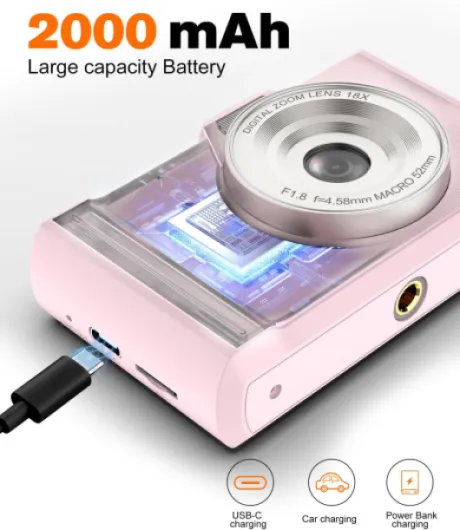
The battery is one of the nicer points on this camera. It uses a 2000mAh lithium-ion battery, which is bigger than what you usually find in cheap compacts. In practice, I could get through a full day of casual use without stressing about it. That means a mix of photos, a few short video clips, some menu browsing, and reviewing pictures on the screen. I didn’t have it die on me randomly, and the battery indicator seems reasonably honest.
QIVORO claims something like “all weekend on a single charge” and 48 hours of average life. That obviously depends on how you use it, but for light use (a kid taking pictures here and there, or a tourist snapping a few shots during the day), it’s realistic to go multiple days without charging. If you start recording long videos or constantly reviewing footage, you’ll drain it faster, but it’s still better than many cheap cameras I’ve used before.
Charging is via USB-C, which is great. No need to hunt for a weird proprietary charger. You can plug it into a power bank, laptop, or phone charger. That alone makes it easier to live with than some older budget cameras. It also supports auto shutoff (1/3/5 minutes), which helps save battery if a kid forgets to turn it off. I set it to 3 minutes, and it did help keep the battery from draining when I left it on the table.
One small downside: there’s no fast-charging or anything fancy. It charges at a normal pace, so plan ahead if you drained it fully. Also, I didn’t see any clear info on buying a spare battery easily, so if you want backup power, you’ll probably rely on a power bank. Overall though, for this type of product, the battery is pretty solid and one of the reasons it works well as a travel or kid’s camera.
Packaging and included extras: everything you need to start
The packaging is pretty standard budget electronics style. Nothing fancy, but it gets the job done. The camera comes in a simple box with some basic printing, and inside everything is packed in plastic bags and cardboard slots. It’s not premium unboxing territory, but honestly, for this kind of product, I don’t really care. What matters is that it arrives protected and with all the parts, and that was the case.
Inside the box, you get the camera body, the 32GB SD card, the battery already included, a USB-C cable, and an OTG adapter so you can connect it to phones or tablets that support it. There’s also a small manual. The manual is basic but enough to figure out the main functions. One of the Amazon reviewers mentioned they couldn’t easily find how to record video, and I get that — the instructions could be clearer on some buttons and modes. You might need a bit of trial and error or a quick YouTube search if you’re totally new to cameras.
The fact that they include a 32GB card is actually a big plus, especially if you’re buying it as a gift. You don’t have that annoying moment of “oh, we forgot the memory card, we can’t use it yet.” 32GB is plenty for a beginner: you can store a lot of photos and several videos before needing to clear it. The OTG adapter is also a nice touch if you want to pull photos onto a phone without a computer, though it depends on your phone’s compatibility.
Overall, the packaging and accessories are practical and decent for the price. No luxury feeling, but you get everything you need to start shooting right away. For a kid or teen, that’s perfect: open the box, charge it a bit, and you’re off taking pictures without extra spending.
Build and durability: plastic but acceptable for the price
Durability-wise, this is clearly a budget device. The body is all plastic, and it has that light, slightly hollow feel you get with cheap electronics. That said, it doesn’t feel like it’s going to fall apart in your hands. I tossed it in a backpack a few times, carried it in a jacket pocket, and used it with no special care. No cracks, no weird creaks, and the buttons still click fine. For normal everyday use, it seems okay.
I didn’t drop it from any crazy heights, but it did take a small drop from a chair onto a wooden floor once. It survived without any visible damage, and everything still worked. I wouldn’t rely on it to survive repeated hard drops on concrete, though. There’s no rubberized protection, no shockproof claims, and definitely no water resistance. If you’re buying this for a kid, I’d say: it can handle normal clumsy handling, but I wouldn’t bring it to the beach and let it get filled with sand or splashed with water.
The lens mechanism is internal since it’s a fixed lens with digital zoom, so you don’t have a big extending barrel that can jam easily. That’s a plus for durability. The SD card slot and battery door feel a bit flimsy but not outrageously so. You just need to be gentle and not yank them around. The included 32GB SD card is fine for casual use; if it dies, at least it’s a standard SD, so replacing it is cheap and easy.
Given the price point and target audience, I’d say durability is acceptable but not bulletproof. It’s better than a pure toy camera, but not on the level of a rugged action cam. If you treat it like a normal gadget and don’t abuse it, it should last. For kids, I’d maybe add a small case or pouch just to avoid scratches and hard impacts in a school bag.

Photo and video quality: fine in daylight, weak in low light
On the performance side, you have to separate the marketing numbers from real-world use. The camera says 4K and 64MP, but the sensor is small (1/4" CCD), and the processing is basic. In good daylight, outdoors or near a bright window, the photos are actually pretty decent. Colors are okay, detail is acceptable for casual use, and for sharing on social media or printing small photos, it gets the job done. You’re not getting pro quality, but for kids and beginners, it’s more than enough.
Autofocus is single-servo, so it locks focus once when you half-press the shutter. For still subjects, it works fine and is fairly quick. If someone is moving quickly, you’ll get some misses, especially indoors. The “Anti-Shake” helps a bit with small hand movements, but it’s not magic. If you shoot in low light and move the camera, you’ll still get blur. The Amazon reviews mentioning it works best in the day are spot on. Indoors at night, you either need to use the flash or accept some noisy, soft photos.
Video is where you feel the budget side more clearly. The files are AVI, which is old and not as efficient as modern formats. The so-called 4K looks okay in good light but doesn’t compete with a mid-range smartphone camera. It’s fine for simple vlogs, school projects, or family clips, but don’t expect cinematic quality. The anti-shake helps keep walking shots a bit smoother, but again, this isn’t gimbal-level stabilization. Audio is basic; it picks up voices, but there’s no fancy noise reduction, so you’ll also get wind and background noise.
Zoom is 18x digital, which means the more you zoom, the softer and more pixelated the image becomes. Up to around 4–5x, it’s still usable for casual shots; beyond that, it’s more for fun than for quality. If you want sharp zoom shots, you’re better off physically moving closer. Overall, performance is okay for the price if you use it how it’s meant to be used: daylight, casual photos, simple videos. If you expect it to beat a modern smartphone, it won’t.
What you actually get with this QIVORO compact
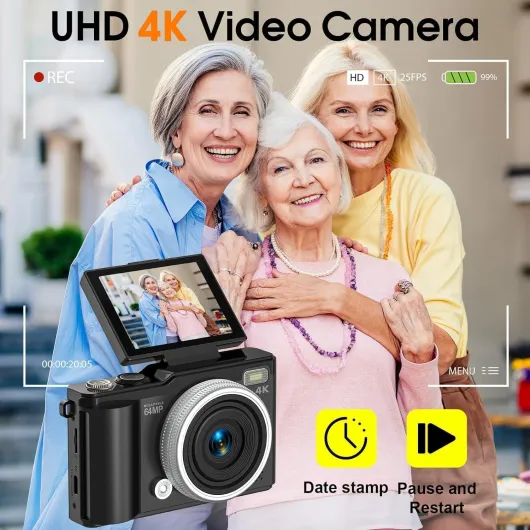
This camera is the QIVORO DC16H-TH, also listed as model Q12. It’s a compact digital camera with a 2.8" LCD screen, built-in flash, and it comes with a 32GB SD card plus an OTG adapter in the box. It’s sold as a 4K 64MP camera with 18x zoom, autofocus, anti-shake, and a 2000mAh battery. On paper it sounds loaded, but in practice you need to understand that a lot of those numbers are marketing and interpolation, not a big high-end sensor.
Out of the box, you get pretty much everything you need to start shooting: the camera, the SD card already usable, a USB-C cable, and some basic accessories. No need to buy a card separately, which is nice if you’re buying this for a kid or as a quick gift. It charges over USB-C, which is convenient because most people already have those cables around. There’s a small built-in flash, an electronic viewfinder (which honestly I barely used because the screen is enough), and a tripod thread at the bottom.
Specs-wise, it’s clearly entry-level: 1/4" CCD sensor, JPEG for photos, AVI for videos, and basic auto shooting modes. The advertised 64MP is basically upscaled from a lower native resolution (the spec sheet also mentions 45MP), so don’t expect real 64MP detail like on a high-end phone. The 18x zoom is digital, not optical, so image quality drops as you zoom in. Focus is single-servo AF (AF-S), so it locks focus once, not tracking like fancy cameras.
In daily use, I treated it as a simple point-and-shoot. Flip it on, check framing on the 2.8" screen, half-press to focus, full press to take the shot. The menu has options for resolution, flash, self-timer, and a couple of scene-like tweaks, but nothing too deep. That’s honestly a good thing for the target users: kids, teens, and people who just want to press a button and get a picture without thinking too much.
Pros
- Very simple to use, good for kids, teens, and total beginners
- Lightweight and compact with solid 2000mAh battery life
- Comes with 32GB SD card and USB-C charging, so ready to use out of the box
Cons
- Image and video quality drop noticeably in low light and at high digital zoom
- Marketing claims (64MP, 4K) sound better on paper than they look in real use
- Plastic build and old AVI video format, not ideal for more serious users
Conclusion
Editor's rating
After using this QIVORO 4K compact camera in real life, my opinion is pretty straightforward: it’s a decent beginner camera that does the basics well enough, especially in daylight, but it doesn’t beat a good smartphone and it’s not meant for serious photography. The best parts are the light weight, simple interface, included 32GB SD card, and solid battery life. You can hand it to a kid, a teen, or a complete beginner and they’ll figure it out quickly. For casual photos, holidays, school projects, and basic vlogs, it’s totally fine.
On the downside, the image quality drops fast in low light, the “18x zoom” is digital and gets mushy when pushed, and the 4K/64MP labels are more marketing than real performance. Video format (AVI) is old, and the build is clearly plastic and budget. If you already have a modern phone with a decent camera, this won’t be an upgrade; it’s more of a fun extra gadget. But if you want a cheap, separate camera for kids or beginners so they can learn without risking expensive gear, it’s a reasonable choice that offers good value in that specific role.