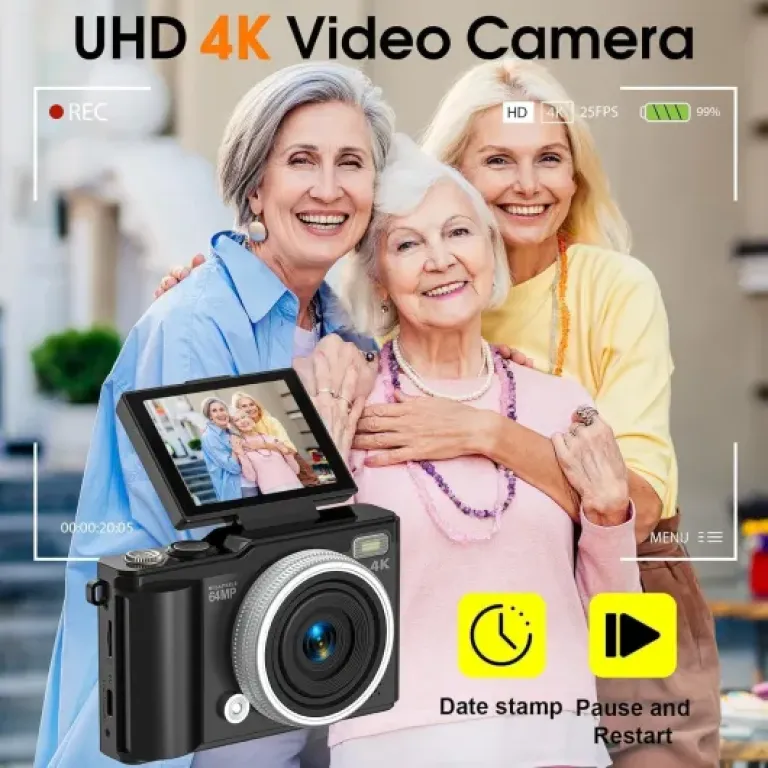

Summary
Editor's rating
Is it worth the money? Depends what you expect it to replace
Small, light, and a bit toy-like, but practical
Battery life and storage: fine for a day out, not for a full weekend shoot
Feels cheap but holds up fine if you’re not rough with it
Image quality: decent in good light, struggles when it gets dark
What this camera actually offers (beyond the big numbers on the box)
Pros
- Compact and lightweight with a flip-up screen that makes selfies and vlogging easy
- Autofocus and macro mode are genuinely useful for everyday subjects and close-ups
- Good value for beginners and teens, with battery and microSD card included out of the box
Cons
- Image quality drops quickly in low light and at high zoom levels
- Build feels cheap and fully plastic, with no weather sealing
- Digital zoom and digital stabilisation are limited, not ideal for serious video work

Specifications
View full product page →| Brand | TAUAHA |
A cheap 4K camera that I actually used instead of my phone
I bought this TAUAHA 4K compact camera mainly out of curiosity. The price was low enough that I wasn’t expecting much, and the brand is completely unknown to me. I’ve been using it for a couple of weeks for quick photos, some short clips for social media, and a bit of webcam use for calls. I normally just use my phone (a mid‑range Android), so that’s my main comparison point.
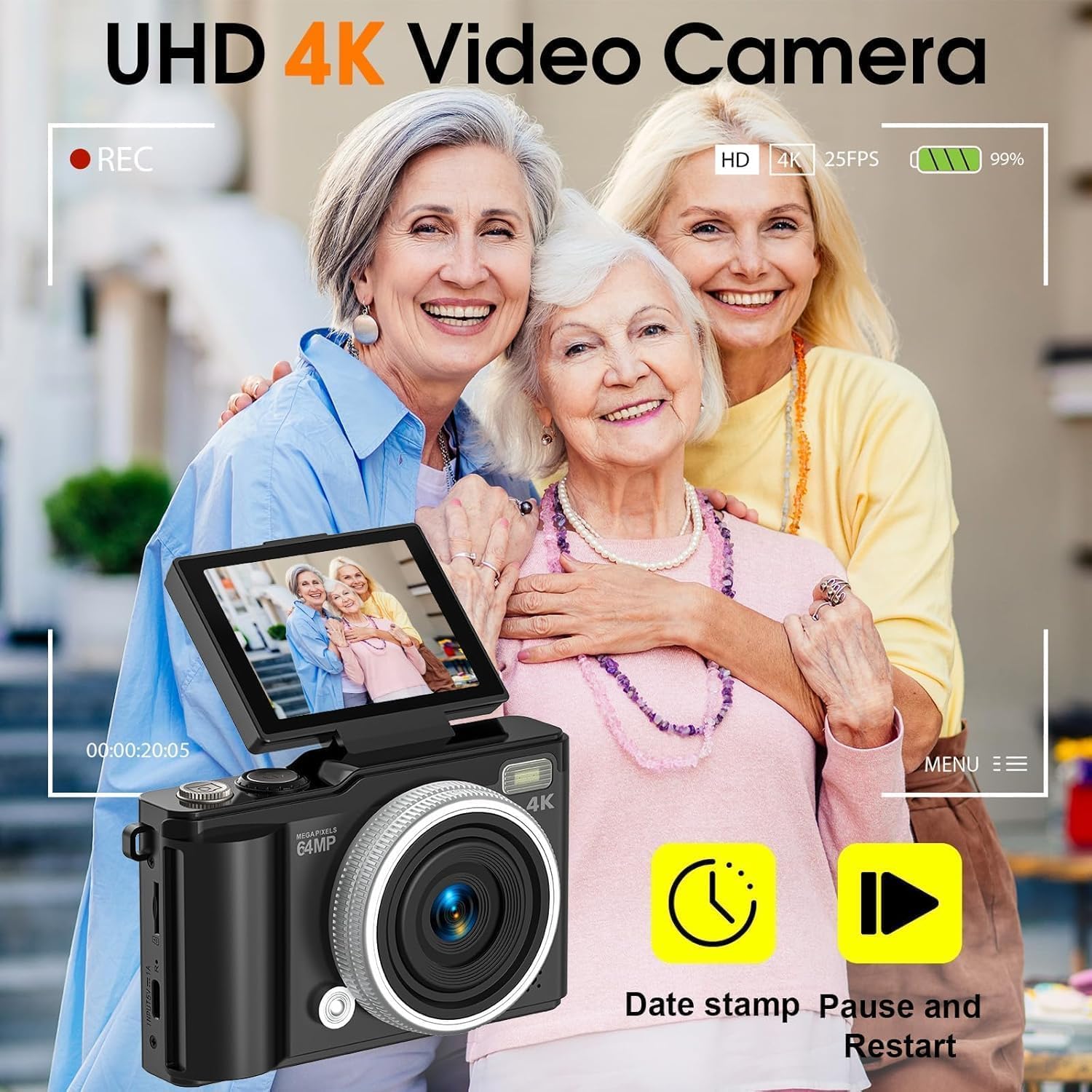
In day-to-day use, it’s basically a small point‑and‑shoot with a flip screen and a few nice tricks. The autofocus, the macro mode, and the 180° flip-up screen are the three things that actually matter on this camera. The rest is mostly marketing. The “64MP” spec looks good on paper, but you can tell it’s a tiny 1/3" sensor, so you have to keep your expectations realistic, especially in low light.
What surprised me is how quickly I ended up just throwing it in my jacket pocket when going out with friends or for a walk. It’s light, doesn’t feel like a big DSLR hanging off your neck, and it’s simple enough that you don’t have to think. Press power, half-press for focus, shoot. For casual stuff, that’s honestly all I wanted.
It’s not perfect: image quality is decent but not mind-blowing, low light is clearly its weak spot, and the digital zoom is mostly a backup, not something you’ll love using. But for the price, for a beginner or a teen, or as a “I don’t care if it gets scratched” camera, it actually makes sense. If you expect pro-level photos because it says 4K and 64MP, you’ll be disappointed. If you treat it as a basic, affordable camera with a flip screen, it gets the job done.
Is it worth the money? Depends what you expect it to replace
Price-wise, this TAUAHA camera sits in that entry-level compact zone where you’re competing with two things: older name-brand compacts on discount, and people just using their smartphones. For what you pay, you’re getting a complete package: camera, battery, microSD card, flip screen, 4K recording, autofocus, macro mode, and webcam function. If you look at it from that angle, the value is actually pretty solid, especially for a first camera for a kid or someone who doesn’t want to mess with settings.
Where the value gets more debatable is if you already have a reasonably recent smartphone. In good light, your phone will probably match or beat this camera in terms of image quality and low-light performance, thanks to all the software processing phones use now. What this camera gives you that a phone doesn’t is: a real shutter button, a flip screen for framing yourself, a more “camera-like” experience, and the fact that you’re not risking your main phone near water, sand, or a clumsy teenager.
Compared to cheap compacts from bigger brands, this one stands out mainly by the flip-up screen and the included card. Many older compacts don’t have that selfie-friendly screen, and they often top out at 1080p instead of 4K. On the other hand, the big brands usually have better color science, more consistent autofocus, and stronger build quality. So you’re basically trading brand reputation and slightly better refinement for a lower price and a few modern features.
For me, the camera sits in the “good value if you know what you’re getting” zone. It’s great for beginners, kids, or someone who wants a cheap vlogging tool with a flip screen and doesn’t want to buy into a whole camera system. If you’re picky about image quality or want something that will keep you happy for many years as you get more serious about photography, I’d save up for a used mirrorless or a better compact. But as a simple, affordable, all-in-one device, it does justify its price.
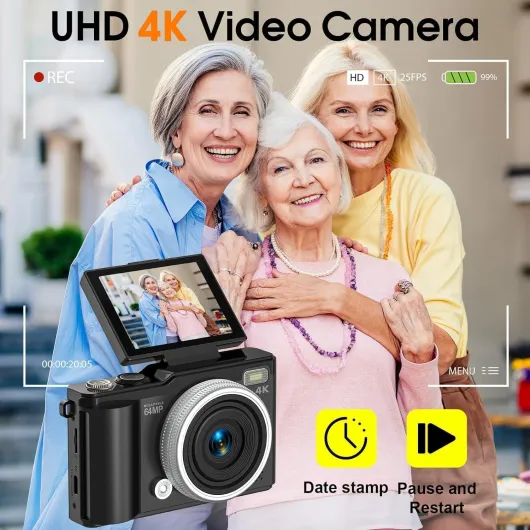
Small, light, and a bit toy-like, but practical
Design-wise, this thing is clearly built to be compact and light first. It’s easy to slip into a jeans pocket or a small bag. In hand, it feels closer to a chunky compact than a serious camera. The black finish looks fine from a distance, but once you hold it, you can tell it’s mostly plastic. Not shocking for the price, but don’t expect a premium feel. It does have a slight grip on the right side that helps you hold it without feeling like it’ll slip out.
The 2.4" flip-up screen is the key design feature. It flips 180° so you can see yourself when filming or taking selfies. The screen is small and not super sharp, but it’s bright enough indoors and in the shade. In direct sun, you need to tilt it and sometimes shield it with your hand to see properly. The menu layout is basic: a few icons, simple settings, nothing fancy. You won’t get lost in options because there just aren’t that many, which is actually a plus for beginners.
Buttons are straightforward: power, shutter, zoom rocker, mode/menu, playback. They’re a bit clicky and feel cheap, but they respond fine. The zoom control is where you feel the budget aspect the most – it’s not very smooth, and you can see steps in the zoom instead of a fluid movement. For photos that’s not a big deal; for video, it can look a bit jerky if you zoom while recording. Ports are standard: USB for charging/data and a slot for the microSD card. No HDMI out, so don’t expect to plug it directly into a TV easily.
In daily use, the design is practical but basic. It’s the kind of camera you’re not scared to throw in a backpack with keys and a power bank. If you’re used to heavier cameras, this feels almost toy-like, but the flip screen and simple controls make it friendly for kids or someone who just wants something easy. It doesn’t feel fragile like it’ll fall apart in a week, but I wouldn’t want to drop it on concrete either – it’s still lightweight plastic at the end of the day.
Battery life and storage: fine for a day out, not for a full weekend shoot
The camera comes with a rechargeable lithium-ion battery and a microSD card in the box, which is nice because you can start using it right away. In my use, I was getting roughly a day of casual shooting: a mix of 50–80 photos and around 15–20 short clips (30 seconds to 1 minute each) before the battery warning started to show. If you just take photos, you’ll squeeze more out of it; heavy video recording drains it a lot faster.
Charging is done via USB, so you can plug it into a power bank, laptop, or normal charger. A full charge from low takes around 2–2.5 hours in my experience. There’s no fancy fast charging or anything like that, but for this type of device it’s fine. The battery is removable, which is good in theory because you could buy a spare if you find a compatible one, but it’s a “nonstandard” type, so you’d have to hunt a bit online and might end up with generic replacements.
On the storage side, the included microSD card is enough to get started, but it fills up pretty fast if you shoot a lot of 4K video. For normal photos and short clips, it’s okay. If you think you’ll be filming longer vlogs or trips, I’d just grab a bigger microSD (32GB or 64GB from a known brand) and you’re sorted. File sizes in 4K are not tiny, so it adds up quickly.
In real life, I’d say the camera is comfortable for one day out: a family outing, a walk in a park, or an event, as long as you’re not recording everything non-stop. For a weekend trip where you plan to film a lot, I’d bring a power bank or charge it every night. It’s not a battery monster, but it’s not terrible either – pretty average for a compact. The good point is the simplicity: USB charging, removable battery, included card. The weak point is if you expect it to handle long 4K recording sessions without planning for power, that’s not going to happen.
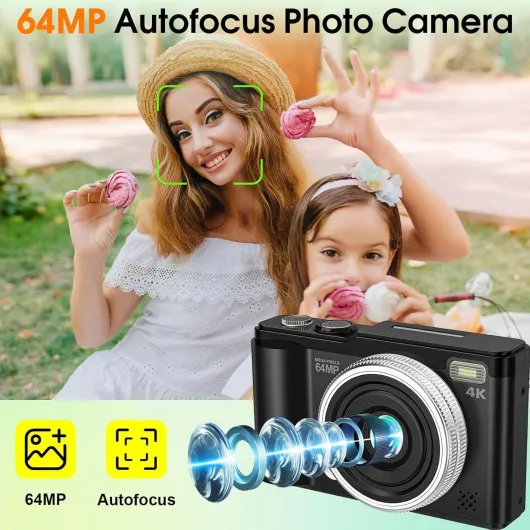
Feels cheap but holds up fine if you’re not rough with it
From the first time I picked it up, I could tell this camera is built to a budget. The plastic body, the lightweight feel, and the clicky buttons don’t scream “premium”. That said, after carrying it around in a backpack and jacket pocket for a couple of weeks, it hasn’t shown any real issues. No creaks, no random parts loosening, and the flip screen hinge still feels the same as day one.
I didn’t drop it from height, but it did survive a couple of minor bumps – like knocking it against a door frame while it was hanging on my wrist strap and tossing the bag a bit carelessly on the sofa. No cracks, no misaligned parts. The plastic will probably scratch if you really abuse it, but it’s not super soft either. It’s more that “toy camera” kind of toughness: it doesn’t feel premium, yet it doesn’t fall apart right away.
There’s no weather sealing, no rubber gaskets, nothing like that. So I treated it as: no heavy rain, no beach sand, no dusty workshop. A bit of light drizzle while running from the car to a building was fine, but I wiped it quickly and didn’t push my luck. The lens is internal (no big zoom barrel sticking out), which helps a bit for durability because there are fewer moving parts exposed. Still, I was careful not to poke or press on the front element.
Overall, I’d say durability is acceptable for a budget compact. It’s fine for a teen, for travel, for daily casual use, as long as the person using it isn’t throwing it around. It’s not a rugged action camera and it’s not built like an expensive mirrorless. If you’re realistic about that and use a small case or at least keep it away from keys, it should last. The lack of a clear warranty beyond the basic Amazon stuff is a bit of a question mark, but that’s the trade-off with a lesser-known brand like this.
Image quality: decent in good light, struggles when it gets dark
Let’s be blunt: this is a small-sensor budget camera, so the performance follows that. In good daylight – outside, near a window, or under decent indoor lighting – photos are actually quite alright. Colors are a bit on the punchy side, sharpness is decent in the center, and for family shots, travel snapshots, or stuff for social media, it’s totally usable. Compared to my mid-range phone, the level of detail is similar; sometimes the camera looks a bit sharper because it seems to add more sharpening in-camera.
Where it falls down is low-light and indoor evenings. As soon as the light drops, noise creeps in, details get mushy, and autofocus starts to struggle more. You can still get shots, but you have to be more careful: hold the camera steady, avoid zooming, and accept that some photos will be soft. The built-in flash helps if your subject is close, but it has that typical compact-camera flash look: flat light, harsh shadows. It’s fine for quick party pics where you just want to remember who was there, not for anything artistic.
The 16x zoom is digital, and that shows. Up to about 3–4x, it’s acceptable for casual use. Past that, you’re mostly enlarging pixels and you start seeing noise and softness. I pretty much treated it as a 3x zoom in real life. If you’re expecting a true optical zoom like on bigger cameras, this is not it. The digital image stabilisation helps a bit when zoomed in, but don’t expect miracles – you still need steady hands.
For video, 4K looks sharp enough in good light, and the autofocus does okay if you’re not moving too fast. For walking vlogs, it’s usable, but you’ll see some shake because it’s only digital stabilisation. Sound quality from the built-in mic is basic: voices are clear enough in a quiet room, but it picks up background noise and wind easily. For simple YouTube or TikTok style clips, it’s fine; for more serious video, you’d want an external mic, which this camera doesn’t support. Overall, performance is good enough for beginners and casual users, but if you’re picky about image quality, especially at night, you’ll hit its limits quickly.
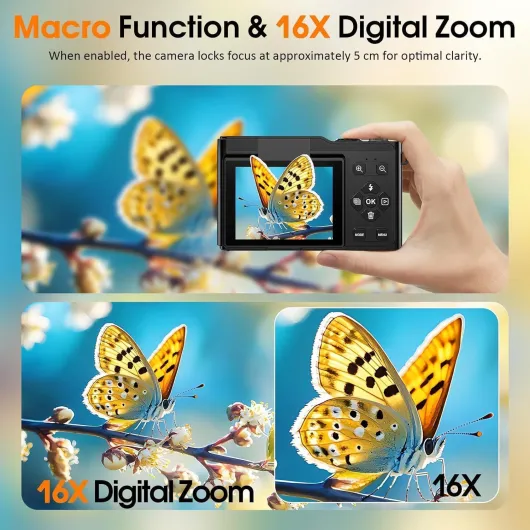
What this camera actually offers (beyond the big numbers on the box)
On paper, this camera throws a lot of numbers at you: 4K video, 64MP photos, 16x zoom, autofocus, macro mode, 2.4" flip screen, and it even comes with a microSD card and battery in the box. The reality is a bit more down-to-earth. It’s basically a compact camera built around a small 1/3" CMOS sensor with digital zoom and digital stabilisation. So you’re not getting DSLR quality; you’re getting decent snaps and usable video for casual stuff.
The autofocus is there and actually works reasonably well for static subjects and slow movement. It’s not fast like a modern phone, but it’s not painful either. Face shots, pets sitting still, objects on a table – it locks on most of the time. When people start moving quickly or the light gets bad, it hunts a bit more and you sometimes end up with soft shots. The macro mode is honestly one of the more fun parts: being able to get the lens 5–10 cm away from a flower or a small object and have it focus properly is nice, especially for hobby stuff or product pics.
The 4K video is there, but don’t expect cinema quality. Detail is fine in good light, and the files are in MP4, so easy to handle. Rolling shutter is noticeable if you whip the camera around, and the digital stabilisation is just okay – good enough for walking slowly, not for running or sports. As a webcam, it’s plug-and-play over USB, which I tested on Windows. It shows up as a camera device and works for Zoom/Teams without extra drivers, which is handy if your laptop webcam is trash.
Overall, the feature list looks bigger than what you truly feel in real use. The useful bits for me were:
- Flip screen for selfies and vlogging
- Autofocus that’s “good enough” for slow scenes
- Macro mode for close-ups
- Included card and battery, so you can use it out of the box
Pros
- Compact and lightweight with a flip-up screen that makes selfies and vlogging easy
- Autofocus and macro mode are genuinely useful for everyday subjects and close-ups
- Good value for beginners and teens, with battery and microSD card included out of the box
Cons
- Image quality drops quickly in low light and at high zoom levels
- Build feels cheap and fully plastic, with no weather sealing
- Digital zoom and digital stabilisation are limited, not ideal for serious video work
Conclusion
Editor's rating
After using this TAUAHA 4K 64MP compact camera for a couple of weeks, my take is pretty straightforward: it’s a simple, budget-friendly camera that does the basics well enough, as long as you don’t expect miracles from the specs printed on the box. In good light, photos and videos are perfectly fine for family shots, travel snaps, and social media. The flip-up screen, autofocus, and macro mode are actually useful, not just marketing. The included battery and microSD card make it easy for a beginner or a teen to start shooting immediately without extra purchases.
On the downside, the small sensor shows its limits in low light, the 16x “zoom” is mostly digital and not very impressive, and the build feels clearly plastic. It’s not the camera you buy if you want to grow into serious photography or if you already have a strong phone camera and care a lot about image quality. But if you want a separate device for casual photos, simple vlogging, or to give to a kid without stressing about them dropping an expensive phone, it makes sense.
So who is it for? Beginners, teens, and casual users who just want a cheap, easy camera with a flip screen and 4K video for everyday use. Who should skip it? People who already have a good smartphone camera, anyone looking to get into more serious photography, or those who are very picky about low-light performance and build quality. Treat it as a basic tool, not a pro device, and you’ll probably be happy with what you get for the money.