
Summary
Editor's rating
Value: cheap, complete kit, and good enough quality if you know what you’re buying
Design: light, plasticky, but easy to carry and use one-handed
Battery life: fine for a day out if you’re sensible, but don’t expect miracles
Durability: feels like a toy but holds up if you’re not brutal with it
Performance: decent 4K and photos in good light, struggles when things get harder
What this little 4K camera actually offers (beyond the big numbers on the box)
Pros
- Very easy to use for beginners and teens, simple menus and controls
- Comes as a complete kit with SD card, case, strap, battery, and USB cable
- Decent 4K and photo quality in good light for the price, plus useful webcam mode
Cons
- Weak low-light performance and heavily marketed 64MP that doesn’t translate to pro-level detail
- Plasticky build and no water resistance, feels more like a toy than a serious camera
- Digital zoom quickly degrades image quality and battery life is only average, especially for video

Specifications
View full product page →| Brand | ZMOQNG |
A cheap 4K camera that teens can actually use without reading a manual
I’ve been playing with this ZMOQNG DC077A camera for a bit, and I’ll be honest: I bought it mainly because it was cheap, small, and claimed 4K and 64MP. I wasn’t expecting much from an unknown brand, more like a toy than a serious camera. But I wanted something I could hand to kids or throw in a backpack without worrying about it. In that sense, it does what it says: it’s simple, light, and you can start shooting in a couple of minutes.
The first thing that struck me is how straightforward it is. You turn it on, press the shutter, and that’s basically it. The menus are basic, the icons are clear enough, and you don’t get buried in options like on a DSLR or mirrorless. If you’re used to a modern smartphone, the image quality won’t blow you away, but it’s not terrible either, especially in good light. It’s honestly better than I expected for the price, but clearly not on the level of a proper camera from Canon/Sony/Panasonic.
Compared to just using my phone, the main difference is that this feels like a dedicated little gadget you can give to a teenager or a beginner without stress. You’ve got a physical shutter button, a little zoom lever, and a real grip. Kids like having “their camera” instead of borrowing your phone. The included 8GB card and extra bits mean you can use it right out of the box, which is practical if you’re not into shopping for accessories.
So overall, my first impression: it’s a low-cost, no-frills camera that’s clearly built for beginners and casual users, not for enthusiasts. It gets the job done for simple photos and 4K video in decent light, with some nice extras like webcam mode. It’s not perfect, it feels a bit toy-like in places, but for a teen, a student, or as a throw-in-the-bag travel backup, it makes sense.
Value: cheap, complete kit, and good enough quality if you know what you’re buying
On the value side, this camera actually makes sense. For the price, you’re getting a 4K-capable compact, 64MP photos (even if upscaled), autofocus, built-in flash, and a full starter kit with 8GB card, case, strap, battery, and USB cable. If the goal is to give a teen or beginner a simple camera without spending a lot, it’s a decent deal. You don’t have to add accessories right away, which keeps the total cost under control.
Compared to using just a smartphone, it’s a bit of a mixed bag. A mid-range phone will often give better photos in low light and more advanced processing. But this camera has a few things going for it: optical-style handling, physical buttons, and no risk of your kid dropping your expensive phone. For families or people who want a separate device for trips or school projects, that alone can justify the price. Plus, the webcam function is a nice bonus for online classes or video calls.
Against big brands like Canon, Sony, or Panasonic, this thing can’t really compete on image quality or build, but it also costs much less. If you start looking at branded compacts with 4K and decent zoom, you quickly jump to a much higher price bracket. So it comes down to expectations: if you want a cheap point-and-shoot that gets the job done and you don’t care about brand prestige, the value is pretty solid. If you’re picky about color accuracy, autofocus speed, or low-light performance, you’ll probably feel the limits fast.
For me, the fair summary is: it’s good value for casual users and as a gift for teens or beginners, but not a bargain for someone who already has a good smartphone and wants a real upgrade. It fills a specific niche: an affordable, simple camera you don’t mind handing to kids or taking on rough trips where you wouldn’t risk your main gear.
Design: light, plasticky, but easy to carry and use one-handed
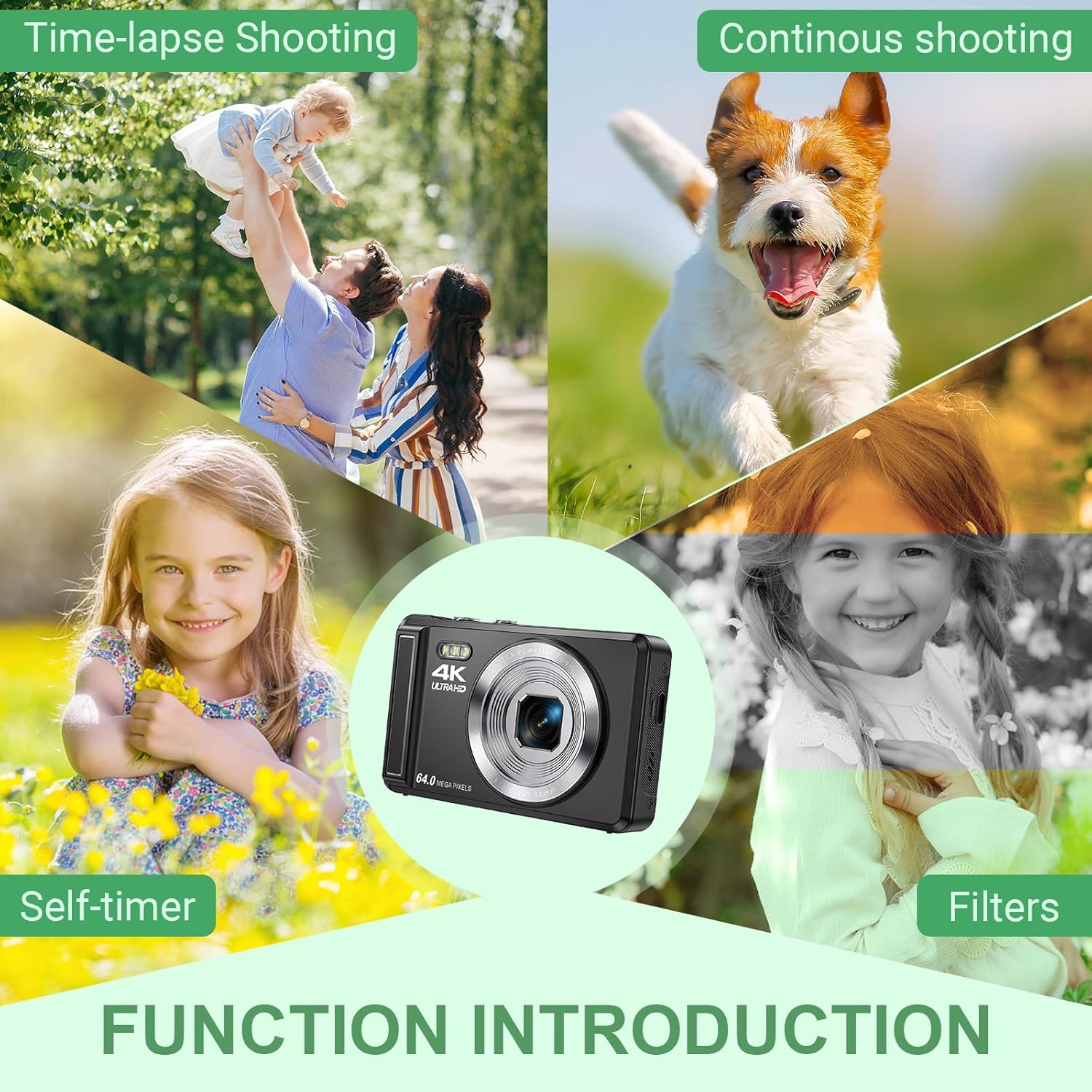
The design is very straightforward: small black plastic body, 2.8-inch LCD on the back, lens fixed in the front, and a basic grip. It weighs around 0.25 kg (about 0.24–0.25 lbs), so it’s really light in the hand. You can easily shoot one-handed, which is nice for vlogging or for kids with smaller hands. It doesn’t feel premium at all, but it also doesn’t feel like it will fall apart as soon as you drop it on the sofa.
The buttons are simple: power, shutter, zoom rocker, and a few navigation buttons around the OK/Menu area. The menu is bare-bones but clear. After 10 minutes of poking around, I knew where everything was: resolution settings, flash mode, timer, and the basic system settings. There’s no touchscreen, which at first feels a bit old-school when you’re used to phones, but at least you don’t get fingerprints all over the display. The 2.8-inch screen is not super bright or ultra sharp, but it’s enough to frame your shots and check if they’re roughly in focus.
One thing I liked is the compact form factor with the included lanyard and case. You can wear it around your neck or wrist and forget about it until you need it. For travel or days out, that’s more comfortable than walking around with a big camera bag. The downside is that there’s basically no weather sealing: it’s not water-resistant, and the plastic doesn’t give much confidence if it gets knocked around in heavy use. I wouldn’t bring it into heavy rain or a sandy beach without being careful.
Overall, the design is practical and beginner-friendly, but clearly budget. It looks like what it is: a low-cost compact camera with a simple layout. If you’re okay with a plasticky feel and just want something light and easy, it’s fine. If you’re used to the solid build of a Canon or Sony compact, this will feel like a toy by comparison.
Battery life: fine for a day out if you’re sensible, but don’t expect miracles
The camera uses a 1200 mAh lithium-ion battery, which is pretty standard for small compacts. In real use, that means: if you mostly take photos with the screen on, you can get through a normal day out as long as you’re not shooting non-stop. Roughly speaking, I’d say you can manage a few hundred photos or a mix of photos and short clips before it starts to complain. There’s no huge battery indicator drama, but it’s not a workhorse either.
Where the battery drops faster is 4K video and webcam mode. Recording 4K eats through the battery noticeably quicker, so if you’re planning long continuous videos, you’ll hit the limit pretty fast. Same if you use it a lot as a webcam without external power. The good point is that you can charge it via USB, so plugging it into a power bank or a laptop helps. Some buyers mentioned getting two batteries in the box, which is honestly the best way to deal with this: just swap when one is dead.
Charging time is not blazing fast. From low to full, you’re looking at around a couple of hours depending on your charger. There’s no fancy fast charging or detailed battery management options. It’s very basic: plug in, wait, unplug. For teens or beginners, that’s fine. Just don’t forget to charge it the night before a trip, or you’ll end up rationing your shots halfway through the day.
So my take: the battery is okay but not impressive. It’s aligned with the price and size of the camera. It works for casual use, short vlogs, and family outings, especially if you have a second battery or a power bank. If you expect DSLR-level endurance or want to film long events in one go, this is not the right tool.
Durability: feels like a toy but holds up if you’re not brutal with it
In terms of durability, you have to remember this is a budget plastic compact, not a rugged action cam. The body is light and a bit hollow-feeling. If you squeeze it, you can feel a little flex. That said, after tossing it in a backpack a few times, wearing it around the neck, and letting younger hands play with it, it didn’t fall apart. No rattling parts, no buttons stuck, no cracks. So while it doesn’t feel premium, it’s not ultra fragile either, as long as you’re somewhat careful.
The lens assembly is fixed, so you don’t have a protruding zoom barrel that can easily get bent like on some older compacts. That reduces one common failure point. The lens cover, however, is just a simple plastic shutter, not a sealed system. Sand, dust, or moisture could be a problem if you abuse it at the beach or in dirty environments. Also, the camera is clearly labeled as not water resistant, so I wouldn’t risk using it in heavy rain or near pools without protection.
The buttons and ports are basic but functional. The battery door and SD card slot flap feel a bit flimsy; if something is going to break first, I’d bet on that hinge. You can tell it’s a cost-cutting area. Same for the lanyard loop: it works, but I wouldn’t hang a brick off it. For a light camera, it’s enough, but I wouldn’t swing it around like a toy.
Overall, I’d say durability is acceptable for casual family use. It’s not built for harsh conditions, but for teens, students, and travel if you keep it in the provided case, it should be fine. If you’re clumsy or want something you can drop and splash around, better look at an action cam or a more rugged model. This one is more “be a bit careful and it’ll last” than “throw it around and forget it.”
Performance: decent 4K and photos in good light, struggles when things get harder
Let’s talk performance, because that’s where the marketing numbers and reality don’t always match. In good daylight, the camera does a pretty solid job for the price. Photos look sharp enough, colors are fairly natural (a bit on the cool side sometimes), and the 64MP files give you plenty of resolution to crop a bit. Is it actually resolving true 64MP detail? No, not really. But for prints, social media, or just keeping memories, it’s more than enough. For teens or beginners, it’s absolutely fine.
The 4K video at 30 fps is usable. Sharpness is okay, and for vlogging or filming days out, it does the job. Don’t expect good stabilization though: it only has digital stabilization, and you can see some wobble if you walk while filming. For static shots or light panning, it’s acceptable. The autofocus in video is basic: it works, but it’s not super fast or sticky. It’s okay if you’re at a normal distance and not moving too much, but it can hunt a bit in tricky scenes or low contrast.
Where it really shows its limits is low light and indoor scenes. The small 1/3" sensor starts to produce noise quickly, and the camera compensates by slowing the shutter or boosting ISO, which softens the image. The built-in flash helps for close subjects (family photos at the table, parties in a small room), but the look is very compact-camera-ish: flat light, sharp shadows. It’s usable, but don’t expect miracles in dim bars or night streets. Compared to a modern mid-range smartphone, the phone will usually win in low light.
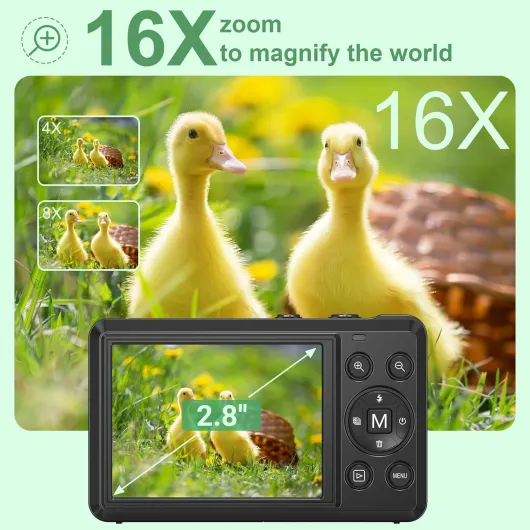
The 16x digital zoom is also one of those features that sounds big on paper but isn’t magic. Up to about 4x, it’s still okay. Past that, it’s basically cropping and enlarging, so you lose detail and get more noise. I’d say use the zoom sparingly and move your feet when you can. In short, performance is good enough for casual use in decent light, clearly limited when things get dark or when you push the zoom too far. For the price, it’s acceptable, but don’t buy it thinking it’ll replace a serious camera.
What this little 4K camera actually offers (beyond the big numbers on the box)
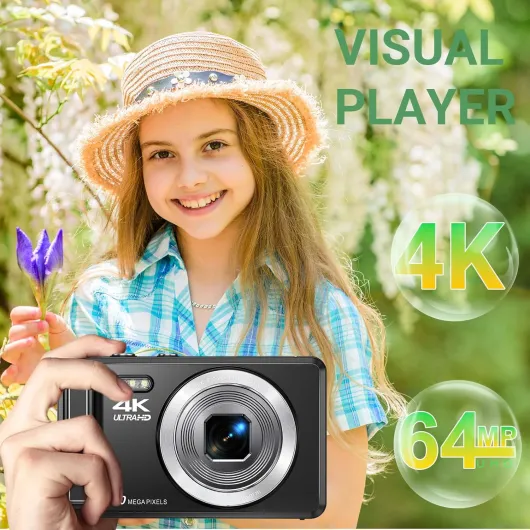
On paper, this camera looks pretty loaded: 64MP photos, 4K video, autofocus, 16x digital zoom, 2.8-inch screen, 1200 mAh battery, and an 8GB microSD card included. That’s a lot of specs for a cheap compact. But you have to read those numbers with a bit of skepticism. The 64MP is clearly upscaled from a small 1/3" CMOS sensor, so don’t expect DSLR-level detail. Same for 4K: it records in 4K resolution, but it’s more about sharpness than about rich colors or low-light performance.
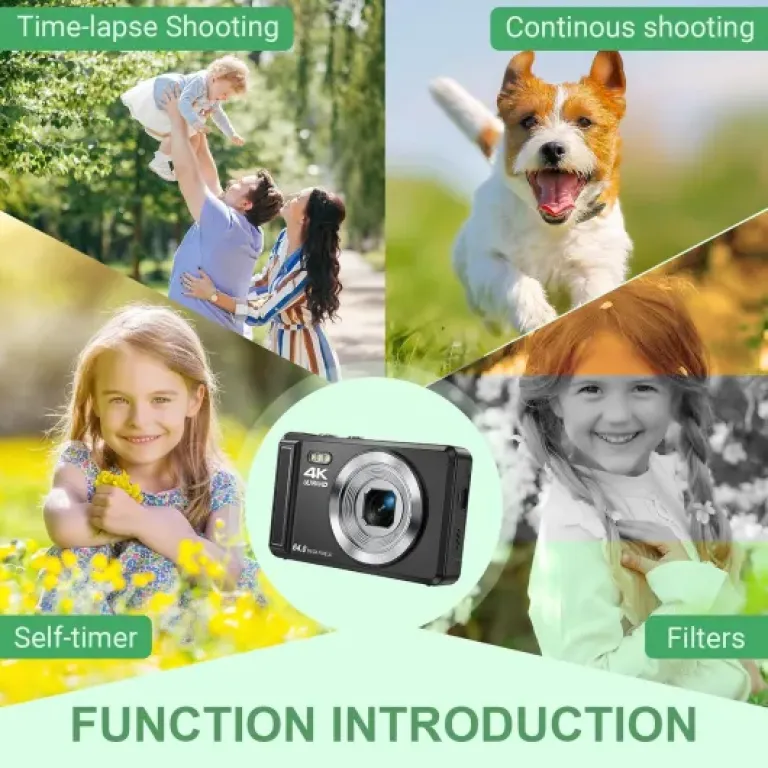
Function-wise, it’s very much a point-and-shoot. You have automatic exposure, automatic white balance, and a basic autofocus system with a single focus point. There’s no manual mode, no aperture or shutter priority, and no RAW files. You can switch between photo and video, turn on the flash, use a self-timer, and play with a few creative modes like slow motion, continuous shooting, and smile detection. It also doubles as a webcam over USB, which is honestly one of the more useful features if you’re doing calls or streaming.
In terms of accessories, the box is actually decent: you get the camera, a protective case, lanyard, 8GB card, rechargeable battery, and USB cable. Some kits apparently include a second battery, which is handy because 1200 mAh doesn’t last forever in video. Out of the box, you basically have everything you need to start taking photos or plugging it into a laptop for webcam use. No need to buy extra stuff on day one, unless you want a bigger SD card.
So in practice, I’d describe this camera as: a simple compact with inflated spec numbers, but with enough real features to be useful. It’s clearly designed for teens, students, and beginners who want something easy and cheap. If you go in with that mindset and not expecting pro quality, it makes sense. If you’re looking for serious photography control or low-light performance, this is not it.
Pros
- Very easy to use for beginners and teens, simple menus and controls
- Comes as a complete kit with SD card, case, strap, battery, and USB cable
- Decent 4K and photo quality in good light for the price, plus useful webcam mode
Cons
- Weak low-light performance and heavily marketed 64MP that doesn’t translate to pro-level detail
- Plasticky build and no water resistance, feels more like a toy than a serious camera
- Digital zoom quickly degrades image quality and battery life is only average, especially for video
Conclusion
Editor's rating
This ZMOQNG DC077A is basically a no-nonsense starter camera. It’s light, simple to use, and comes with everything you need to start shooting: SD card, battery, case, and cable. In decent light, photos and 4K videos look fine for social media and everyday memories. It’s not a big-brand powerhouse, but for teens, students, and people who just want a basic camera instead of handing over their phone, it does the job reasonably well. The webcam mode is a nice extra if you do a lot of video calls or online classes.
On the downside, the image quality is clearly limited in low light, the 64MP spec is more marketing than magic, and the plastic build doesn’t inspire much confidence long-term if you’re rough with your gear. Battery life is okay but not great, and the 16x digital zoom is more of a crop than a real zoom. So it’s not for enthusiasts, not for people chasing perfect photos, and it won’t replace a decent smartphone camera in every situation.
If you want a cheap, self-contained camera you can give to a beginner, take on holiday, or use as a spare/walkaround device, it’s a reasonable choice and offers good value for money. If you’re serious about photography or video, or if you already own a strong phone camera and want a real step up, you’re better off saving for a branded compact or entry-level mirrorless instead.