
Summary
Editor's rating
Value for money: good deal for casual users, not for gear snobs
Design and handling: toy‑like, but in a good way
Battery life and charging: better than expected, as long as you’re realistic
Waterproofing and durability: tough enough, but only if you respect the seals
Photo and video quality: think 2008 compact camera, not modern smartphone
What this camera actually offers (beyond the marketing blurb)
Pros
- Good value: includes 32 GB card, battery, and basic accessories so you can use it straight away
- Simple to use for kids and beginners, with fully automatic modes and an underwater setting
- Decent battery life for casual holiday use and light, bright design that’s easy to spot around water
Cons
- Image quality is only average and feels dated compared to modern smartphones
- Waterproofing heavily depends on carefully closing the battery door; user error can lead to leaks
- Included wrist strap feels flimsy and not fully reassuring for swimming or jumping from boats

Specifications
View full product page →| Brand | ISHARE |
A cheap way to film your holidays underwater
I picked up this ISHARE waterproof camera as a low‑risk option for a beach trip and some pool time, mainly because I didn’t want to risk my phone in a dodgy plastic pouch again. The idea was simple: something cheap, waterproof, and easy enough that kids and non‑techy relatives could use without constant supervision. On paper it ticks a lot of boxes: 30MP photos, 1080p video, 17 ft waterproof rating, 32 GB card included, and a bright orange body that’s hard to lose.
In practice, it feels very much like what it is: a budget, entry‑level waterproof camera aimed more at families and kids than serious photographers. If you’re expecting GoPro or Olympus TG‑level quality, you’re going to be disappointed. But if you just want holiday memories that look decent on a phone or laptop screen, it mostly gets the job done, with some caveats.
What stood out to me right away is how simple it is to get going. The microSD card is already in the slot, the battery is removable and rechargeable, and the menus are basic. You do have to format the card before use, but that’s a quick menu option. There’s no app, no Wi‑Fi, no overcomplicated stuff—just plug into a computer with the USB cable to pull your photos and videos.
Overall, my take after using it around water for a bit is that it’s a fun, low‑stress camera for casual use, especially for kids and beginners. It’s not perfect: the image quality has a bit of an old‑school feel, the shutter lag takes getting used to, and the waterproofing relies heavily on you closing the battery door properly. But for the price, and for what it’s clearly designed to do, it’s a pretty solid little toy‑camera for holidays rather than a serious piece of kit.
Value for money: good deal for casual users, not for gear snobs
Price‑wise, this camera sits in that affordable, entry‑level zone where you’re clearly not paying for high‑end optics or a big brand logo. For what you get—camera, battery, 32 GB card, waterproofing, and a bunch of basic features—I’d say the package is good value for casual use. You don’t need to buy extra storage or accessories just to start using it, which is nice when you’re buying for kids or as a secondary holiday gadget.
Compared to using your phone in a waterproof pouch, this is simply less stressful. You’re not risking an expensive smartphone every time you jump in the sea. The image quality is usually worse than a modern phone, but the trade‑off is peace of mind and the fact you can hand it to a 5‑year‑old without having a panic attack. For a lot of families, that alone justifies the cost. And compared to proper rugged cameras like the Olympus TG series or a GoPro, you’re paying a fraction of the price, which makes sense if you only go snorkelling once a year.
On the flip side, if you’re even a bit of a camera nerd, you’ll quickly hit the limits: small sensor, basic lens, lots of digital zoom and marketing numbers that don’t really translate into real‑world sharpness. The photos are fine for screens, but not something you’ll be editing heavily or printing big. If you expect more, it’s worth saving up and going for a known rugged brand or an action cam.
Overall, I’d rate the value as pretty solid for families, kids, and casual snorkellers who just want memories and don’t care about perfect quality. It’s not the bargain of the century, and there is definitely better gear out there if you’re willing to spend more, but at this price level, with the card included and the simple setup, it’s hard to complain too much as long as your expectations match the budget.
Design and handling: toy‑like, but in a good way
The first thing you notice is the bright orange body. It looks a bit toy‑ish, but that’s actually a plus around water—easy to see if you drop it in the pool or the sea, and easy to spot in a messy beach bag. The size is compact, roughly pocket‑camera dimensions, and light at around 270 grams. It’s small enough for kids’ hands but not so tiny that adults feel like they’re holding a key fob. The buttons are raised and fairly big, which helps when your fingers are wet or you’re wearing a simple pair of water shoes or gloves.
The 2.8‑inch LCD screen is fine indoors or in the shade, but like most cheap screens, it struggles a bit in very bright sunlight. Underwater, you’ll still see enough to frame your shot, but don’t expect smartphone‑level brightness. There’s no optical viewfinder at all, so you rely entirely on the screen. For kids and casual users, that’s normal, but it does mean composing shots in harsh light can be a bit of guesswork.
One design detail you have to pay attention to is the battery/memory card door. It’s intentionally tight and a bit fiddly because that’s what keeps the water out. You need to slide and press it firmly until you’re absolutely sure it’s locked with no visible gap. If you’re the type who rushes things, this is where problems start—some of the negative reviews about leaks sound like the door maybe wasn’t fully shut. Personally, I had to open and close it a few times at home to get used to the motion before trusting it in water.
In terms of controls, it’s very straightforward: shutter on top, zoom buttons, mode button, and a simple D‑pad on the back. No dial, no confusing custom settings. The plastic body does feel a bit on the cheap side, especially compared to rugged cameras from big brands, but that matches the price. I wouldn’t call it premium, but it doesn’t feel like it’s going to fall apart immediately either. It’s more like a solid toy camera than a fragile gadget, which for a family holiday isn’t necessarily a bad thing.
Battery life and charging: better than expected, as long as you’re realistic
The camera comes with a 1050 mAh lithium‑ion battery, which on paper doesn’t sound huge, but in real use it holds up quite well for a simple device like this. One user mentioned getting around 7 days of use, about 30 minutes of shooting per day, on a single charge. My experience was in the same ballpark: for typical holiday use—some snorkelling, a bit of pool time, a few photos during the day—you can easily go several days without needing to recharge, as long as you’re not constantly recording long videos.
Charging is done through the included USB cable, with the battery left inside the camera. There’s no separate external charger, which keeps things simple but means you can’t charge a spare battery while using the camera. For a budget device, that’s not shocking. Plug it into a laptop, power bank, or USB plug and it charges like any other small gadget. Charge time is not super fast, but if you just plug it in overnight, it’s ready for the next day. No fancy fast‑charge here, but it’s fine.
One thing to keep in mind is that every time you open the battery door, you’re messing with the waterproof seal. So the fewer times you have to open it on a trip, the better. That’s actually where the decent battery life helps: you can charge before your holiday or at the hotel, then avoid opening it at the beach or on a boat. If you’re the type who constantly checks the battery and pops it open, you’re increasing the chance of sand or hair getting on the gasket, which is exactly what you don’t want.
Overall, I’d say battery life is quietly one of the strengths of this little camera. It’s not a powerhouse, but for the kind of light, casual shooting it’s clearly designed for, it holds up well enough that it doesn’t become a headache. Just treat the battery door carefully and plan your charging so you’re not opening it in wet or sandy environments, and you’ll be fine.
Waterproofing and durability: tough enough, but only if you respect the seals
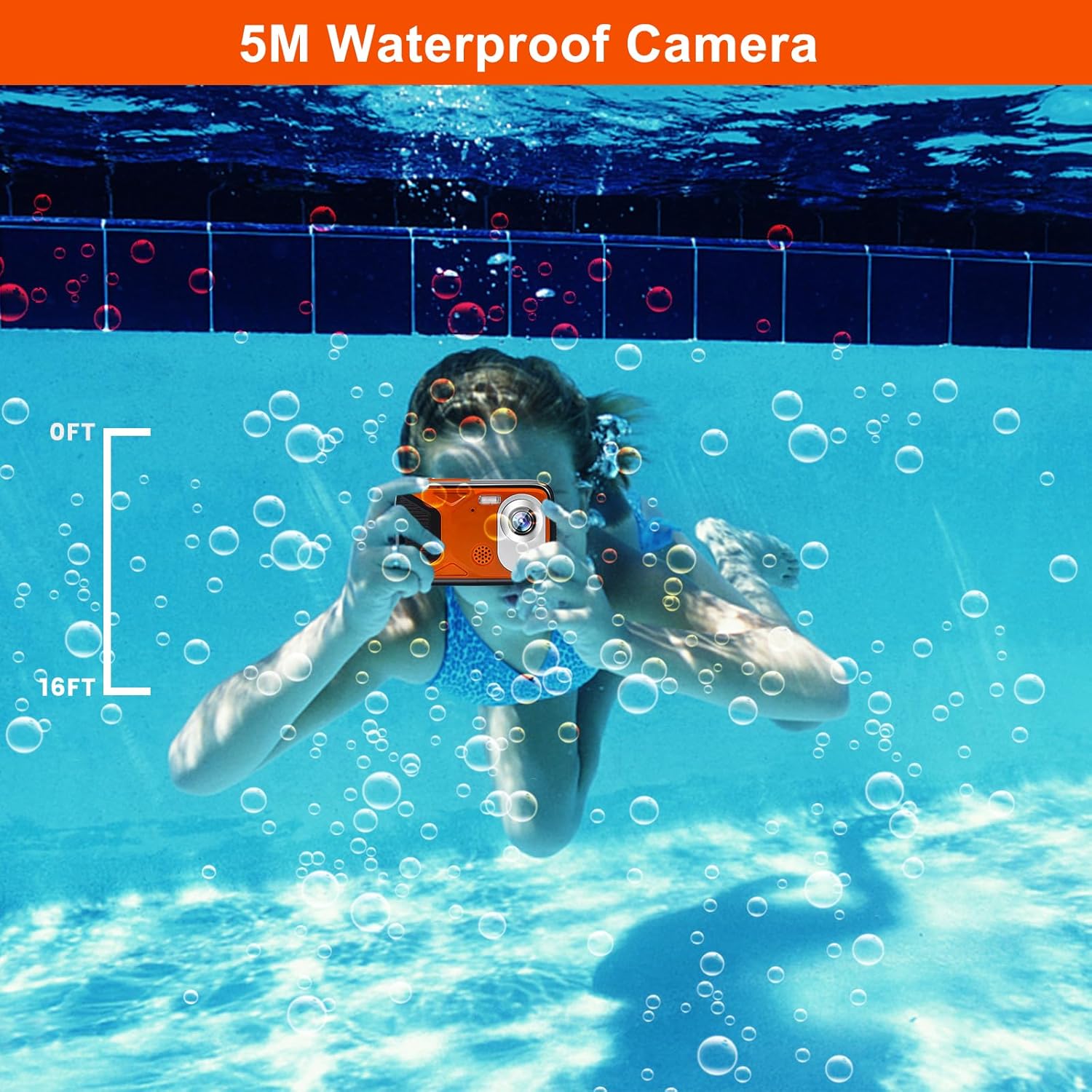
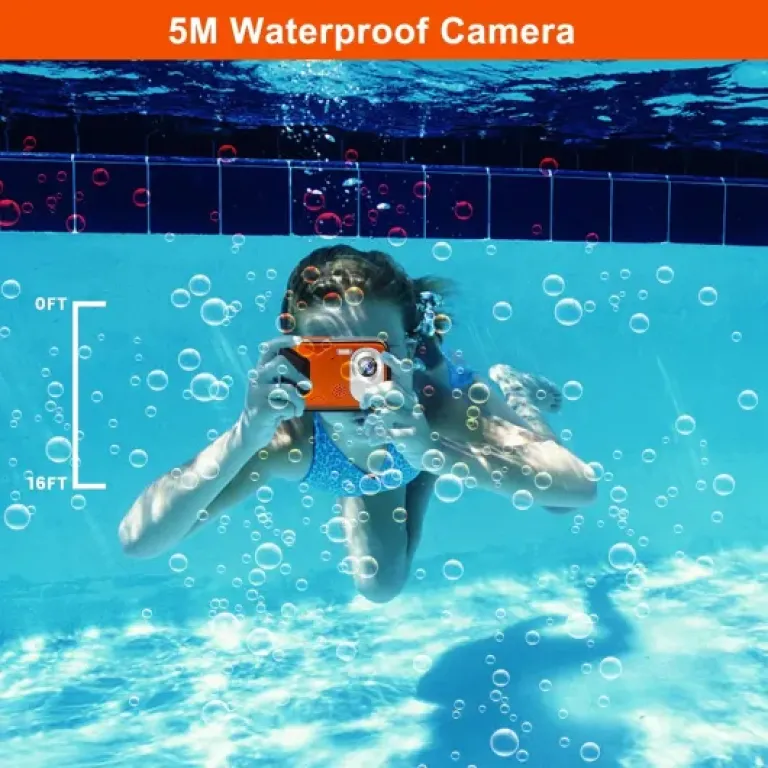
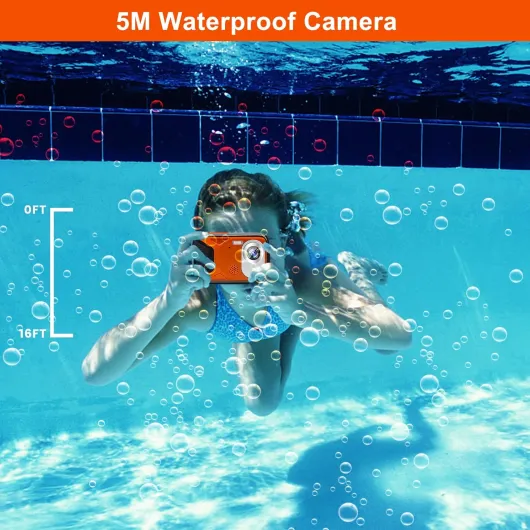
This is sold as a 5 m / 16–17 ft waterproof camera, and from my use and from most of the positive reviews, it can handle what it claims: snorkelling, swimming pools, baths, and shallow sea use. A lot of people mention kids using it in rock pools and baths with no problems, and my own time with it underwater didn’t cause any leaks. The body feels fairly solid for a plastic camera, and it shrugs off drops from kids’ hands without drama. One user even mentioned their son dropping it many times and it still working fine.
However, there are also a few 1‑star reviews about the camera filling with water after a few days or a week of use. That’s the risk with any waterproof device that relies on a user‑closed door rather than a sealed housing. If the door isn’t completely shut, or if a tiny bit of sand, hair, or dirt gets into the seal, water can and will find its way in. The battery door here is intentionally tight, which some people call fiddly, but that’s exactly what keeps it waterproof. You really have to double‑check that it’s locked with no visible gap every single time before going into the water.
In terms of general toughness, this is closer to a rugged toy than a pro rugged camera. The plastic will scratch if you abuse it, but it doesn’t feel fragile. The bright orange finish helps you spot it if you drop it in shallow water. The included wrist strap is, honestly, a bit flimsy. I didn’t fully trust it for jumping off boats or swimming in waves, and some reviewers did the same as me: replaced it or backed it up with a stronger strap or some kind of hand harness. Losing a cheap camera isn’t the end of the world, but it’s still annoying.
So my take: durability is decent for the price, but it heavily depends on you treating the waterproof door properly and not relying blindly on the thin wrist strap. If you’re careful—rinse it with fresh water after sea use, check the seal, don’t open it on the beach—it should last through holidays and kids’ adventures. If you’re rough, careless, or expect it to behave like a high‑end rugged camera, you’re probably going to be disappointed at some point.
Photo and video quality: think 2008 compact camera, not modern smartphone
Let’s be direct: despite the 30MP claim, this does not compete with a recent smartphone camera, especially in tricky light. The sensor is small and the processing is basic. Photos have that old compact camera vibe—a bit soft, colours slightly muted, and detail that looks fine on a phone or laptop screen but falls apart if you zoom in too much. One Amazon review nailed it by saying the images look like something from around 2008, and I agree with that. For kids and casual holiday snaps, that’s totally acceptable. For printing large or doing any editing, not so much.
Underwater, performance is decent for what it is. In clear water with good sunlight (snorkelling near the surface, swimming pools, shallow rock pools), you get recognisable, usable photos. Fish, coral, kids playing in the pool—all of that comes out clearly enough to share with friends or keep as memories. Colours aren’t super punchy, but they’re reasonably close to what you see, especially if you use the underwater mode. Don’t expect sharpness like a GoPro or a proper rugged camera, but you can definitely tell what’s going on in the shots.
Video tops out at 1080p, which sounds fine, but again, the quality is more budget level. It’s okay for casual clips: snorkelling, kids jumping in, quick pans of the reef. The built‑in digital stabilisation is there, but it’s not magic—if you’re swimming and moving around a lot, footage will shake. The audio from the built‑in microphone is usable above water, but underwater it’s mostly muffled noise, which is normal for this type of camera.
There is a noticeable shutter lag when you press the button, especially underwater. You need to hold the camera steady for a moment after pressing or you’ll end up with blurred or mistimed photos. This is something kids figure out after a bit of trial and error, but if you’re trying to capture fast action, it can be frustrating. Continuous shooting helps a bit, but it’s not super fast. Overall, the performance is okay for the price: not impressive, not terrible, just serviceable for casual use and kids who are more excited about having taken a photo than about pixel‑peeping the result.
What this camera actually offers (beyond the marketing blurb)
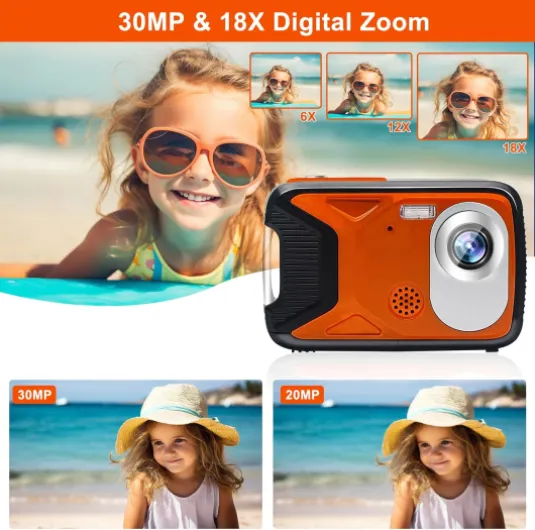
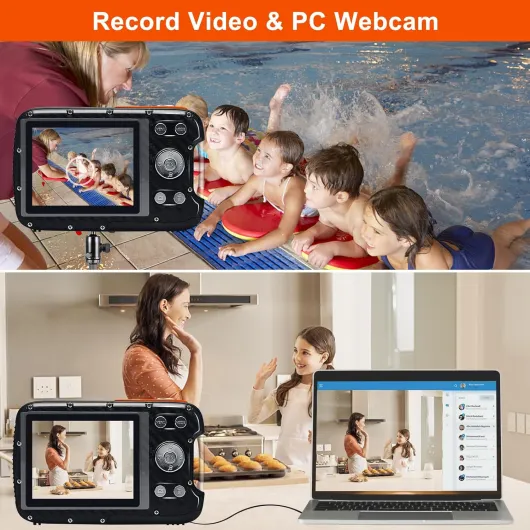
On paper, the spec sheet looks impressive for the price: 30MP stills, 1080p video, 18x digital zoom, 8x optical zoom, 2.8" LCD, underwater mode, face detection, smile capture, continuous shooting, and it even doubles as a basic PC webcam. In reality, a lot of those numbers are more marketing than magic, but you do get a decent set of features for casual use. The main thing is that everything is automatic—exposure, white balance, focus—so you don’t need to know anything about photography to use it.
The camera comes with quite a complete kit: you get the camera, a 1050 mAh lithium‑ion battery, a 32 GB microSD card already installed, a USB cable, a small pouch, a basic wrist lanyard, and a user manual. For a budget device, that’s actually good value because you don’t have to buy storage or a charger separately. You just need a USB plug or a laptop to charge it. This makes it easy to hand over to kids or relatives; everything they need is in the box.
Menus are simple and frankly a bit dated in terms of interface style, but they’re readable. You can switch between photo, video, audio recording, and playback modes using the mode button. In playback, you can delete shots, protect them, run a slideshow, rotate, and even crop a bit. There are some scene modes like underwater and panorama, but don’t expect miracles—these are minor tweaks, not pro tools. Still, having an underwater mode is handy to stop the colours looking completely washed out under the surface.
Overall, as a product, I’d describe it as a no‑frills, family‑friendly waterproof compact. It’s clearly aimed at novices and kids rather than enthusiasts. The specs sound bigger than what you really see in the final files, but for basic holiday snaps, social media posts, and letting children play photographer at the pool, it does what it says, as long as you keep your expectations in check.
Pros
- Good value: includes 32 GB card, battery, and basic accessories so you can use it straight away
- Simple to use for kids and beginners, with fully automatic modes and an underwater setting
- Decent battery life for casual holiday use and light, bright design that’s easy to spot around water
Cons
- Image quality is only average and feels dated compared to modern smartphones
- Waterproofing heavily depends on carefully closing the battery door; user error can lead to leaks
- Included wrist strap feels flimsy and not fully reassuring for swimming or jumping from boats
Conclusion
Editor's rating
If I sum it up, this ISHARE waterproof camera is a simple, budget‑friendly way to get underwater photos and videos without risking your phone. It feels a bit like a toy, but in the context of family holidays and kids messing around in pools and rock pools, that’s not a bad thing. Image quality is decent but nothing more—think older compact camera rather than modern smartphone. For viewing on a laptop or TV and keeping memories of fish, coral, and kids jumping in, it does the job.
Where it shines is ease of use and low stress: SD card included and pre‑installed, straightforward menus, bright orange body, and a battery that comfortably lasts several casual days of shooting. Most of the frustrations come from the same place as with any cheap waterproof device: you absolutely must make sure the battery door is fully shut and the strap is secure. Treat it with a bit of care and it should hold up; rush things or ignore the seal and you’re rolling the dice.
I’d recommend this to parents looking for a first camera for their kids, casual snorkellers who go on holiday once a year, and anyone who just wants simple underwater snaps without spending big. If you’re serious about image quality, plan to dive deeper than a few metres, or are picky about sharpness and colours, skip this and look at a GoPro or a proper rugged compact. For everyone else, it’s a good value, no‑frills little camera that gets the basic job done, with some rough edges you can live with at this price.