
Summary
Editor's rating
Value for money: makes sense as a gift, less so if you already have a good phone
Pink, light, and obviously plastic – kids will like it more than camera nerds
Battery life and charging: fine for a day out, but keep the cable nearby
Build quality: light and slightly cheap, but surprisingly okay for kids
Image and video quality: good enough for kids, not an upgrade over a decent phone
What this camera actually offers (beyond the big numbers on the box)
Pros
- Very simple to use with clear menus and basic auto modes, good for kids and beginners
- Lightweight pink body with 180° flip screen, handy for selfies and vlogging
- Includes 32GB microSD card and works as a USB webcam, so you can use it right away
Cons
- Image and video quality not better than a decent modern smartphone, especially in low light
- No real image stabilization and only digital zoom, so zoomed or handheld video looks shaky
- Plastic build and non-removable battery limit long-term durability and flexibility

Specifications
View full product page →| Brand | Gecool |
A cheap way to give kids a “real” camera
I’ve been playing with this pink Gecool 4K 64MP camera for about two weeks, mostly at home and on a couple of walks. I didn’t treat it gently on purpose: I tossed it in a backpack without a case, let a 10‑year‑old niece use it, and tried it as a quick vlogging camera for a small YouTube test. My goal was simple: see if this is a decent starter camera or just a toy with big numbers printed on the box.
First thing: this is clearly aimed at beginners and kids, not at someone who’s already used to a real DSLR or a good mirrorless camera. You feel it right away from the menu, the weight, and the plastic feel. It’s more like a step up from a kid toy camera or a very basic smartphone, not a replacement for a proper camera. If you’re expecting miracles from “64MP” and “4K”, you’re going to be a bit disappointed.
I tried it in different situations: indoor shots in average light, outdoor daylight, some quick handheld video in 4K, and a few close-up shots using the so‑called macro option. I also used it as a webcam on a Windows laptop for a couple of video calls. So it got a bit of real‑life use, not just “take two photos and put it back in the box”. That’s where its strengths and weaknesses become very obvious.
Overall, my feeling is: for kids, teenagers, or total beginners who just want something simple and pink with a flip screen, it gets the job done. For adults who already have a half‑decent smartphone, it’s more of a side gadget. It’s not terrible, but it’s also not some secret budget pro camera. It sits somewhere between toy and basic tool, and whether that’s good enough depends a lot on what you expect.
Value for money: makes sense as a gift, less so if you already have a good phone
Looking at the price point and what you get in the box – the camera, a 32GB microSD card, built‑in battery, flip screen, and 4K/64MP marketing specs – I’d say the value is pretty solid for a specific type of buyer. If you’re a parent or relative looking for a first “real” camera for a kid or teenager, this hits a nice balance: not too expensive, not so cheap that it feels like a disposable toy, and simple enough that they can use it alone.
Compared to a mid‑range smartphone camera, though, this doesn’t really win on pure image quality. Most modern phones will give sharper photos, better low‑light performance, and much better stabilization in video. So if the person you’re buying for already has a decent phone, this camera is more about the experience of using a dedicated camera than about getting better pictures. Some kids like having a separate device they can control, with buttons and a flip screen, and for them it makes sense.
Where it does score points is the webcam and vlogging angle. For someone who doesn’t want to use their phone for calls and recordings all the time, this gives them a separate tool with a flip screen and tripod mount. Image quality is not pro level, but it’s more than enough for casual YouTube, school projects, or chatting with friends online.
In short, the value is good if you see it as a beginner’s toy‑camera‑plus: better than cheap toy cameras, but not competing with real cameras or good phones. If your expectations match that, the price feels reasonable. If you’re expecting a budget version of a real 4K mirrorless camera, you’re going to feel a bit let down.

Pink, light, and obviously plastic – kids will like it more than camera nerds
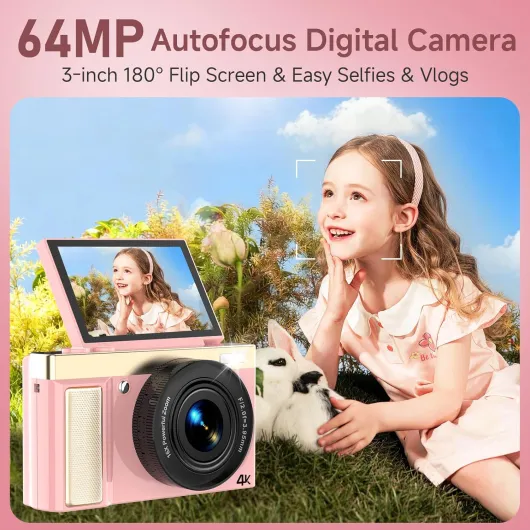
The first thing you notice is the color and size. This thing is small and light, almost toy‑like. The pink finish is exactly what you expect from a product clearly targeted as a gift for daughters, nieces, or girlfriends who like pink gadgets. It doesn’t look premium, but it does look friendly and approachable. A 10‑year‑old grabbed it and instantly felt comfortable holding it, which tells you a lot about the design direction.
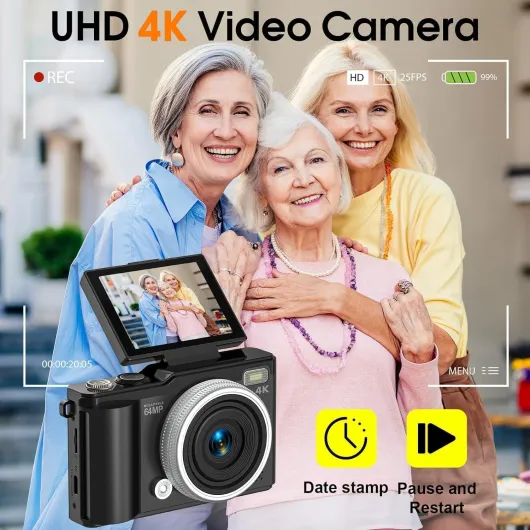
The 3" flip screen is the main design win. It rotates 180° so you can see yourself when filming or taking selfies. For vlogging or TikTok‑style videos, that’s actually quite handy. The hinge doesn’t feel super strong like on expensive cameras, but for the price it’s acceptable. I flipped it open and closed a lot over two weeks, and it never felt like it was going to snap, but I also wouldn’t let a very small child twist it aggressively. The bezels are thick and the screen itself is basic, but it’s usable indoors and outdoors as long as the sun isn’t hitting it directly.
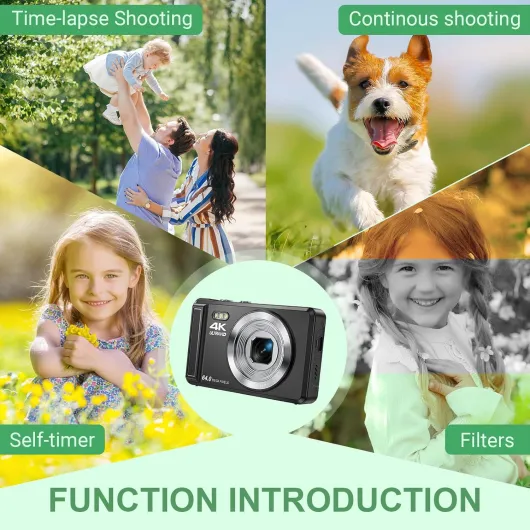
Button layout is very simple: power, shutter, zoom rocker, and a few basic menu and mode buttons. No mode dial, no complex controls. Menus are text‑heavy but straightforward. A beginner can figure out how to switch between photo, video, and playback without help. There are some extra features buried in the menu (timelapse, filters, beauty mode), but even if you ignore all of that, the camera is easy to live with. The USB‑C port and microSD slot are on the side, and there’s a standard tripod screw on the bottom, which is useful if you want to mount it on a cheap tripod for stationary vlogging.
Overall, in terms of design, it’s more toy‑camera than serious gear, but that’s kind of the point. It’s light, pocketable, and not intimidating. If you’re a parent, you won’t panic when your kid handles it. If you’re a camera enthusiast, you’ll instantly see the compromises, but you’re also not the real target here.
Battery life and charging: fine for a day out, but keep the cable nearby
The camera uses a built‑in rechargeable lithium‑ion battery that you charge via USB‑C. There’s no separate charger or removable battery, so you just plug the camera directly into a USB port or phone charger. That’s practical for beginners because there’s less stuff to manage, but it also means you can’t just swap in a spare battery if it dies mid‑day. You’re stuck finding a power bank or wall socket.
In my use, I got roughly a half‑day of mixed shooting (photos, some 4K clips, some menu browsing and playback) before the battery indicator dropped to the last bar and I started to feel a bit nervous. If you only shoot occasionally and turn the camera off between shots, you can stretch it to a full casual day out. If a kid is constantly recording video and flipping the screen around, it drains faster. It’s not awful, but it’s not long‑haul either.
Charging time is fairly standard. From nearly empty to full took around 2 hours plugged into a regular phone charger. You can technically use it as a webcam while plugged in, which helps for long online classes or streaming sessions, but I wouldn’t rely on it for hours and hours of recording away from a power source. There’s no fast‑charge magic here, just basic USB charging that gets the job done.
Overall, I’d call the battery situation acceptable but nothing more. For a kid or beginner who uses it in short bursts, it’s fine. For serious vlogging or long trips, you’ll either need a power bank or be ready to ration your shooting. The non‑removable battery is the main limitation: when it’s empty, you’re done until it charges again.
Build quality: light and slightly cheap, but surprisingly okay for kids
The camera body is very light plastic. When you pick it up, it doesn’t feel premium at all, but that’s not necessarily a bad thing for the target audience. Light means if a kid drops it from couch height or knocks it off a table, the impact is less brutal than with a heavy metal body. I didn’t drop it on purpose from high up, but it did get tossed into a backpack with keys and a power bank, and it came out without any cracks or obvious scratches after two weeks.
The flip screen hinge is always the weak point on cheap cameras. On this one, it feels okay as long as you don’t twist it aggressively. I opened and closed it a lot, flipped it for selfies, and let my niece handle it. No looseness or creaking developed in that short time. Still, I wouldn’t call it tough. If a kid yanks it sideways or sits on it, I can easily see it snapping. So: fine with normal use, but not built for rough abuse.
Important to note: it’s not water‑resistant at all. There’s no sealing, no rubber gaskets, nothing. So this is not a beach or pool camera. A bit of drizzle is probably okay if you wipe it quickly, but any serious rain or splashes are risky. The buttons and ports are exposed enough that I wouldn’t push my luck. Same story with dust and sand: keep it away from the beach bag chaos if you can.
Overall, durability is good enough for careful kids and everyday use, but not something I’d trust in harsh conditions. For the price and target audience, that’s fair. Just don’t expect tank‑like build quality, and maybe add a cheap little case if you plan to throw it in bags often.
Image and video quality: good enough for kids, not an upgrade over a decent phone
Let’s talk about the part everyone cares about: how the photos and videos actually look. In bright daylight, the camera does a decent job. Colors are a bit on the punchy side, sometimes slightly off, but for casual use and social media it’s fine. The 64MP number is mostly marketing – you can tell the sensor isn’t some high‑end thing – but for small prints or Instagram, the photos are usable. When I zoomed in on a computer, details are clearly softer than what you’d get from a mid‑range smartphone, but not terrible.
In low light or indoors, the limits show quickly. With ISO only going up to 3200 and no real image stabilization, photos get noisy and soft pretty fast. If you’re just shooting your kids in the living room for fun, it’s okay. But if you’re expecting clean, sharp images in dim restaurants or evening scenes, you’ll be disappointed. The built‑in fill light helps a little for close subjects, but it’s not a full flash, and it doesn’t magically fix bad lighting.
Video in 4K is… fine for the price, but again, don’t expect cinema quality. The files are MP4, and the resolution is there, but dynamic range is limited (bright skies blow out easily, shadows get crushed), and handheld footage shows a lot of shake because there’s no proper image stabilization. For a kid vlogging in their room or in the garden, it’s perfectly acceptable. For someone trying to start a serious YouTube channel, I’d say a modern smartphone will generally produce better and more stable video.
The autofocus is single‑servo contrast‑detect, so it focuses once when you half‑press the shutter. It’s OK for stills and slow subjects. It’s not great for fast‑moving kids or pets running around. The 16x zoom is digital only, so when you zoom in a lot, the image degrades and looks more like a crop than a real zoom lens. For kids who just want to “zoom in on the moon” or far objects, it’s fun, but from a quality point of view it’s nothing special. Overall performance: good enough for beginners and casual snaps, but nothing that beats a decent modern phone.
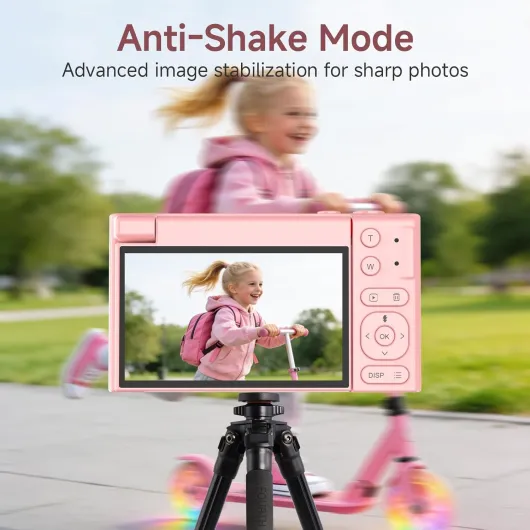
What this camera actually offers (beyond the big numbers on the box)
On paper, the specs sound impressive: 64MP photos, 4K video, 3" 180° flip screen, autofocus, 16x digital zoom, macro mode, 32GB card included, USB‑C recharge, and webcam function. If you just read the listing, you might think you’re getting something close to an entry‑level mirrorless camera. In reality, it’s closer to a compact camera that leans heavily on software tricks and upscaling to get those big numbers.
In everyday use, the main thing you notice is how simple the camera is to run. Turn it on, it boots fast, you press the shutter, it focuses and takes a shot. There’s no deep manual control, no complex exposure settings, and no confusing dials. It’s mostly auto everything: auto exposure, auto white balance, and basic autofocus. For a total beginner or a kid, that’s actually a plus. There’s nothing important to mess up, which means more usable pictures without reading a manual.
The camera comes with a 32GB microSD card already in the slot, so you can literally start shooting right out of the box. That sounds minor, but for a gift, it’s helpful: you’re not stuck on day one because you forgot to buy storage. It shoots JPEG for photos and MP4 for videos, so everything imports easily to a PC. The webcam mode is also straightforward: plug it in via USB‑C, choose the USB Camera mode, and it shows up as a webcam in apps like Zoom or Teams on Windows.
In short, the spec sheet is a bit inflated, but the basic package is clear: a very simple compact camera with a flip screen and webcam mode, mainly meant for casual use and vlogging practice. If you read the specs as marketing rather than strict truth, the product makes more sense. It’s not a pro camera; it’s a simple all‑in‑one gadget for kids, teens, and beginners who want something more “real” than just a phone.
Pros
- Very simple to use with clear menus and basic auto modes, good for kids and beginners
- Lightweight pink body with 180° flip screen, handy for selfies and vlogging
- Includes 32GB microSD card and works as a USB webcam, so you can use it right away
Cons
- Image and video quality not better than a decent modern smartphone, especially in low light
- No real image stabilization and only digital zoom, so zoomed or handheld video looks shaky
- Plastic build and non-removable battery limit long-term durability and flexibility
Conclusion
Editor's rating
After a couple of weeks with this pink Gecool 4K 64MP camera, my conclusion is pretty clear: it’s a simple, kid‑friendly camera that does the basics and adds a flip screen and webcam mode. It’s not trying to compete with serious cameras, and honestly it doesn’t compete with good modern smartphones either in terms of pure image quality. But for kids, teenagers, and total beginners who just want something easy, light, and a bit fun, it works.
The strong points are the lightweight design, simple menus, included 32GB card, and the 180° flip screen, which makes vlogging and selfies much easier. The webcam function is also handy if you want a separate device for online calls and simple streaming. On the downside, the build is clearly plastic, low‑light performance isn’t great, there’s no real image stabilization, and the big “64MP / 4K” claims are more marketing than a real leap in quality.
If you’re buying a first camera for a kid or teen, or as a light gift for someone who just wants to play with vlogging without using their phone all the time, it makes sense and offers decent value. If you’re an adult who already owns a decent smartphone and you care about image quality, I’d skip this and either stick with your phone or save for a better compact or mirrorless camera. It’s a fun little device, but it’s still closer to a starter gadget than serious photo gear.