
Summary
Editor's rating
Value for money: good deal for beginners, less so if you’re picky
Design & handling: light, plasticky, but easy to live with
Battery life & charging: two small batteries that do the job
Build quality & durability: feels cheap, but holds up (with care)
Photo & video performance: decent in good light, struggles in low light
What this camera really is (once you ignore the big numbers)
Pros
- Very light and compact with a 180° flip screen, handy for vlogging and selfies
- Comes with 2 batteries and a 16GB card, so you can start shooting immediately
- 4K video and photo quality are decent in good light for social media and casual use
Cons
- Weak low-light performance with noticeable noise and basic flash look
- All-plastic build feels cheap and not very confidence-inspiring long term
- Digital 16x zoom and big megapixel claim are mostly marketing and not very usable in practice

Specifications
View full product page →| Brand | HOOPWNE |
A cheap 4K camera that looked too good to be true
I picked up this HOOPWNE 4K 75MP compact camera because I wanted something small for trips and quick YouTube clips without dragging around my bigger mirrorless. The price was low enough that I was expecting a toy, but the specs on paper are pretty bold: 4K video, 75MP photos, WiFi, flip screen, autofocus, 2 batteries and an SD card in the box. It sounded like one of those “does everything” gadgets you see all over Amazon.
I’ve used it for about two weeks: a couple of walks in the city, some indoor shots at home, and a few short vlogs for Instagram and YouTube. I also tried it as a webcam for calls. So this is not lab testing, just real day-to-day use: walking, point-and-shoot, quick clips, dumping footage to my phone and laptop.
Right away, I’ll say this: it’s not on the same level as a real DSLR or a serious mirrorless. If you’re expecting that, you’ll be disappointed. But compared to a basic smartphone or an old compact camera, it can be interesting, especially if you like having physical controls and a flip screen. You just have to be clear about what you’re paying for.
In this review I’ll go through how it actually behaves: build, image quality, video, autofocus, battery, and whether the WiFi and webcam stuff is actually useful or just marketing. There are things it does pretty well for the price, and a few details that annoyed me. It’s not perfect, but it does get the job done for a beginner or casual vlogger in a lot of cases.
Value for money: good deal for beginners, less so if you’re picky
Given the feature list and what you actually get in the box (camera, 2 batteries, 16GB card, charger), the value is pretty solid if you’re a beginner or just want something simple for vlogging and travel. You don’t have to buy extra batteries or an SD card right away, so the total cost stays low. For someone who has only used a phone before and wants a dedicated camera with a flip screen and 4K, it’s an affordable entry point.
Where the value becomes more debatable is if you already own a decent smartphone. Many mid-range phones today shoot very good 4K video with better dynamic range and smarter processing. The HOOPWNE gives you the flip screen, physical controls, and the feeling of using a “real” camera, but in terms of pure image quality, it’s not always a big upgrade over a good phone. If your phone is old or basic, then yes, you’ll probably see a difference. If you have a recent iPhone, Pixel, or Samsung, the jump will be smaller.
Compared to entry-level cameras from big brands, this HOOPWNE is cheaper and more generous in accessories, but you lose on lens quality, autofocus sophistication, and long-term support. Firmware, spare parts, and compatibility are more of a question mark with a lesser-known brand. So if you think you’ll get serious about photography or video later, it might be smarter to save up for something more established.
Personally, I’d say the camera is good value if you: 1) are a beginner, 2) mainly shoot in good light, 3) want a flip screen and simple controls, and 4) don’t want to spend a lot. If you’re picky about image quality, low-light performance, or audio, you’ll hit its limits pretty fast and might regret not spending more upfront.
Design & handling: light, plasticky, but easy to live with
Physically, the camera is very light (around 250 g). In the hand it feels closer to a toy camera than a serious body, mostly because of the plastic shell. That said, the grip is decent: there’s a small bump on the front where your fingers sit, and it doesn’t feel like it will slip out of your hand immediately. It fits easily in a jacket pocket or small bag, which is definitely a plus for travel or everyday carry.
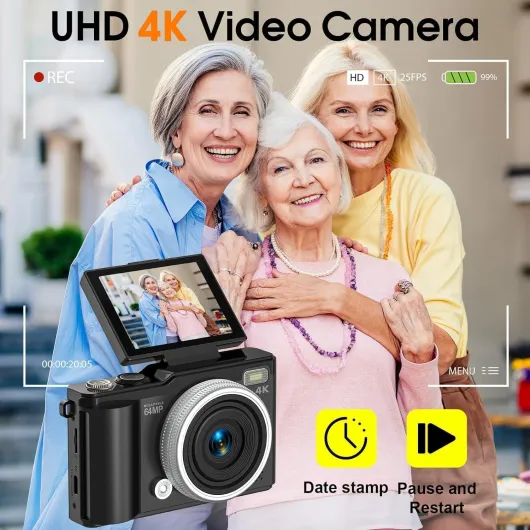
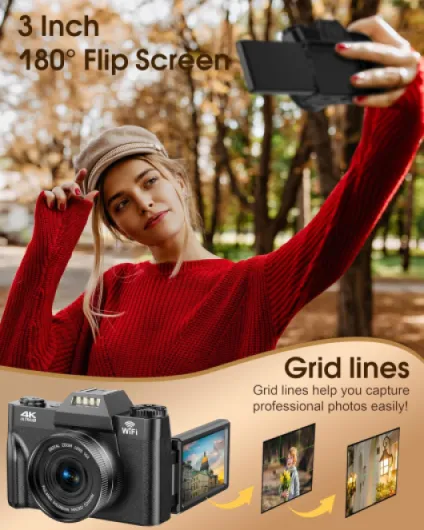
The buttons and layout are pretty straightforward. You’ve got a mode button, a directional pad, playback, menu, and a dedicated video record button. Nothing fancy, but you don’t get lost in it. The 3-inch screen rotates 180° upwards for selfies and vlogging, which is honestly one of the main reasons to buy it. The hinge feels okay, not super solid but not flimsy either. I wouldn’t twist it aggressively, but for normal use it seems fine so far.
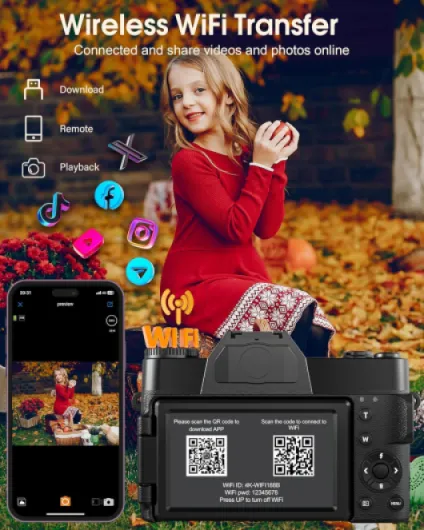
Ports and slots: there’s a micro SD card slot, USB port for charging and data, and a built-in flash on the front. No hot shoe for an external flash, no mic jack for an external microphone, so you’re stuck with the built-in mic. That’s one of the limitations: if you want better audio later, you can’t really upgrade it, you’ll need an external recorder or a different camera.
In day-to-day use, the menu system is basic but understandable. The fonts and graphics look dated, but it’s functional. I didn’t spend a lot of time digging through menus; once I set resolution and a couple of preferences, I mostly just turned it on and shot. If you like simple gear that doesn’t drown you in options, you’ll probably like that. Just don’t expect the polished feel or build quality of a big brand compact. For the price, I’d call the design practical but clearly budget.
Battery life & charging: two small batteries that do the job
Battery-wise, the camera comes with two 1500mAh lithium-ion batteries and a small USB charger. That’s actually a strong point. With one battery, I managed roughly 1.5 to 2 hours of mixed use (some photos, some short 4K clips, some menu fiddling, screen always on). If you’re only taking photos and short clips, one battery can easily last an afternoon. If you’re recording longer vlogs in 4K, you’ll chew through it faster, but having a second one in the pocket removes most of the stress.
Charging is done via USB, either with the included charger or directly in-camera. It’s not fast-charging; you’re looking at about 2 hours or a bit more to go from empty to full per battery. For me, the routine was simple: shoot during the day, plug both batteries in the evening, and they’re ready the next morning. For travel, you just need to remember to pack the charger and maybe a USB multi-port if you have several devices.
One small downside: there’s no clear percentage indicator on the screen, just a basic battery icon. It’s not super precise, so you might think you have half left and then suddenly drop to low. That’s why having two batteries is almost mandatory with this kind of camera. I also noticed that recording long 4K clips heats the camera a little, but I didn’t hit any thermal shutdowns in my tests. Still, I wouldn’t expect it to handle hour-long continuous 4K recordings without issues.
In short, battery life is decent for a compact camera at this price. It’s not impressive, but it’s not a disaster either. The fact that they include two batteries out of the box is a real plus, especially compared to some big brands that give you only one and charge more for a spare. For a day of casual shooting or vlogging, you’re covered as long as you swap and charge sensibly.
Build quality & durability: feels cheap, but holds up (with care)
The camera is clearly made to a budget. The body is all plastic, and you can feel that as soon as you touch it. There’s a bit of creaking if you squeeze it, and the buttons don’t have that solid click you get on higher-end gear. That said, after carrying it in a backpack, jacket pocket, and using it daily for about two weeks, I didn’t see any cracks or obvious wear. So it’s cheap, but not falling apart instantly.
The flip screen hinge is usually the weak point on this kind of camera. On this one, it’s okay but I wouldn’t call it tough. If you open and close it gently, it should last. If you’re rough with it or let kids twist it around, I can see it loosening over time. Same for the battery and SD card doors: they’re thin plastic with simple latches, so don’t force them. It’s not water resistant, so forget about shooting in heavy rain or near the pool without being careful.
I didn’t drop it from a big height, but it did survive a small knock against a table and a minor slip from a chair to the floor (wooden floor, about half a meter) without any visible damage or functional issue. Still, I wouldn’t rely on it surviving serious falls. If you’re clumsy or plan to use it in rough conditions (hiking, beach, kids’ hands), I’d add a small padded case and treat it like a fragile gadget, not like a rugged action cam.
Overall, durability is acceptable for the price, as long as you’re not expecting a tank. It’s fine for normal travel and home use, but if you need something really tough or weather-sealed, this is not it. Think of it more like a decent budget electronic device: it will last if you’re a bit careful, but it’s not built to be abused.
Photo & video performance: decent in good light, struggles in low light
Let’s be direct: in good light, outdoors or near a window, this camera does a pretty solid job for casual use. Photos look crisp enough for social media and basic prints, colors are okay (a bit on the cool side sometimes), and the autofocus usually locks on without too much hunting. The 4K video at 30 fps is genuinely usable for YouTube and TikTok if you’re not too picky. It’s not cinema-level, but it’s clean enough and clearly sharper than 1080p from many older devices.
Where it starts to fall apart is low light. Indoors at night or in a dim room, noise creeps in fast. The small 1/2.3" sensor and the lens just aren’t built for dark scenes. The built-in flash helps for still photos if your subject is close, but it gives that typical compact-camera flash look: flat, harsh, not very flattering. For video in low light, you really need some extra lamps or you’ll get grainy footage and a bit of focus hunting.
The autofocus is “okay but not more than that.” For static subjects or slow movement, it’s fine. When I tried to film kids running or cars passing quickly, it sometimes lagged or pulsed a bit. There is no advanced tracking like on bigger cameras. Same for the 16x digital zoom: up to around 4x it’s acceptable, beyond that you really start losing detail, and at the max zoom it looks like a crop from a cheap sensor. So I mostly used it at wide or slight zoom and moved my feet instead.
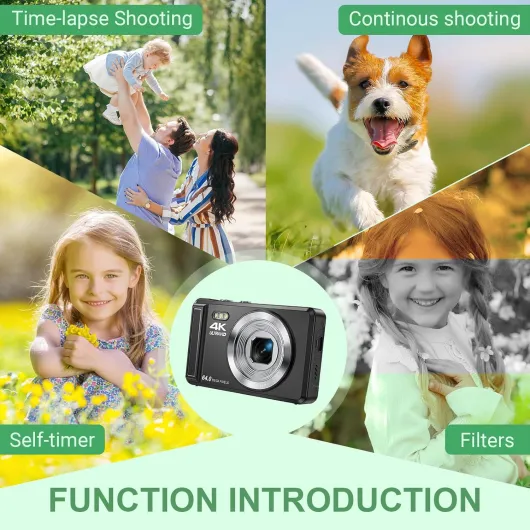
Filters and creative modes are more of a toy than a serious feature, but they’re fun. The time-lapse mode works, but you need a tripod for anything usable. Slow motion is there, but the quality drops, and it’s more a gimmick than something you’ll rely on. Overall, performance is fine for beginners and social content, as long as you stay in decent light and accept that the impressive numbers on the box don’t match pro-level output.
What this camera really is (once you ignore the big numbers)
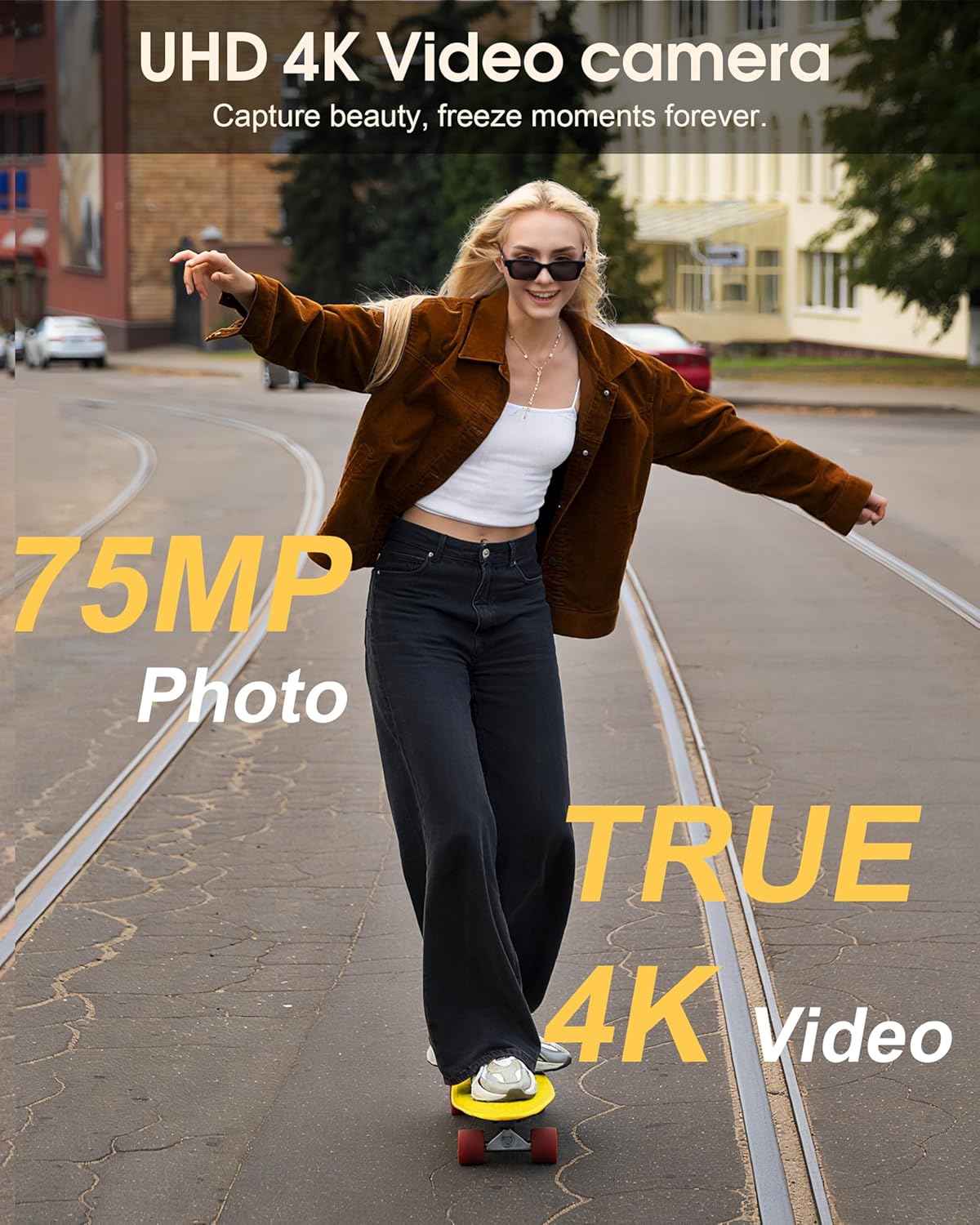
On paper, this thing looks packed: 4K 30 fps video, 75MP photos, 16x digital zoom, autofocus with 199 AF points, WiFi, flip screen, and it even comes with a 16GB microSD card and two 1500mAh batteries. That’s a lot of buzzwords. In practice, you quickly realize a few things: the 75MP number is clearly software upscaling, and the 16x zoom is digital only, so you’re basically just cropping. So if you’re used to brands like Canon or Sony, keep your expectations in check.
Function-wise, it’s a simple point-and-shoot with some extra modes: time-lapse, loop recording, slow motion, burst, self-timer, and a handful of filters (retro, watercolor, etc.). You can shoot stills and video at the same time, which is actually handy when you’re vlogging and want a quick photo without changing mode. Almost everything is automatic: exposure, white balance, focus. There aren’t deep manual settings like on more expensive cameras, so it’s clearly aimed at beginners.
Where it stands out a bit is the 180° flip screen and the webcam mode. For someone who wants to film themselves talking to the camera, framing is easy: flip the screen, hit record, done. The webcam function is basic but it works: plug it into a PC with USB, select it as a camera in your meeting or streaming software, and you’re good. The image is better than many built-in laptop webcams, but not mind-blowing.
So overall, the best way to look at this HOOPWNE is: a cheap, all-in-one compact for beginners and casual vloggers, not a pro camera. If you accept that, the feature list starts to make more sense. If you’re buying it because of the 75MP or 16x zoom thinking it’s some kind of pro gear, you’ll probably be disappointed once you see the actual files on a big screen.
Pros
- Very light and compact with a 180° flip screen, handy for vlogging and selfies
- Comes with 2 batteries and a 16GB card, so you can start shooting immediately
- 4K video and photo quality are decent in good light for social media and casual use
Cons
- Weak low-light performance with noticeable noise and basic flash look
- All-plastic build feels cheap and not very confidence-inspiring long term
- Digital 16x zoom and big megapixel claim are mostly marketing and not very usable in practice
Conclusion
Editor's rating
After using the HOOPWNE DC7817 for a bit, my honest take is: it’s a decent little camera for beginners and casual vloggers, as long as you know what you’re getting into. In good light, it takes clear photos and 4K videos that are totally fine for YouTube, Instagram, or family memories. The 180° flip screen, the simple menus, and the fact that it comes with two batteries and a memory card make it easy to pick up and start shooting right away. You don’t need to be a tech nerd to figure it out.
On the downside, the big numbers on the box (75MP, 16x zoom, 199 AF points) sound better than they behave in real life. Low-light performance is weak, the digital zoom quickly ruins image quality, and the build feels cheap. The autofocus is okay but not fast or smart enough if you’re trying to film a lot of movement. If you’re used to a modern smartphone or a real camera from Canon/Sony/etc., you’ll notice these limits quickly.
I’d recommend this camera to: beginners, teens, or casual users who want a cheap dedicated camera for travel, basic vlogging, or family use, and who mostly shoot in daylight. It’s also fine if you want a simple webcam upgrade over your laptop. I’d skip it if you’re serious about video quality, plan to shoot a lot in low light, or already own a good recent smartphone. In that case, better to save up for a more capable camera instead of trying to squeeze pro results out of this one.