
Summary
Editor's rating
Value for money: decent deal if you know what you’re buying
Retro look, toy-like feel
Battery life: actually one of the strong points
Build and durability: lightweight, but don’t abuse it
Image quality and autofocus: good for socials, not for pixel peepers
What you actually get with this W&O camera
Pros
- 180° flip screen and ring light make vlogging and selfies easy
- Decent 4K video and photo quality for social media and casual use
- Good battery life with USB-C charging and included 32 GB SD card
Cons
- Cheap plastic feel and no real grip or weather protection
- Low-light performance and autofocus are only average
- Limited flash control and no optical stabilization

Specifications
View full product page →| Brand | W&O |
A budget 4K vlogging camera that feels like a modern disposable
I’ve been playing with this W&O digital camera for a bit, and the best way I can describe it is: a modern point-and-shoot that’s clearly built for beginners and casual vlogging, not for photography nerds. It looks like a tiny retro camera, claims 4K, has a flip screen and a ring light, and comes with a 32 GB card. So you literally take it out of the box, charge it, and you’re ready to film or shoot. No extra gear needed, which is nice.
In use, it feels closer to a slightly upgraded kids’ camera than to a real DSLR or a serious mirrorless. The menus are simple, the body is super light, and you can tell right away it’s aimed at teenagers, people starting YouTube/TikTok, or anyone who just wants something separate from their phone. The brand is basically unknown, and that shows a bit in the finish and some weird design decisions, but it’s not junk either.
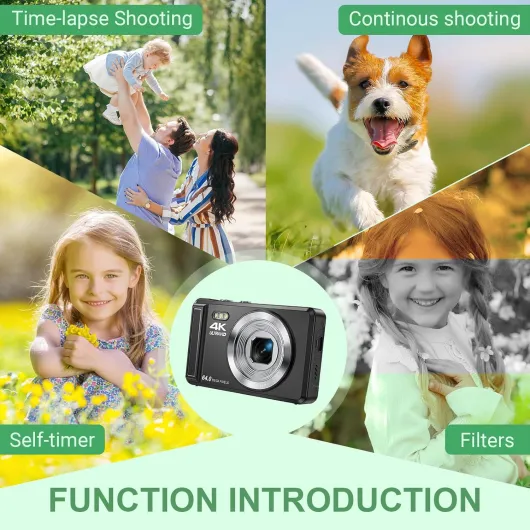
The main pitch is: 4K video, AI autofocus, 180° flip screen, ring light, and long battery life. On paper, that sounds packed. In practice, it does a decent job on the basics, especially for the price, but there are also clear limits. Low light is not great, zoom is purely digital, and the image quality is good enough for social media but nothing that will blow up on a billboard. Think everyday clips, not cinematic masterpieces.
If you’re thinking of buying this for proper photography, you’re probably going to be disappointed. If you see it as a fun, cheap tool to learn framing, talk to the camera, and shoot simple videos without draining your phone battery, then it starts to make more sense. That’s basically how I approached it, and with that mindset, it was easier to see the good and the bad without expecting miracles.
Value for money: decent deal if you know what you’re buying
For the price range this sits in, the value is pretty decent, as long as you understand what it is and what it isn’t. You’re getting: a compact camera with 4K video, a flip screen, a ring light, SD card included, USB-C charging, and a battery that actually lasts. That’s already more than some cheap compacts that don’t even give you a card in the box. For a beginner who just wants something simple to start vlogging or taking photos without touching their phone, that’s attractive.
Where the value becomes “just okay” is when you compare it to a mid-range smartphone. Many phones will beat this camera in low light, autofocus, and overall image processing. But of course, a phone at that level usually costs much more than this camera, and you might not want to risk your phone in every situation. So it’s really about whether you want a separate device dedicated to content. For a teen or someone who doesn’t want to be on their phone all day, this makes sense.
The Amazon rating around 4.2/5 lines up with how I feel: people who buy it with reasonable expectations are happy; people who expect a mini DSLR are disappointed. For example, one user complains there’s no easy way to force the flash on. That kind of detail shows the limits of this as a “real camera”. It’s more of a fun device than a tool with full manual control and advanced options.
If you’re on a tight budget and want to learn framing, basic shooting, and talking to camera with a flip screen, I’d say the value is good. If you already have a solid smartphone and you’re picky about image quality, you might be better off sticking with your phone or saving up for a used entry-level mirrorless. So in short: good value for casual users, average value for demanding users.
Retro look, toy-like feel
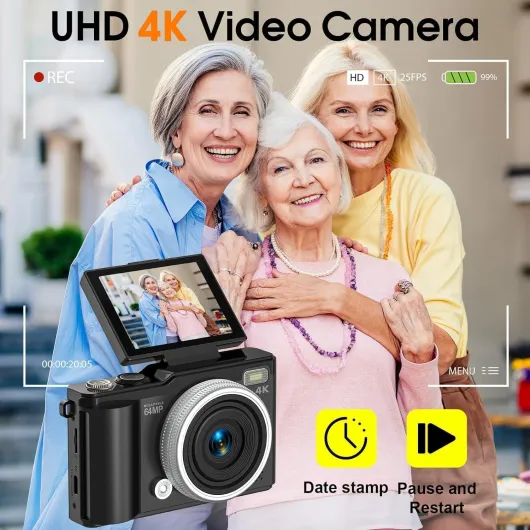
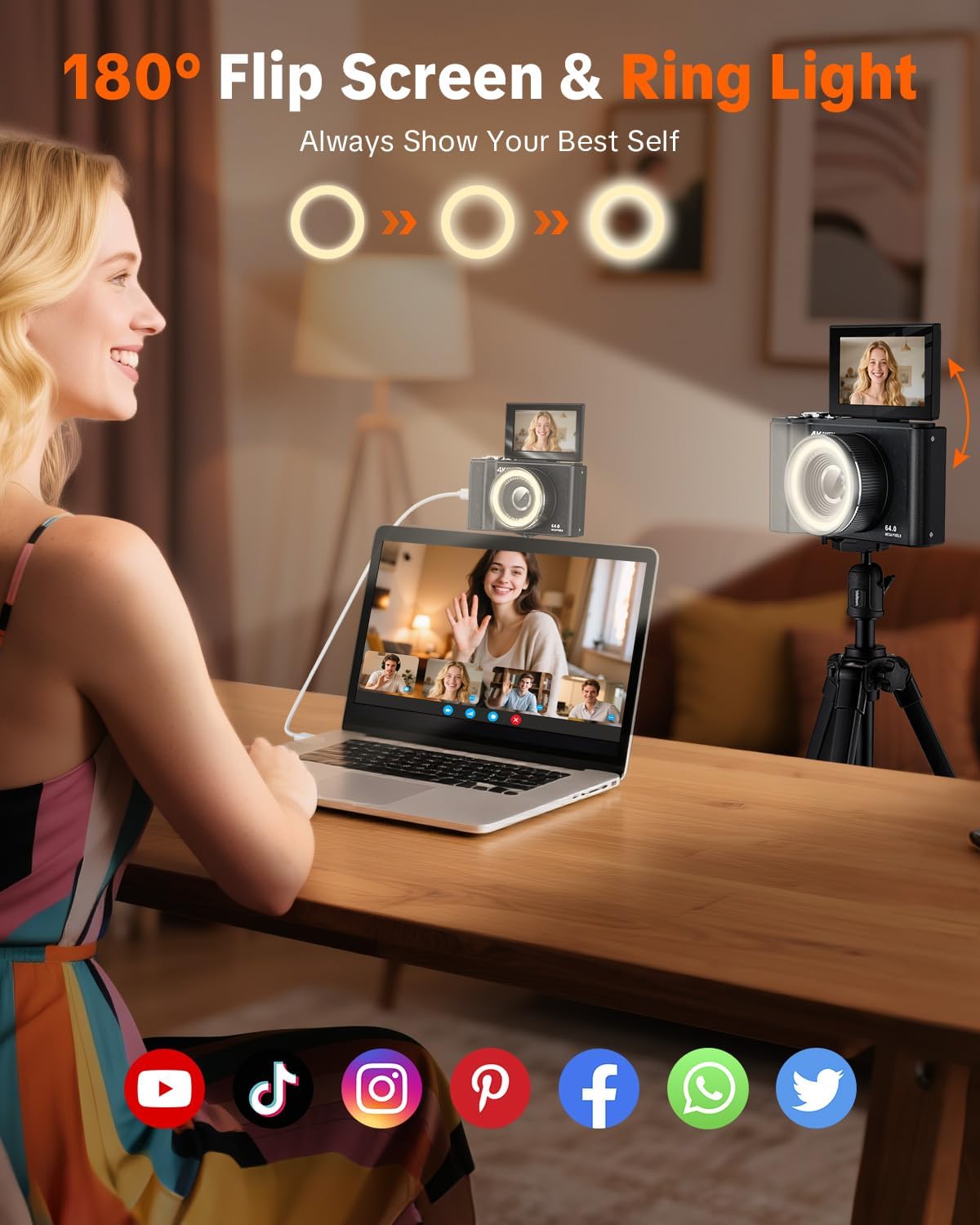
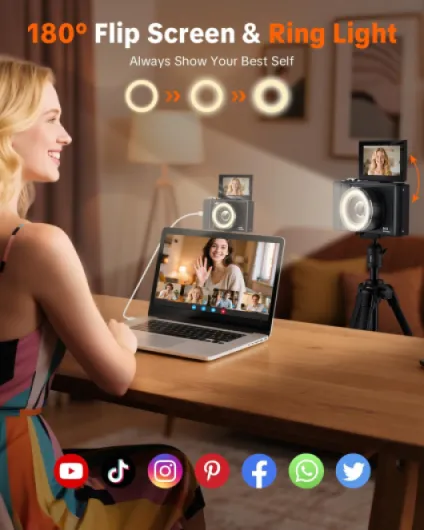
Design-wise, it looks cooler than it feels. The black vintage-style body is pretty nice to look at, and at first glance it could pass for an old-school compact from back in the day. The 180° flip screen is the real star here: you can flip it all the way forward for selfies or vlogging, or keep it at the back like a normal camera. For someone filming themselves, this matters more than any fake megapixel number. You always see your framing, which saves a lot of frustration.
In hand, though, you instantly feel that this is a budget device. It’s very light, almost toy-light, and the plastic doesn’t feel premium. It’s not the sort of camera you’ll be scared to throw in a backpack, which is also a plus. Buttons are simple and big enough, the menu is basic, and after a short time you’ve pretty much figured out where everything is. I didn’t find any weird hidden settings; it’s all straightforward, which is good for beginners but might feel too limited if you’re used to more advanced cameras.
One thing to note: there’s basically no grip. It’s just a smooth compact body. For short use it’s fine, but if you walk around vlogging for a while, your hand gets a bit tired because you’re pinching it instead of holding a real grip. I’d seriously consider a small handle or a mini tripod you can screw underneath if you plan to use it a lot for talking to the camera. That also stabilizes things a bit, because there’s no real optical stabilization on board.
On the side, you’ve got a USB-C port for charging and file transfer, and the SD card slot is easy enough to reach. No HDMI, no headphone jack, nothing fancy. Just the basics. For the target user, that’s okay. For more advanced stuff, like monitoring audio or plugging into a bigger screen, it’s clearly not built for that. So in short: nice to look at, a bit cheap to touch, but practical enough for casual use.
Battery life: actually one of the strong points
The 2500 mAh battery is one area where this camera does pretty well. The brand claims around 7 hours of continuous recording on a full charge. In real life, with some on/off, menu browsing, and photo + video mix, I got through a full afternoon of shooting without worrying about it dying. I wouldn’t count on a full 7 hours of pure 4K recording in one go, but for normal use (shoot a bit, stop, shoot again), it’s clearly better than a lot of cheap compacts and way better than most phones when recording long videos.
The fact that it charges over USB-C is also handy. I plugged it into a standard phone charger and a power bank, and both worked fine. You can also record while it’s charging, which is useful if you want to use it as a webcam or do long static recordings, like a podcast or a tutorial. Just put it on a tripod, plug it in, and forget about the battery. This is honestly a big plus compared to older cameras that use proprietary chargers or weak batteries.
There’s only one battery included, and it’s internal, so you can’t just swap it like on bigger cameras. That’s a downside if you plan to shoot all day without access to power. But given the battery life and the ability to run off a power bank, it didn’t bother me too much. For a beginner or someone filming casual content, the combo of decent capacity and easy charging is enough.
In short, battery life is one of the parts that feels less “cheap” on this product. It holds up well for its category, and the USB-C charging with recording-while-charging makes it more flexible than a lot of similar budget cameras I’ve tried. If you’re worried about constantly recharging or buying AA batteries, this one avoids that headache.
Build and durability: lightweight, but don’t abuse it
On durability, I’d describe it as “light but not fragile, just don’t expect tank-level toughness.” The plastic body is clearly budget, but nothing felt like it was about to fall off in my hands. The flip screen hinge is usually the weak point on these small cameras, and here it feels okay but not bulletproof. You can flip it around many times without issue, but I wouldn’t snap it open aggressively or let a small kid twist it around like a toy robot arm.
I tossed it in a backpack a few times without a case, and it survived fine: no scratches on the lens, no loose parts, no weird noises. It’s so light that even if you drop it from desk height onto something not too hard, it will probably be okay. But there’s no official shockproofing or weather sealing. So rain, sand, and hard concrete drops are definitely things to avoid. If you plan to travel a lot with it, I’d get a small padded pouch just for peace of mind.
The buttons and ports feel basic but functional. The USB-C port didn’t wobble, and the SD card slot door closes properly. It’s made in China by a no-name brand, so long-term reliability is a bit of a question mark. The good news is they mention a 2-year manufacturer warranty, which is reassuring on paper at least. How smooth the warranty process is, no idea, but it’s better than nothing.
Overall, I’d say it’s durable enough for normal, careful use, especially for a teenager or beginner who isn’t deliberately rough with their gear. Just don’t buy it expecting GoPro-level abuse resistance. Treat it like a small electronic gadget, not like a rugged action camera, and it should hold up fine.
Image quality and autofocus: good for socials, not for pixel peepers
Let’s talk about what matters: photos and videos. In daylight or decent indoor lighting, the camera does a pretty solid job for its price. Photos are sharp enough, colors are okay (a bit on the punchy side sometimes), and the CCD sensor gives a slightly grainy, nostalgic feel that some people actually like. It’s not clean like a newer phone sensor, but it has that “old digital compact” vibe. For casual shots of friends, pets, trips, or outfits, it gets the job done.
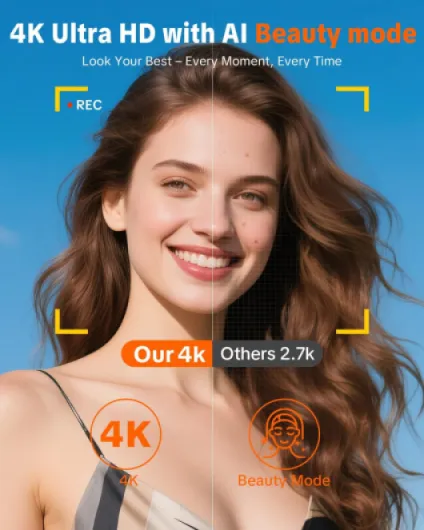
Video in 4K is surprisingly usable for YouTube and TikTok, as long as you don’t expect pro-level stuff. The detail is there, but dynamic range is limited: bright windows blow out, and dark areas get muddy pretty fast. If you mostly film yourself talking indoors with the ring light on, it’s fine. If you try to film a sunset or a high-contrast scene, you’ll see the limits fast. Also, there’s no real stabilization, so walking shots can be shaky unless you hold it very steady or use a small tripod/handle.
Autofocus is advertised as AI high-speed. In real life, I’d call it “good enough but sometimes confused”. If you’re a single person in the frame, it usually locks on your face and stays there. If you move quickly or there are multiple people, it can hunt a bit, especially in low light. For kids and pets running around, it catches some moments and misses others. Compared to a phone like a mid-range Samsung or iPhone, the phone will usually track better. But again, at this price, the autofocus is acceptable for casual use and especially for static talking-head videos.
Low light is where it struggles. Indoors at night without much light, noise goes up, colors wash out, and the image looks flat. The ring light helps for close selfies, but it’s not a magic fix. If you’re thinking of filming in dim bars or at night outside without extra lighting, don’t expect miracles. Overall, performance is decent but clearly limited by the small sensor and cheap optics. For learning and casual content, it’s okay. For anything serious, you’ll want something better.
What you actually get with this W&O camera
Out of the box, it’s pretty straightforward: camera, 32 GB microSD card, USB-C cable, and a basic manual. No separate charger brick, you just plug the cable into any USB charger or laptop. The fact that they include the card is a real plus at this price. I’ve had way pricier cameras arrive without storage, which is annoying when you want to start right away. Here, you charge it, pop the card in (or it’s already in, depending how they packed it), and you’re set.
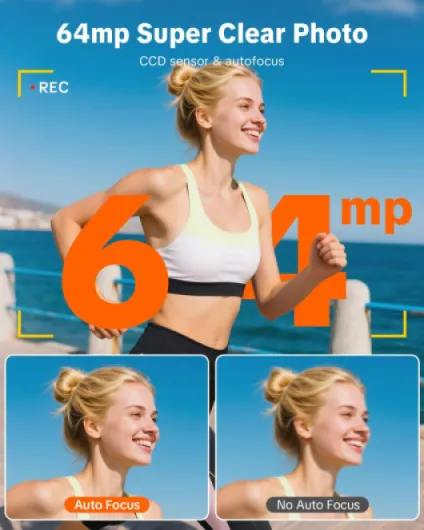
The camera claims 64 MP photos and 4K (2160p) video, but keep in mind that on this type of cheap compact, those numbers are mostly marketing. The sensor is tiny (1/2.5-inch CCD), and the 64 MP is clearly upscaled. In practice, the photos are okay for screens and social media, not something you’ll print huge. Same for 4K: it gives you a sharp enough image for YouTube, but don’t expect the clarity and dynamic range you’d get from a real 4K mirrorless. It’s fine, just not magic.
They also shout about AI high-speed autofocus and a ring light with beauty mode. Autofocus does work and it’s quick enough for casual use, but it’s not on the level of big brands where the camera sticks to the eye or face perfectly. Here, it finds focus most of the time, but it can hunt if the light is weak or the subject moves a lot. The ring light and beauty mode are clearly targeted at selfies and TikTok-style content: they smooth skin a bit and add some frontal light so your face doesn’t look like you’re in a cave.
Overall, the spec sheet is a bit exaggerated, but the core idea holds: small, light, simple, with a flip screen and built-in light. If you read the description as “fun beginner camera” instead of “mini professional camera”, it lines up more with what you actually get in the box and how it behaves in daily use.
Pros
- 180° flip screen and ring light make vlogging and selfies easy
- Decent 4K video and photo quality for social media and casual use
- Good battery life with USB-C charging and included 32 GB SD card
Cons
- Cheap plastic feel and no real grip or weather protection
- Low-light performance and autofocus are only average
- Limited flash control and no optical stabilization
Conclusion
Editor's rating
Overall, this W&O digital camera is a fun, beginner-friendly compact that makes sense if you see it as a step up from a toy, not as a budget version of a serious camera. The strengths are clear: 180° flip screen, built-in ring light, long-lasting battery, included 32 GB card, and simple menus. For a teenager, a casual vlogger, or someone who just wants a separate device to film daily life and basic YouTube/TikTok content, it does the job without being complicated or heavy.
On the flip side, it has obvious limits: image quality is decent but nothing more, low light is weak, autofocus is okay but not flawless, and the body feels cheap. There are also little annoyances, like limited flash control and no real stabilization. If you already have a good smartphone, this won’t suddenly give you pro results. It’s more about having a dedicated camera that’s easy to handle, looks a bit retro, and doesn’t drain your phone battery.
If you’re a beginner, a kid, or a casual creator who wants to experiment with vlogs and photos without spending a lot, this is a reasonable choice. If you’re more serious about photography or video and you care a lot about image quality, manual control, and durability, you should probably skip this and look at used cameras from bigger brands. In short: good little starter cam, but keep your expectations realistic.