
Summary
Editor's rating
Value for money: strong starter kit, but accessories add up
Design and handling: light, compact, a bit plasticky but practical
Battery life: usable but you’ll probably want a spare
Build and durability: feels solid enough, but not for rough abuse
Image quality and autofocus: strong for the price, with a few limits
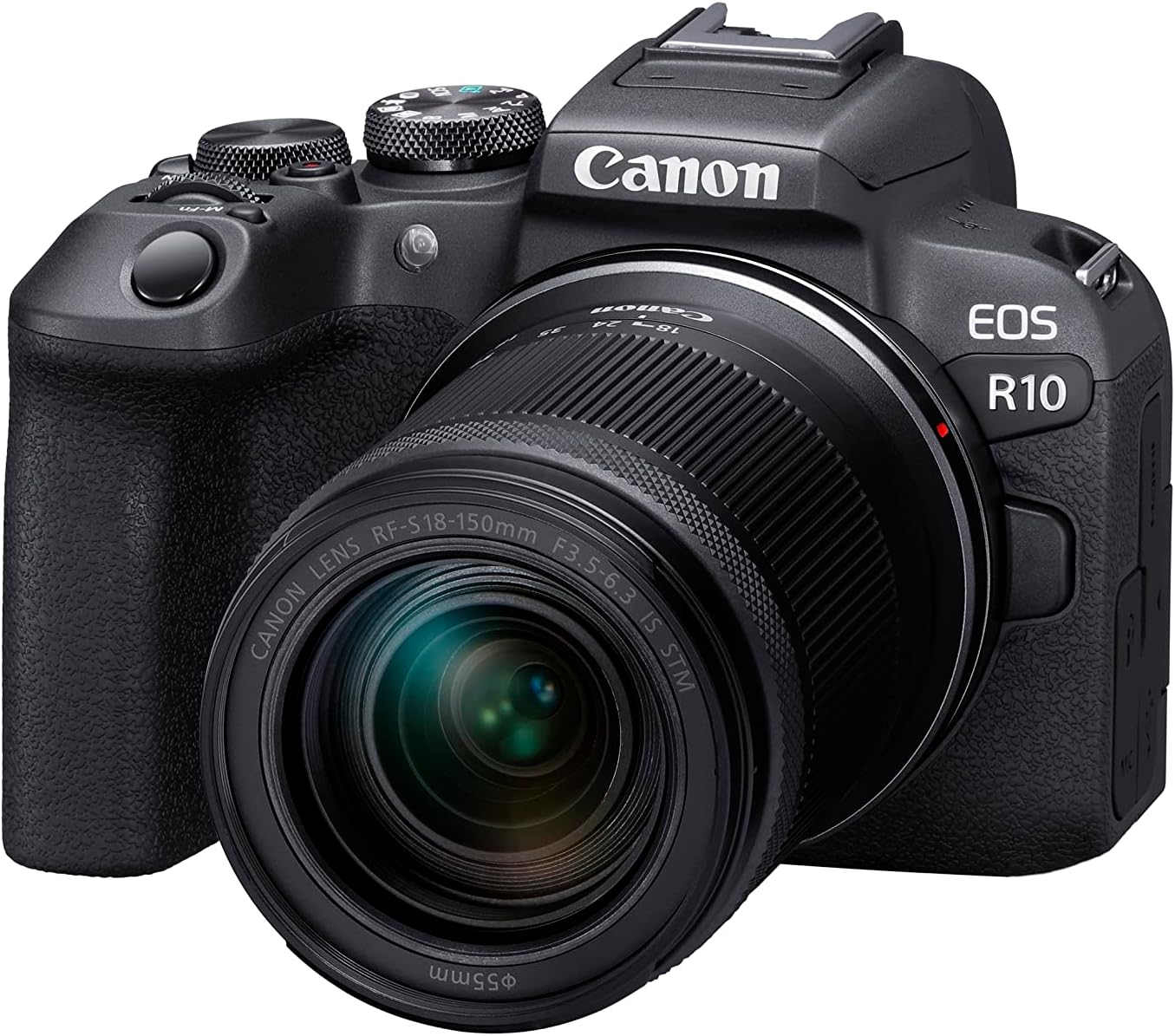
What you actually get with this R10 kit
Pros
- Lightweight body with a very versatile 18–150mm zoom that covers most everyday situations
- Fast and reliable autofocus with face detection, good for portraits, kids, and casual action
- Solid image quality and 4K video in a user-friendly package that’s beginner-friendly but still capable
Cons
- No in-body image stabilization and relatively slow kit lens (f/3.5–6.3) limit low-light performance
- Average battery life and no USB charging; a second battery is basically required for longer days
- Plastic-heavy build with no serious weather sealing, not ideal for rough or extreme conditions

Specifications
View full product page →| Brand | Canon |
A beginner camera that doesn’t feel like a toy
I’ve been using the Canon EOS R10 with the RF-S 18–150mm lens for a few weeks, mainly for family stuff, some walks in the park, and a bit of casual video. I’m not a pro, I just wanted something clearly better than my phone and old DSLR without needing a photography degree to operate it. This kit is sold as a "beginner" setup, but in the hand it feels more like a small serious camera than an entry-level toy.
The first thing that hit me is how light it is. Compared to my old Canon DSLR from years ago, the R10 feels almost half the weight, especially with this 18–150mm lens that covers pretty much everything from wide landscapes to a decent zoom for wildlife or sports. I actually carry it around instead of leaving it on a shelf, which is already a win. A camera you don’t bring is useless, no matter how fancy the specs are.
Image-wise, the jump from a phone is obvious. You get proper background blur, cleaner low-light shots, and a lot more control. The autofocus with face detection is the thing I noticed most in practice: it locks on people and keeps them in focus even when they move, which is handy when you’re dealing with kids or pets that never stand still. I didn’t have to fight the camera; it mostly did the right thing out of the box.
It’s not perfect though. The menu is packed with options, the battery could be better, and the lens is not very bright (f/3.5–6.3), so indoors you quickly hit the limits if the light is bad. But for a first proper camera, it’s a pretty solid balance of ease of use, performance, and price. If you’re okay learning a bit and not expecting miracles in the dark, it gets the job done nicely.
Value for money: strong starter kit, but accessories add up
Looking at value, this R10 + 18–150mm combo sits in a pretty sweet spot for someone who wants one lens that does almost everything. You get a modern APS-C sensor, fast autofocus, 4K video, and a very flexible zoom range in a light package. If you compare that to buying a body plus two separate lenses (like an 18–55 and a 55–200), this single-lens kit keeps things simple and often ends up cheaper overall. For a beginner or someone upgrading from a bridge camera, that simplicity has real value.
The main hidden cost is in extras. Out of the box, you still need at least: an SD card, a camera bag, probably a second battery, and maybe a simple tripod if you want to do more video or low-light work. None of this is specific to the R10, but it’s worth mentioning. Also, the RF and RF-S lens ecosystem is still growing and not exactly cheap. The good news is this body can also use Canon RF lenses and, with an adapter, older EF/EF-S lenses, so you’re not locked in. But if you stick to native RF glass, you’ll notice the prices.
In terms of what you actually get for the money: image quality is solid, autofocus is reliable, the lens covers a wide range, and the camera is easy enough for a beginner but still capable enough if you want to learn manual settings later. The main compromises are the slower lens (f/3.5–6.3), no in-body stabilization, and average battery life. If you’re okay with those and don’t shoot a ton in very dark conditions, the kit feels like good value.
Compared to cheaper entry-level models, the R10 gives you better burst speed, more AF points, and a more future-proof mount. Compared to pricier models, you save money but lose some advanced features and ruggedness. So I’d say the value is pretty solid if your goal is a flexible, all-round first camera that can handle travel, family, and casual wildlife without needing multiple lenses right away.
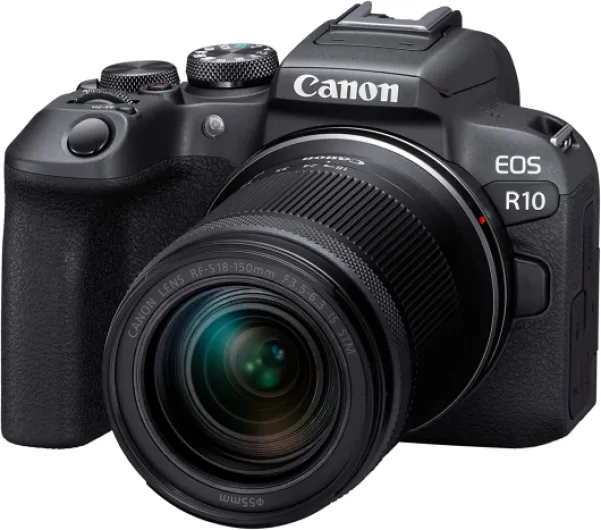
Design and handling: light, compact, a bit plasticky but practical
From a design point of view, the EOS R10 is clearly built to be compact and portable. The body is small but not tiny, and the grip is actually decent for a camera this size. I have average-sized hands and I could hold it securely with one hand, though with the 18–150mm zoomed all the way out, the combo becomes a bit front-heavy. It’s still way lighter than a classic DSLR with a similar zoom lens, so carrying it all day in a sling bag or even around the neck is manageable.
The layout of the buttons is typical Canon: mode dial on top, front and rear dials for shutter and aperture, a joystick, and a few customizable buttons. If you’ve used a Canon before, you’ll feel at home quickly. If you’re new, it takes a couple of days to remember where things are, but it’s not a nightmare. The touchscreen helps a lot: you can change settings and move the AF point just by tapping. The fully articulating screen is very handy for low-angle shots, overhead shots, or filming yourself. It doesn’t feel fragile, but I still treat it with care.
The downside is the overall feel is more plastic than metal. It doesn’t feel cheap like a toy, but you can tell it’s not a rugged pro body. There’s no official weather sealing mentioned, so I wouldn’t push it in heavy rain or dusty environments without some protection. The card and battery doors are okay but not tank-like. For home use, travel, and casual outdoor shooting, I don’t see a problem, but if you’re rough with your gear, you’ll want to be a bit careful.
One thing I liked is the electronic viewfinder: it’s not huge, but it’s sharp enough and responsive. It shows you exposure and white balance live, which helps avoid surprises. Compared to an old optical viewfinder DSLR, being able to see the final look before pressing the shutter is very practical. Overall, the design is focused on usability and portability more than premium feel. For the price and target audience, that’s fair, but don’t expect a tank-like build.
Battery life: usable but you’ll probably want a spare
Battery life on the EOS R10 is, in my experience, decent but nothing more. It’s a mirrorless camera with an electronic viewfinder and a bright LCD, so it drains power faster than old optical-viewfinder DSLRs. During a typical half-day outing, taking a mix of photos and short video clips, I could get through on one battery, but I usually ended the day somewhere between 20–30% remaining. If I shot a lot of 4K video and used the screen constantly, it went down faster.
Canon includes one battery and a charger in the box, which is standard, but for real-world use I would strongly recommend a second battery if you plan to shoot longer days, events, or travel. It’s not that the R10 is terrible on battery, it’s just average for a modern mirrorless. You notice the drop more if you chimp a lot (constantly reviewing photos), use Wi-Fi to transfer images to your phone, or do long bursts at 23 fps. All those things eat battery quickly.
One practical point: charging is via the external charger, not USB-C directly in the camera (at least with this kit and spec list). That means you can’t just plug in a power bank to top it up in your bag; you need access to a plug and the charger. For home use, not a big deal. For travel, it’s one more thing to pack and remember. I would have liked USB charging for convenience, especially since many cheaper cameras now offer it.
So, in short: battery life is fine for casual use, but if you’re planning a long day of shooting or lots of video, don’t rely on a single battery. It’s one of those hidden costs you should factor into the total price. Not a deal-breaker, but not a strong point either. I’d rate it as “okay, but plan ahead.”
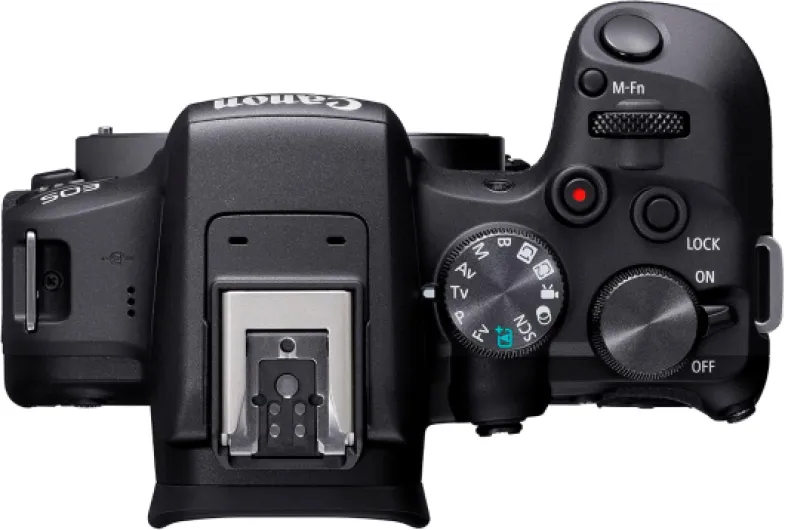
Build and durability: feels solid enough, but not for rough abuse
On the durability side, after handling it for a while, the R10 feels like a mid-range camera: not fragile, but not something I’d throw around either. The body is mostly plastic, but the parts you touch the most (grip, dials) feel reasonably solid. I carried it in a small bag, bumped it a few times getting in and out of the car, and used it in light drizzle once with no obvious issues. So for everyday use, it gives a decent impression of reliability.
That said, there’s no real mention of proper weather sealing in the specs, and you can feel that in the design. The doors for the battery and SD card don’t have that heavy, rubber-sealed feel you get on higher-end bodies. I personally wouldn’t trust it in heavy rain, on a dusty safari, or in very harsh environments without extra protection. If your use is more like city trips, parks, home, and occasional hikes, it should be fine as long as you’re not reckless.
The lens itself (RF-S 18–150mm) extends quite a bit when you zoom, which always makes me a bit cautious about impacts. The zoom ring is smooth and doesn’t feel loose, and there was no wobble in my copy, which is good. But like all extending zooms, if you knock it while fully extended, I wouldn’t be surprised if something misaligns. So again, it’s about treating it as a camera, not a brick. A simple padded bag goes a long way.
Long-term, Canon has a decent track record with their consumer cameras. My old Canon DSLR survived years of trips and random bumps. I can’t say yet how the R10 will age, but based on feel I’d say it’s built to last if you’re reasonably careful, not if you’re the type to toss gear loose into a backpack with keys and tools. For the price and target audience, the durability seems fair, just don’t expect pro-level toughness.
Image quality and autofocus: strong for the price, with a few limits
In terms of performance, this is where the R10 feels like a real camera and not just a fancy gadget. The 24.2 MP APS-C sensor delivers clean, detailed images in normal lighting. For daytime photos, landscapes, portraits, and general travel shots, I had no complaints. Colors out of camera are classic Canon: a bit warm, skin tones look natural, and JPEGs are very usable without heavy editing. If you shoot RAW, you get enough flexibility to fix exposure and white balance mistakes easily.
The autofocus is one of the strong points. With 651 AF points and face detection, it locks onto people quickly and usually sticks to them. For moving subjects like kids running around or dogs, it did a good job in my tests. It’s not perfect in very low light or with very fast movement, but for normal everyday use it’s more than enough. Eye detection works well at closer distances. I rarely had completely missed focus when I let the camera handle it, which is not something I can say about older DSLRs I’ve used.
Where you start to see some limits is in low light. The kit lens is f/3.5–6.3, so when you zoom in, you’re quickly at f/6.3, which means the camera needs higher ISO to keep the shutter speed reasonable. Up to ISO 3200, results are still quite usable for casual use. Beyond that, noise becomes more noticeable, especially if you zoom in or print big. For social media and small prints, it’s fine, but don’t expect super clean night shots handheld without thinking about your settings or using a tripod.
For video, the 4K looks sharp and the autofocus tracks faces well, which is nice if you want to film yourself or record family events without fuss. The lack of in-body stabilization means you have to rely on the lens IS and digital stabilization, so handheld walking shots can still look a bit shaky. For static or lightly moving shots, it’s okay. Overall, performance is pretty solid for this level: strong autofocus, good image quality, but somewhat limited by the slower lens and lack of in-body stabilization.
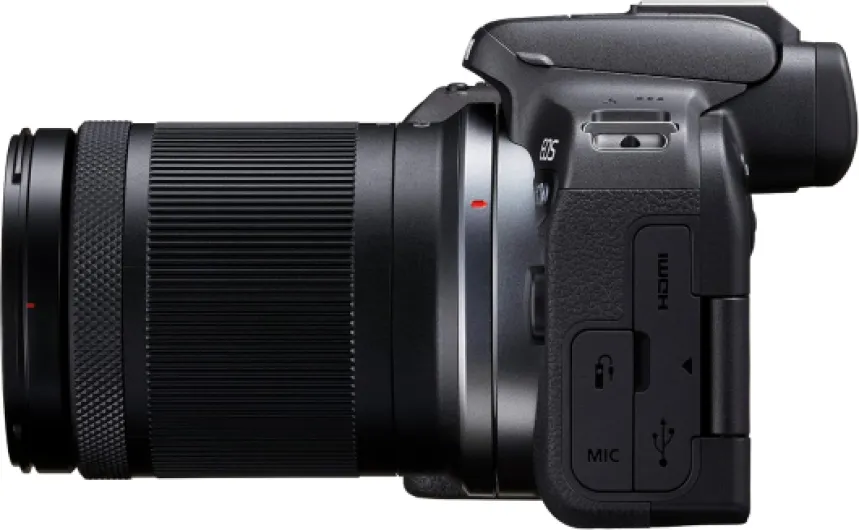
What you actually get with this R10 kit
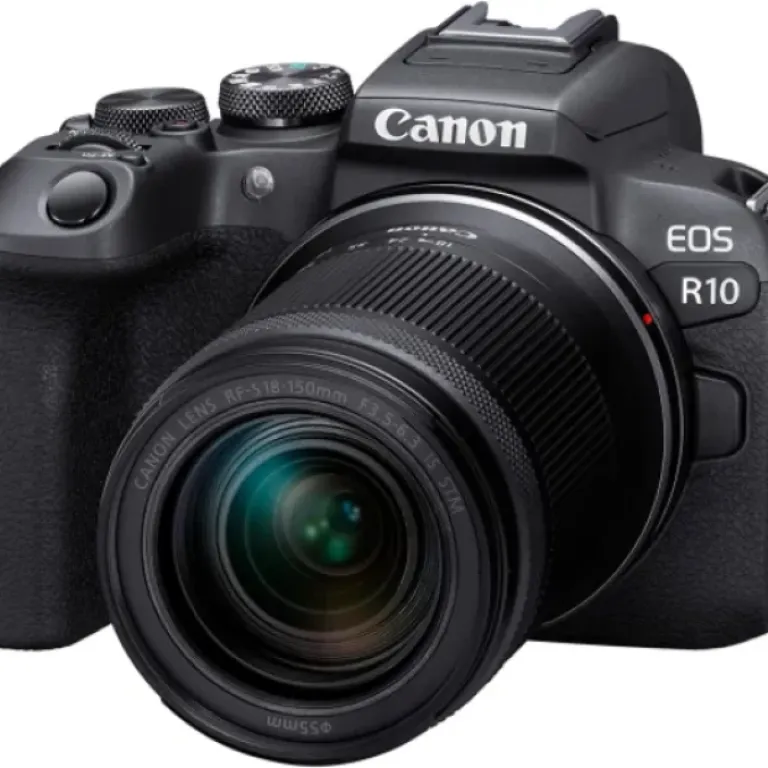
This specific bundle is the Canon EOS R10 body plus the RF-S 18–150mm f/3.5–6.3 lens. So out of the box, you’ve got one camera, one lens, a battery and charger, and that’s basically it. No memory card, no camera bag, no extra battery. Just the essentials to start shooting. The sensor is 24.2 MP APS-C, which is pretty standard nowadays, and it can shoot both stills and 4K video (2160p) with up to 23 frames per second in burst mode if you use the electronic shutter.
The lens is the key part of this kit. 18–150mm on APS-C gives you a very flexible range. At 18mm you can handle landscapes, group photos, and small rooms if you step back a bit. At 150mm you can zoom in on birds, kids playing football, or details far away. It’s not a pro telephoto, but for a single-lens setup, it covers most casual needs. The lens has optical image stabilization and a stepping motor, so it’s relatively quiet and smooth for video autofocus.
The camera itself has 651 autofocus points and uses Canon’s hybrid AF system, plus face/eye detection. You get a fully articulating touchscreen (handy for vlogging or weird angles), an electronic viewfinder with 2.36M dots, Wi-Fi and Bluetooth for quick transfers, and a single SD card slot (UHS-I). It’s not a professional monster, but the spec sheet is far from basic. You can shoot RAW, C-RAW, HEIF, and JPEG, and video is saved in MP4. For someone starting out, this is more than enough to grow into.
On paper, the R10 sits in the middle of Canon’s APS-C mirrorless range: more serious than their cheapest models, but not as feature-packed as the higher-end R7. For day-to-day use, I never felt limited by resolution or autofocus. Where you do notice the “mid-range” part is in things like battery life, lack of in-body stabilization (it’s digital only), and the plastic-heavy build. Still, for the price of the kit, what you get is quite complete and covers a lot of situations without needing extra lenses on day one.
Pros
- Lightweight body with a very versatile 18–150mm zoom that covers most everyday situations
- Fast and reliable autofocus with face detection, good for portraits, kids, and casual action
- Solid image quality and 4K video in a user-friendly package that’s beginner-friendly but still capable
Cons
- No in-body image stabilization and relatively slow kit lens (f/3.5–6.3) limit low-light performance
- Average battery life and no USB charging; a second battery is basically required for longer days
- Plastic-heavy build with no serious weather sealing, not ideal for rough or extreme conditions
Conclusion
Editor's rating
Overall, the Canon EOS R10 with the RF-S 18–150mm lens is a very capable starter kit that actually makes sense in real life. It’s light, easy enough to use, and the lens range means you can cover a lot of situations with one piece of glass: landscapes, portraits, kids’ sports, basic wildlife, and travel. Image quality is clearly above what you get from a phone or old compact camera, and the autofocus with face detection takes away a lot of the frustration beginners usually have.
It’s not perfect. The body is mostly plastic, there’s no real weather sealing, the lens is relatively slow (f/3.5–6.3), and battery life is just okay. You’ll want at least a second battery and a decent SD card. Low-light performance is good up to a point, but this isn’t the camera for serious night photography without extra gear or faster lenses. And if you’re super picky about stabilization for video, the lack of in-body stabilization might bother you.
If you’re a beginner or casual user who wants a proper camera for family, travel, and learning photography, this kit is a strong option. It gets the job done, leaves room to grow, and doesn’t feel overly complicated. If you’re a pro looking for heavy-duty build, dual card slots, or hardcore low-light performance, you should look higher in Canon’s range. For most normal people upgrading from a phone or old DSLR, the R10 + 18–150mm hits a pretty good balance between performance, size, and price.