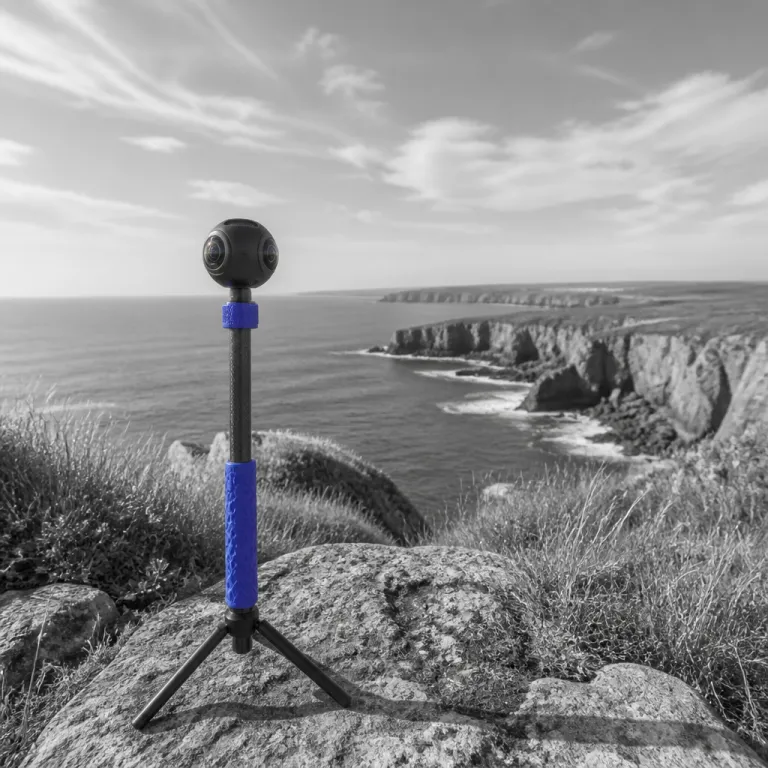
DJI Osmo 360 II: teaser, timing, and what 360 really buys you
DJI Osmo 360 II: teaser, timing, and what 360 really buys you
DJI has announced that a new 360-degree Osmo camera will be revealed on August 13 at 12 PM GMT via an official launch livestream on DJI’s event page, accompanied by a short teaser that appears to show real footage from the upcoming dual-lens device. For solo creators in the United States and elsewhere who are already juggling an action camera, a phone, and maybe an Osmo Pocket, the obvious question is whether a second generation 360 camera is a meaningful tool or just another device to charge and mount. The answer depends less on headline video resolution and more on how you plan to shoot, edit, and publish content across YouTube, Instagram, and TikTok.
The original DJI Osmo 360 has been reported as capable of capturing very high resolution 360 video and panoramic stills, so any Osmo 360 II upgrade has to improve real world image quality, workflow, and reliability rather than just numbers on a spec sheet. DJI’s teaser materials and early regional listings hint at a larger 2150 mAh battery, NFC pairing, and 5.7K-class 360 capture at up to 30 fps, but until the official DJI product page and press release are live, those details should be treated as indicative rather than final specifications. Even modest changes can matter when you are filming a full day report or travel vlog and need reliable quick release mounts, fast pairing with the Mimo app, and fewer missed shots. A 360 camera like the DJI Osmo 360 II records the entire sphere around you, which lets you reframe a panoramic video into multiple standard 16:9, 9:16, or 1:1 clips later, effectively turning one take into several different videos for different platforms.
That reframing flexibility is the real reason many solo shooters move from a traditional single lens action camera such as an Osmo Action to a dual lens 360 camera, even if the nominal resolution sounds similar on paper. When you crop a small window out of the full 360 capture, the effective sharpness drops compared with a dedicated forward facing camera, so you trade some pixel level clarity for creative angles, invisible selfie perspectives, and the ability to fix framing mistakes in editing. If you mostly shoot a clean talking head vlog with a fixed selfie stick and rarely move, a standard combo of a conventional camera and a simple mic will still give you better face detail and low light performance than any consumer 360 cameras can manage today.
For readers comparing options, a structured overview of top 360 degree digital cameras shows how aggressively this category has evolved, but the core trade off remains the same. You gain one take coverage, invisible selfie stick tricks, and easier action framing, while you lose some reframed resolution and often pay a higher price for the combo of camera, battery, and mounts. With the DJI Osmo 360 II, the key question is whether DJI has pushed the balance far enough that a solo creator can rely on this one camera for both immersive panoramic shots and standard everyday clips.
Until DJI publishes the official Osmo 360 II product page and full press release, prospective buyers should treat any teaser based specifications as preliminary rather than confirmed and verify launch details, sensor format, and recording modes directly against DJI’s own documentation once it is available.
Real world gains for solo creators: battery, pairing, and one take capture
From what DJI has shown so far, the DJI Osmo 360 II appears to be less about headline specs and more about smoothing the friction points that made first generation 360 cameras feel like a niche toy. The rumored move from a roughly 1950 mAh to a 2150 mAh battery is modest on paper, yet for a solo shooter running an action camera, a phone, and maybe a DJI Mic receiver, that extra capacity can mean finishing a mountain bike run or city walk without digging for a replacement kit in your bag. NFC pairing should also make it faster to connect the camera to the DJI Mimo app, which matters when you want to check framing, trigger a quick panoramic video, or offload clips for rapid editing on a phone.
In practice, a second generation 360 camera like the Osmo 360 II promises three concrete advantages for a vlogger or travel creator who often works alone. First, you can mount the camera on a selfie stick, hit record once, and then forget about aiming while you ride, ski, or walk through a crowded street, because the dual lens system captures everything around you instead of a narrow forward slice. Second, you can later read the full scene in the timeline and reframe multiple angles from that single clip, which turns one action sequence into several pieces of content for shorts, stories, and a longer report without reshooting.
Third, the invisible selfie effect that hides the stick in the stitched image lets you create floating camera moves that would normally require a second operator or a gimbal, which is why many insta creators quietly rely on 360 cameras for their most dynamic shots. The DJI Osmo 360 II teaser footage suggests that DJI is leaning into this invisible selfie look, and the company’s broader ecosystem of Osmo Standard mounts, Adventure Combo bundles, and quick release accessories should make it easier to swap between helmet, chest, and handheld setups. If you already own an Osmo Action or another action camera, the Osmo 360 II is less a replacement and more a complementary tool that handles chaotic movement and panoramic environments while your main camera covers controlled talking head segments.
For buyers trying to understand where 360 fits alongside compact cameras and phones, a mid range vlogging camera test such as a portable 4K compact review shows how different the workflow feels when you must aim every frame. With the DJI Osmo 360 II, you trade that precise on the spot composition for a more relaxed shoot now, edit later approach, which can be liberating for solo shooters who want to stay present in the moment. A simple starter workflow is to record a single long 360 clip, mark key moments with voice notes or hand waves, then in the Mimo app or DJI Studio drop in auto reframing, lock the horizon, and export separate 16:9 and 9:16 versions for YouTube and TikTok.
To make those trade offs easier to visualize, it helps to think in terms of core specs that DJI is likely to emphasize once the full data sheet is public:
- Sensor size and resolution: larger sensors generally improve dynamic range and low light performance, while higher capture resolution (for example, 5.7K 360 at 30 fps or above) gives you more detail to work with after reframing a 16:9 or 9:16 crop.
- Stabilization system: modern 360 cameras rely on advanced electronic stabilization and horizon leveling, which can replace a gimbal for most action shots if the algorithms are strong; look for sample clips that show running, biking, and quick pans.
- Low light performance: night city walks, indoor events, and dim travel scenes quickly reveal noise and smearing, so real world tests from major reviewers will matter more than marketing claims.
- Battery life and charging: capacity, fast charge support, and swappable batteries determine whether you can shoot a full day with a single Adventure Combo kit.
- Connectivity and workflow: NFC pairing, Wi‑Fi transfer speeds, and app stability directly affect how quickly you can publish to YouTube, Instagram Reels, and TikTok.
Who should actually buy a 360 camera, and what to watch on August 13
Not every creator needs a DJI Osmo 360 II, and that is fine. If your channel is mostly sit down commentary, product reviews filmed indoors, or simple walk and talk pieces in low light, a standard combo of a traditional camera, a bright lens, and a good microphone such as DJI Mic will still deliver cleaner files and easier editing. A 360 camera shines when you are moving quickly through space, when you cannot predict where the action will happen, or when you want to capture panoramic environments that feel immersive without hiring a second shooter.
Action heavy vloggers, travel creators, and insta storytellers who love dynamic movement are the ones most likely to benefit from the Osmo 360 II and similar cameras. Mounting a 360 camera on a helmet, a chest harness, or a long selfie stick lets you record a full spherical video of a bike descent, a ski run, or a city tour, then later choose whether the final clip looks like a standard forward facing shot or a wild orbiting perspective. For those creators, the ability to treat one camera as both an action camera and a panoramic capture tool can justify the higher price of a full Adventure Combo with extra battery, mounts, and a protective replacement kit for lens replacement after inevitable scrapes.
On August 13, the specs that matter most are not just the headline resolution numbers, but the sensor size, the low light performance, the quality of the in camera stabilization, and the true detail you get after reframing a 16:9 clip from the full 360 capture. US based buyers also need to watch how any ongoing DJI restrictions affect availability in the United States, because limited distribution can change the effective price once you factor in import costs and support. If you are curious about how 360 and VR style capture compares with other immersive tools, a test of a stereoscopic device such as the Qoocam Ego 3D video action camera highlights that 360 cameras prioritize flexible reframing and ease of use over pure depth realism.
Until DJI publishes the full spec sheet and price, the safest way to think about the DJI Osmo 360 II is as a specialist tool that either fits your shooting style perfectly or adds unnecessary complexity. If you often miss moments because you were pointing the camera the wrong way, or if you crave invisible selfie shots that make your audience feel like they are riding alongside you, a second generation 360 camera could quietly become your main rig. If you mostly need a clean, sharp, forward facing image with minimal editing, the smarter move is to invest in a better single lens camera, a fast lens, and solid audio, because the best camera is not the megapixel count, but what you will still shoot with in five years.
Once the DJI Osmo 360 II launch event has taken place, the next step is to check the official DJI product page and early reviews from established camera testers to validate sensor size, stabilization performance, low light behavior, and real reframed detail before making a purchase decision.