Summary
Editor's rating
Value: strong image quality for the money, but there are trade-offs
Design: nice to look at, not always nice to hold
Battery life: okay, but bring a spare
Build & durability: feels more "consumer" than pro, but not fragile
Performance: strong photos, decent video, AF good enough for most people
What you actually get with the X‑T50 + 16‑50mm kit
Pros
- 40.2 MP sensor with IBIS in a very compact body: great detail and low-light flexibility
- New XF 16‑50mm kit lens is light, reasonably fast at the wide end, and optically solid
- Strong photo performance with good dynamic range and classic Fuji Film Simulations
Cons
- Small grip and body make it uncomfortable for longer use without an extra grip or thumb rest
- Build and tactile feel are more "consumer" than the specs and price suggest
- Battery life is only average and video features are good on paper but not ideal for long or serious video work

Specifications
View full product page →| Brand | Fujifilm |
A compact Fuji that looks casual but shoots serious files
I’ve been using the Fujifilm X-T50 with the new XF 16-50mm f/2.8-4.8 as a walkaround kit for a bit, mainly for street, family stuff and some quick video. I came from APS‑C and full-frame bodies (Canon and Sony), so I’m not new to mirrorless gear, and I bought this more as a lightweight second body rather than a main workhorse. On paper, 40.2 MP, IBIS and a fastish standard zoom in such a small body sounds pretty solid for the price.
In real life, the camera feels like a weird mix: the image quality and features are clearly in the mid/high range, but the body size and some design choices feel more like a beginner camera. That’s not necessarily bad, but you need to know what you’re getting into. If you’re expecting the solid brick feel of an X‑T3 or X‑T5, this isn’t it. If you want something you can throw in a small bag and forget it’s there, then it makes more sense.
I mostly shot RAW+JPEG with different Film Simulations, used the kit lens for everything (no primes for this test), and did a mix of daylight, indoor low light, and a few short 4K clips. I didn’t baby it: it went in a sling bag, got used one‑handed, and I changed settings on the fly while walking. That’s usually where cameras show their strengths and weak spots fast.
Overall, my feeling is: image quality and features are really strong for the size, but handling, grip and a couple of design choices hold it back a bit. It’s not bad at all, but it’s not the miracle small body some people might expect either. If you’re okay with adding a grip and you mainly care about photos, it starts to make a lot more sense.
Value: strong image quality for the money, but there are trade-offs
In terms of value, I’d say the X‑T50 kit sits in a "good but not unbeatable" zone. You’re paying for a compact body, a high-res 40 MP sensor, IBIS, and a new standard zoom that’s faster than typical kit lenses at the wide end. If you compare it to some full-frame entry-level kits, you might find similar prices, but they often lack IBIS or don’t match the same combo of size and features. Within the APS‑C world, 40 MP with stabilization in a small body is still relatively rare.
The catch is that the body doesn’t feel as premium as the specs suggest. One Amazon reviewer summed it up well: they kept it because there’s nothing else as small with 40 MP and IBIS at this price, but they also said it feels cheap in the hand and that some Fuji X lenses struggle with 40 MP. I agree partly. The kit lens is good, but if you start buying older Fuji zooms, you might not get the full benefit of the sensor. If you plan on investing in the better Fuji primes and higher-end zooms, the system cost rises quickly.
On the positive side, this kit gives you a lot of flexibility out of the box: wide to short tele, weather resistance on the lens, IBIS to help in low light, and the whole Film Simulation ecosystem for nice JPEGs straight from the camera. If you’re the kind of user who doesn’t want to edit heavily, that has real value. The camera also holds its own for occasional video, so for someone who wants a hybrid but leans more toward photos, it makes sense.
So, is it "good value"? Yes, if you specifically want a small Fuji with 40 MP, IBIS, and a versatile kit zoom, and you’re okay with the handling quirks and mid-range build feel. If you don’t care about size as much, or if video is your main priority, there are other brands and bodies that might fit you better for the same money. It really depends what you value more: compactness and Fuji color, or ergonomics and tank-like build.
Design: nice to look at, not always nice to hold
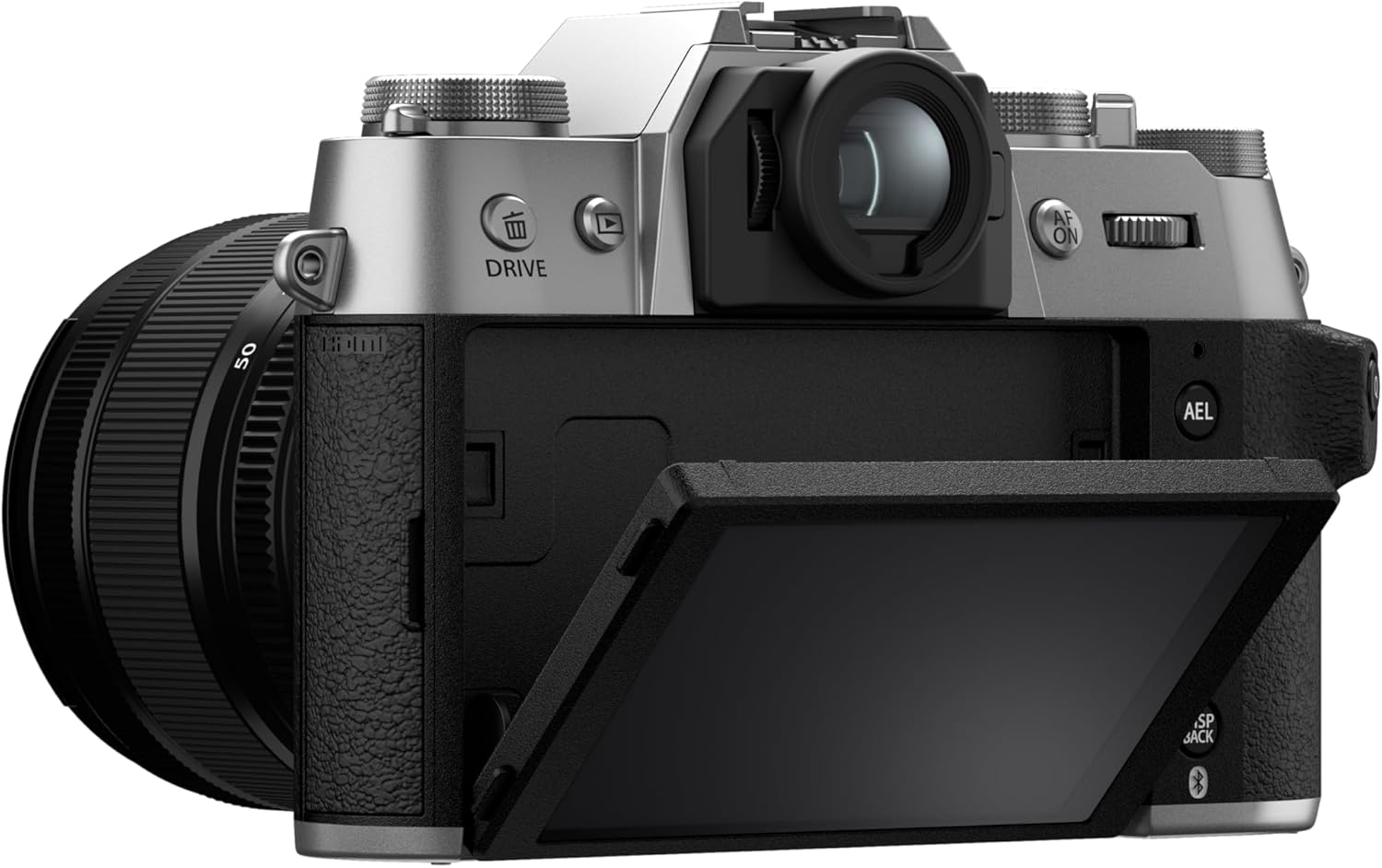
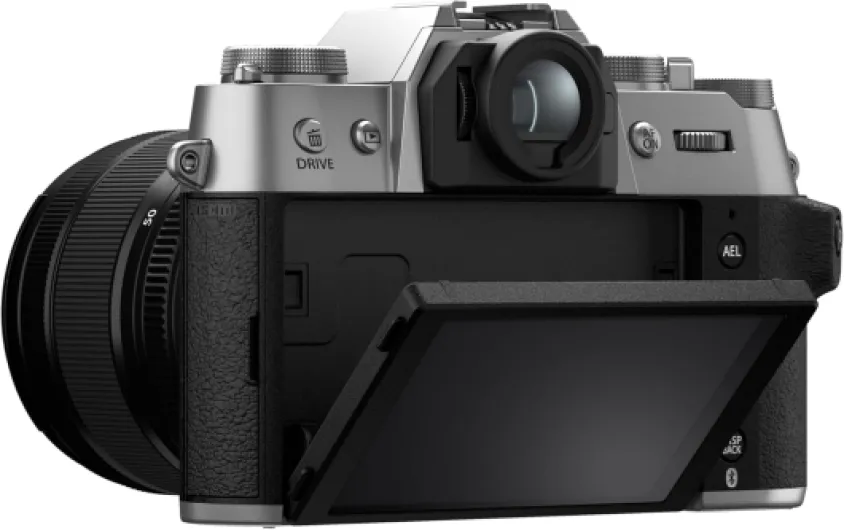
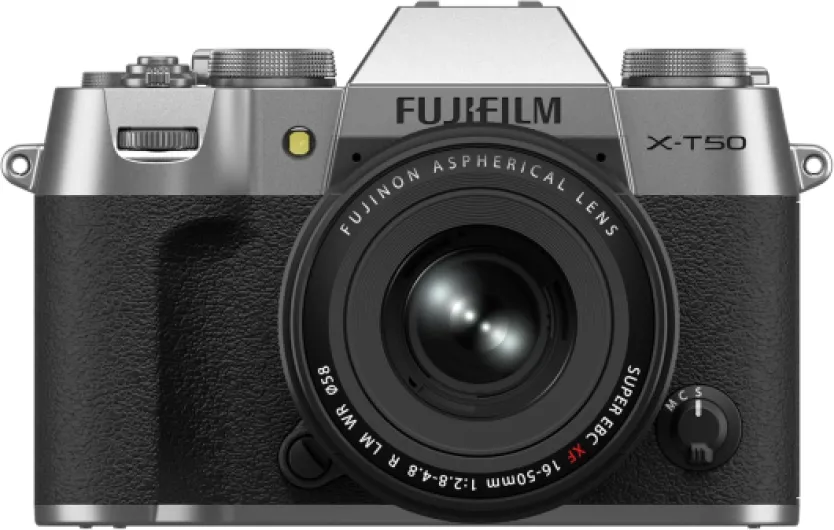
Design-wise, the X‑T50 in silver looks good on the table. Retro Fuji vibe, compact, and the silver/black combo with the 16‑50mm makes it look like an old rangefinder-style camera. The problem is that it looks better than it feels in the hand, especially if you have medium to large hands. The body is small and quite flat on the front, with only a modest grip bump. It’s usable, but after a couple of hours of walking and shooting one‑handed, I started to feel it in my fingers.
Several users online mentioned needing a SmallRig grip or a thumb rest, and I agree. Without an extra grip, the camera feels a bit too toy-like in the hand, especially with heavier lenses. With just the 16‑50mm it’s acceptable, but not great. If you’re coming from something like a Canon M6 II or a Sony a6600, this Fuji feels more compact but also less secure in the hand. It’s the classic trade-off: pocketability vs comfort. Personally, I’d budget for a small grip plate from day one.
The two big design changes versus the older X‑T30 line are: the mode dial instead of an ISO dial, and the Film Simulation dial on the top plate. The mode dial is fine; it makes the camera easier to understand if you’re used to regular PASM dials. You lose some of the pure "Fuji dials everywhere" experience, but in practice it’s faster for many people. The Film Sim dial though… I’m not a fan. It’s easy to knock accidentally, and it feels a bit gimmicky on a body that’s otherwise pretty serious. I’d rather have a custom dial or something more flexible.
Control placement overall is decent: shutter speed dial, exposure comp dial, front and rear command dials, and a logical menu layout. The EVF is on the small side and not super immersive, but it’s fine for casual use. The tilting screen works well for low and high angles, but if you want to vlog or do a lot of front-facing video, the lack of a fully articulating screen is a limitation. In short: design looks cool, works okay, but handling isn’t the strong point of this camera without add-ons.
Battery life: okay, but bring a spare
Battery life on the X‑T50 is fine but not impressive. It’s one of those cameras where, if you’re just doing a casual afternoon of shooting JPEGs and a few RAWs, you’ll probably get through it without much stress. Once you start doing a mix of RAW+JPEG, some burst shooting, chimping a lot on the rear screen, and throwing in a few 4K clips, the battery level drops faster than you’d like.
In my use, a single battery was enough for a light day (around 200–250 shots, a handful of short videos, some Wi‑Fi transfers). On a heavier day with constant shooting and more video, I was already nervous around mid-afternoon. That’s not shocking for a small mirrorless body, but it means this is not a camera you take on a full travel day without at least one spare battery or a power bank. The good news is you can charge via USB‑C, so topping up on the go is easy if you’re okay with leaving it plugged in during lunch or a coffee break.
Compared to some bigger bodies I’ve used, the X‑T50 definitely sits on the lower side of endurance. If you’re coming from a DSLR or a more efficient mirrorless, you’ll feel it. If you’re used to smaller APS‑C mirrorless cameras, it’s about what you’d expect. The EVF and screen brightness settings also matter: crank them up and the battery drops faster. I ended up turning the brightness down slightly and avoiding unnecessarily long image review times.
So, battery life is not a deal-breaker, but it’s not a strength either. For casual users, one battery might be enough most days. For anyone who shoots a lot, travels, or does events, I’d say a second battery is basically mandatory. Factor that into the overall cost of the kit, because it changes the real-world price a bit.
Build & durability: feels more "consumer" than pro, but not fragile
Build quality is where opinions split. Some people say it feels solid, others say it feels cheap. My take: it sits somewhere in the middle. The body doesn’t feel like it’s going to fall apart, but it also doesn’t give that reassuring dense feel of higher-end Fujis or some full-frame competitors. The weight is low, which is nice in a bag, but in the hand it can give off a slightly plastic vibe, even if structurally it’s fine.
The dials and buttons have decent click and feedback, but not top-tier. The shutter dial and exposure comp wheel are okay, not loose, but you can tell this is not the flagship line. The lens, the XF 16‑50mm, is light and feels more on the "consumer" side too. It’s sharp optically, but the build is clearly designed to keep weight and cost down. The good thing is that it’s weather-resistant (WR), which is rare for kit zooms, so you do get some peace of mind in light rain or dusty conditions.
I didn’t baby the camera: it went into a bag with no special protection, was used in light drizzle, and saw a bit of dust at the park. No issues so far: no creaks, no loose dials, no problems with the lens zoom ring. So in practice, it seems durable enough for normal everyday use, but I wouldn’t treat it like a tank. If you’re used to the rugged feeling of pro DSLRs or the X‑T1/X‑T3 style bodies, this will feel like a step down.
For an average enthusiast who takes care of their gear, I don’t see durability being a big concern. Just be realistic: the finish can pick up small marks, and the lighter build means it’s not the body you want to drop or bash around. A small half-case or grip plate can help both with protection and handling. Overall: solid enough for the target user, but don’t expect a brick.
Performance: strong photos, decent video, AF good enough for most people
Let’s talk about how it actually performs. For stills, the 40.2 MP sensor is the main reason to buy this camera. The RAW files have plenty of detail, and dynamic range is solid. You can push shadows without everything turning to mush, and ISO up to 3200 is very usable. Above that, you start to see fine grain, but it’s more of a texture than ugly color noise. For travel, street and family use, it’s frankly more resolution than most people need, which is both good (for cropping) and bad (it punishes bad technique and soft lenses).
Autofocus is fast in good light. Face/eye detect works well for normal scenes, and the 425 phase-detect points cover enough of the frame to track people walking toward you. In low light, it slows down a bit and sometimes hunts, especially at the long end of the 16‑50mm where the aperture is f/4.8. It’s not at the level of the latest Sony or Canon AF systems, but for everyday use it’s good enough. If you shoot fast-moving sports or erratic action, this wouldn’t be my first pick, but for kids, street and travel it holds up.
Video-wise, you get 6K and 4K modes, which sounds fancy, but I see this body as photo-first with decent video on the side. The 6K and 4K footage looks sharp, and IBIS helps smooth out hand-held shots, but rolling shutter is visible if you pan too fast. Also, with long takes and higher resolutions, heat can become a concern; for short clips it’s fine, but I wouldn’t choose this as a dedicated video body for long interviews or events. The tilting screen also isn’t ideal for self-recording.
The in-body stabilization is one of the nicest practical features. With the 16‑50mm I could shoot around 1/5–1/10s at the wide end and still get a decent keeper rate if I was careful. That’s pretty handy indoors or at night without a tripod. Combined with the sensor, it makes the camera feel more capable than its size suggests, as long as you respect its limits. Overall: performance in photos is very solid for the size and price; video is fine but not the main reason to buy it.
What you actually get with the X‑T50 + 16‑50mm kit
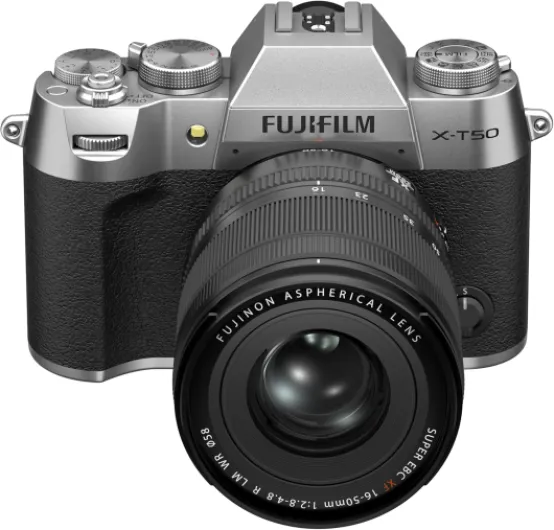
On the spec sheet, the X‑T50 is basically a compact body with the same 40.2 MP X‑Trans CMOS 5 HR sensor as the higher-end Fujis, the X‑Processor 5, and 5‑axis in-body image stabilization rated up to 7 stops. In plain terms: you’re getting big-boy resolution and IBIS in a body that weighs around 438 g (body only) and stays small even with the kit zoom. The kit lens here is the new XF 16‑50mm f/2.8‑4.8 R LM WR, which covers the usual wide-to-short-tele range on APS‑C (24–76mm equivalent).
Autofocus is hybrid with phase detection, 425 points, and all the usual tracking modes. It shoots up to 11 fps, does 6K and 4K video, and supports SD UHS‑II cards (V60 or V90 if you care about higher bitrate video). The EVF magnification is 0.62x, so not huge, and the rear screen is a tilting 3" LCD, not fully articulating. There’s Wi‑Fi and Bluetooth, USB‑C, and Micro‑HDMI. No fancy extras in the box: it’s basically body, lens, battery, strap, and the usual paperwork.
The big talking point versus older small Fujis (like the X‑T30 II) is IBIS and the 40 MP sensor. That’s what makes this kit interesting for people who want high-res files but don’t want to carry an X‑T5 or X‑H2 around. However, that also means your lenses need to be decent, because 40 MP will show softness and focus errors more clearly. The new 16‑50mm holds up pretty well, but some older Fuji zooms will feel a bit outclassed by this sensor.
In day-to-day use, the camera feels like a "mini X‑T5" in terms of what it can do, but the interface is slightly simplified. You get a proper mode dial instead of a dedicated ISO dial, and there’s that new Film Simulation dial on top. So the positioning is clear: it’s a compact, high-res, photo-first body aimed at enthusiasts and advanced amateurs who want Fuji colors and dials without going all-in on the bigger models.
Pros
- 40.2 MP sensor with IBIS in a very compact body: great detail and low-light flexibility
- New XF 16‑50mm kit lens is light, reasonably fast at the wide end, and optically solid
- Strong photo performance with good dynamic range and classic Fuji Film Simulations
Cons
- Small grip and body make it uncomfortable for longer use without an extra grip or thumb rest
- Build and tactile feel are more "consumer" than the specs and price suggest
- Battery life is only average and video features are good on paper but not ideal for long or serious video work
Conclusion
Editor's rating
For me, the Fujifilm X‑T50 with the XF 16‑50mm is a very capable small camera that shines in photo quality but compromises on handling and "feel". The 40 MP sensor, IBIS and the new kit zoom make it a strong combo for travel, street, and everyday photography. You can throw it in a small bag, shoot detailed RAWs, rely on solid JPEGs with Film Simulations, and handle most situations without changing lenses. For that kind of use, it works well and feels like a practical tool.
Where it’s less convincing is if you care a lot about grip comfort, big bright viewfinders, and a tank-like body. The camera is small enough that you almost need a grip or thumb rest to make it comfortable for long sessions, and the Film Simulation dial feels more like a toy than a useful control for advanced users. Video is decent but not the main strength; it’s okay for short clips, but I wouldn’t buy this as a dedicated video camera. Battery life is average at best, so plan on at least one spare.
I’d recommend this kit to people who want a compact Fuji with top-tier APS‑C image quality, mostly shoot photos, like Fuji colors, and value portability over robustness. It’s good for enthusiasts, travelers, and anyone who wants a serious camera that doesn’t look or feel intimidating. On the other hand, if you shoot a lot of video, have big hands, or want a more solid, pro-feeling body, I’d look at the X‑T5, X‑S20, or even other brands. The X‑T50 is a nice little camera, but it’s not the perfect all-rounder some might expect.