
Summary
Editor's rating
Is the D7500 + 18‑140mm kit good value in 2026?
Design and handling: not pretty, but very usable
Battery life and real‑world shooting endurance
Build quality and how tough it feels
Image quality, autofocus and low light: how it actually behaves in the field
What you actually get in the box and what this kit can do
Pros
- Versatile 18‑140mm lens covers wide to telephoto, so you can shoot most situations with one lens
- Good image quality and low‑light performance for a DX DSLR with 20.9 MP sensor and ISO up to 51,200 usable
- Comfortable grip and plenty of physical controls make it practical for real‑world shooting
Cons
- Only one SD card slot, which is not ideal for critical or professional work
- Tilting screen and older live‑view AF make it less attractive for serious video or vlogging
- DSLR system in a market that’s moving to mirrorless, so not the most future‑proof choice

Specifications
View full product page →| Brand | Nikon |
A camera for when your phone just isn't cutting it anymore
I’ve been using the Nikon D7500 with the 18‑140mm kit lens for a few weeks, mainly for weekend trips, family stuff, and some casual wildlife shots. I bought it because my phone photos were starting to annoy me, especially in low light and when I wanted real background blur or fast action. I’m not a pro, but I’ve used a couple of Canon and older Nikon DSLRs before, so I wasn’t starting from zero either.
The first thing I noticed is that this camera feels like a proper tool, not a gadget. It’s not tiny, it’s not super light, but once you put the strap on and walk around with it for a day, it’s manageable. The 18‑140mm lens covers pretty much everything I need: wide enough for landscapes and buildings, long enough for portraits and some basic wildlife or sports. You don’t have to keep swapping lenses every five minutes, which is honestly the main reason I went for this kit instead of a body‑only deal.
In terms of use, it’s clearly aimed at people who want to learn or already know a bit. There are auto modes if you’re lazy or new, but the interesting part is when you start playing with aperture priority, shutter priority, and manual. The menu is dense, there are a lot of options, and the first evenings I basically sat on the sofa going through settings instead of watching Netflix. It’s not plug‑and‑play like a phone, but that’s also the point of buying this type of camera.
Overall, my first impression: it’s a pretty solid mid‑range DSLR, not the newest kid on the block, but it feels reliable. It’s not perfect: only one SD card slot, no fully articulating screen, a bit bulky. But if you’re serious about photos and you want something that can do sports, travel, and everyday shots without babying it, this body + lens combo gets the job done without feeling cheap.
Is the D7500 + 18‑140mm kit good value in 2026?
In terms of value, this kit sits in an interesting spot. It’s not the cheapest way to get into interchangeable‑lens cameras, and it’s not the most modern either, especially with mirrorless dominating now. But when you look at what you actually get—20.9 MP sensor, 8 fps burst, 51‑point AF, 4K video, solid build, and a versatile 18‑140mm lens—it’s pretty solid value if your main focus is photography and you want one lens that covers most situations.
The 18‑140mm lens is a big part of the value equation. On its own, it usually costs a decent chunk, and it genuinely lets you do a lot: from wide city shots to portraits and casual wildlife. If you went body‑only and then tried to build the same range with multiple lenses, you’d probably spend more and end up swapping lenses all the time. So for someone who wants to travel light with one setup, this kit makes sense financially and practically.
Where the value is a bit weaker is if you care a lot about video, eye‑AF, or future‑proofing. Mirrorless systems from Nikon (Z series), Sony, Canon, etc., offer better autofocus in live view, better video features, and more modern ergonomics. If you’re starting from scratch and are sure you want to invest heavily into a system for the next 5–10 years, going mirrorless might be smarter, even if it costs more up front. Also, the D7500 only has one SD slot, which is fine for hobby use but not ideal if you’re shooting critical events.
Overall, I’d say the value is good for serious hobby photographers who care more about stills than video and want a reliable tool rather than the newest tech. If you find the kit at a decent discount compared to current mirrorless bundles, it’s an easy one to recommend. If the price is very close to modern mirrorless kits, then it’s worth thinking hard about how important video, compact size, and long‑term system are to you before deciding.

Design and handling: not pretty, but very usable
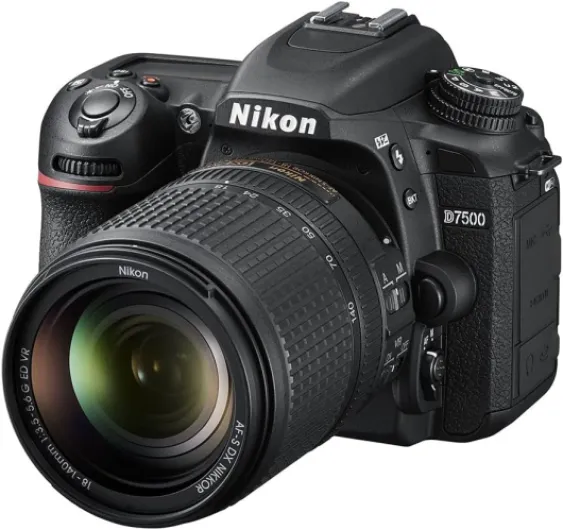
Design‑wise, the D7500 is classic Nikon DSLR: black brick with a grip. Nothing fancy, but it’s functional. The grip is actually one of the things I liked most. It’s deep enough that the camera feels secure in one hand, even with the 18‑140mm zoomed out. I’ve used smaller mirrorless bodies that feel like you’re holding a bar of soap with a lens attached; this one doesn’t have that problem. It weighs around 720 g for the body, plus the lens, so it’s not light, but the balance is decent.
You get a good amount of physical controls: two control dials, dedicated ISO button near the shutter, AF‑ON, and a top LCD screen. For real use, this matters a lot. I can change ISO, aperture, and shutter speed without diving into menus, which is exactly what you want when shooting sports or moving subjects. The learning curve is a bit steep if you come from a phone or a basic compact camera, but after a few days, muscle memory starts to kick in. Compared to cheaper entry‑level DSLRs, the D7500 feels more like a tool you can set up exactly how you want.
The rear screen is a 3.2‑inch tilting touchscreen. Tilt is handy for low‑angle shots or when the camera is above your head, but it doesn’t rotate fully sideways, which is a bit annoying for self‑recording or some vertical shooting situations. The touchscreen is responsive enough for menus and focus point selection, but I still used the physical buttons most of the time. The viewfinder is optical, bright enough, and covers 100% of the frame, which is nice when you’re framing precisely.
On the downside, the overall look and interface feel a bit dated in 2026 compared to newer mirrorless bodies with nicer screens and cleaner menus. Also, there’s only one SD card slot on the side, which is fine for hobby use but not ideal if you’re shooting paid jobs and want backup. Still, from a practical point of view, the design is built for real shooting, not for showing off on a desk, and that’s what matters here.
Battery life and real‑world shooting endurance
The D7500 uses the EN‑EL15a battery, which is a common Nikon battery used across several models. That’s already good news because spares are easy to find. In practice, battery life is one of the nice surprises with this camera. Shooting mostly through the optical viewfinder, I got through a full day of sightseeing (around 600–800 shots, some bursts, some chimping on the screen, a bit of Wi‑Fi transfer) without the battery dying on me. I only hit the low battery warning late in the evening.
If you use live view and video a lot, the story changes. Recording 4K video and using the screen heavily will drain the battery noticeably faster. On a half‑day outing where I shot a mix of stills and several 4K clips, I ended up around 30–40% battery by the time I got home. So for hybrid photo/video use, I’d say one spare battery is basically mandatory if you don’t want to think about it. For mostly photo use via the viewfinder, one battery is usually enough for a day, unless you’re shooting a wedding or some long event.
Charging is simple: you get an external charger (MH‑25a). You can’t charge via USB directly in the camera, which is a bit dated compared to newer gear that can charge from a power bank. For travel, it means you need to pack the dedicated charger and deal with an extra plug. Not the end of the world, but worth knowing if you were hoping to run everything off USB‑C.
Overall, I’d rate the battery performance as good but not magical. For stills, it’s strong. For heavy video users, it’s just okay and you’ll want a second or even third battery. It’s definitely better than most mirrorless cameras I’ve tried in terms of stills endurance, but the lack of in‑body charging is a small annoyance in 2026 when so many devices can do that.
Build quality and how tough it feels
I haven’t thrown the D7500 off a cliff, but I have used it in some less‑than‑ideal conditions: light drizzle, cold mornings, and dusty park sessions. The body feels solid, with a mix of carbon‑fiber reinforced material and rubberized areas. It’s not a metal tank like higher‑end pro bodies, but it doesn’t feel like a toy either. The grip covering and buttons don’t feel loose, and after a few weeks of use, there’s no creaking or weird flex when you twist it a bit with the lens attached.
Nikon markets it as having some level of weather sealing. In practice, I used it in a light rain with a hood on the lens, wiped it down with a cloth afterwards, and it kept working fine. I wouldn’t stand under a storm with it unprotected, but for normal outdoor use, it feels safe enough. The doors for the SD card and ports close firmly and don’t feel like they’ll break off with normal use. Just don’t expect the same toughness as a top‑end pro DSLR that costs a lot more.
The 18‑140mm lens itself is fairly robust for a kit zoom. The zoom ring has enough resistance that it doesn’t creep when pointed up or down, and it doesn’t feel wobbly at the mount. That said, it’s still a consumer lens: lots of plastic, no serious weather sealing, and if you abuse it, it’ll probably show it. For regular use (travel, family, casual sports), it should hold up fine as long as you’re not throwing it loose in a bag without a divider.
My impression is that the D7500 kit is built to handle real‑world use: travel, frequent outings, being tossed in a backpack, and used in slightly rough environments. It’s not indestructible, but it feels more durable than entry‑level DSLRs. If you treat your gear reasonably, I don’t see this camera giving up quickly. If you’re the type that drops things often or shoots in heavy rain and sand all the time, you might want to look at tougher bodies or add some protective covers.
Image quality, autofocus and low light: how it actually behaves in the field
The strong point of the D7500 is the overall performance for the price. The 20.9 MP sensor with Expeed 5 processing handles most situations well. In good light, images are crisp, with decent dynamic range and colors that look natural without much tweaking. I shot mostly JPEG fine with some RAW for tricky scenes, and even the JPEGs straight out of camera were usable with minimal editing. Compared to my older entry‑level DSLR, I can pull back shadows and highlights more before the file falls apart.
The 51‑point autofocus system is not the latest mirrorless tracking, but for a DSLR it’s still solid. I used it at a local football match and for dogs running in the park. In continuous AF and high‑speed burst (8 fps), it kept up reasonably well. It’s not perfect—if the subject moves erratically or light is poor, you’ll get some missed focus—but for hobby‑level sports and wildlife, it gets the job done. Single‑point AF for still subjects is fast and reliable. Face detection through the optical viewfinder isn’t a thing like on mirrorless, so you have to be a bit more deliberate with your focus points.
Low light is where I really felt the jump from cheaper cameras and phones. The native ISO goes up to 51,200 and can be pushed higher. Realistically, I was comfortable up to ISO 6400 for everyday use. Above that, noise starts to show more, but it’s still better than what I get from a phone. Shooting indoor family events without flash was much easier, and the VR (optical stabilisation) on the 18‑140mm lens helps keep shutter speeds a bit lower without everything turning into a blur.
For video, 4K is sharp, but there’s a crop and autofocus in live view is not on the same level as modern mirrorless cameras. If your main thing is video or vlogging, this camera is just okay; it works, but you’ll fight the AF sometimes and the tilting screen isn’t ideal. For mainly photo use with some occasional video, the performance is pretty solid overall. It’s not the best in any single category, but it balances speed, quality, and reliability in a way that suits serious hobbyists.
What you actually get in the box and what this kit can do
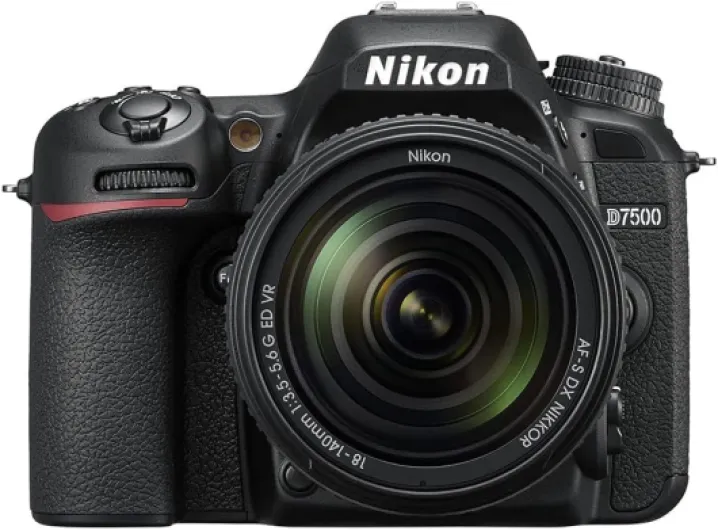
Out of the box, you get the D7500 body, the AF‑S DX 18‑140mm f/3.5‑5.6G ED VR lens, battery (EN‑EL15a), charger, strap, body cap, eyepiece, and a USB cable. No SD card and no remote, so don’t expect to start shooting if you didn’t buy a card. It’s a single SD slot camera, UHS‑I, so it’s not built like a pro body with dual slots and super fast cards, but for general use it’s fine. I shot bursts of RAW at around 8 fps and the buffer cleared fast enough for normal sports and wildlife, just don’t expect pro‑level continuous shooting for minutes.
The sensor is 20.9 MP DX (APS‑C), which is a decent balance between resolution and file size. You’re not hitting crazy megapixel numbers, but honestly, for prints, social media, and even some client work, it’s more than enough. Files are sharp and detailed with a good lens. The kit lens is not a prime lens miracle, but for a do‑everything zoom, it’s actually pretty good. At 18mm you can grab wide scenes; at 140mm you can isolate subjects fairly well. It’s the kind of lens you leave on the camera 90% of the time.
On the video side, it does 4K/UHD. It’s not some cinema rig, but for travel clips, YouTube‑style stuff, or family videos, the quality is decent. You get HDMI out, mic input, and a tilting touchscreen, which helps for low‑angle shots and basic vlogging. Just know the screen only tilts, it doesn’t flip to the side, so if you want to film yourself a lot, it’s not as convenient as modern mirrorless cameras.
So in practice, this kit is a solid all‑rounder: one body, one lens, and you can cover landscapes, portraits, sports, and travel without building a full system right away. It’s not the newest tech compared to current mirrorless options, and it’s not the cheapest beginner camera, but it hits a sweet spot if you want something serious that you can grow with for a few years without upgrading immediately.
Pros
- Versatile 18‑140mm lens covers wide to telephoto, so you can shoot most situations with one lens
- Good image quality and low‑light performance for a DX DSLR with 20.9 MP sensor and ISO up to 51,200 usable
- Comfortable grip and plenty of physical controls make it practical for real‑world shooting
Cons
- Only one SD card slot, which is not ideal for critical or professional work
- Tilting screen and older live‑view AF make it less attractive for serious video or vlogging
- DSLR system in a market that’s moving to mirrorless, so not the most future‑proof choice
Conclusion
Editor's rating
After using the Nikon D7500 with the 18‑140mm lens for a while, my overall feeling is that it’s a reliable, no‑nonsense DSLR that still holds up well if your priority is photography. The image quality is solid, autofocus is fast enough for most sports and wildlife at hobby level, and the 18‑140mm range covers almost everything you’d want on trips or everyday outings. Battery life is good for stills, the body feels sturdy, and the handling with all the physical controls makes it pleasant to use once you get past the initial learning curve.
It’s not perfect, though. Only one SD card slot, a tilting (not fully articulating) screen, and video features that feel a bit behind modern mirrorless cameras mean it’s not the best choice if you’re mainly into video or want all the latest autofocus tricks. Also, in 2026, you have to accept that you’re investing in an older DSLR system while most brands are pushing mirrorless.
Who is this for? It’s a good fit for people who are serious about learning photography, want better results than a phone, and prefer a solid, traditional DSLR feel. It’s also suitable for students and hobbyists doing sports, wildlife, or travel who want one flexible lens. Who should skip it? If you mainly shoot video, want the smallest possible camera, or plan to build a big system over the next decade, I’d look at mirrorless instead. But if you find this kit at a fair price and your focus is mostly still photos, it’s a pretty solid choice that will serve you well for several years.