
Summary
Editor's rating
Value for money: good for vloggers, less convincing for casual shooters
Design: very practical for video, with a few annoying choices
Battery life: usable, but you really want spares
Durability and build: solid enough, but not a tank
Performance: image quality and autofocus are strong, software is not
What this camera actually is (and what it isn’t)
Pros
- Very good autofocus with Eye AF and Product Showcase mode for vlogging and product videos
- Bright 24–70mm f/1.8–2.8 lens and 1-inch sensor give better low-light and background blur than a phone
- Compact body with fully articulating screen and decent built-in mic with windscreen
Cons
- No built-in flash or viewfinder, which limits it as a general-purpose compact camera
- Battery life is short for heavy 4K video use, spare batteries are basically mandatory
- Wi-Fi/app workflow is unreliable and frustrating compared to modern phone ecosystems

Specifications
View full product page →| Brand | Sony |
A pocket camera that actually tempted me away from my phone
I’ve been using the Sony ZV-1 for a few weeks, mainly for YouTube-style videos and some casual photos on trips. I usually rely on my phone (a recent Android with a decent camera), so I didn’t expect a small compact camera to change much. But I was curious about the 1-inch sensor, the flip screen, and all the vlogging features Sony keeps pushing. I didn’t get it for professional work, more as a “throw in the bag and go” camera.
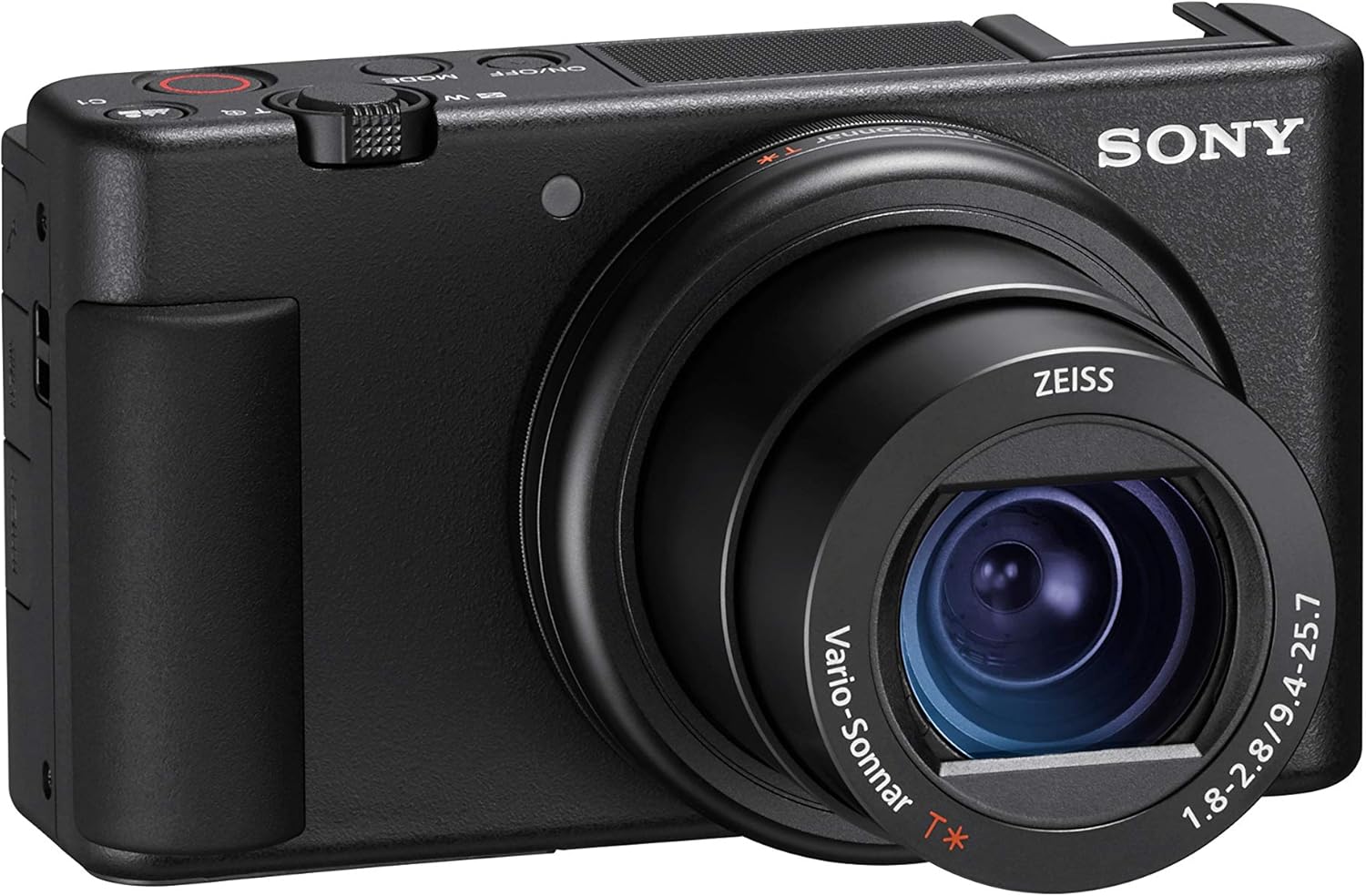
Right away, I noticed this thing is clearly designed around video and content creation. The flip-out screen, the big red record button, the hotshoe with the little wind muff for the mic – it screams “vlogger”. If you’re expecting a classic compact photo camera with a viewfinder and flash, this is not it. It’s more like a small video tool that also takes good stills when you need them.
During the first days, I used it for short vlog clips, a couple of indoor product shots on my desk, and some quick night scenes in the street. I also tried the Wi-Fi transfer and the so-called “Product Showcase mode” everyone talks about. Some things impressed me right away, others annoyed me pretty fast. It’s not a miracle box, but it does certain jobs really well.
If you’re thinking about moving up from a smartphone because you want better background blur, more reliable autofocus, and a proper flip screen, this camera starts to make sense. Just be ready for a few trade-offs: no built-in flash, battery that drains fast when filming, and a wireless transfer system that feels stuck in 2015. Overall, I see it as a tool: pretty solid at what it’s built for, but not the perfect all-rounder some product pages hint at.
Value for money: good for vloggers, less convincing for casual shooters
On the value side, the ZV-1 sits in a slightly awkward spot. It’s not cheap, and for the price you’re getting a fixed-lens compact with no viewfinder and no flash. If you only take photos occasionally and mostly share on social media, a modern phone will probably be enough and more convenient. That’s where some of the negative reviews make sense: if you expect a simple point-and-shoot that just does everything easily, this camera can feel overcomplicated and limited at the same time.
Where the value starts to make sense is if you actually plan to vlog or create regular video content. The combination of the 1-inch sensor, bright lens, solid autofocus, flip screen, decent built-in mic with windscreen, and optical stabilization is hard to find in one compact package. You don’t need to buy extra lenses, and you can plug in a better mic if you want. For a small YouTube or TikTok setup, it’s a pretty practical one-box solution, as long as you also budget for spare batteries and a memory card.
Compared to something like using your phone with a gimbal and external mic, the ZV-1 gives you more control over depth of field, exposure, and a more “camera-like” handling. On the other hand, the phone wins on convenience, instant sharing, and app quality. Given the complaints about the Sony app and Wi-Fi connection, I’d say don’t buy this expecting a smooth wireless workflow. Think of it more as a “shoot on camera, then offload with a card reader or cable” device.
So in terms of value for money: for vloggers and creators who know why they want a dedicated camera, it’s pretty solid. For someone who just wants a general travel camera or a better point-and-shoot, it’s a bit less convincing, especially given the missing flash and so-so app experience. There’s better bang for the buck if you’re mainly a stills shooter. But if your main goal is talking to the camera, product videos, and small content projects, the ZV-1 does enough things right to justify its price, as long as you accept its quirks.
Design: very practical for video, with a few annoying choices
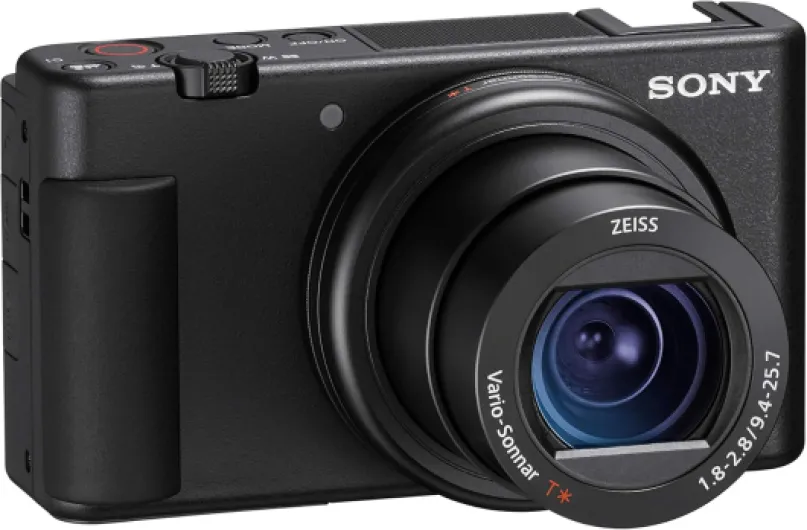
Design-wise, the ZV-1 is pretty straightforward: a small black brick with a lens that retracts when you turn it off and a fully articulating 3-inch LCD that flips to the side and forward. The first thing I liked is how easy it is to hold at arm’s length when vlogging. The grip isn’t huge, but there’s a bit of a bump that helps, and the camera is light enough that my wrist didn’t complain during 10–15 minute walk-and-talk recordings. Add a small grip or mini tripod and it feels even better.
The articulating screen is the main strength here. It rotates 180° and also swivels, so you can frame yourself, shoot low-angle shots, or film from above without breaking your back. The screen is touch-sensitive, but Sony still relies a lot on physical buttons and menus. Touch is mostly for focus and a few settings, not full navigation, which feels half-baked in 2026. Still, for picking a focus point quickly, it does the job.
A couple of design decisions are questionable. First, no built-in flash. For a compact camera aimed at casual users, that’s a weird choice. One of the Amazon reviews even trashes it for that, and I get it: if you’re used to compacts that just pop a flash in low light, you’ll be disappointed. You can mount an external flash on the hotshoe, but that kills the compact idea and adds cost. Second, micro-USB instead of USB-C is just outdated. Charging and data still work, but when everything else I own is USB-C, carrying a separate cable is annoying.
On the positive side, the top layout is simple: big red record button, on/off, mode button, and a zoom rocker. There’s a standard 3.5 mm mic input on the side, HDMI out, and the shoe on top for accessories. The supplied wind muff clips onto the shoe and actually helps a lot outdoors. Overall, the design is practical for video and content creation, but if you expect a classic compact with flash and a viewfinder, you’ll feel like something is missing.
Battery life: usable, but you really want spares
The battery situation is pretty typical for a small compact that does 4K video: it’s okay, but it drains fast when filming. On light mixed use (a few short 4K clips, some photos, camera on and off throughout the day), I could get through half a day of casual shooting. If I tried to vlog more seriously, doing several 10-minute clips in 4K with the screen flipped out and stabilization on, I’d see the battery drop alarmingly fast. After a couple of sessions like that, I just accepted that this is a “carry at least one spare” type of camera.
One of the Amazon reviews in Italian even mentions it clearly: this is not a “battery cam” and you should plan to buy extra batteries if you like shooting video. I fully agree. For stills only, you might feel less pressure – photos don’t drain as fast as continuous video. But as soon as you start using it like a vlog tool, with the screen always on, autofocus working hard, and the internal mic running, the small NP-BX1 battery gets eaten up quickly.
Charging is done via micro-USB in-camera, which works but isn’t ideal. It’s slower than some modern USB-C setups, and you can’t really use the camera comfortably while it’s charging from a power bank unless you’re on a tripod. Some kits or variants include an external charger, which helps because you can charge one battery while using another. Personally, I’d budget for at least two extra batteries and a cheap third-party charger if you plan regular video work.
There’s no magic here: compact body, small battery, 4K recording – you know how that ends. If you’re used to phones that you can plug into a power bank and keep filming for hours, this will feel more limiting. For short clips, TikToks, Reels, and some B-roll, it’s fine. For long talking-head sessions or full-day events, you’ll be swapping batteries and checking the battery icon more often than you’d like.

Durability and build: solid enough, but not a tank
In terms of build quality, the ZV-1 feels sturdy enough for everyday use, but it’s still a small electronic gadget with a retractable lens, so I wouldn’t abuse it. The body is mostly plastic, but it doesn’t feel toy-like. The buttons have a decent click, the dials aren’t loose, and the screen hinge feels surprisingly firm. I flipped the screen in and out a lot while testing, and there was no wobble or creaking. That hinge is important for this type of camera, and so far it seems up to the job.
The lens mechanism is the part I baby the most. When you turn the camera off, the lens retracts and a little shutter closes to protect the front element. It’s practical, but like all retractable lenses, it’s not something you want to drop. I kept it in a small pouch when throwing it in a backpack, just in case. There’s no weather sealing advertised, so I wouldn’t risk heavy rain, dust, or sand. Light drizzle and a bit of dust from normal city use are fine, but this is not a rugged action cam.
Buttons and ports are laid out in a way that doesn’t feel fragile, but the micro-USB and HDMI flaps are still small bits of plastic that could wear out with heavy use. The hotshoe and mic mount feel solid enough; the included wind muff clips on and off without feeling like it’s going to snap. Over a few weeks of use (in and out of bags, some quick one-handed operation, a couple of minor bumps), the camera didn’t show any obvious wear apart from fingerprints on the screen and body.
So, durability-wise, I’d say: good for normal everyday creators, not meant for harsh environments or careless treatment. Compared to a phone, it’s more fragile simply because of the moving lens and screen. Compared to other compact cameras, it’s pretty standard. If you treat your gear halfway decently and maybe use a small case, it should last. Just don’t expect it to survive drops, heavy rain, or sandy beaches without consequences.
Performance: image quality and autofocus are strong, software is not
On the performance side, the ZV-1 is pretty solid for a compact. The 1-inch sensor and the 24–70mm f/1.8–2.8 lens give you noticeably better low-light performance and background blur than a typical phone, especially at the wide end. For video, 4K looks sharp, colors are decent, and the autofocus is the real star. Eye AF locks onto faces quickly, and when I used Product Showcase mode during a quick unboxing test, the focus jumped from my face to the object and back without hunting all over the place. For desk videos, that’s genuinely useful.
For stills, the 20.1 MP RAW files are clean enough up to ISO 1600–3200 if you don’t pixel-peep too much. It’s not a full-frame camera, so don’t expect miracles in dark bars or concerts, but for travel, portraits, and general use, it’s more than fine. The lens is sharp in the center, a bit softer at the edges when wide open, but nothing dramatic. The 24–70mm range is a good compromise: wide enough for vlogging and landscapes, long enough for portraits and some detail shots. If you want wildlife or sports reach, you’ll be frustrated.
Continuous shooting is rated up to 24 fps, which is nice on paper, but I rarely used it except to test it. Buffer fills up pretty fast with RAW, and this is not a sports camera anyway. Where the camera struggles a bit is with overheating and long 4K sessions. For quick clips (under 10–15 minutes), I was fine. When I tried a longer 4K recording in a warm room, it got hot and warned me. That’s typical of small bodies, but it’s something to keep in mind if you plan to film long events.
The big downside in performance is the Wi-Fi/Bluetooth transfer and software. One of the Amazon reviews calls the software “stupid” and I kind of agree. The wireless transfer can be flaky: sometimes it connects quickly, other times the app refuses to see the camera or drops mid-transfer. If you’re patient and don’t mind fiddling with it, you’ll get your files over, but it’s not smooth. I ended up using a card reader more often, which defeats the “shoot, transfer, post in a snap” promise. So: solid camera performance, weak app experience.
What this camera actually is (and what it isn’t)
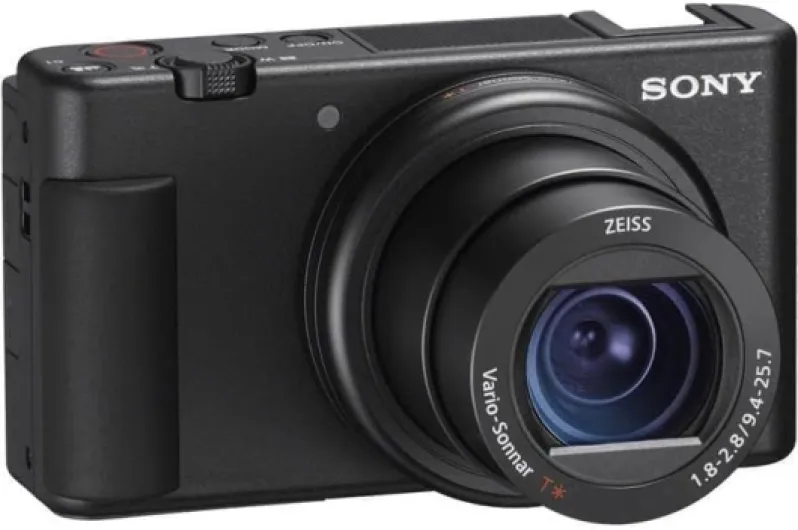
The Sony ZV-1 is basically a compact camera with a fixed 24–70mm equivalent zoom lens, a 1-inch sensor, and a fully articulating LCD screen. It records up to 4K video and shoots 20.1 MP stills in JPEG or RAW. It’s light (around 294 g), fits in a jacket pocket, and the lens is reasonably bright at f/1.8–2.8. On paper, that’s a nice combo for people who want something better than a phone but don’t want to deal with interchangeable lenses and big bodies.
Sony clearly tuned it for creators: you get Real-Time Eye AF, Product Showcase mode, a directional 3-capsule microphone with a supplied windscreen, and a flip-out selfie screen that rotates to the side. There is no viewfinder, which for me is fine for video but a bit annoying in bright daylight for photos. You get optical image stabilization, a hotshoe, HDMI out, and a micro-USB port (yeah, not USB-C, which is a bit dated now). It works with SD/SDHC/SDXC cards, and UHS-I is supported.
In practice, I’d describe it as a video-first compact. Yes, it can shoot nice photos, but all the design choices scream vlogging: the tally light, the big record button, the background blur button, and the way the screen flips for selfies. If you want a travel camera that you’ll mostly use for stills, there are better-balanced options with viewfinders and longer zooms. If you mainly want something to film yourself or products on a desk, this is more its territory.
Also, the listing says things like “travel photography, sports photography, professional photography”. I’d calm that down a bit. For travel and casual work, sure. For real sports and professional use, it’s more of a backup or a B-camera. The autofocus and image quality are decent for the size, but the small body, limited zoom, and overheating risk in long 4K sessions keep it in the “creator compact” category, not a do-it-all pro machine.
Pros
- Very good autofocus with Eye AF and Product Showcase mode for vlogging and product videos
- Bright 24–70mm f/1.8–2.8 lens and 1-inch sensor give better low-light and background blur than a phone
- Compact body with fully articulating screen and decent built-in mic with windscreen
Cons
- No built-in flash or viewfinder, which limits it as a general-purpose compact camera
- Battery life is short for heavy 4K video use, spare batteries are basically mandatory
- Wi-Fi/app workflow is unreliable and frustrating compared to modern phone ecosystems
Conclusion
Editor's rating
Overall, the Sony ZV-1 is a good little workhorse for people who actually want to film themselves or products regularly. The strengths are clear: solid 4K image quality for the size, a bright 24–70mm lens, very reliable Eye AF and Product Showcase mode, and a flip-out screen that makes framing yourself simple. The built-in directional mic with the included wind muff is also genuinely useful; you can get decent audio without extra gear, and improve it later with an external mic if needed.
On the downside, you have to live with some compromises. No built-in flash, no viewfinder, micro-USB instead of USB-C, and a battery that drains fast when you shoot a lot of video. The wireless transfer and app situation is clunky, and I understand why one reviewer called the software frustrating. If your expectations are more “simple family camera” than “vlog tool”, these limitations will stand out and you might feel you overpaid for something that doesn’t feel that user-friendly.
I’d recommend this camera mainly to beginners and intermediate creators who want a compact, dedicated device for vlogs, travel videos, and small projects, and who are okay carrying spare batteries and using a card reader. If you just want better photos than your phone or a classic travel camera with flash and long zoom, I’d look elsewhere. If you know you’ll use the video features, the autofocus, and the flip screen a lot, then the ZV-1 is a pretty solid choice that gets the job done without being perfect.