
Summary
Editor's rating
Value for money: makes sense if you need toughness more than quality
Chunky, bright yellow, and clearly built to be abused
Battery life: one day of casual shooting, but don’t expect miracles
Waterproof and shockproof: the part where it actually shines
Image and video quality: fine for memories, clearly behind a modern phone
What you actually get in the box and what this camera can (and can’t) do
Pros
- Very rugged: waterproof to 15 m and shock-resistant body that handles drops and rough use
- Simple to use with fully automatic modes, suitable for beginners and kids
- Bright yellow design is easy to spot and 16 GB SD card included so you can shoot right away
Cons
- Image and video quality clearly behind modern smartphones (720p video, limited low-light performance)
- Small, not-very-bright 2.7" screen that’s hard to see in sunlight or underwater
- Battery life only just covers a day of active use and charging requires opening the waterproof door

Specifications
View full product page →| Brand | KODAK |
A cheap way to take photos where your phone might die
I took the KODAK Pixpro WPZ2 on a long weekend at the sea and a couple of pool sessions, basically in all the situations where I usually panic about getting my phone wet. I wasn’t looking for pro quality, just something I could throw in a bag, hand to kids, dunk in the water, and not care too much if it got knocked around. On paper, 16 MP, waterproof to 15 m, shockproof, and a 16 GB SD card in the box sounded like a decent little bundle.
Right away, it feels like a camera designed for people who just want to press a button and get a photo. Almost everything is automatic: focus, exposure, white balance. No RAW, no fancy modes, just JPEGs and 720p video. If you’re used to a modern smartphone, the specs look a bit dated, especially the 720p video and the small 2.7" screen. But that’s not really the point of this thing. The point is: it’s cheap enough and tough enough that you dare to use it where you’d never risk your phone.
Over a few days, I used it in three main situations: at the pool with kids splashing everywhere, on a rocky beach with sand and drops, and as a simple walk-around camera during a hike. I wanted to see if it could really handle water, shocks, and a full day on one battery. I also compared the photos quickly to my mid-range Android phone to see how much I was losing in terms of image quality.
Overall, it does what it says: it takes photos and videos in rough conditions without complaining. Image quality is clearly behind any recent smartphone, but for souvenir shots, social media, and just having fun in the water, it’s acceptable. If you expect sharp, clean photos in low light or cinematic video, you’ll be disappointed. If you just want something you don’t have to baby, it’s more interesting. I’ll break down the good and the bad in more detail below.
Value for money: makes sense if you need toughness more than quality
Looking at the price and what you get (camera + 16 GB SD card + rugged body), I’d say the value is decent, but it really depends on what you expect. If your priority is pure image quality, you’re better off with your phone or a slightly more expensive compact camera that offers 1080p or 4K video and better low-light performance. But if your priority is a device you can throw in the pool without thinking, then the WPZ2 starts to look more interesting. You’re clearly paying for the waterproofing and shock resistance, not for cutting-edge photo tech.
When I compare it to entry-level action cams in a similar price range, the WPZ2 has pros and cons. On the plus side, you get a real zoom lens and a familiar camera shape, which is more comfortable for photos than a tiny box with a wide lens. The included SD card is also a nice touch: not huge, but enough to start. On the downside, the 720p video resolution is behind most action cams, and the lack of strong stabilization means you won’t get smooth footage while moving. So if video is your main focus, an action cam might be a better deal; if you want more of a photo-oriented device, this Kodak is more logical.
The Amazon rating around 4.7/5 with a few reviews matches my feeling: people who buy it knowing it’s a simple waterproof camera are mostly happy. It’s easy to use, compact, and light enough for a hike or a bike ride. But it’s not some miracle device. There is better in terms of image quality and video for not much more money, especially if you catch sales. Where it keeps its value is when you factor in the peace of mind: handing it to kids, using it at the beach, dropping it without stressing.
So in terms of value, I’d say: good if you really need the rugged aspect and don’t care too much about pixel peeping. If you just want a general-purpose camera and you rarely go near water, your phone or a standard compact will probably serve you better. It’s a niche product, but in that niche—"holiday, kids, pool, sea"—it makes sense and the price is fair.
Chunky, bright yellow, and clearly built to be abused
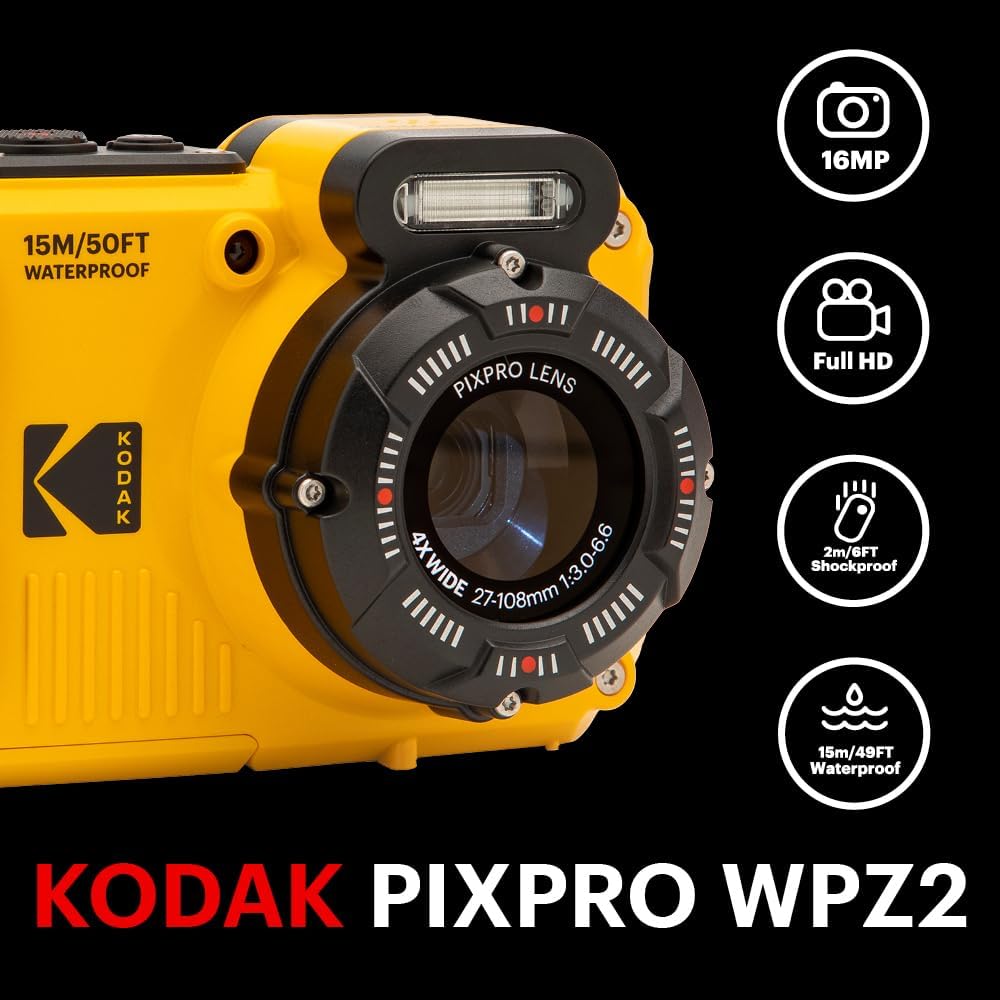
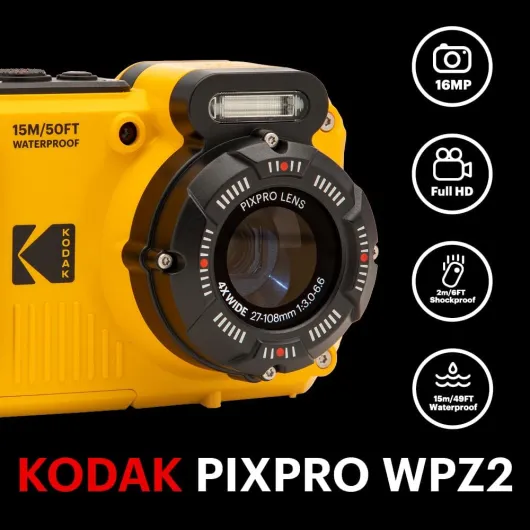
The first thing I noticed is the bright yellow body. It’s not subtle at all, but there’s a good reason: you can actually see it in the water or in a messy beach bag. Compared to slimmer compact cameras, the WPZ2 is quite chunky, with thick edges and rubberized parts. It feels more like a small rugged gadget than a sleek camera. Personally, I liked that, because I wasn’t scared to drop it on the tiles by the pool. It looks and feels like it can take a hit, which is the whole point of this product.
The button layout is simple: shutter button on top, zoom rocker, and a few navigation buttons around the screen. The buttons are big enough to use with wet fingers, which is nice. They do have a slightly spongy feel, not super precise, but after a few hours I got used to how hard I need to press. The lens is in the top corner, so you need to pay a bit of attention not to cover it with your finger, especially if you’re used to holding a phone. I had a couple of shots with a fingertip in the corner at the beginning.
The 2.7" LCD screen is honestly quite small and not very sharp by today’s standards. In direct sunlight, it’s sometimes hard to see if the photo is properly framed, and underwater it becomes even less readable. That’s one of the weak points: you can use it, but it’s not pleasant. It gets the job done, but if you’re used to a big, bright smartphone screen, this will feel like going back in time. The menus also have a very basic, old digital camera look.
On the practical side, the battery and SD card sit behind a locking door with a seal. That door needs to be fully closed and locked if you don’t want water getting in. The hinge feels solid, but you can tell it’s a potential weak spot if you’re too rough or keep opening/closing it with sand in the gaps. The USB port is also behind a flap. One Amazon reviewer mentioned being careful with the connector during charging and transfers, and I agree: it’s not fragile, but it doesn’t feel like something you want to yank or twist too much.
Battery life: one day of casual shooting, but don’t expect miracles
The camera uses a rechargeable lithium-ion battery. KODAK says it’s enough for a day of shooting, and in my use that’s roughly true, as long as you’re not constantly recording video. During one long day at the beach, I did around 150 photos and maybe 15–20 short video clips (10–20 seconds each), with some reviewing on the screen, and I ended the day with about 20–25% battery left. So for casual use, one battery is okay. If you plan to shoot a lot of video or use it over several days without charging, I’d seriously consider buying a spare battery.
Charging is done via the USB port on the camera. That’s practical because you can use any phone charger or a power bank, but it also means opening the waterproof door each time, which is a bit annoying. You have to make sure the rubber seal is clean and the door is properly locked again afterwards, especially if you’ll be going back into the water. Charging time is not super fast: with a regular phone charger, I needed around 2–2.5 hours to go from almost empty to full. There’s no fast charge, and you can’t charge it wirelessly or anything fancy like that.
One thing to note: there’s no battery included according to the spec line, but in practice you do get one in the box (otherwise the camera would be unusable). However, it’s a single small battery, and its capacity is not huge. Compared to my phone, which can sometimes last a full weekend trip with careful use, the WPZ2 definitely feels more limited. The small screen helps save power, but video recording and flash drain it faster than you might think. After a long session in the pool with kids, checking photos and shooting bursts, I saw the battery drop visibly.
In short, the battery is fine for a normal day of holiday shooting, but it’s not generous. If you’re the type who takes hundreds of photos and long videos, or if you’re going somewhere remote without easy charging, plan ahead. Bring a power bank and the cable, or grab an extra battery if you find one compatible. It’s not a deal-breaker, but it’s clearly not an endurance monster either.
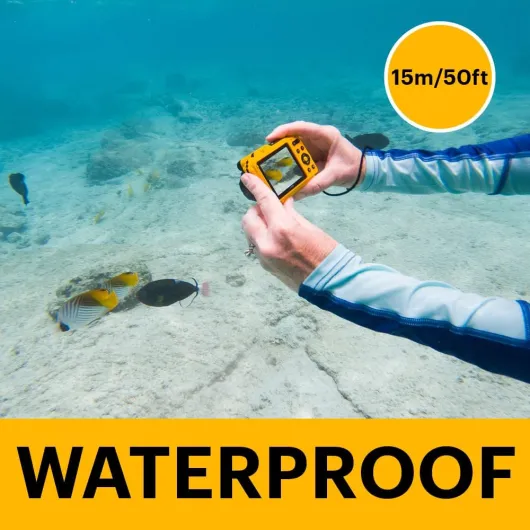
Waterproof and shockproof: the part where it actually shines
This is where the WPZ2 actually makes sense. I used it in the pool, under the shower to rinse off sand, and on a rocky beach where it got knocked around a bit. No leaks, no fogging inside the lens, no weird behavior. Being waterproof to 15 m is overkill for casual snorkeling, but it’s reassuring. I didn’t dive that deep, but at about 2–3 m underwater it had zero issues. The buttons are usable underwater, although a bit stiff, and the camera didn’t freak out when going from cold water to hot sun.
The rubberized body and shock resistance are also useful. I dropped it twice: once from about waist height onto tiles by the pool, and once onto pebbles. In both cases, only a small scuff on the body, nothing on the lens or screen. It feels like a toy in the good sense: you’re not constantly afraid of breaking it. That’s a big difference compared to a phone in a cheap waterproof pouch, which always feels a bit risky and awkward to handle. Here, you just grab it and don’t think too much.
The only part that worries me a bit for the long term is the waterproof doors and connectors. The hinge and lock feel solid enough, but if you keep opening and closing them with sand or salt around, you can imagine the seal wearing out over time. You also have to be careful with the USB connector when charging or transferring photos, as one Amazon review mentioned. It’s not fragile like glass, but it doesn’t feel like something you want to force or bend. So, durability is good, but you still need a minimum of care: rinse it in fresh water after the sea, dry it before opening, and don’t pry the doors with a knife.
Overall, for the price range, the durability is pretty solid. It’s clearly built to be used by families, kids, and people who don’t want to baby their gear. If you just need a camera that survives sand, chlorine, and small drops, it does the job. For serious diving or heavy professional use, I’d probably look at a higher-end rugged camera, but for casual holidays and outdoor fun, it’s good enough and much less stressful than risking a smartphone.
Image and video quality: fine for memories, clearly behind a modern phone
Let’s be clear: the 16 MP sensor and 720p video are not going to blow you away if you’re used to a recent smartphone. In good daylight, outdoors, the photos are decent: colors are okay, sharpness is acceptable in the center, and for casual holiday shots or posting on social media, it’s fine. Compared to my mid-range Android phone, the phone wins easily in detail and dynamic range, but the WPZ2 is “good enough” for simple use. Indoors or in the shade, you see the limits: more noise, softer images, and the camera sometimes struggles with white balance, giving slightly yellow or blue tones.
The 4x optical zoom is useful when you’re at the pool or the beach and don’t want to walk into the water each time. At full zoom, images get softer and you feel the digital stabilization trying to keep things steady. If you have a steady hand, it’s okay, but it’s not super sharp. Digital image stabilization helps a bit for video, but don’t expect miracle results. Walking while filming is still shaky, more like an old camcorder than a modern action camera. For quick clips of the kids jumping in the pool, it’s fine; for anything more serious, it’s not ideal.
The face detection works, but it’s basic. It locks on faces in good light, but it’s not as fast or sticky as on a phone. Burst mode is handy for action shots: the camera can shoot multiple frames quickly, but the buffer fills up after a short burst and then it needs a moment to write to the SD card. With the included 16 GB card (class 10, 10–20 MB/s write speed), it’s not lightning fast, but it’s acceptable for casual use. Autofocus is contrast-based and can hunt a bit in low light or on low-contrast subjects.
Video in 720p at 30 fps is probably the most outdated part. On a modern TV or monitor, you clearly see the lack of detail compared to 1080p or 4K. For quick clips of the beach or a snorkeling session, it’s okay, but you won’t be editing “cinematic” travel videos with this. The sound is also basic: it picks up voices and ambient noise, but wind noise and splashes can easily ruin the audio. If you treat it as a simple waterproof camcorder for memories, it’s fine. If video is your priority, you might want to look at an entry-level action cam instead.

What you actually get in the box and what this camera can (and can’t) do
Out of the box, the Pixpro WPZ2 is pretty straightforward: you get the camera, a 16 GB KODAK SD card, the battery, a USB cable, and the usual paper manuals. No charger block, just the cable, so you’ll use your phone charger or plug it into a computer. The 16 GB card is enough for casual use: at 16 MP JPEG and 720p video, you can store a decent number of photos and a few clips before needing to empty it. It’s not huge, but at least you can start shooting right away without buying extra stuff.
In terms of features, it’s very basic but clear: 16 MP CMOS sensor, 4x optical zoom, 720p video at 30 fps, digital image stabilization, face detection, burst mode, built-in flash, and fully automatic exposure. There’s Wi‑Fi and USB, but don’t expect some fancy app ecosystem or super-fast transfers. This is more “copy files to your PC” than “seamless smartphone integration”. The menus are simple, text-based, and a bit old-school, but you find your way around after 10 minutes.
The camera is rated waterproof to 15 m and shockproof, with a rubberized body. That’s the real selling point: it’s made to be thrown in a backpack, used with wet hands, and taken into the pool or the sea. No external housing needed, just make sure the doors are closed properly. The lens is fixed in the body (no extending barrel), which helps with durability and keeps sand out. You won’t find manual modes, interchangeable lenses, or 4K here; this is for basic photography and simple video in harsh conditions.
In practice, it sits in that weird middle ground between a smartphone and an action cam. It’s tougher than a phone and easier to hold than a tiny GoPro-style camera, but the video resolution is lower and the photos are nothing special. If you understand that before buying, it’s much easier to appreciate what it does well: staying alive in situations where your phone could drown or crack.
Pros
- Very rugged: waterproof to 15 m and shock-resistant body that handles drops and rough use
- Simple to use with fully automatic modes, suitable for beginners and kids
- Bright yellow design is easy to spot and 16 GB SD card included so you can shoot right away
Cons
- Image and video quality clearly behind modern smartphones (720p video, limited low-light performance)
- Small, not-very-bright 2.7" screen that’s hard to see in sunlight or underwater
- Battery life only just covers a day of active use and charging requires opening the waterproof door
Conclusion
Editor's rating
The KODAK Pixpro WPZ2 is basically a tough little camera for people who’d rather sacrifice a bit of image quality than risk drowning their phone. It’s not a tech monster: 16 MP, 720p video, a small 2.7" screen, and simple JPEG-only output. In good light, the photos are decent and perfectly fine for holiday memories and social media, but they don’t compete with a recent smartphone. Video is clearly dated in terms of resolution and stabilization, so if you care a lot about video quality, you’ll probably find it a bit underwhelming.
Where it earns its keep is on the durability side. Waterproof to 15 m, shock-resistant housing, bright yellow body that’s hard to lose, and a design you can hand to kids without stressing. It survived drops, pool sessions, and sand without any drama. Battery life is okay for a day of casual shooting, but not more, and you do need to be careful with the waterproof doors and USB connector over time. The included 16 GB SD card is a small but handy bonus that lets you start using it right away.
If you’re a casual user who wants a simple, rugged camera for the pool, beach, or light outdoor activities, and your expectations on image quality are reasonable, this is a pretty solid choice for the price. On the other hand, if you mainly shoot on land, rarely go near water, or care a lot about video resolution and sharp photos, you’ll get more value from either your phone or a slightly more advanced compact or action cam. In short: good tool for rough holiday use, not a camera for enthusiasts or pixel addicts.