
Summary
Editor's rating
Value for money: makes sense for beginners, less so if your phone is already good
Design and handling: light, small, and a bit toy-like
Battery life: fine for short sessions, plan for the two-battery rotation
Build and durability: travel-friendly but not something I’d abuse
Image and video performance: better than a cheap phone, not a miracle 4K rig
What you actually get with the ORDRO D27
Pros
- Very light and compact with a 180° flip screen, easy to carry and vlog with
- 6x optical zoom gives better reach and detail than digital zoom on cheap phones
- Good starter package for beginners and teens, with Wi‑Fi and two batteries included
Cons
- Image and video quality are only decent, especially in low light
- Plastic build with no weather sealing and a hinge you need to treat carefully
- Zoom motor noise can be heard in quiet scenes when using the built-in mic

Specifications
View full product page →| Brand | ORDRO |
A budget 4K vlogging camera I actually wanted to carry around
I’ve been playing with the ORDRO D27 for a bit as a small vlogging and travel camera. I normally shoot on my phone and occasionally a Sony compact, so I wasn’t expecting miracles from a cheaper 4K camera. I mostly wanted to see if a beginner-friendly 4K vlog camera with flip screen and optical zoom could realistically replace my phone for casual trips and YouTube bits. Short version: it kind of can, but only if you accept a few clear trade-offs.
I took it out on a couple of walks, a day trip to a park, and used it indoors for some talking-head style clips. I also handed it to someone who’s basically a beginner to see if they could figure it out without me hovering over their shoulder. Between the flip screen, the Wi‑Fi transfer, and the 6x optical zoom, it definitely feels more like a “real camera” than just shooting on a phone, but it’s not magic either.
What struck me first is how light it is. At 175 g, it really is lighter than most phones, and that matters when you’re carrying it all day or holding it at arm’s length to vlog. You don’t get that wrist fatigue you get with some heavier mirrorless bodies, and it fits easily in a small bag or even a jacket pocket. So in terms of portability, it does what it promises.
But it’s not perfect. The specs scream 4K and 64 MP in big letters, then you look at the fine print and see an 8 MP sensor and 16 MP effective stills. So you quickly realise this is a budget camera with some marketing gloss on top. If you go in expecting a decent step up from a cheap phone camera, it makes sense. If you expect pro-level 4K, you’ll be disappointed. That’s the mindset you need before you buy it.
Value for money: makes sense for beginners, less so if your phone is already good
In terms of value, the ORDRO D27 sits in that awkward but interesting spot between cheap no-name cameras and more serious compacts from big brands. You get 4K video, a flip screen, 6x optical zoom, Wi‑Fi, two batteries, and a genuinely compact body at a price that’s quite reasonable compared to full-on mirrorless kits. For someone just getting into vlogging or a kid who wants their own camera, it’s a decent package that doesn’t feel like a toy, but also doesn’t cost as much as a phone.
If you compare it to a basic budget phone camera, the D27 has clear advantages: proper optical zoom, a dedicated flip screen for framing, and more "camera-like" handling. That alone can justify the price if you’re serious about learning how to film yourself and not just snapping random clips. On the other hand, if you already own a midrange or flagship smartphone from the last couple of years, your phone might beat it in low light, dynamic range, and overall convenience. Where this camera wins is the zoom flexibility and the feeling of using a separate device just for content.
The two Amazon reviews are both very positive, calling it good value and a perfect first camera. I agree with that angle: as a first camera for a teen or beginner, it makes a lot of sense. It’s cheap enough that you’re not terrified they’ll break it, but capable enough to teach them the basics of framing, zoom, and simple manual controls. For a casual travel user who doesn’t want to think too much and just wants better zoom than their cheap phone, it also works.
If you’re more advanced, already editing regularly, and picky about image quality, I’d say this is probably not for you. At that point, it’s worth saving more for a used Sony/Canon compact or an entry-level mirrorless with a kit lens. So from a value perspective, I’d say: good value for beginners and teens, only average value if you already own a strong phone camera or expect pro-level results.
Design and handling: light, small, and a bit toy-like
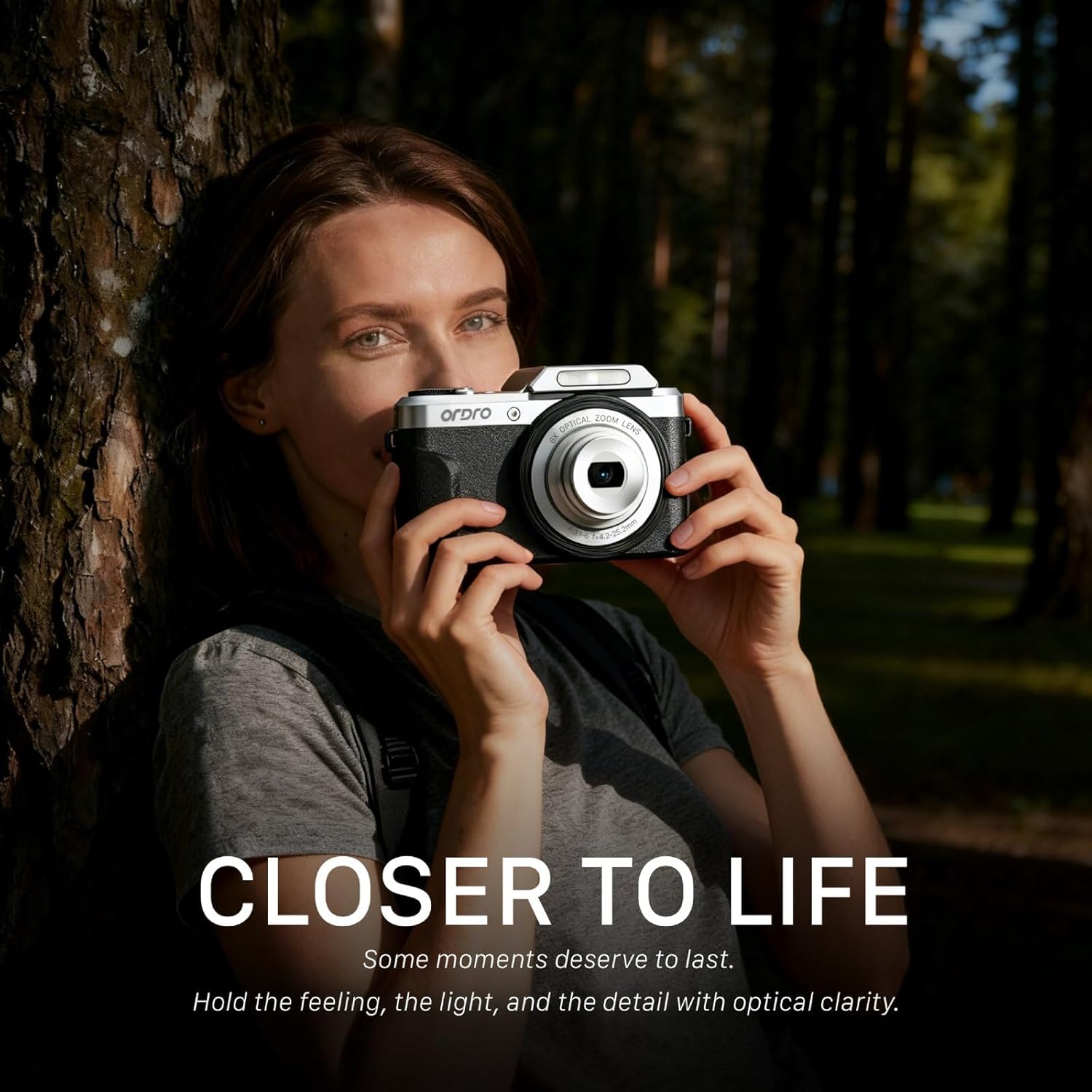
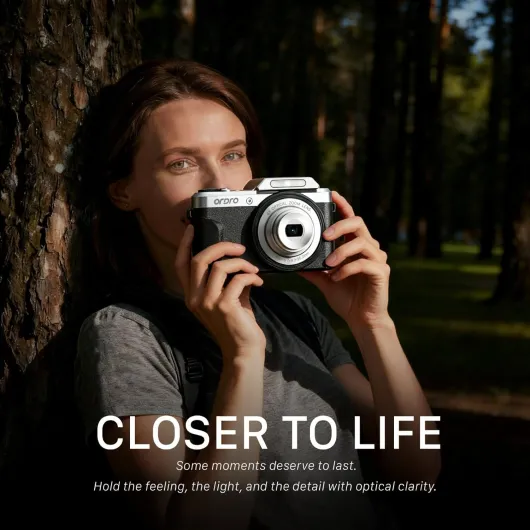
Design-wise, the ORDRO D27 sits somewhere between a compact camera and a chunky point-and-shoot. It’s very light at around 175 g, and that’s the first thing you notice when you pick it up. It doesn’t feel like a brick in your hand, which is great if you’re vlogging at arm’s length for a while. The grip is okay but not super deep. I never felt like I was going to drop it, but compared to my older Sony compact, it feels a bit more like a gadget than a serious camera. For a teen or beginner, that’s probably fine; it’s not intimidating at all.
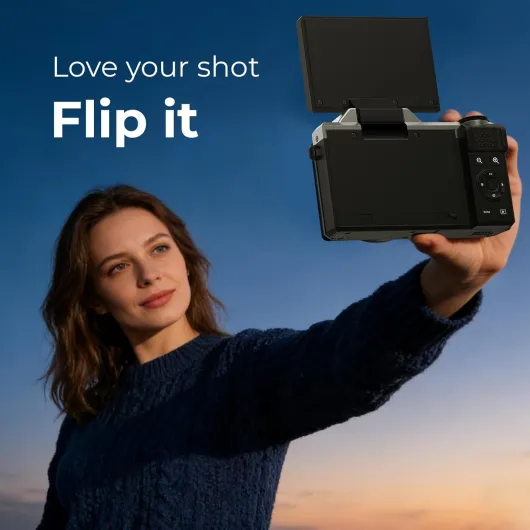
The 2.8-inch flip screen is the main design highlight. It rotates 180° so you can see yourself while filming. For vlogging, that’s non‑negotiable, and it works as expected. The resolution is only 640 x 480, so it’s not razor sharp, but it’s good enough to check framing, focus, and whether you’re in the shot. Outdoors in bright light, it’s usable but not fantastic; you sometimes have to tilt it or shade it with your hand to see properly.
The buttons are fairly straightforward: zoom rocker around the shutter, mode dial/menu buttons on the back, and no crazy clutter. A beginner can pick it up and be filming in a few minutes without reading the manual. The Wi‑Fi shortcut is useful if you plan to use the app often. The camera also has a built-in flash and an electronic viewfinder, though the EVF is not really the star here; most people will just use the screen. The hot shoe on top gives you room to grow a bit, adding a mic or light later if you get more serious.
Overall, I’d call the design practical but basic. It’s compact enough to throw in a handbag or small backpack, which matches what one Amazon reviewer said. It doesn’t feel premium, but at this price I didn’t expect it to. If you care more about portability and a flip screen than fancy materials or weather sealing, the design does the job. If you’re used to something like a higher-end Canon or Sony compact, this will feel a bit cheap in the hand, but that’s the trade-off for the lower cost.
Battery life: fine for short sessions, plan for the two-battery rotation
The D27 uses a 1200 mAh lithium-ion battery, and the specs say around 100 minutes of recording. In practice, that number is in the ballpark but depends heavily on how you use it. Continuous 4K recording with the screen flipped out and Wi‑Fi off will get you close to that, but if you’re constantly starting/stopping clips, reviewing footage, and using Wi‑Fi to transfer, the battery drains faster. I’d personally plan on around an hour to an hour and a quarter of mixed use per battery if you’re not being super careful.
The good part is that ORDRO actually includes two batteries, which matches what one of the Amazon reviewers mentioned. That means you can keep one in the camera and one in your pocket or bag and swap when needed. For a day out, this is basically the minimum I’d want. I wouldn’t go on a full-day trip with only one battery unless you’re very light on filming. The batteries are small and light, so carrying a spare is no big deal.
Charging is straightforward, though not particularly fast. It’s not like phone fast-charging; you’ll want to plug them in well before you go out. If you’re travelling, it’s worth getting into the habit of charging both batteries every night. There’s no massive power management here, so if you leave the camera on in your bag by mistake, you’ll find a dead battery later. It’s a basic system.
Overall, I’d say the battery situation is acceptable but not impressive. It matches the compact size and price of the camera. If you’re doing short vlogs, TikTok clips, or casual holiday footage, two batteries will cover you. If you’re planning long event coverage or all-day filming, you’ll either need more batteries or a different camera. For a beginner vlogging setup, it’s fine as long as you’re organised and actually carry that second battery.
Build and durability: travel-friendly but not something I’d abuse
The ORDRO D27 is clearly built to be light and portable, not bombproof. The body feels like standard plastic, with a finish that’s fine but nothing special. There’s no weather sealing, and it’s explicitly listed as not water resistant. So this is not a camera you want to use in heavy rain, on the beach with lots of blowing sand, or in very rough conditions without some care. For normal travel, city trips, and home use, it’s okay, but I wouldn’t throw it around or keep it loose in a backpack with keys and coins.
The flip screen mechanism feels decent but not heavy-duty. It rotates smoothly and doesn’t feel like it’ll snap off immediately, but you can tell it’s not designed for years of abuse. If you’re careful when flipping it out and don’t twist it the wrong way, it should be fine. The hinge is one of those parts I’d treat gently, especially if a younger teen is using it. Dropping the camera on the screen side would probably end badly, so a small case is a good idea.
The lens mechanism has that faint motor sound when zooming, which is normal here, but it also means you should avoid dust and sand as much as possible. Any compact camera with a retractable lens is vulnerable to grit getting into the mechanism. A simple habit like turning it off before putting it away and not changing zoom while it’s in a pocket helps. The included strap is basic but does the job, and honestly I’d use it – this kind of light, small camera is easy to fumble.
There’s a 1-year manufacturer warranty, which is standard and at least gives you some peace of mind out of the box. I wouldn’t buy this expecting it to last ten years of heavy, daily use. I’d see it more as a starter or travel camera that will be fine if you treat it with a bit of care. For a teenager or beginner who’s reasonably responsible, it’s okay. For a very rough user or harsh outdoor conditions, I’d look at something more rugged.
Image and video performance: better than a cheap phone, not a miracle 4K rig
Let’s talk about what most people care about: image and video quality. The D27 advertises 4K and 64 MP, but the sensor is 8 MP with 16 MP effective stills, so keep your expectations in check. In real use, the 4K footage at 30 fps looks decent on a laptop or TV, especially in good light. Details are good enough for YouTube and casual travel videos. It’s clearly sharper than 1080p from some older compact cameras, but it’s not on the same level as a modern high-end phone or a mirrorless camera. Colors are okay out of the box, maybe a bit punchy, and you can tweak them in editing if you want.
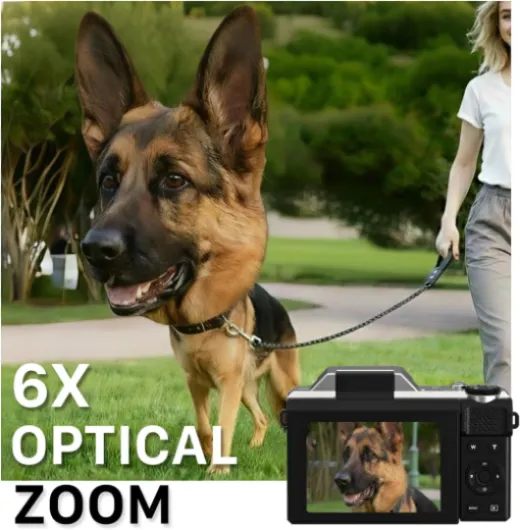
In bright daylight, the camera does fine. Landscapes, street scenes, and basic vlogs look clean as long as you don’t pixel-peep too hard. The 6x optical zoom is the real advantage over a phone in this price range. Zooming in on distant subjects like birds or people at the far end of a park actually keeps a reasonable level of detail, unlike digital zoom on cheaper phones which just gets mushy. You do hear a faint motor noise when zooming, like the product description mentions, and you’ll pick that up in very quiet scenes if you’re relying on the built-in mic. It’s not a defect, just something to be aware of.
Low light is where the limits show. Indoors at night or in dim rooms, noise creeps in fast. The small 1/2.7" sensor can’t work magic. You can still get usable footage if you have some decent lighting or don’t mind a bit of grain, but if you’re expecting clean nightclub or evening street footage without lights, you’ll be disappointed. The built-in flash helps for stills but not video, obviously. Autofocus is okay for casual use: it locks on faces most of the time and doesn’t hunt too badly, but it’s not super fast or super sticky if you move toward or away from the camera quickly.
For beginners, I’d rate the performance as pretty solid for the price, with clear limits. It will look better than a very cheap phone, especially when you use the optical zoom and compose properly with the flip screen. But if you already have a newer midrange or flagship phone, don’t expect this to blow it out of the water. Where it wins is consistency with zoom and the feeling of using a dedicated camera with proper framing and controls. For a first vlogging setup for a teenager or a casual YouTube channel, it gets the job done well enough.
What you actually get with the ORDRO D27
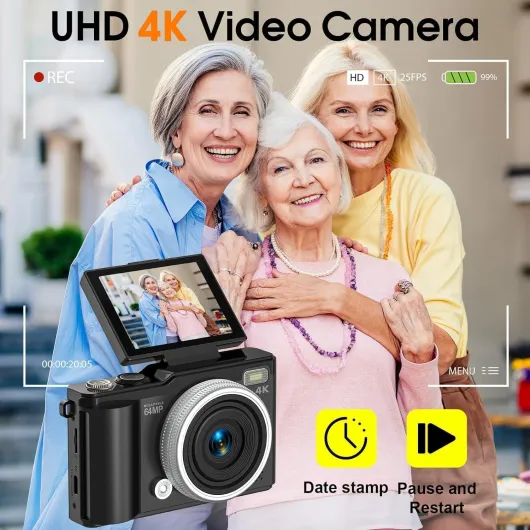
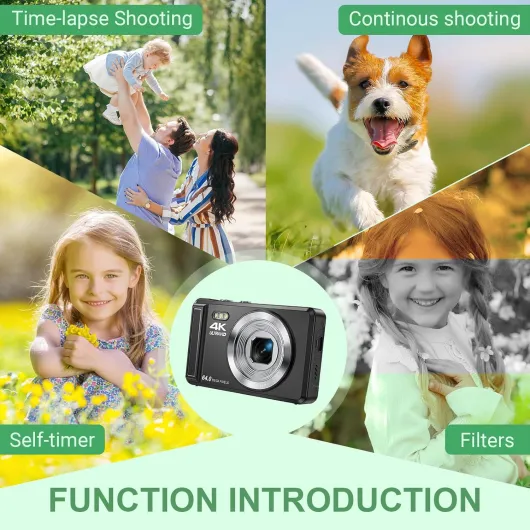
On paper, the ORDRO D27 tries to tick a lot of boxes for beginners and casual vloggers: 4K video at 30 fps, a 180° flip screen, Wi‑Fi, 6x optical zoom, and a compact body. It shoots MP4 for video and JPEG for photos, nothing fancy, and uses a 1/2.7" CMOS sensor. The stills are listed as 16 MP effective, and the video tops out at 2160p/30. It’s clearly aimed at teens, beginners, or anyone who wants something more than a phone but doesn’t want to dive into big cameras and interchangeable lenses.
In the box, you get the camera body, batteries (two in practice, according to the user reviews and what I’ve seen), a basic strap, and the usual cables. No SD card, so you need to buy a microSD separately before you can actually use it. The camera has a hot shoe mount on top, so you can attach an external mic or light later if you want, which is nice for a starter setup. It connects via Wi‑Fi to a phone app so you can transfer clips without taking the card out, which is handy if you’re editing straight on your phone for TikTok, Instagram, or quick YouTube uploads.
The feature set is a mix of auto and limited manual control. You get various focus modes (AF-A, AF-S, AF-C, MF), some scene modes and filters, plus exposure control options like program, manual, and shutter priority. Don’t expect DSLR-level control, but there’s enough there for someone to start learning the basics without getting overwhelmed. The aperture is listed as F1.8–F2.6 on the wide end, which is decent for lower light, though the small sensor still limits you.
In practice, I’d describe the whole package as a simple starter kit for learning vlogging and basic photography rather than a full creative workhorse. It’s clearly built to be easy to use, light, and cheap enough that you’re not terrified of breaking it on a trip. If you already own a midrange or high-end phone with a good camera, this is more of a sidegrade with optical zoom and a flip screen, not a massive upgrade across the board.
Pros
- Very light and compact with a 180° flip screen, easy to carry and vlog with
- 6x optical zoom gives better reach and detail than digital zoom on cheap phones
- Good starter package for beginners and teens, with Wi‑Fi and two batteries included
Cons
- Image and video quality are only decent, especially in low light
- Plastic build with no weather sealing and a hinge you need to treat carefully
- Zoom motor noise can be heard in quiet scenes when using the built-in mic
Conclusion
Editor's rating
The ORDRO D27 is a simple, lightweight 4K vlogging camera that makes sense if you’re just starting out or buying a first camera for a teenager. The 6x optical zoom, flip-out screen, and compact size are the main reasons to get it. In good light, video quality is perfectly fine for YouTube and social media, and the optical zoom clearly beats digital zoom on cheap phones. The Wi‑Fi transfer and two-battery setup are also practical for travel and day trips, as long as you remember to charge and swap them.
On the flip side, this is still a budget camera with a small sensor. Low-light performance is only okay, the body feels more plastic than premium, and the 4K label is a bit optimistic compared to what you get from higher-end gear or recent flagship phones. The zoom motor noise and lack of weather sealing are also things to keep in mind if you care about audio or plan to shoot in rough conditions. I’d recommend this to beginners, teens, and casual vloggers who want to learn on a dedicated camera without spending a fortune. If you’re already serious about content creation or have a strong phone camera and you’re picky about image quality, you’ll probably outgrow this quickly and should look higher up the range.