
Summary
Editor's rating
Price vs what you actually get
Small, light, and clearly built to be thrown in a bag
Battery life: better than expected for casual use
Build quality and how it holds up in real life
Image quality and autofocus: decent in good light, average elsewhere
What you actually get in the box
Does it actually replace your phone for casual photos?
Pros
- Simple, beginner-friendly camera that’s ready to use out of the box with the included 32 GB SD card
- Compact and light with a useful 5x optical zoom and 24 mm wide angle for everyday shots
- Good value for casual users thanks to decent battery life and adequate image quality in good light
Cons
- Average low-light performance and basic autofocus, especially for moving subjects
- Build quality feels cheap, with plasticky buttons and a battery door that needs gentle handling
- Video limited to 1080p/30 fps with basic stabilization and no advanced features

Specifications
View full product page →| Brand | Clikoze |
A cheap way to get back to a real camera
I picked up this Clikoze bundle with the Kodak Pixpro FZ55 because I wanted a small camera I could throw in my bag and not worry about. My phone takes good photos, but I missed having a real zoom and a separate device for holidays and nights out. This kit looked simple: camera, 32 GB SD card and a cleaning cloth. No need to think about which card to buy or extra accessories.
After a couple of weeks using it for walks, family gatherings and some random street shots, I’d sum it up like this: it’s a basic compact camera that does the job if you keep your expectations in check. It’s clearly aimed at beginners or people who just want a straightforward point-and-shoot, not someone trying to replace a DSLR or a high-end phone camera.
The bundle itself is convenient. You open the box, charge the battery, pop in the card, and you’re ready to go. No extra cables or weird setup. The manual is short and simple, and if you’ve ever used a compact camera before, you’ll be shooting in five minutes. The learning curve is low, which is probably why a lot of reviewers say it’s good for starters.
Is it perfect? No. The sensor is only 16 MP CCD, there’s no fancy stabilization, video tops out at 1080p/30 fps and low light isn’t its strong point. But for the price and for casual use, it’s a pretty solid little kit. If you just want a separate camera that you can hand to kids, friends, or use on holiday without stressing, it makes sense.
Price vs what you actually get
From a value point of view, this Clikoze bundle sits in a pretty reasonable spot. You’re getting a compact camera, a 32 GB SD card and a cleaning cloth in one shot. If you bought everything separately, you’d probably pay a bit more and have to think about compatibility and card speed. Here, you open the box and start shooting, which is nice for people who don’t want to overthink tech details.
Compared to slightly cheaper no-name cameras you see online, the FZ55 at least comes from a known line (Kodak Pixpro) and has a bunch of real user reviews around 4.2/5. That gives a bit more confidence than some random brand with no track record. On the other hand, if you’re willing to spend more, you can get cameras with better sensors, stronger autofocus, and more features. So it sits in that budget/entry-level middle ground: not the cheapest toy, not a serious enthusiast camera.
For what it costs, you’re paying mainly for convenience and simplicity: pocket size, optical zoom, basic 1080p video, and a kit that’s ready to go. If you already own a recent phone with a decent camera and don’t care about optical zoom, then the value is lower for you, because your phone might already do as well or better in many situations. But if you want a separate device, something you can hand to kids, take on holiday without worrying too much, or just keep as a backup camera, it’s pretty solid value.
Personally, I’d say it’s worth it if you’re clear about what you’re buying: a simple, budget compact that gets the job done for everyday photos. If you expect high-end image quality, strong low-light performance, or advanced features, you’ll be disappointed. If you just want a straightforward camera bundle that works out of the box and doesn’t break the bank, the price feels fair.

Small, light, and clearly built to be thrown in a bag
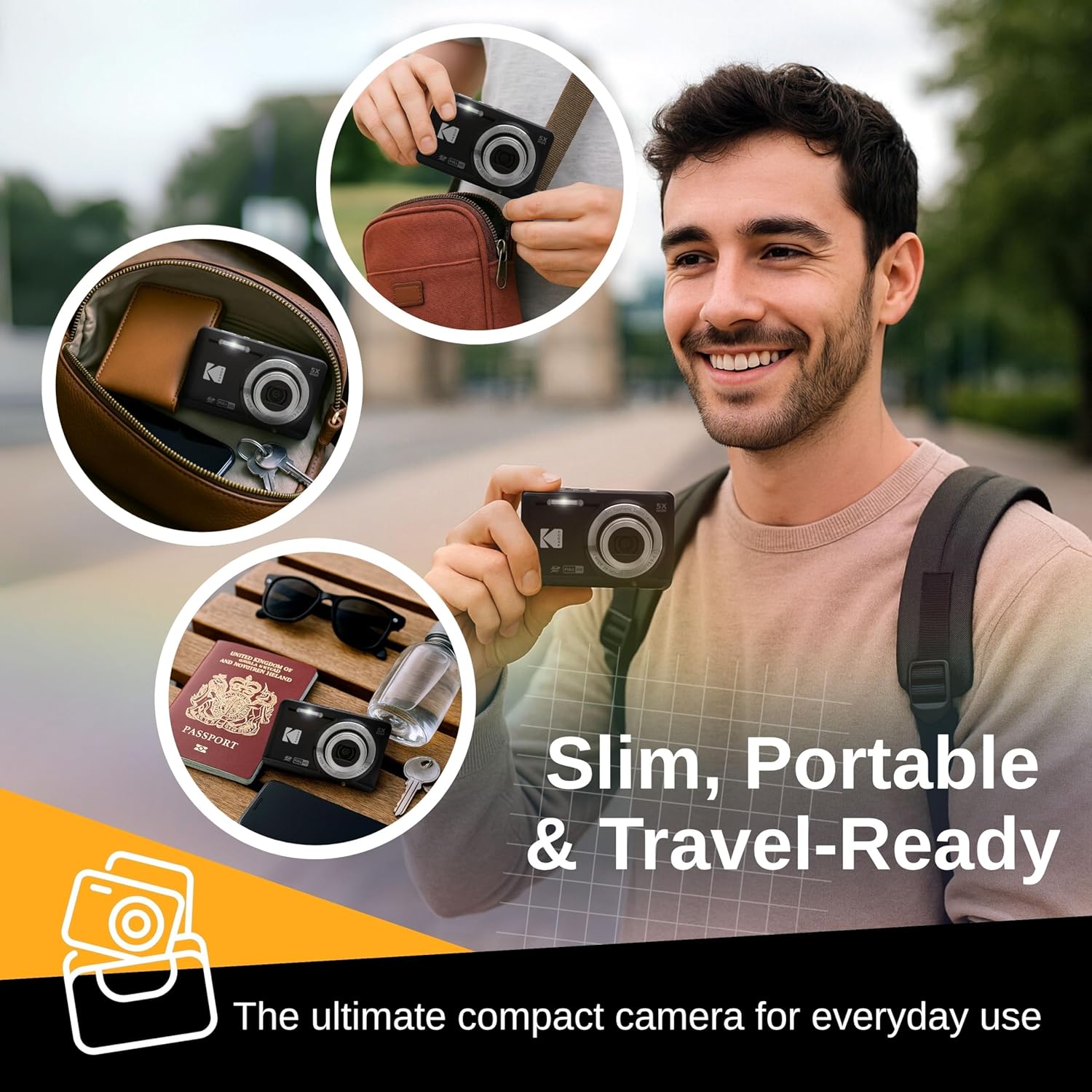
In terms of design, the FZ55 is exactly what you’d expect from a budget compact. It’s light (around 500 g including battery and card), slim enough to slide into a jacket pocket, and the black finish is pretty discreet. Nothing flashy, nothing that screams “expensive camera”, which I actually like when I’m walking around in busy areas. You can keep it on your wrist with the included strap and not feel weighed down.
The button layout is simple: shutter button on top with a zoom rocker around it, power button next to it, and on the back you’ve got the 2.7-inch LCD, a mode button, playback, menu, and a directional pad with OK in the middle. After a day or two, you don’t have to think about where things are. It’s clearly made for people who don’t want to dig through complex menus. That said, the buttons feel a bit plasticky, and the shutter button in particular doesn’t have the most reassuring half-press feedback. A couple of times I thought I’d half-pressed to focus but it had already taken the shot.
The LCD is fine for framing and checking your pictures, but don’t expect phone-level brightness or sharpness. The viewing angles are okay, but in bright sunlight it’s a bit of a struggle, and you sometimes end up shading the screen with your hand. There’s no touchscreen, which doesn’t bother me at this price, but if you’re used to tapping your phone screen to focus, you’ll have to get used to the old-school feel.
Port access is basic: one USB port for charging and file transfer, and the SD card and battery live in the same compartment at the bottom. The battery door feels like it could be a weak point if you’re rough with it, so I wouldn’t slam it shut. Overall, the design is functional. It’s not pretty or premium, but it’s compact, easy to use, and light enough that you actually take it with you, which is the main point.
Battery life: better than expected for casual use
The battery is a small lithium-ion cell weighing about 15 grams, and honestly, it holds up better than I thought it would. On a typical day out, taking around 150–200 photos and a few short 1080p clips, I didn’t manage to drain it completely. You start to see the battery indicator drop in the afternoon, but it’s not a disaster. For light use, you can easily get through a full day on a single charge.
If you shoot a lot of video or constantly review your shots on the screen, the battery obviously drops faster. On one heavier test day, with a bunch of 1–2 minute videos and lots of menu fiddling, I got closer to 3–4 hours of active use before it started to feel risky. There’s no external charger in the box: you charge via USB directly in the camera. That’s convenient for travel, since you can use any USB adapter or power bank, but it also means you can’t charge a spare battery while using the camera unless you buy extra gear.
There’s no fancy power management menu, but the camera does go to sleep after a bit of inactivity, which helps. I’d still recommend picking up a second battery if you plan long days of shooting, especially on trips where you’re not always near a plug. For most casual users who take a few photos here and there, the included battery is enough and lines up with what some Amazon reviews mention about decent battery life.
Overall, I’d rate the battery as “good enough” for what this camera is. It’s not built for heavy professional use, but for a weekend trip, a city day, or family events, it holds up fine. As long as you charge it the night before and don’t expect miracles in video-heavy situations, you’re covered.

Build quality and how it holds up in real life
Physically, the FZ55 feels like a typical budget compact: mostly plastic, light, and not exactly bombproof. After a couple of weeks of use, including being tossed into a backpack without a case, it hasn’t fallen apart, but you can tell it’s not meant for rough conditions. There’s no water resistance at all, so I was careful around rain and sand. If you want something for the beach or harsher environments, you’ll need a different type of camera or at least a protective pouch.
The buttons and dials are where you feel the cost cutting. They work, but they don’t feel very solid. One Amazon review mentioned the shutter and flash not always working perfectly, and I get what they mean. I didn’t have full failures, but I did have a couple of slightly weird moments where the shutter didn’t trigger as expected, or the timing felt off. It’s not constant, but it doesn’t inspire full confidence either. The battery door also feels like a potential weak spot. If you’re heavy-handed, I can see it snapping over time.
The lens mechanism (the part that extends when you turn the camera on) has been fine so far. It opens and retracts smoothly, and I haven’t had any grinding or jams. That said, these small extending lenses are always vulnerable to dust and knocks, so I’d avoid turning the camera on while it’s in a tight pocket or bag. This is where the included Clikoze cleaning cloth is actually useful: I found myself wiping the lens quite often to avoid smudges and dust, which helps keep image quality stable.
In short, durability is acceptable for a budget compact used with a bit of care. It’s not a tank, but if you treat it as an everyday travel gadget and don’t drop it on concrete every weekend, it should last. The 1-year warranty from Clikoze is reassuring, but if you’re rough with your gear, you might want to invest in a small case and be a bit gentle with the doors and buttons.
Image quality and autofocus: decent in good light, average elsewhere
Let’s be clear: this is a simple CCD compact, so performance is very dependent on lighting. In good daylight, the 16 MP sensor and 24–120 mm (equivalent) 5x zoom produce photos that are sharp enough for social media, small prints, and family albums. Colors are on the punchy side straight out of the camera, which most casual users will like. You don’t get raw files, so what you see is basically what you get, but for everyday shots it’s fine.
The autofocus is contrast-detect with 9 points and works reasonably fast when there’s enough light. For still subjects, landscapes, and people who are not running around, it locks focus in a second or so. In low light or indoors, it starts to hunt more, and you’ll sometimes end up with soft shots if you’re not careful. There’s no real continuous autofocus for tracking fast movement, so for sports or kids sprinting around, this is not the best option. It’s more for relaxed scenes: travel, city walks, portraits, that kind of stuff.
Zoom-wise, the 5x optical zoom is handy. Compared to using only a phone, you can actually frame a bit tighter without relying on digital zoom. The wide 24 mm end is nice for group shots and landscapes. Image quality stays acceptable across the zoom range, but you do see some softness at the long end, especially if you’re not holding the camera steady. There’s no powerful optical stabilization, so you need to brace yourself a bit, especially indoors.
Video is limited to 1080p at 30 fps. It’s okay for clips of trips or quick family videos, but that’s it. The footage is usable, but stabilization is basic and the sound is nothing special. For vlogging or serious video work, I’d pass. For simple travel memories, it gets the job done. Overall, performance is fine for the price: good in daylight, average in low light, and clearly aimed at casual shooters rather than enthusiasts.
What you actually get in the box
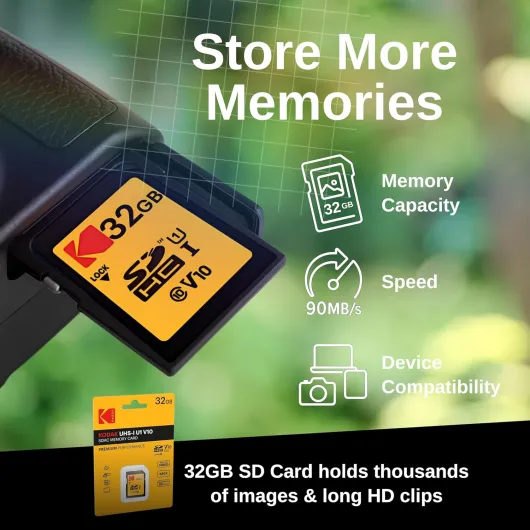
The bundle is pretty straightforward. You get the Kodak Pixpro FZ55 compact digital camera in black, a 32 GB SDHC card, and a Clikoze-branded microfiber cleaning cloth. That’s it. No fancy case, no extra battery, no tripod. The SD card brand can vary, but in my case it was a basic 32 GB card that handled photos and 1080p video fine. Nothing high-end, but it didn’t choke or corrupt files during my tests.
The camera itself is a small 16.1 MP compact with a 24 mm wide-angle lens and 5x optical zoom. It shoots JPEG photos and MP4 video at up to 1080p/30 fps. There’s a 2.7-inch LCD on the back, a simple directional pad for menus, and a few buttons for mode, playback and deleting shots. It runs on a small lithium-ion battery that’s included in the box. You also get a wrist strap and a USB cable for transferring files and charging.
On paper, the specs are very “entry-level”: CCD sensor, automatic exposure, basic autofocus with 9 points, no fancy manual controls, and limited shooting modes (mostly automatic and landscape). It’s clearly designed for point-and-shoot use. The white balance presets (auto, cloudy, daylight, flash, fluorescent, incandescent) are there if you want to tweak a bit, but most users will just leave everything on auto and be fine.
Overall, the bundle is honest: you pay for a basic camera plus the essentials to start shooting. No hidden surprises. If you expect an advanced system with raw files, 4K video or interchangeable lenses, this is not it. If you want a simple camera that works straight out of the box with zero extra shopping, the package makes sense and keeps things easy.
Does it actually replace your phone for casual photos?
The real question for a camera like this in 2026 is: why not just use your phone? After using it side by side with my mid-range smartphone, I’d say the FZ55 has a few clear advantages, but also some compromises. The main win is the 5x optical zoom. Being able to zoom optically without turning your photo into a noisy mess is nice, especially for travel, buildings, and candid shots from a bit further away. The 24 mm wide angle is also handy for group shots where you can’t step back.
In good light, the photos are very usable. For Facebook, Instagram, or printing small photos, you won’t see a big difference from a phone, and sometimes the camera even does better because the lens is actually made to zoom. The camera’s auto modes are simple: you basically leave it on automatic and let it decide. For a beginner or someone who just wants to click and move on, that’s actually a strength. No endless tweaking, no complex menus. You take the shot, and that’s it.
Where it falls behind modern phones is low light and speed. Indoors or at night, the small CCD sensor struggles. You get more noise, slower autofocus, and more risk of blur. Some phones with strong computational photography will give cleaner results in those conditions. Also, there’s no real burst mode or smart subject detection here, so if you like shooting fast action or kids who never stop moving, the success rate is lower than with a good phone.
Still, for someone who wants a separate camera to keep their phone free, or for kids/teens who don’t have a high-end phone yet, the FZ55 is effective. It does what it promises: simple stills and basic video, without apps, notifications, or distractions. It’s not a miracle device, but as a straightforward tool for casual photos, it works.
Pros
- Simple, beginner-friendly camera that’s ready to use out of the box with the included 32 GB SD card
- Compact and light with a useful 5x optical zoom and 24 mm wide angle for everyday shots
- Good value for casual users thanks to decent battery life and adequate image quality in good light
Cons
- Average low-light performance and basic autofocus, especially for moving subjects
- Build quality feels cheap, with plasticky buttons and a battery door that needs gentle handling
- Video limited to 1080p/30 fps with basic stabilization and no advanced features
Conclusion
Editor's rating
After using the Clikoze Kodak Pixpro FZ55 bundle for a bit, my conclusion is pretty simple: it’s a basic, no-nonsense compact camera kit that makes sense for beginners, casual users, and anyone who wants a separate camera from their phone without spending a lot. The 16 MP sensor, 5x optical zoom and 1080p video are not impressive on paper in 2026, but in practice they’re enough for holidays, family events, and everyday snapshots, as long as you mostly shoot in decent light.
The main strengths are the small size, the ready-to-use bundle (camera + 32 GB card + cloth), and the straightforward operation. There’s almost no learning curve, the battery life is decent for casual use, and the image quality is fine for social media and small prints. On the downside, build quality is clearly budget, low light performance is average, video is basic, and there are a few quirks with buttons and responsiveness that remind you this isn’t a premium device.
If you’re a beginner, a teen getting into photography, or someone who just wants a simple travel camera that doesn’t rely on your phone, this kit is a good fit. If you’re picky about image quality, shoot a lot at night, or want advanced controls and 4K video, you should skip this and look at higher-end compacts or mirrorless cameras. Overall, for the price and the target user, it’s a solid, practical option that does what it says without pretending to be more than it is.