
Summary
Editor's rating
Value for money: cheap, feature-packed, but with clear trade-offs
Design and handling: feels light, a bit plasticky, but easy to live with
Battery life and storage: two batteries help, but don’t expect miracles
Build quality and durability: fine for normal use, not for abuse
Image and video performance: fine for casual use, weaker if you’re picky
What you actually get in the box and what this thing can (and can’t) do
Pros
- Comes as a complete kit: two batteries, 64GB card, wide-angle and macro lenses included
- 180° flip screen and WiFi/app control are handy for vlogging and solo shooting
- Good enough image quality in daylight for YouTube, social media, and casual photos
Cons
- 5K/64MP specs look better on paper than in real life; low-light performance is mediocre
- Build quality and flip screen hinge feel plasticky and not very confidence-inspiring
- Autofocus and digital zoom struggle with moving subjects and higher zoom levels

Specifications
View full product page →| Brand | NBD |
A cheap “real camera” to replace your phone… or not?
I picked up this NBD 5K 64MP camera because I wanted something a bit more "real" than my phone for vlogging and quick product photos, but I didn’t want to drop DSLR money. On paper it looks loaded: 5K video, 64MP photos, 16x zoom, WiFi, flip screen, two batteries, 64GB card, plus wide-angle and macro lenses. For the price, it almost sounds too good to be true, so I went in with low expectations.
I used it mainly for home videos, some outdoor shots during a weekend trip, and as a webcam for a few calls. I’m not a pro photographer, but I’ve used a couple of entry-level Canon and Sony cameras before, and of course modern smartphones. So my point of comparison is basically: can this beat a mid-range phone camera and a cheap action cam, or is it just a toy with big numbers on the box?
Right away, the camera feels like it’s aimed at beginners and casual users. The menus are simple, the flip screen is clearly made for selfies and YouTube, and you don’t get buried in technical settings. That’s nice if you just want to press record and go. But if you’re used to more control over exposure or focusing, you’ll quickly see the limits. The specs suggest something close to a real mirrorless, but the experience is more like a decent compact camera.
Overall, after a couple of weeks, my feeling is mixed. It’s not junk, it does get the job done for basic content, and for the price you get a full kit that’s ready to use out of the box. But the 5K/64MP claims sound better than they look, especially if you’re picky about image quality. If you go in thinking "budget camera that’s a bit better than a basic webcam or toy cam", you’ll probably be okay. If you expect pro-level footage because of the numbers, you’ll be disappointed.
Value for money: cheap, feature-packed, but with clear trade-offs
Looking at the price and everything you get – camera, 64GB card, two batteries, wide-angle and macro lenses, flip screen, WiFi – the value looks strong on paper. For someone starting out with vlogging or wanting a dedicated camera that’s not just their phone, it’s an affordable all-in-one kit. You don’t need to buy extra batteries or memory just to get going, which is nice compared to some brands that nickel-and-dime you on accessories.
But then you have to factor in the actual image and video quality. This is where the trade-off appears. Compared to a recent mid-range smartphone, in good light it’s similar, sometimes slightly better because of the lens options. In low light, many phones will simply do better. Compared to an entry-level used mirrorless or DSLR, this NBD loses in almost every quality aspect, but of course those systems cost more and need extra lenses. So it sits in this middle spot: better than a pure toy camera, not as strong as proper camera gear.
If your main goal is simple vlogs, YouTube videos, or product shots for online listings, and you’re on a tight budget, the value is actually decent. The flip screen, included lenses, and two batteries make life easier. If you’re more into photography as a hobby and care a lot about sharpness, low-light performance, and fast autofocus, I’d honestly save up a bit more for a used Canon/Sony/Micro Four Thirds setup. Long term, that’s a better investment, even if the upfront cost is higher.
So in terms of value, I’d call it: good for beginners and casual creators, average for anyone more serious. The 4.2/5 Amazon rating makes sense to me – people who know camera gear will rate it lower, people moving up from a cheap no-name camera or using it as a webcam will probably be happy. Just don’t buy it solely because of "5K" and "64MP" on the box; buy it because you want a cheap, all-in-one starter camera and you’re okay with its limits.
Design and handling: feels light, a bit plasticky, but easy to live with
Design-wise, this camera is clearly built for casual use rather than hardcore photography. It’s light and compact (about 12.6 x 11 x 8.2 cm), so you can toss it in a small bag or even a big jacket pocket without thinking about it. The graphite colour is neutral and doesn’t scream “toy”, but once you hold it, you can tell it’s mostly plastic. It doesn’t feel like it’s going to fall apart right away, but it’s not in the same league as even an older Canon or Sony body.
The 180° flip screen is the best design feature here. For vlogging or selfies, it’s very handy. You can see your framing, check if you’re in focus, and monitor the recording timer. The hinge feels okay so far – not super solid, but it doesn’t wobble excessively. I did baby it a bit because I don’t trust it to handle rough treatment. The screen itself is 3 inches and the resolution is modest (360 x 640), so it’s not razor sharp, but it’s clear enough to judge composition and basic focus.
The buttons and menus are simple. You have a mode dial, a shutter button, zoom control, and a few menu buttons on the back. No wheel for quick exposure tweaks or anything fancy. For beginners, that’s probably a good thing: you won’t get lost. For someone used to more advanced controls, it feels a bit limiting and slow to adjust things. The grip is small but okay for my medium-sized hands. If you have big hands, your pinky will probably hang off the bottom.
Port placement is basic: USB for data/charging and a slot for the TF card. No headphone jack, no hotshoe for an external flash, and no weather sealing. So this is really a "take it out on a nice day" kind of camera, not something you’d rely on in heavy rain or dusty environments. Overall, I’d say the design is practical but cheap-feeling. It’s fine for casual users and kids/teens, but if you’re used to more serious gear, you’ll notice the compromises right away.
Battery life and storage: two batteries help, but don’t expect miracles
NBD includes two 1500mAh batteries, which is honestly one of the nicest parts of the package. One battery alone gave me roughly 60–90 minutes of mixed use: some 5K video clips, some 1080p, and a handful of photos, with the screen on the whole time. If you shoot mostly photos and short clips, you can stretch it longer. If you record long 5K or 4K videos, it drains faster. Having the second battery means you can realistically cover a day of casual shooting if you remember to swap and charge.
You can charge via USB with an adapter or a power bank, which is handy when traveling. I often just plugged it into a power bank between shoots. Charging from empty to full takes a bit over two hours per battery in my experience. There’s no fancy fast-charging here. The battery indicator isn’t super precise either; it tends to drop from full to half quickly, then hangs at half for a while. So you kind of learn to swap batteries proactively instead of waiting for it to die mid-clip.
Storage-wise, you get a 64GB TF card included, and the camera supports up to 256GB. The included card is a nice touch because it means you can actually start shooting right away. But keep in mind: 5K and 4K videos chew through space fast. After a day of shooting mostly in 4K, I had already filled more than half the card. If you plan to film long vlogs or trips, I’d budget for a bigger, faster card pretty soon.
In terms of heat, the camera gets a bit warm during long 5K recordings, but I didn’t hit any shutdowns. That’s good, but I also wasn’t recording hour-long takes; more like 5–10 minute segments. Overall, battery and storage are acceptable for the price. Not impressive, not terrible. The two batteries are a real plus, but don’t expect GoPro-level efficiency or pro-camera endurance. You’ll still need to manage your power and memory if you shoot a lot.
Build quality and durability: fine for normal use, not for abuse
After handling it for a bit, it’s pretty clear this camera is made with cost-cutting in mind. The body is mostly plastic, and you can feel a bit of flex if you squeeze it. That said, nothing creaks loudly or feels like it’s about to snap. For everyday use – home, casual outings, filming in the car, that type of stuff – it feels good enough. I tossed it in my backpack a few times (in its little pouch, not totally naked) and it came out without any damage or new rattles.
The weak points are the moving parts: the flip screen hinge and the lens threads. The screen hinge has held up so far, but I’m careful with it. If you’re rough, constantly flipping it back and forth or tossing the camera around, I can see it loosening over time. The screw-on wide-angle and macro lenses also feel a bit cheap. You need to be gentle when mounting them; cross-threading or overtightening would be easy if you’re not paying attention.
There’s no weather sealing, so I wouldn’t trust this in rain, at the beach with lots of sand, or in very dusty places. A light splash or a bit of dust probably won’t kill it, but it’s clearly not designed for harsh environments. Also, the battery and card doors feel a bit flimsy. They close fine, but the plastic latch doesn’t give the same confidence as more expensive cameras. Treat it like consumer electronics, not like a rugged action cam.
In short, durability is okay for careful users. If you’re buying this for a teenager or as a family camera, just set expectations: don’t drop it, don’t leave it in the rain, and don’t yank the screen around. There’s a 1-year warranty, which is at least some backup if something fails early, but I wouldn’t expect this to last 10 years of heavy use. It feels more like a 2–3 year casual-use device than a long-term investment piece.
Image and video performance: fine for casual use, weaker if you’re picky
Let’s talk about the pictures and videos, because that’s what really matters. In good light, like outdoors during the day or in a room with plenty of windows, the camera produces decent, usable images. Colours are a bit on the punchy side but not crazy, and for social media or family albums, it’s totally fine. Compared to a mid-range smartphone, I’d say it’s roughly on par in daylight, sometimes slightly softer. The 64MP mode mostly just gives you bigger files rather than clearly sharper photos.
In low light, you start to see the limits. The small 1/2.3" sensor and the processing struggle. At ISO 1600 and above, there’s visible noise and smudging, and details get mushy. If you’re just taking quick shots for memories, it’s acceptable, but if you zoom in or look on a big screen, you’ll notice the grain. Video in low light looks a bit washed and noisy too. The advertised ISO 6400 is there, but I wouldn’t use it unless I had to. A modern smartphone with good night mode will usually do better.
The 5K and 4K video modes sound nice on the box. In reality, the footage is okay but not razor sharp like a more expensive camera. Rolling shutter (that jello effect when you move the camera quickly) is present but not horrible. Autofocus during video is hit-and-miss. If you stay at a fixed distance, it’s fine. If you move towards or away from the camera, it sometimes hunts or snaps in a bit late. For sit-down talking videos, it works. For kids running around or any fast movement, it struggles.
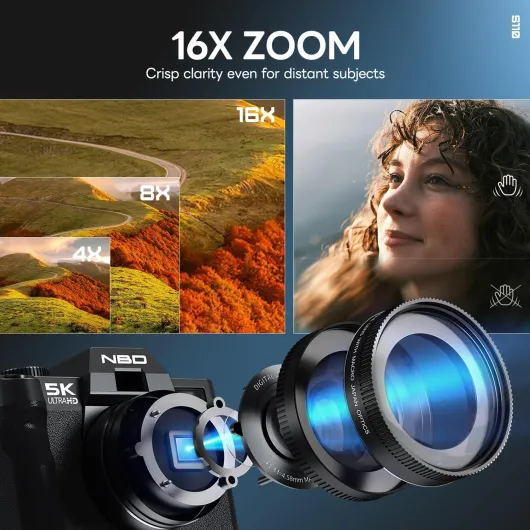
The 16x zoom is digital only, which means it’s basically cropping the image. Up to maybe 4x it’s still okay; past that, it gets soft and noisy, especially in anything but perfect light. Anti-shake helps a bit if you have shaky hands, but it’s more like basic digital stabilisation than proper optical stabilisation. For walking vlogs, you’ll still see bobbing and small shakes. Overall, performance is fine for beginners and casual vloggers, but if you’re serious about image quality, this will feel like a step down from even an older entry-level mirrorless.
What you actually get in the box and what this thing can (and can’t) do
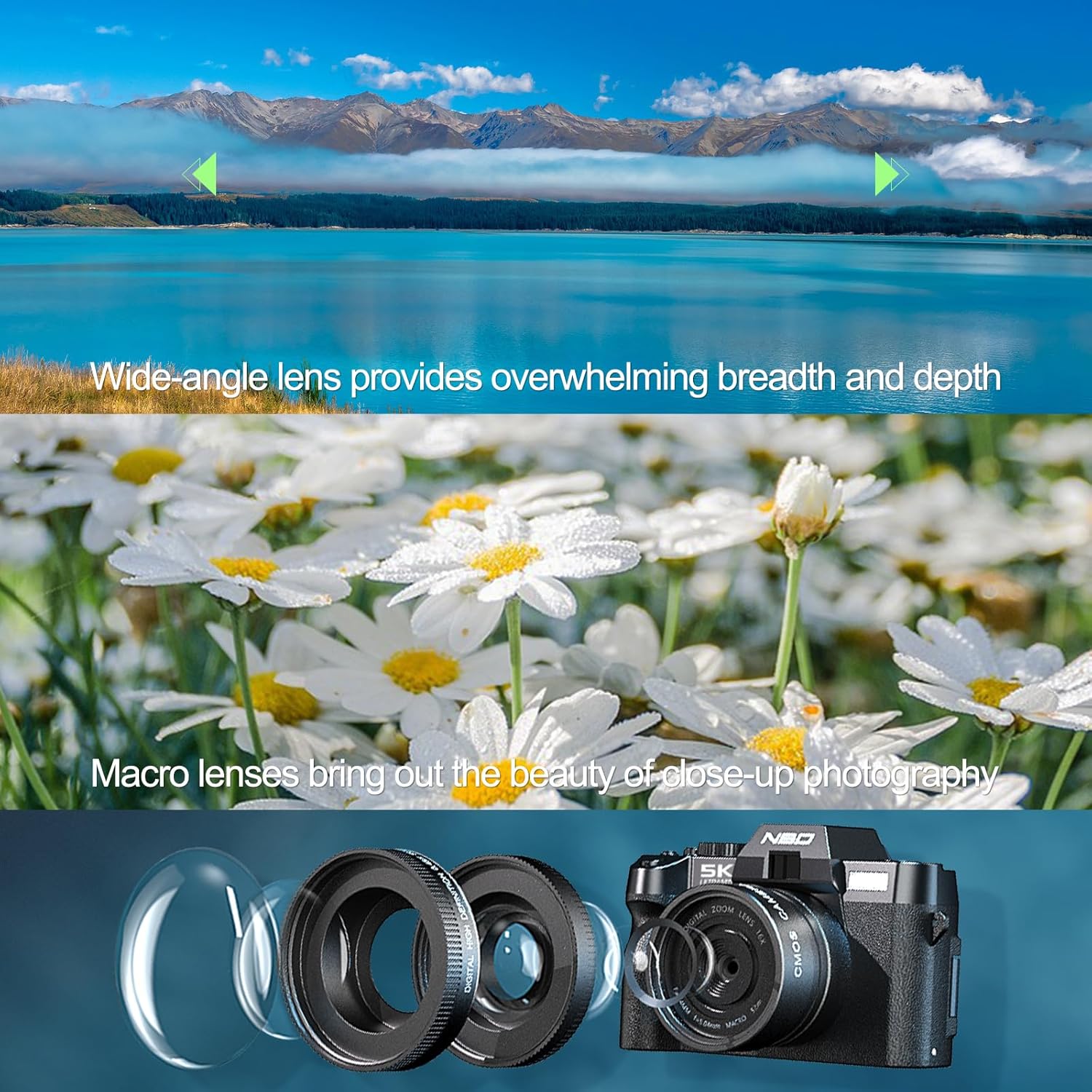
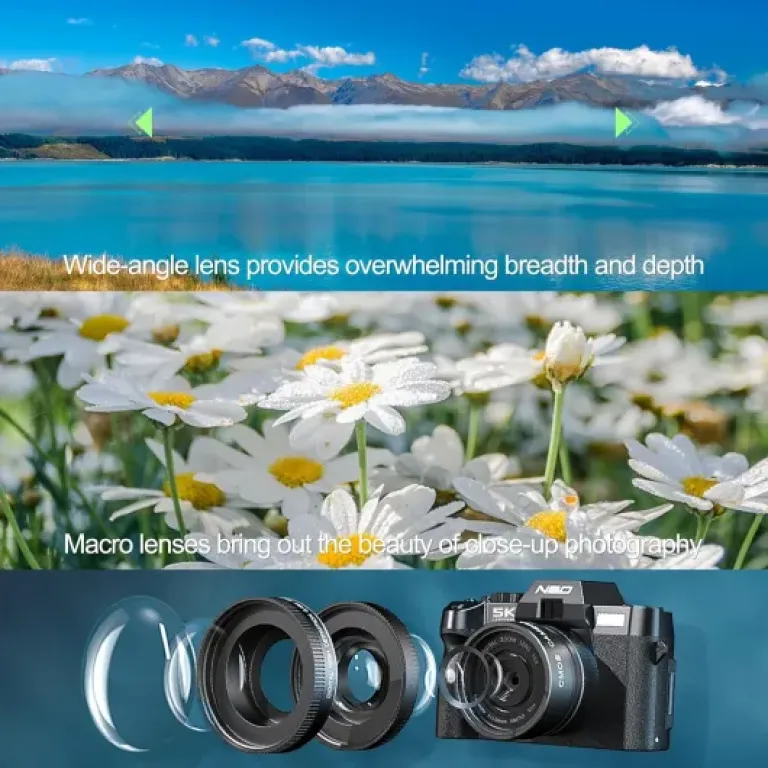
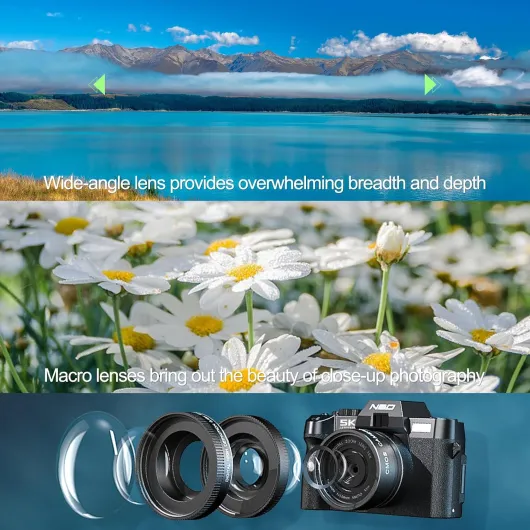
Out of the box, you get a pretty complete set: the camera body, a 52mm wide-angle lens, a macro lens, 64GB TF card, two 1500mAh batteries, a simple strap, lens cap, and the usual cables. So yes, you really can start shooting without buying anything extra, which is a big plus at this price. The wide-angle and macro are screw-on lenses, not separate glass like you’d see on a DSLR, but they give you some flexibility compared to a fixed basic compact.
On paper, the specs are stacked: 5K video, 64MP photos, 16x digital zoom, WiFi, app control, anti-shake, 1/2.3" CMOS sensor, ISO 100–6400. In practice, the sensor and processing are clearly entry-level. The 64MP is basically upscaled; the files are big, but the detail isn’t on the same level as a real 64MP sensor from a DSLR or high-end phone. Same with 5K: the resolution is there in the file, but the lens and sensor limit how sharp it actually looks. For social media and casual viewing, it’s fine, just don’t expect cinema-quality shots.
The camera supports several resolutions (5K/4K/2K/1080p/720p) in MOV format and standard JPG for photos. There’s no RAW option, so if you like to edit heavily, you’re stuck with what the camera gives you. The autofocus is basic AF-A; it works for still subjects but hunts a bit if the light is bad or if you move towards/away from the camera while filming. For vlogging at arm’s length it mostly keeps up, but you’ll see it breathing focus sometimes.
So overall, the "presentation vs reality" is: it looks like a feature-packed hybrid camera, but behaves more like an entry-level compact with extras. It’s decent for: vlogs, family videos, simple product shots, and as a webcam. It’s weaker for: fast action, low light, and anything where you want very clean, sharp detail. As long as you line up your expectations with that, the spec sheet won’t feel like a lie, just a bit optimistic.
Pros
- Comes as a complete kit: two batteries, 64GB card, wide-angle and macro lenses included
- 180° flip screen and WiFi/app control are handy for vlogging and solo shooting
- Good enough image quality in daylight for YouTube, social media, and casual photos
Cons
- 5K/64MP specs look better on paper than in real life; low-light performance is mediocre
- Build quality and flip screen hinge feel plasticky and not very confidence-inspiring
- Autofocus and digital zoom struggle with moving subjects and higher zoom levels
Conclusion
Editor's rating
After using the NBD 5K 64MP camera for a bit, my overall take is that it’s a budget-friendly, all-in-one kit that does the basics fairly well, but it’s not a magic upgrade over everything else. The flip screen, included 64GB card, two batteries, and the extra lenses make it easy to start vlogging or shooting casual photos right away. In good light, the image quality is perfectly usable for YouTube, social media, or family memories. As a step up from really cheap toy cameras or basic webcams, it’s clearly better.
On the other hand, the big 5K/64MP numbers are a bit misleading if you’re expecting pro-level results. The sensor is small, low-light performance is just okay, the autofocus is basic, and the build is clearly on the budget side. If you’re serious about photography or you already own a decent smartphone, this won’t blow you away. It’s more of a practical tool than something you’ll be excited to pixel-peep with.
Who is it for? I’d say: beginners who want a simple vlogging camera with a flip screen, parents who want a dedicated camera for holidays without spending a fortune, and anyone who prefers not to film everything on their phone. Who should skip it? People who care a lot about image quality, low-light performance, or fast autofocus, and anyone thinking this will replace a real DSLR or mirrorless. For what it costs, it’s good value if your expectations are realistic, but there’s definitely better gear out there if you’re ready to spend more.