
Summary
Editor's rating
Audio by Bang & Olufsen: good, but don’t expect full headphones
Value for money: good features, but not cheap and not perfect
Design: looks okay, but still obviously gadget glasses
Battery & power: depends entirely on what you plug it into
Comfort: fine for an episode, borderline for a full season
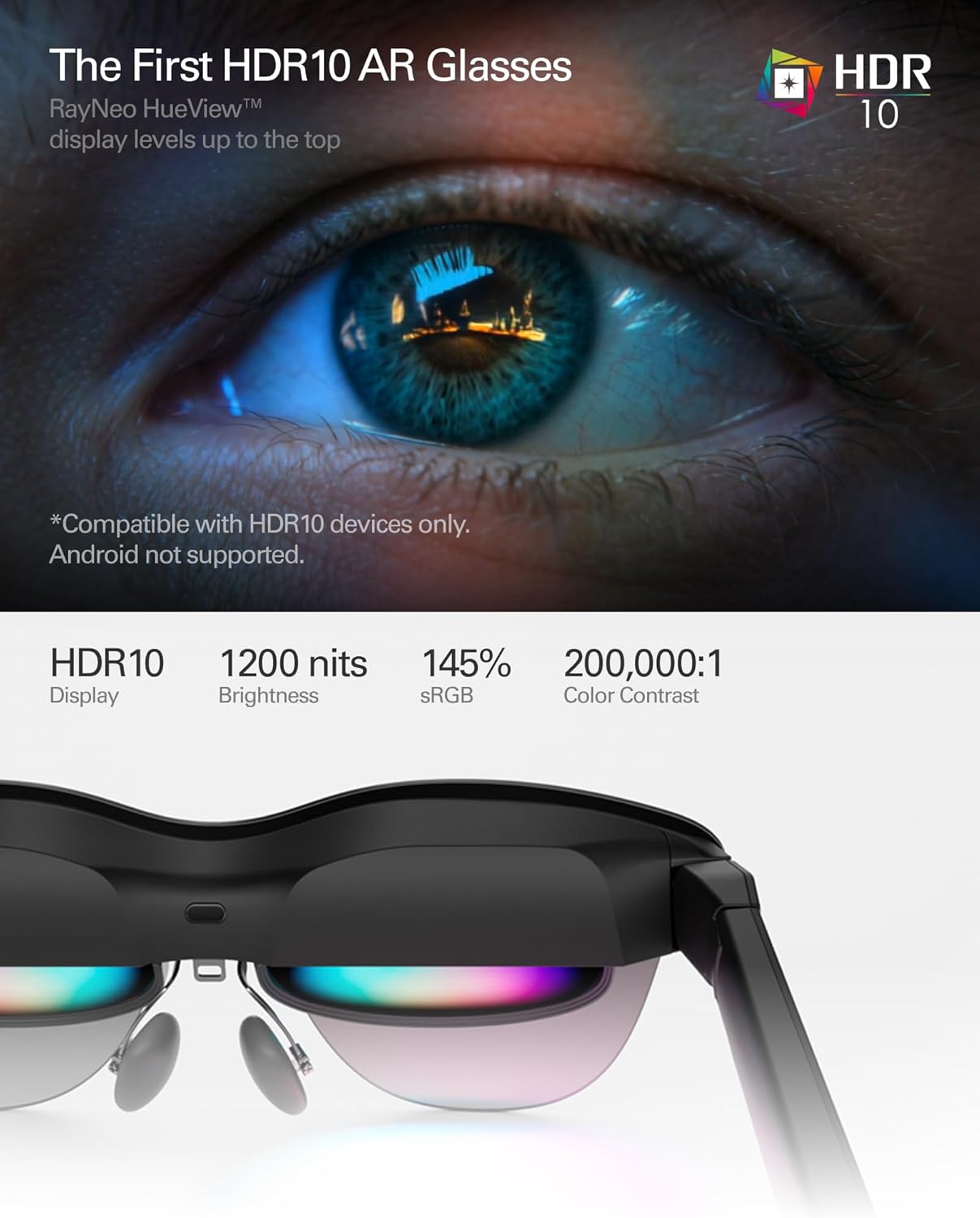
Image quality & gaming: very decent, HDR is the main selling point
What these glasses actually do (and don’t do)
Pros
- Very good image quality with HDR10 and 120 Hz for movies and gaming
- Plug‑and‑play over USB‑C with many devices (when they support video out)
- Lightweight compared to VR headsets and usable for travel or late‑night viewing
Cons
- Always tethered by a cable and fully dependent on another device
- Comfort becomes an issue after longer sessions, especially on the nose
- Needs extra adapters/accessories for some phones and for better audio isolation

Specifications
View full product page →| Brand | RayNeo |
AR glasses that try to replace your TV
I’ve been using the RayNeo Air 4 Pro for a bit as my "lazy couch cinema" setup, mostly plugged into a smartphone and a gaming laptop. On paper, it ticks a lot of boxes: HDR10, 120 Hz, 3D support, audio tuned by Bang & Olufsen, and a huge "201-inch" virtual screen. In reality, it’s less flashy: it’s a pair of display glasses that show whatever your device sends over USB‑C. No built‑in apps, no standalone use, so you always depend on another device.
My main goal was clear: replace watching Netflix and YouTube on a small phone screen in bed, and test it with some PC and PS5 gaming. I’ve owned or tried a few similar glasses (Xreal/Air-style products), so I wasn’t going in blind. I had some idea of what works well (comfort, focus, brightness) and what usually annoys me (cables, compatibility, and motion sickness in 3D).
Overall, the RayNeo Air 4 Pro is a pretty solid media viewer, especially for HDR movies and bright, colorful content. But you have to be ready for some compromises: the cable is always there, the fit won’t suit everyone, and depending on your phone or console you might need extra adapters that aren’t in the box. The Amazon average of 3.8/5 feels about right: not terrible, not magical, just a decent but imperfect product.
If you expect a full AR headset or a Meta Quest-style device, this is not it. Think of it more as a personal cinema screen with some 3D tricks and decent audio. For travel, late‑night viewing, or using a big screen without bothering anyone, it does the job. For anything beyond that, you’ll start to notice its limits pretty quickly.
Audio by Bang & Olufsen: good, but don’t expect full headphones
The audio side is marketed heavily with the Bang & Olufsen name and "4 precision speakers" for 360° spatial sound. In practice, the sound quality is good for open‑ear speakers, but it doesn’t replace real over‑ear or in‑ear headphones. Voices are clear, effects in movies are well separated, and for casual gaming it does the job. Bass is present but not very deep; you feel it more as a light thump than real rumble.
The open‑ear design has one big advantage: you stay aware of your surroundings. I could still hear someone talking to me in the room or a doorbell ringing. The downside is obvious: sound leaks both ways. People next to you will hear your movie or game at medium to high volume, especially in a quiet room. On a train or plane, it’s okay if you keep the volume moderate, but for total privacy you’ll want to plug in separate earphones instead.
RayNeo sells a "Sound Tube" accessory that’s supposed to channel the audio more directly into your ears and boost volume and clarity. I didn’t have that accessory, so I can’t judge it directly, but I can see why they made it. The built‑in speakers are fine, but if you really care about punchy audio or you watch a lot of content in noisy environments, you’ll probably find them a bit weak. For late‑night watching in bed with low ambient noise, they’re totally acceptable and even nice because your ears stay open and don’t get sweaty.
As for the spatial sound claims: you do get a bit of stereo and directional feeling, but it’s not some magical surround bubble. It’s more like a decent wide stereo soundstage. Overall, I’d rate the audio as better than average for glasses, but clearly below even mid‑range dedicated headphones. If you set your expectations accordingly, you won’t be too annoyed.
Value for money: good features, but not cheap and not perfect
Looking at the price bracket and the 3.8/5 Amazon rating, the RayNeo Air 4 Pro sits in that awkward middle: more expensive than basic display glasses, cheaper than full AR/VR headsets, and delivering a mix of strengths and annoyances. You’re paying for HDR10, 120 Hz, the Vision 4000 chip, and the Bang & Olufsen‑tuned audio. If you actually care about HDR movies and plan to use it a lot for media, there is some value there compared to older non‑HDR models.
On the other hand, there are hidden costs: if your iPhone doesn’t have native USB‑C video out or you’re on an older model, you’ll need an extra adapter or hub, often sold separately and not cheap. Same for the "Sound Tube" if you want better audio isolation, or prescription inserts if your eyesight isn’t perfect. So the real cost of a comfortable, complete setup can creep up pretty fast.
Compared to competitors like Xreal‑style glasses, the main extra here is HDR10 and the AI processing. If that matters to you and you watch a lot of HDR content, the RayNeo makes more sense. If you just want a big 1080p screen for occasional Netflix or some gaming, there are sometimes cheaper options that will be "good enough" without the fancy processing. Comfort is also similar to other models: okay but not flawless, so you’re not getting a big advantage there.
In short, value is decent but not mind‑blowing. If you know exactly why you want HDR glasses and you’re okay dealing with cables and adapters, the money feels somewhat justified. If you’re just curious and not sure you’ll use them often, I’d either wait for a discount or look at cheaper alternatives before jumping in.
Design: looks okay, but still obviously gadget glasses
Design‑wise, the RayNeo Air 4 Pro looks like a slightly chunky pair of sunglasses with a thicker front frame to house the displays and optics. Color is just "Air 4 Pro" (basically black/very dark), so no fancy options. On the face they don’t look ridiculous, but you can’t really pass them off as normal glasses if someone is standing close. For home, hotel rooms, or planes, that’s fine. I wouldn’t walk around outside with them for long; you can see the cable, and your view of the real world is dimmed.
The build feels mostly plastic, with some metal in the hinges and the temples. It doesn’t feel cheap to the point of breaking in your hands, but it also doesn’t feel like a premium metal frame. It’s in that "decent consumer electronics" zone. The weight is around 76 g, which is okay for this kind of device. Not feather‑light, but lighter than a full VR headset. Most of the bulk is in the front, where the displays are, so balance matters a lot for comfort.
The cable plugs into one of the temples via USB‑C. It’s not detachable on both ends (one end is fixed), so if the cable dies, you’ll probably have to replace the whole thing or go through support. The cable length is enough for handhelds and laptops on your lap, but for a desktop tower under a desk, it can feel short unless you use an extension. There are small vents and speaker grilles along the temples, plus the Bang & Olufsen branding, which is nice but doesn’t change much in daily use.
One thing I liked is that there are adjustable nose pads and the frame has some flex, so you can tweak the angle and how it sits on your face. This matters a lot because a few millimeters up or down can change how sharp and centered the image looks. Overall, design is okay: practical, not pretty. It looks like a piece of tech, and that’s exactly what it is.
Battery & power: depends entirely on what you plug it into
The RayNeo Air 4 Pro itself has no internal battery, which simplifies some things and complicates others. Power comes directly from the device you connect via USB‑C. That means no charging the glasses, no separate charger to carry, and they’re always ready as long as your phone, laptop, or console has juice. On the flip side, they drain your source device faster, and there’s no way around that.
On my Android phone, I noticed a pretty clear hit to battery life. Streaming video over Wi‑Fi with the glasses plugged in drained roughly 30–40% faster than without them. On a long train ride, that’s something you really feel. With a laptop or Steam Deck, it’s less of a problem because those devices already have bigger batteries, but it still shortens your usable time. If you’re planning to use these mainly with a phone, I’d seriously consider carrying a power bank.
There’s also the question of heat. Because all the work is done by the connected device, the glasses themselves stay reasonably cool, but my phone got noticeably warmer during long HDR streaming sessions. It didn’t overheat or shut down, but it’s something to keep in mind if your phone already runs hot with normal use. With a laptop, the fans will spin up a bit more, but that’s normal.
So in terms of "battery", the verdict is simple: the glasses are battery‑free, which is convenient, but they borrow autonomy from whatever you plug them into. If you’re okay managing that with power banks or plugging into the wall, it’s fine. If you wanted a totally self‑contained device you can use for hours without caring about your phone’s battery, this is not that product.
Comfort: fine for an episode, borderline for a full season
Comfort is always the tricky part with this type of glasses, and the RayNeo Air 4 Pro is no exception. The 76 g weight is reasonable, but because most of it is on the front, you feel it on the bridge of your nose after a while. The adjustable nose pads help a lot; I had to spend a good 10 minutes playing with them on the first day to find a position where the image was centered and my nose didn’t feel crushed. Once dialed in, I could watch a full movie, but I still felt some pressure afterwards.
The temples are flexible and don’t clamp too hard, which is good if you have a wider head. On the flip side, the grip is a bit loose if you lean forward or move quickly. I wouldn’t game standing up with these, but for sitting or lying in bed they stayed in place. If you already wear prescription glasses, you’ll either need clip‑in lenses (if available) or contact lenses. Wearing them over normal glasses is basically a no‑go; it’s awkward and uncomfortable.
For longer use, I’d say 1–2 hours is fine, beyond that you start to notice neck and nose fatigue. I did a 3‑hour gaming session on a laptop and had to take short breaks every hour. Compared to a full VR headset, it’s lighter and less sweaty, but compared to just looking at a TV, it’s obviously more demanding. The open‑ear design helps a bit with heat; there’s no big cushion trapping warmth around your face.
Eye comfort is a mixed bag. The low blue light and flicker‑free claims are nice, and I didn’t get classic screen headache, but because you’re focusing on a fixed optical distance, some people might feel eye strain after a while. I’m used to screens, so it was manageable, but I can see why some reviewers might complain about discomfort. If you’re sensitive, I’d keep sessions shorter at the start and see how your eyes react before using it all evening.
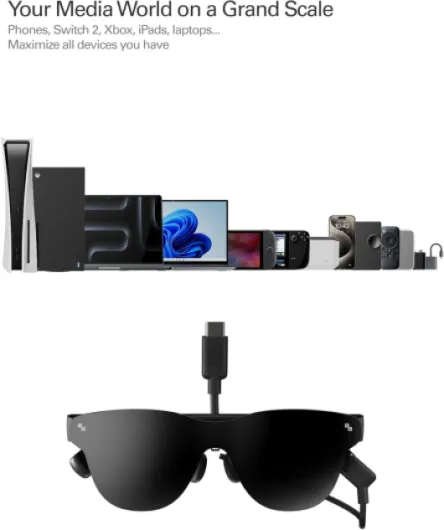
Image quality & gaming: very decent, HDR is the main selling point
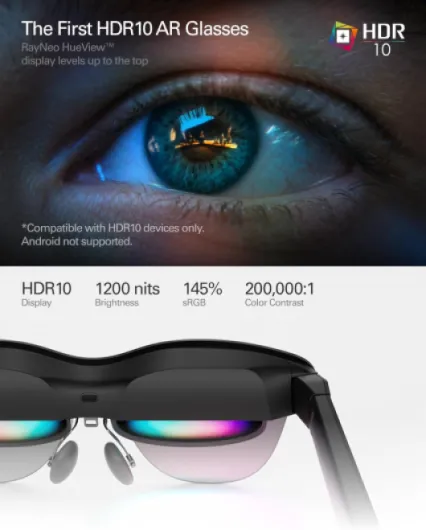
On the image quality side, this is where the Air 4 Pro is actually pretty good. The OLED panel, 1920×1080 per eye and support for HDR10 make movies and games look sharp and colorful. Blacks are deep, and HDR content from Netflix and Disney+ (through a compatible device) really shows more contrast than older AR glasses I’ve tried. The claimed "over 10 billion colors" is marketing, but in practice the gradients look clean and I didn’t notice obvious banding.
The 120 Hz refresh rate is also a plus for gaming. On my gaming laptop and Steam Deck, fast‑paced games felt smooth with less motion blur than at 60 Hz. Of course, you’re still limited by what your hardware can output, but the glasses themselves don’t seem to be the bottleneck. Input lag felt acceptable for casual and even some competitive gaming; I wouldn’t use it for top‑tier esports, but for single‑player or casual multiplayer, it’s fine.
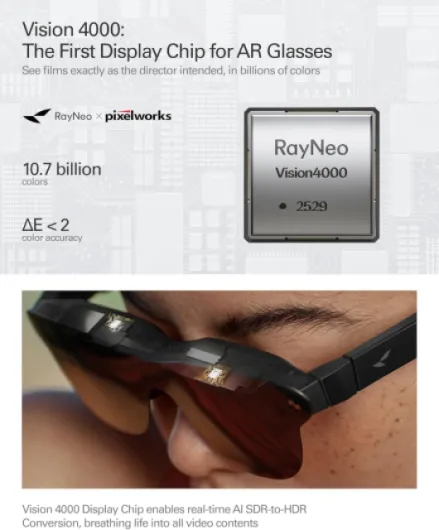
The AI SDR‑to‑HDR upscaling is one of those things you notice more when you toggle it off and on. Some older shows and YouTube videos looked a bit flatter without it. With it on, highlights and shadows get a small bump, sometimes a bit too much, but mostly in a good way. It’s not like turning an old DVD into 4K, but it does make content look less washed out. The 2D‑to‑3D conversion is more hit‑and‑miss: cartoons and slower movies benefit the most, while fast action scenes can look weird or give a slight headache if you pay too much attention.
One limitation: brightness is good enough indoors and on a plane, but in a very bright room or near a window during the day, you’ll wish it could go a bit higher. With the optional light shield (if you get or improvise one) it’s better. For nighttime use, it’s totally fine and you’ll probably even lower the brightness. So in short, performance is pretty solid for movies and gaming, with HDR being the main reason to pick this over cheaper, older models.
What these glasses actually do (and don’t do)
The RayNeo Air 4 Pro is basically a head‑mounted external monitor. You plug it into a device over USB‑C, and it mirrors or extends that screen into your field of view. No battery inside, no Android system, no app store. Everything depends on the phone, PC, console, or handheld you connect. Officially it supports Android, iPhone (with the right adapter), Mac, Steam Deck, Switch, and PS4/PS5. In practice, how smooth it is depends heavily on what you plug in.
The advertised 201-inch virtual screen is marketing speak. In reality, it feels like sitting in the mid‑rows of a decent cinema: big enough to be immersive, but obviously it’s still a projected image in front of you. The resolution per eye is 1920×1080 at up to 120 Hz, with HDR10 support. That’s good for movies and gaming, and the HDR part does make a visible difference in contrast compared to older non‑HDR glasses I’ve tried.
They also push the Vision 4000 chip for AI processing: SDR‑to‑HDR upscaling and 2D‑to‑3D conversion. This is not magic, but it does give a little boost to older or flatter content. Some YouTube videos looked a bit more punchy, and the fake 3D effect works okay on certain movies and anime, less so on busy action scenes where it can look a bit off. There’s also support for native 3D content if you have the right files or apps.
Important to understand: there’s no real mixed reality like passthrough cameras or hand tracking. They mention inside‑out tracking and sensors, but as a user you mostly just get head‑tracking style stability. You’re not placing windows in your living room like with a full AR headset. If you go in thinking "big private screen" instead of "future AR helmet", you’ll be a lot less disappointed and the product will make more sense.
Pros
- Very good image quality with HDR10 and 120 Hz for movies and gaming
- Plug‑and‑play over USB‑C with many devices (when they support video out)
- Lightweight compared to VR headsets and usable for travel or late‑night viewing
Cons
- Always tethered by a cable and fully dependent on another device
- Comfort becomes an issue after longer sessions, especially on the nose
- Needs extra adapters/accessories for some phones and for better audio isolation
Conclusion
Editor's rating
After spending real time with the RayNeo Air 4 Pro, I’d describe it as a solid personal cinema screen with some nice extras, not a revolution. The image quality with HDR10 and 120 Hz is genuinely good, especially for movies and bright games. Blacks are deep, colors pop, and the size of the virtual screen is big enough to feel immersive without being ridiculous. For late‑night Netflix, anime, or single‑player gaming sessions, it gets the job done and can even feel pretty cozy.
Where it falls short is mostly in comfort, ecosystem, and expectations. You’re always tethered by a cable, there’s no standalone mode, and comfort is fine for 1–2 hours but not ideal for marathons. Audio is better than average for open‑ear speakers but still far from proper headphones. And if your phone or console setup isn’t perfectly compatible out of the box, you’ll be buying extra adapters. The 3D and AI upscaling are nice toys, but not life‑changing; you’ll probably use them sometimes, not all the time.
I’d recommend the Air 4 Pro to people who already know they like this kind of device: frequent travelers, folks who share a small space and don’t want a big TV, or gamers who want a private screen without wearing a full VR helmet. If you’re just curious or very sensitive to comfort issues, I’d either try it with a good return policy or hold off. It’s a good but imperfect product that suits a specific use case rather than a one‑size‑fits‑all solution.