
Summary
Editor's rating
Value: good for very specific users, questionable for others
Design: cool little brick, not great in the hand
Battery life & connectivity: usable, but bring spares and a power bank
Materials & build: feels more plastic than the price suggests
Durability & everyday use: feels more like a B-cam than a workhorse
Performance: solid image quality, AF finally decent, but some limits
What the Lumix S9 actually is (and isn’t)
Pros
- Compact full-frame body with good 6K open gate and 4K 10-bit video options
- Phase detect AF and in-body stabilisation work well for vlogging and casual shooting
- Strong phone integration via Lumix Lab app with fast 5 GHz Wi‑Fi and Real Time LUT support
Cons
- Plasticky feel, minimal controls, and no hot shoe despite the high body-only price
- 12-bit RAW instead of 14-bit reduces flexibility for heavy photo editing
- No charger or USB-C cable included; average battery life means extra cost for spares

Specifications
View full product page →| Brand | Panasonic |
A full-frame vlogging brick you’ll either like or return quickly
I’ve been using the Panasonic Lumix S9 (body only, Smokey White) for a couple of weeks as a small walkaround and vlogging camera alongside a bigger body (S5II borrowed from a friend). I shoot both photos and video for work and travel, nothing fancy, but I’m picky with usability. I bought it mainly because I wanted something full-frame, small, and easy to throw in a sling bag with one compact L-mount lens.
On paper, the S9 checks a lot of boxes: 24.2MP full-frame sensor, 6K/4K video, phase detect AF, in-body stabilisation, flip screen, and a very compact body. Add the whole “open gate” thing and the new Lumix Lab app with quick transfer, and it sounds like the perfect little content camera. That’s the theory.
In practice, it’s a bit more mixed. Image quality is pretty solid, the stabilisation is genuinely useful, and the autofocus is finally good enough on Panasonic for casual use and talking-head videos. But the body feels more like a stylish gadget than a serious work tool. The lack of a proper grip, no hot shoe, and some weird omissions (no charger or cable in the box, 12-bit RAW only) make it feel slightly compromised.
So this review is basically: if you’re a vlogger or travel shooter who values size and looks, the S9 might make sense. If you’re more into photography or need more control and ergonomics, you’re probably better off with something like the S5II/S5IIX or even a different brand. I’ll break down what worked for me and what annoyed me so you can see where you fall.
Value: good for very specific users, questionable for others
Let’s be blunt: for almost £1K body only, the S9 sits in a crowded price range. You can get a Panasonic S5II for not much more if you catch a deal, and that camera gives you better build quality, more controls, a viewfinder, and stronger overall flexibility. Or you can look at alternatives like the Sigma fp / fp L if you want a small full-frame box with 14-bit RAW. So the S9 isn’t automatically good value just because it’s small and full-frame.
Where it starts to make more sense is if you specifically want a compact full-frame vlogging camera with open gate recording and strong app integration. If your workflow is: shoot clips, send to phone, edit quickly, post to social, then the S9 actually lines up pretty well. The open gate MP4 Lite mode, Real Time LUTs, and fast 5 GHz Wi‑Fi transfers are genuinely helpful. In that use case, the compromises in build and 12-bit RAW hurt less, because you’re not trying to squeeze every last bit of quality out of stills.
However, once you factor in: body price + at least one L-mount lens + extra batteries + maybe a cage or mic mount (since there’s no hot shoe), the total cost climbs quickly. At that point, you really need to be honest with yourself about how much you value the small size and phone-focused workflow compared to a slightly bigger but more complete camera like the S5II.
So for value, I’d say: good for the right user, mediocre for everyone else. If you already own L-mount glass, want a small B-cam for video and travel, and care a lot about social media output, the S9 is a decent buy. If you’re starting from scratch or care more about photography and ergonomics, there are better ways to spend this amount of money.
Design: cool little brick, not great in the hand
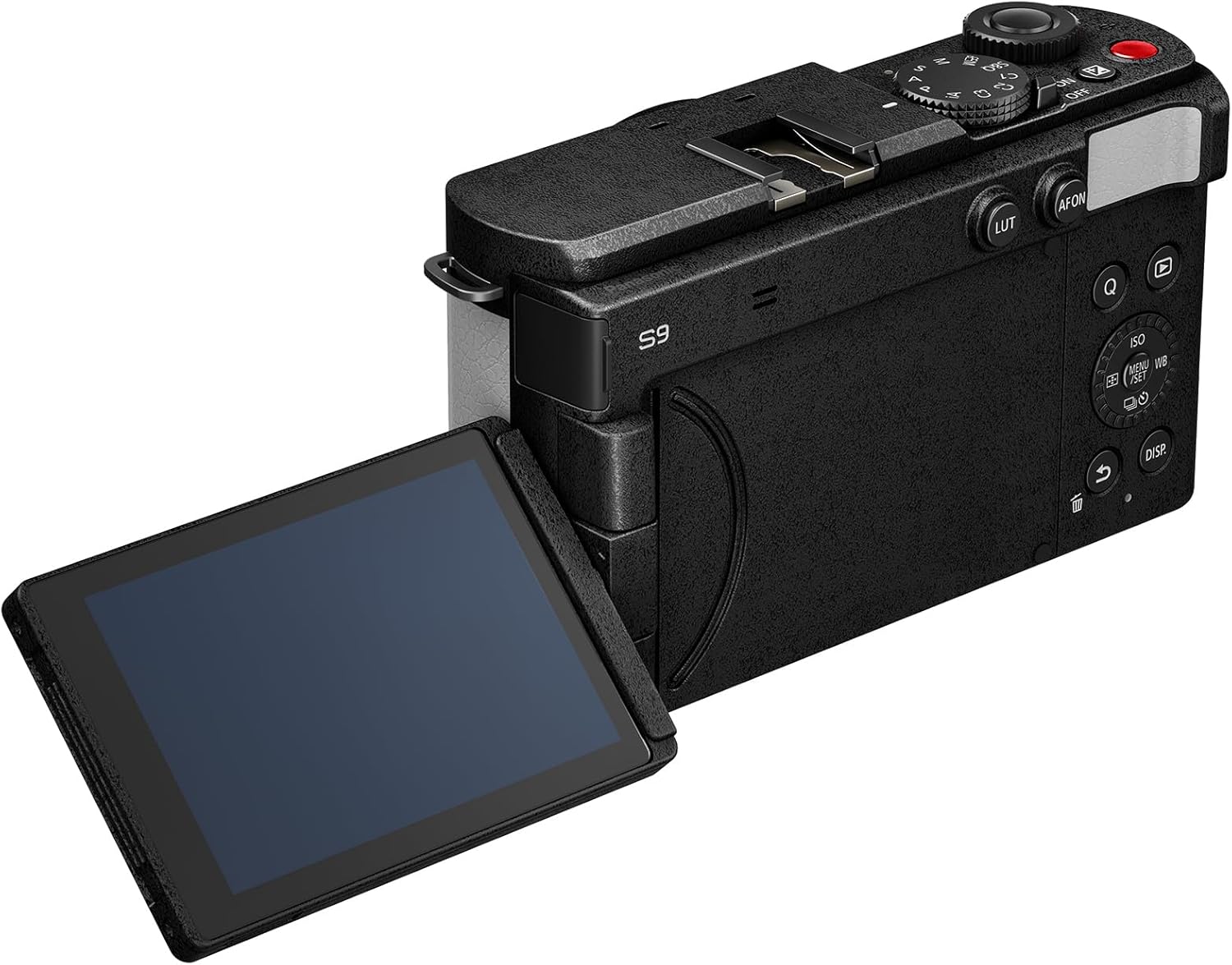
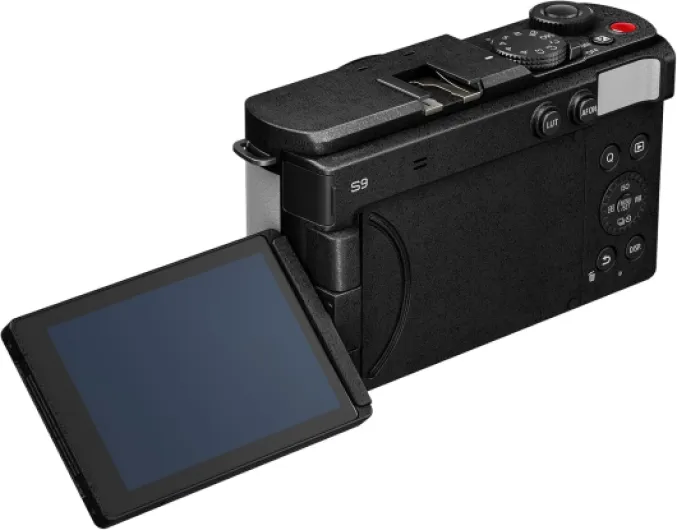
Design-wise, the S9 looks like a retro-ish compact box with a lens mount slapped on. The Smokey White version I used definitely stands out compared to the usual black cameras. It looks more like a lifestyle gadget than a tool, which some people will like. On a table or in photos, it looks pretty clean. In the hand, you quickly notice the compromises. There’s basically no real grip, just a slightly textured front, so with anything bigger than a tiny prime lens it feels a bit sketchy to hold one-handed.
One thing that really annoyed me: there’s no hot shoe on top. That means no standard on-camera flash, no easy way to mount a shotgun mic or wireless receiver up there, and no simple on-camera trigger for certain accessories. For a camera clearly marketed at vloggers, that’s a weird omission. You’re forced to use cages, side mounts, or other add-ons if you want to build a small video rig, which kind of kills the compact simplicity.
The button layout is very minimal, almost too minimal. If you’re used to Panasonic’s higher-end bodies with lots of dials and custom buttons, this feels stripped down. You can still get the job done, but you end up diving into menus more often than you’d like. Changing some video settings or AF modes while shooting feels slower than it should be. For basic vlog use it’s fine, but I wouldn’t want this as my only camera on a fast-paced job.
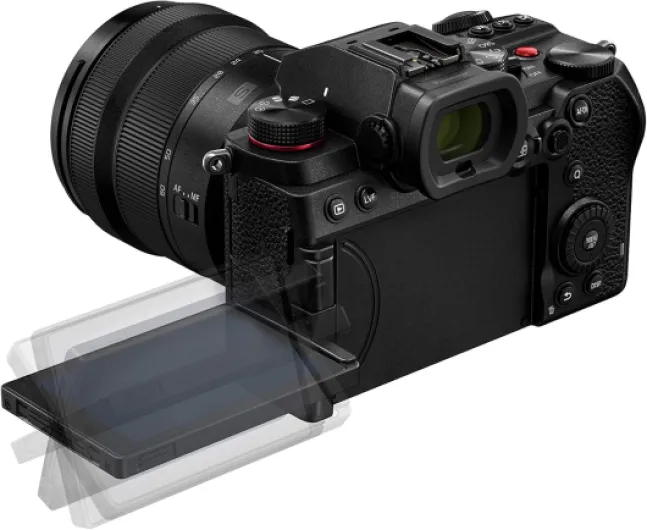
The free-angle screen is one of the design highlights. It flips fully forward, which is great for vlogging and low/high angle shooting. The OLED panel is decent, not mind-blowing, but good enough outdoors most of the time. Overall, the design is compact and nice to look at, but if you prioritise handling and expandability over style, it’s a bit of a letdown. It feels like Panasonic leaned more into looks and compactness than pure usability.
Battery life & connectivity: usable, but bring spares and a power bank
Battery life on the S9 is okay but not great. It’s a small body running full-frame 6K/4K video, so I wasn’t expecting miracles. In my use, doing a mix of short 4K clips, some open gate tests, and stills, I was getting roughly a half day of active shooting on one battery before I started getting nervous. If you’re vlogging a lot or recording longer talking-head segments, I’d say plan on two to three batteries for a full day. For occasional clips and mostly photos, one battery might get you through, but it’s tight.
The good part is USB-C charging. You can top it up from a power bank, laptop charger, or wall adapter, which is handy when travelling. The annoying part is that Panasonic doesn’t include a charger or even a USB-C cable in the box. If this is your first camera, that’s pretty frustrating. I ended up using a laptop USB-C cable and a 65W GaN charger I already had. It works, but out of the box experience feels cheap for the price.
On the connectivity side, the 5 GHz Wi‑Fi and Bluetooth combo with the new LUMIX Lab app is actually one of the nicer parts. Transfer speeds to my phone were much faster than older apps I’ve used. I could shoot a clip, send it to my phone, apply a LUT or crop for vertical, and have it ready for Instagram or TikTok in a couple of minutes. It’s one of the few cameras where I didn’t immediately hate the app experience, which says a lot.
So overall, battery and connectivity are good enough, but you need to budget for extra batteries and probably a proper charger if you don’t like charging in-body. If you’re used to DSLRs that last all day on one battery, this will feel like a step down. If you’re coming from other mirrorless video-focused bodies, it’s roughly in the same ballpark, just with that extra annoyance of the empty box accessories-wise.
Materials & build: feels more plastic than the price suggests
Let’s talk feel. For a body that costs close to four figures without a lens, the S9 doesn’t give off a very premium vibe. The outer shell feels quite plasticky, especially compared to an S5II or other mid-range mirrorless bodies. It doesn’t feel like a toy, but it also doesn’t give that reassuring solid feel you might expect at this price. If you’ve handled Panasonic’s S-series before, you’ll notice the downgrade right away.
The dials and buttons are okay, but nothing special. The click on the main dial is decent, but some of the smaller buttons feel a bit shallow. They work, I never had misfires, but they don’t scream durability. The hinge on the articulating screen actually feels better than I expected though. I flipped it around a lot for vlogging and low angles, and it never felt like it was about to snap. So while the camera feels light and plasticky, that particular part seems solid.
Where the cost-cutting really shows is in what’s not included: no USB-C cable, no AC adapter, no battery charger, nothing. You get the body and the battery, and that’s basically it. Panasonic pitches this as an eco move, encouraging you to reuse chargers and cables, which is fair on one level, but at this price it still feels a bit cheap. If this is your first camera or you don’t have a pile of USB-C chargers lying around, you’re instantly forced to spend more.
Overall, the materials are fine but underwhelming. The upside is that the camera ends up pretty light, which is nice for travel and vlogging arms. The downside is you never quite forget that you’re holding a more budget-feeling body that costs more than it feels. If build quality and tactile feel matter to you, that’s something to think about before pulling the trigger.
Durability & everyday use: feels more like a B-cam than a workhorse
I haven’t abused the S9 for months, but in the couple of weeks I had it, I used it like I normally would: tossed in a sling bag, carried without a case, used in light drizzle once, and bumped around a bit in a car. It held up fine, no creaks, no weird flex, and the articulating screen stayed tight. So in normal use, it behaves okay, but you can tell it’s not built like a tank. There’s no mention of serious weather sealing, and I wouldn’t trust it in heavy rain or dusty environments without extra protection.
The finish on the Smokey White version looks nice out of the box, but I can see it picking up marks and scuffs faster than a plain black body. After a short time, I already noticed small signs of use along the edges where it rubbed against my bag. Nothing dramatic, but if you want it to stay pristine, you’ll probably end up babying it or buying a case or cage, which again adds bulk to a camera that’s supposed to be small.
Because of the minimal grip and plastic feel, I was always a bit cautious using heavier lenses. With a compact prime like a Sigma Contemporary, it’s fine. With something bigger, it feels front-heavy and slightly unbalanced, which doesn’t inspire long-term confidence. It’s one of those cameras that feels better as a B-cam or travel camera than your main workhorse body.
So in terms of durability, I’d call it decent but not bulletproof. It’ll handle normal daily use, trips, and vlogging just fine if you’re not reckless. But if you work in tougher conditions or you’re rough on your gear, I’d lean towards something like the S5II instead. The S9 feels more like a stylish, compact companion than the camera you want to rely on as your only body for paid gigs in bad conditions.
Performance: solid image quality, AF finally decent, but some limits
In terms of pure image quality, the S9 is pretty solid. The 24.2MP full-frame sensor delivers clean files with good dynamic range for everyday use. At low ISO, JPEGs look nice straight out of camera, and the colours are typical Panasonic: a bit neutral, which I actually like because it’s easy to tweak later. The issue for me is the 12-bit RAW limitation. When I tried to rescue badly exposed shots or push shadows hard, I could feel less flexibility compared to 14-bit files from other cameras I’ve used. Not a disaster, but noticeable if you like heavy editing.
Autofocus is where Panasonic historically lagged behind, but here the phase hybrid AF with 779 points is actually pretty decent. Face and eye detection for humans worked well in normal light, and it did an okay job with pets too. For vlogging, it kept me in focus most of the time, even when I moved closer to the lens. In low light, it’s not perfect; I had a few micro-hunts and random misses, but nothing like older contrast-only Panasonic AF. For casual and semi-serious video, I’d say it’s good enough.
Video performance is the main reason to buy this. 6K open gate and 4K 10-bit recording give you plenty of resolution and flexibility. Open gate is genuinely useful if you’re shooting once and exporting to multiple aspect ratios for different platforms. The files look clean, and pairing that with Real Time LUT means you can bake in your look if you want a quick turnaround. For a small travel or B-cam, it works well. Rolling shutter is present in 6K if you whip pan like crazy, but it didn’t ruin my footage in normal use.
One thing to note: this camera is clearly tuned for video-first workflows. If you’re mainly a stills photographer, you’ll probably feel like you’re giving up a bit in RAW depth, ergonomics, and viewfinder use (or lack of it if you expected one). For hybrid shooters who lean towards video, though, the performance is decent, especially if you already live in the L-mount ecosystem and want a smaller body to match your lenses.
What the Lumix S9 actually is (and isn’t)
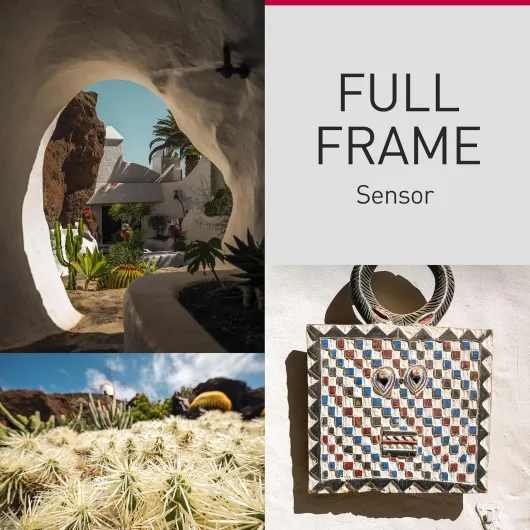
The Lumix S9 is basically Panasonic’s smallest full-frame L-mount body aimed at vloggers and content creators. It uses a 24.2MP full-frame CMOS sensor, very similar to what’s in the S5II line, with 10-bit video up to 6K (open gate) and 4K modes. It has 779-point phase hybrid autofocus, in-body image stabilisation, and a fully articulating 3" screen. There’s built-in Wi‑Fi (including 5 GHz) and Bluetooth, and it’s designed to work closely with the new LUMIX Lab smartphone app for quick transfer and LUT handling.
Important point: this is sold here as body only. Despite the listing mentioning 24–70mm, you do NOT get a lens in the box. It’s L-mount, so you’ll be pairing it with Panasonic, Sigma, or Leica lenses. If you don’t already own L-mount glass, factor in at least one compact lens into your budget; otherwise this is just an expensive white brick on your desk.
The camera can shoot stills in RAW and JPEG, but RAW is limited to 12-bit, which annoyed me more than I expected once I started pushing shadows and highlights in Lightroom. Compared to something like the S5II or even the Sigma fp L, you lose a bit of flexibility in heavy edits. For casual shooting it’s fine, but if you like to really push files, it’s a step down.
Feature-wise, it’s clearly tuned for video and social media: open gate MP4 Lite mode, easy aspect ratio changes in the app, and Real Time LUT support so you can load your own looks directly into the camera. For someone who mostly posts to TikTok/Reels/YouTube Shorts, this all makes sense. For a more traditional photographer who wants a viewfinder, a good grip, and deep customisation, this feels like a secondary body at best.
Pros
- Compact full-frame body with good 6K open gate and 4K 10-bit video options
- Phase detect AF and in-body stabilisation work well for vlogging and casual shooting
- Strong phone integration via Lumix Lab app with fast 5 GHz Wi‑Fi and Real Time LUT support
Cons
- Plasticky feel, minimal controls, and no hot shoe despite the high body-only price
- 12-bit RAW instead of 14-bit reduces flexibility for heavy photo editing
- No charger or USB-C cable included; average battery life means extra cost for spares
Conclusion
Editor's rating
The Panasonic Lumix S9 is a compact full-frame camera that clearly targets vloggers and social media creators more than traditional photographers. The good parts are easy to see: solid 24.2MP image quality, usable phase-detect autofocus, effective in-body stabilisation, and strong video options including 6K open gate and 4K 10-bit. The Real Time LUT feature and the new Lumix Lab app with fast 5 GHz Wi‑Fi make it surprisingly quick to shoot, transfer, tweak, and post from your phone. As a small travel or B-cam in the L-mount ecosystem, it does its job.
The trade-offs are also pretty clear. The body feels more plastic than the price suggests, there’s no hot shoe, ergonomics are basic, and RAW is limited to 12-bit. Panasonic doesn’t include a charger or even a USB-C cable, which is annoying at this price point. Battery life is average and you’ll want spares. Compared to an S5II, you give up build quality, controls, and some flexibility just to save size and gain the more lifestyle-focused design.
I’d recommend the S9 to people who mainly shoot video for TikTok, Reels, and YouTube, already use L-mount lenses, and really want a small, light body with good stabilisation and quick phone integration. It’s also fine as a light B-cam for Lumix shooters. If you’re more into stills, want a tougher body, or are buying your first serious camera, I’d steer you towards the S5II/S5IIX or other similarly priced bodies instead. The S9 isn’t bad, but it’s quite niche, and you need to match that niche for it to feel like money well spent.