
Summary
Editor's rating
Value for money: good body, basic kit lens, and some trade-offs
Design: compact, nice in hand, but a bit stripped down
Battery life: fine for casual use, weak for long shoots
Performance: autofocus and image quality are the strong points
What you actually get with the EOS R8 kit
Effectiveness for real use: photos, video and streaming
Pros
- Light full-frame body with good ergonomics and flip screen
- Autofocus is fast and reliable for people, animals and basic action
- 4K60 video, webcam over USB and good out-of-camera colours for content creation
Cons
- No in-body image stabilisation and basic, slow kit lens
- Battery life is average, extra batteries or power bank are basically required for heavy use

Specifications
View full product page →| Brand | Canon |
A small full-frame that doesn’t feel like a brick
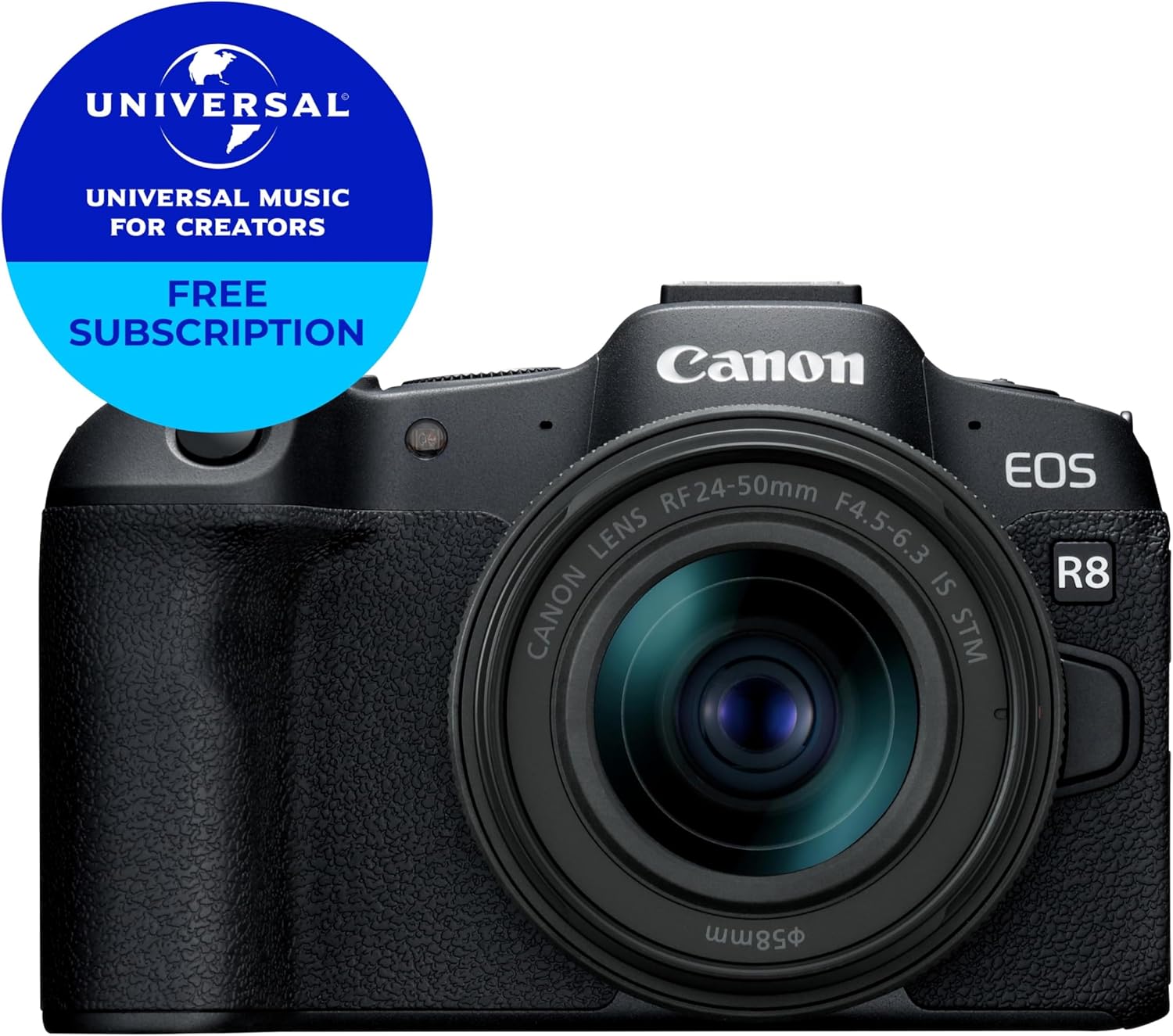
I’ve been using the Canon EOS R8 with the RF 24–50mm kit lens for a couple of weeks, mainly for family stuff, a bit of street, and some basic video and streaming. I usually shoot with APS‑C cameras, so going back to full-frame in such a light body was the first thing that surprised me. It really doesn’t feel like the usual heavy full-frame setup you drag around and regret after two hours.
From day one, what stood out was how easy it is to get sharp shots. The Dual Pixel AF II is fast and sticks to faces and eyes without much menu fiddling. I took it to a birthday party indoors, mixed lighting, kids running everywhere, and still got a good hit rate without fighting the camera. For someone who doesn’t want to spend the whole evening tweaking settings, that’s a big plus.
On video, I used it for a couple of 4K clips and one short live stream as a webcam via USB. The camera handled that pretty well. No weird drivers, just plug into the PC and it shows up. For people doing YouTube, Twitch or Teams calls with something better than a laptop cam, that feature alone is pretty handy.
It’s not perfect though. The kit lens is clearly entry-level, the body has no in-body stabilisation, and the battery isn’t the strongest. So you get good image quality and autofocus, but there are a few compromises that you feel once you start using it regularly. Overall, I’d say it’s a pretty solid all-rounder, but not the magic solution for every type of shooter.
Value for money: good body, basic kit lens, and some trade-offs
In terms of value, the EOS R8 sits in a tricky but interesting spot. You get a full-frame sensor, very good autofocus, 4K60, and a light body, which is a solid package. The downside is that Canon clearly saved money on things like the battery, the lack of IBIS, and the basic kit lens. So you’re paying mainly for the sensor and autofocus, not for a fully loaded camera with every feature.
The RF 24–50mm kit lens is okay to start with, but it’s not a lens you’ll keep forever. It’s light, the stabilisation helps, and the STM motor is quiet enough for video, but the max aperture (f/4.5–6.3) is slow. In practice, that means more noise in low light and less background blur. For someone just starting out or using it mainly outdoors, it’s fine. But if you’re a bit more serious, you’ll quickly want to add at least one brighter prime or a better zoom. That adds to the total cost of the system.
Compared to other brands, there are APS‑C options that cost less and still give you good image quality and video features. The main reason to pay for the R8 is if you really want full-frame look and better high-ISO performance in a small body. If that’s not a priority, you might find better value in cheaper APS‑C bodies with more features like IBIS or stronger batteries.
So for me, the value is decent but not mind-blowing. The body itself feels fairly priced for what it can do, but the kit lens and missing IBIS slightly drag down the overall package. If you see it as an entry ticket into Canon’s full-frame RF system and plan to invest in better lenses later, it makes sense. If you want an all-in-one package that covers every need right away, you might feel like you’re paying a bit too much for what you get in the box.
Design: compact, nice in hand, but a bit stripped down
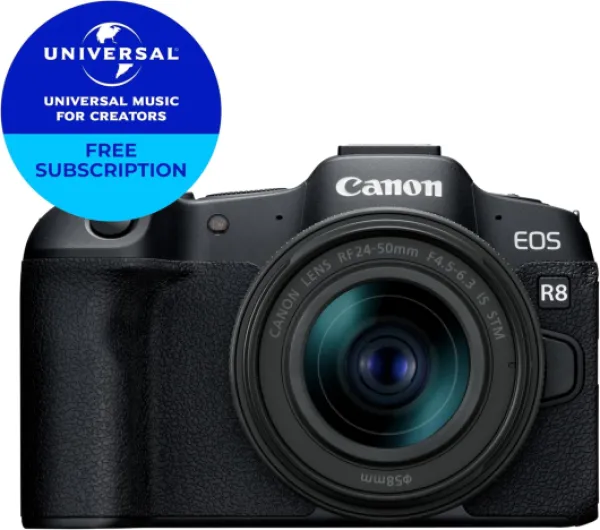
In terms of design, the EOS R8 feels more like an upgraded entry-level body than a chunky pro camera, and I don’t mean that in a bad way. It’s light (around 460 g with battery) and quite compact for a full-frame, especially with the 24–50mm mounted. I was able to throw it in a small sling bag that usually only fits my APS‑C camera and one lens. For travel, that’s a big plus: you actually take it with you instead of leaving it at home because it’s too heavy.
The grip is decent but not huge. With my medium-sized hands, it’s fine, but if you have big hands you might find your pinky hanging a bit under the body. Buttons and dials are placed in a way that’s pretty logical if you’ve used Canon before: mode dial on top, front dial by the shutter, rear dial near the thumb. The on/off switch is easy to reach. The fully articulating screen is handy for low angles, vlogging, and vertical video. No complaints there.
Where you feel the cost-cutting is in the viewfinder and some missing controls. The EVF is okay (2.36M dots), but not top tier. It does the job, but if you come from a higher-end body, you’ll see the difference in clarity and refresh rate. Also, there’s only one SD card slot and not a ton of custom buttons. For casual and semi-serious use, it’s enough. For event pros who shoot paid gigs, the single card slot can be a bit stressful.
On the outside, nothing screams luxury, but nothing feels cheap either. It’s a functional design that focuses more on being light and simple than on giving you every button under the sun. If you like a clean layout and don’t need twenty extra controls, you’ll be fine. If you’re used to bigger bodies with loads of dedicated switches, you may feel a bit limited.
Battery life: fine for casual use, weak for long shoots
The battery situation is clearly not the strongest point of the EOS R8. It uses the smaller LP‑E17 battery, which is more common in Canon’s lower and mid-range bodies. For stills, shooting on and off during a day out, I could manage a few hundred shots, but if you chimp a lot (reviewing photos often) and use the screen more than the viewfinder, you see the battery bar drop quite fast. For a full day trip, I’d definitely bring at least one spare, ideally two if you also plan to shoot video.
On video, the drain is more noticeable. Recording 4K and using features like subject detection eats into the battery pretty quickly. During a short session filming clips for social media, around 40–50 minutes of mixed shooting and standby already had me thinking about the charger. It’s okay if you do short clips, but for proper long-form recording or events, one battery is not enough, no matter how you spin it.
On the upside, you can use USB‑C to power or charge the camera, which helps if you’re near a power bank or a wall outlet. For streaming as a webcam, I just plugged it into the PC and didn’t have to worry as much. For travel, a power bank with USB‑C output is almost mandatory if you don’t like juggling multiple batteries.
So in practice: for casual photography, the battery is acceptable but nothing more. For heavy video users, it’s a weak point you have to plan around with extra batteries or external power. If you’re used to bigger cameras with chunky batteries that last all day, this will feel like a step down in endurance.
Performance: autofocus and image quality are the strong points
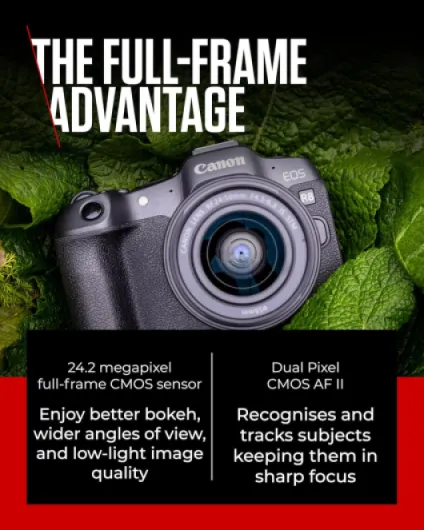
Let’s talk about how it actually performs. The 24.2 MP full-frame sensor is solid. Files have good detail, and the dynamic range is good enough for normal use and some editing. I shot a bunch of scenes with high contrast (backlit windows, cloudy skies) and could pull back shadows and highlights in RAW without the image falling apart too quickly. It’s not a huge jump over other modern 24 MP cameras, but it does what you’d expect from a recent full-frame sensor.
The Dual Pixel CMOS AF II is where the camera feels very capable. Face and eye detection works well for people, and it also recognises animals and vehicles. In practice, I pointed it at kids, a dog, and some cars on the street, and the camera usually locked onto the right subject without me having to move the focus point manually. It also tracks subjects near the edge of the frame, which is handy if you like off-centre compositions. In low light, it still focuses reliably, though not magic – it can hunt a bit with the slow kit lens.
Continuous shooting up to 40 fps with electronic shutter sounds wild. In reality, rolling shutter can appear if you pan quickly, and you’ll fill your card and buffer if you just hold the button. But for short bursts on sports or kids running, it’s very usable. The standard mechanical-like shutter speeds are more than enough for most users. Shutter speed goes down to 30s and up to 1/16000s, which covers basically everything you’ll do without ND filters in daylight.
For video, oversampled 4K up to 60p looks clean, with good detail and no obvious softness. The camera also has Canon Log 3, which is nice if you want more flexibility in colour grading. For simple projects or YouTube, straight-out-of-camera colour is already quite nice, so you don’t have to spend hours in post. The main limit for performance here is not the processor or sensor; it’s the lack of IBIS and the modest kit lens, which hold back what the body could do with better glass and stabilisation.
What you actually get with the EOS R8 kit
Out of the box, you get the EOS R8 body, the RF 24–50mm f/4.5–6.3 IS STM lens, a battery (LP‑E17), charger, strap and the usual caps and manuals. So you’re ready to shoot right away, no need to buy extra stuff just to turn it on. The camera is full-frame, 24.2 MP, and it shoots oversampled 4K up to 60p. It also does 40 fps bursts with the electronic shutter, which is impressive on paper, even if in real life you won’t spam 40 fps every day.
One important point: there’s no in-body image stabilisation (IBIS). Stabilisation is only in the lens here (up to about 4.5 stops). If you were hoping to throw on any old RF prime and have everything perfectly stable handheld, that’s not what this camera does. For stills with the kit lens, it’s okay. For video, you feel it as soon as you walk and shoot at the same time.
Connectivity-wise, you’ve got Wi‑Fi, Bluetooth, USB‑C and micro HDMI. The USB‑C port can be used for direct connection to a computer for webcam use and cloud uploads, which is practical if you don’t want to mess around with card readers all the time. It takes standard SD cards, so no need for expensive CFexpress or other formats.
Overall, in terms of features, you get a modern hybrid camera that covers photo, video, and streaming quite well. The flip side is that Canon clearly cut a few corners to keep the body small and relatively affordable: no IBIS, basic kit lens, and a mid-range battery. If you know this before buying, you won’t be surprised; if you expect a mini R6 Mark II with everything inside, you’ll feel the missing bits.
Effectiveness for real use: photos, video and streaming
In day-to-day use, the EOS R8 is very effective as a hybrid camera if you know its limits. For photos, it’s almost point-and-shoot simple once you set up the autofocus the way you like. I used it for a family gathering, some quick portraits, and a bit of street photography. Most of the time, I left it in aperture priority with auto ISO and just focused on framing. The camera handled the rest pretty well. The JPEGs look good straight out of camera, so if you don’t want to edit RAW all the time, you’re still covered.
For video, the combination of 4K60, good autofocus and flip screen makes it very practical for solo content creation. I tried a simple talking-head setup with the camera on a tripod, using face detection and the kit lens. The focus stayed locked on my face without breathing or hunting. As a webcam over USB, it’s basically plug-and-play. That’s a strong point for people who want to upgrade their online meetings or streaming quality without buying a separate capture card.
Where it’s less effective is in situations where you need stabilisation and better low-light performance from the lens. The kit lens is f/4.5–6.3, so indoors or at night you quickly end up at high ISO, and with no IBIS, you rely on lens IS and steady hands. If you plan to shoot a lot of handheld video while walking, you’ll either need a gimbal or a faster, stabilised lens. The body can handle it, but the base combo out of the box is a bit limited there.
Overall, for vlogging, casual photography, travel and streaming, the camera gets the job done with little hassle. For serious low-light work, long events, or people who want ultra-smooth handheld video, it’s workable but not ideal without extra gear. So it’s effective, but not all-purpose magic – you just have to match it to the right kind of use.
Pros
- Light full-frame body with good ergonomics and flip screen
- Autofocus is fast and reliable for people, animals and basic action
- 4K60 video, webcam over USB and good out-of-camera colours for content creation
Cons
- No in-body image stabilisation and basic, slow kit lens
- Battery life is average, extra batteries or power bank are basically required for heavy use
Conclusion
Editor's rating
After using the Canon EOS R8 + RF 24–50mm kit in real situations, I’d sum it up like this: great sensor and autofocus in a light body, held back by a basic lens, no IBIS, and average battery. For travel, everyday photos, YouTube videos and streaming, it does the job well and is easy to live with. You turn it on, point it at something, and most of the time the shot is in focus and looks good, without spending ages in the menus.
If you’re a content creator, vlogger, or hobbyist photographer who wants full-frame without carrying a brick, this combo makes sense. Just budget for at least one extra battery and, sooner or later, a better lens. If you do paid events, need dual card slots, rock-solid battery life, or rely on in-body stabilisation for video, this is not the ideal tool. In that case, you’re better off looking higher in the range or at models with IBIS and stronger batteries.