
Summary
Editor's rating
Value for money: specs look big, reality is more modest but still fair
Design & handling: feels like a small DSLR, behaves like a budget cam
Battery life & practical use: two batteries help, but don’t expect miracles
Build quality & durability: light plastic, fine if you’re careful
Image quality & autofocus: okay in good light, quickly falls apart in bad light
What this camera really is (once you ignore the marketing)
Wi‑Fi, app control & everyday usability: handy but a bit clunky
Pros
- Comes as a full kit: 2 batteries + 64GB card, ready to use out of the box
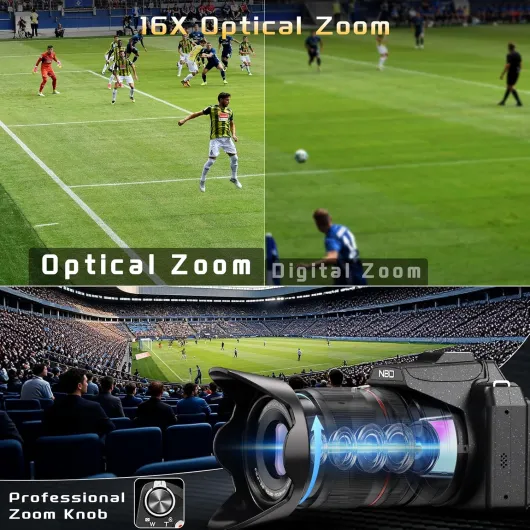
- 16x optical zoom and flip screen are genuinely useful for travel and vlogging
- Decent daylight image quality for casual photos and basic YouTube videos
Cons
- 8K and 64MP are mostly marketing; real detail and low‑light performance are modest
- Plastic build with no weather resistance; feels cheap and needs careful handling
- Autofocus and stabilization are only average, not great for fast action or walking shots

Specifications
View full product page →| Brand | NBD |
An 8K camera for this price? Let's calm down a bit
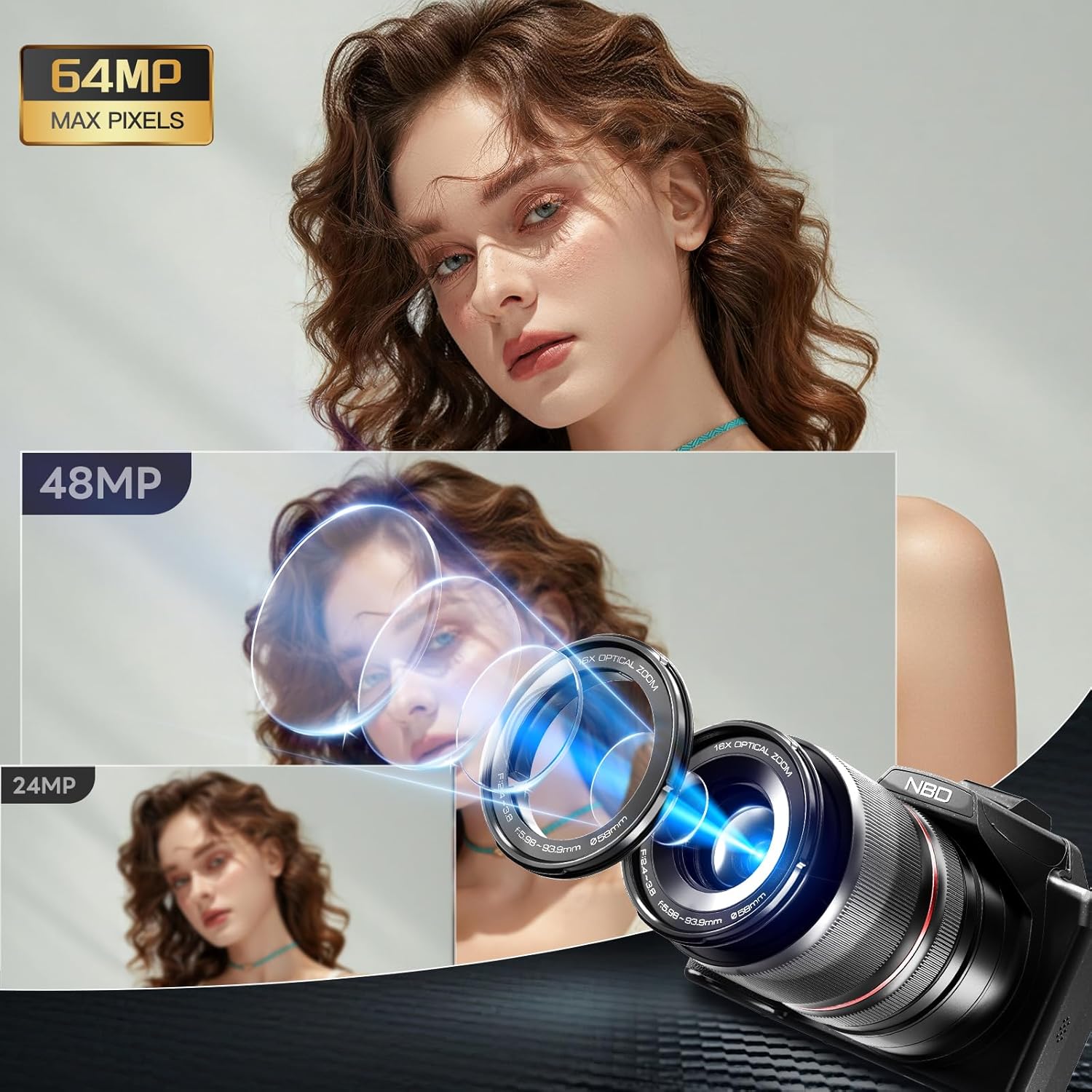
I’ve been playing with this NBD 8K digital camera for about two weeks, mostly for casual photos, a bit of YouTube-style talking-head video, and some outdoor walks. On paper, the spec sheet looks pretty wild for the price: 8K video, 64MP photos, 16x optical zoom, Wi‑Fi, flip screen, 2 batteries, 64GB card in the box. If you just read the Amazon listing, you’d think you’re getting something close to a mid‑range mirrorless for a fraction of the price. In reality, it’s not that level at all.
In day‑to‑day use, this feels like a budget bridge camera that’s trying to look more pro than it really is. It’s not trash, but it’s also not a miracle device. The truth is somewhere in the middle: decent for beginners and casual shooting, not great if you’re picky about image quality or you already own a recent smartphone with a good camera.
What pushed me to try it was the combo of flip screen + zoom lens + two batteries. I wanted something I could throw in a bag, use for simple vlogs, and hand to friends without worrying about them messing up settings on my mirrorless. For that kind of use, it mostly does the job, as long as you keep your expectations in check about the 8K and the 64MP claims.
If you’re thinking about buying it, don’t just look at the numbers on the box. In this review I’ll go through how it actually behaves: build quality, handling, real‑world video/photo performance, battery life, Wi‑Fi/app stuff, and whether it’s worth it compared to just using your phone or saving up for an entry‑level Canon/Sony.
Value for money: specs look big, reality is more modest but still fair
Looking at the Amazon rating around 4.1/5 and the mix of reviews (some 5/5, some 1/5), the pattern kind of makes sense after using it. People who just want a simple camera with a zoom, flip screen, and all accessories in the box tend to be happy. People who buy it thinking they’re getting a true 8K monster are disappointed. The value really depends on what you expect and what you compare it to.
Compared to a recent mid‑range smartphone, the camera only clearly wins in two areas: zoom reach (16x optical is nice for distant subjects) and handling with a real grip. Image quality in good light is in the same ballpark as a decent phone, sometimes a bit worse in low light. But you get that more “camera-like” experience, which some people prefer, especially for kids or older relatives who don’t want to deal with phone menus.
Compared to an entry‑level Canon/Sony/Panasonic compact or mirrorless, the NBD loses in image quality, autofocus reliability, and build. But it’s usually a lot cheaper and comes with everything (batteries, card) included. So if budget is tight and you just want to dabble in photography or YouTube without spending big, it’s not a bad starting point. Just understand that you’re paying for a complete kit with modest performance, not a hidden pro camera.
Overall, I’d say the value is decent but nothing more. You get a lot of features on paper and a functional camera in practice, as long as you accept its limits: small sensor, so‑so low‑light, overhyped 8K, and basic build quality. If you’re okay with that and mainly shoot in daylight or indoors with good lighting, the price feels fair. If you’re even slightly serious about photography or video, I’d personally save up a bit more and go for a used big‑brand camera instead.
Design & handling: feels like a small DSLR, behaves like a budget cam
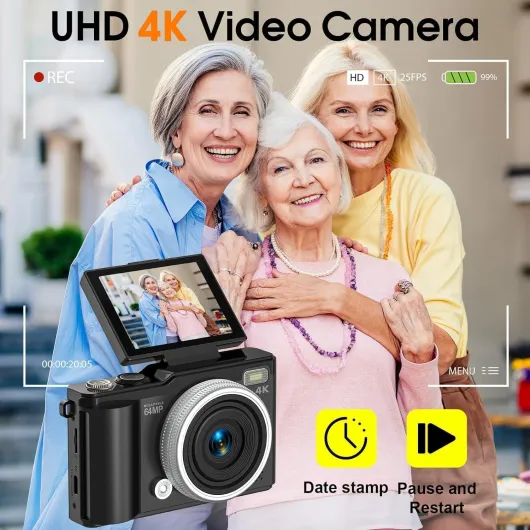
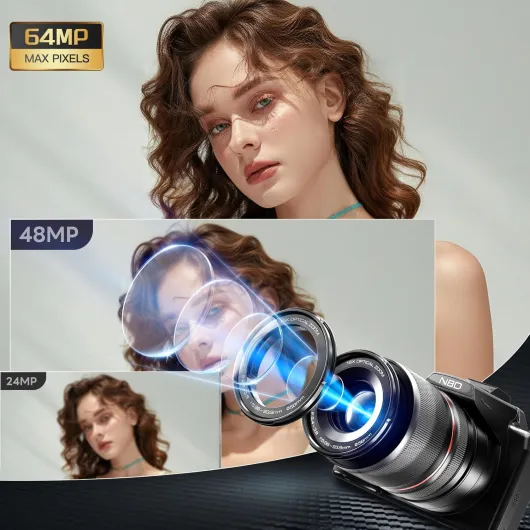
Design-wise, it looks like a shrunken DSLR: chunky grip, big lens barrel, and a 2.8'' flippable LCD that rotates 180°. In the hand, the grip is actually pretty solid – better than I expected. I could hold it one-handed without feeling like I’d drop it. The buttons are clearly labeled, and the mode dial on top is straightforward: you can jump from Auto to M, to video, etc. without digging through menus. For a beginner, that makes it way less annoying to use.
The flip screen is the main thing I liked. It flips up so you can see yourself when vlogging or taking selfies. The resolution is only 480x640, so it’s not super sharp, but it’s enough for framing and checking focus. Outdoors in bright sunlight it gets a bit washed out, and since there’s no viewfinder at all, you’re stuck with the screen. I often had to shade it with my hand to see properly when shooting midday.
The camera is fairly light, so you can carry it all day without thinking about it. But that lightness also comes from the plastic build. The body is all plastic, and the lens zoom mechanism doesn’t feel fragile, but it definitely doesn’t feel premium either. The buttons have a bit of a cheap click to them, and the battery/memory card door has that “don’t slam me too hard” vibe. I wouldn’t throw it around in a backpack without some kind of pouch.
Another small detail: ports and slots. You get USB for charging/data, HDMI out, and the microSD slot next to the battery. They all work, but the rubber covers feel thin. I wouldn’t count on this body to survive a lot of dust, sand, or rain. No weather sealing, not water resistant, so this is more of a city / casual travel / indoor camera than something I’d take hiking in rough conditions unless I’m careful.
Battery life & practical use: two batteries help, but don’t expect miracles
The camera comes with two 2000mAh lithium‑ion batteries, which is honestly one of the nicer parts of the package. A lot of budget cameras throw in a single weak battery and you’re forced to buy extras. Here, at least, you can swap when one dies. In my use, one battery gave me roughly a half‑day of light shooting: around 40–60 photos plus maybe 20–30 minutes of video at 1080p, with some menu fiddling and Wi‑Fi transfers.
If you record long videos (like 20+ minutes straight), the battery drains noticeably faster. Recording at higher resolutions like 4K or above eats even more. I wouldn’t trust one battery for a full day of vlogging or travel if you’re filming a lot. But with two batteries, I managed a full afternoon city walk, lots of zooming and checking playback, and still had a bit of juice left on the second pack. So for casual use, the dual-battery setup is enough, as long as you remember to charge both the night before.
Charging is done via USB directly in the camera. It works, but it’s not fast. I usually plugged it in overnight. I didn’t see any fancy fast‑charge feature, so if you’re in a rush, you’re out of luck. Also, you can’t really use it freely while it’s charging unless you’re okay being tethered to a power bank or wall outlet. It’s usable, just not very comfortable.
One thing I didn’t love: there’s no clear percentage indicator, just a simple battery icon. It jumps from full to half to low pretty quickly, so it’s hard to guess exactly how much time you have left. For a cheap camera, that’s not shocking, but it means you should carry the second battery with you at all times. In short, battery life is acceptable but not impressive, and the fact they include two is what saves it.
Build quality & durability: light plastic, fine if you’re careful
From a durability standpoint, this is clearly not built like a pro camera. The body is plastic, the lens barrel is plastic, and there’s zero sign of weather sealing. The spec sheet even says straight out: not water resistant. So this is something you treat more like a piece of electronics than a rugged tool. I tossed it in a backpack a few times (inside a soft pouch), and it survived just fine. But I wouldn’t trust it bouncing around loose with keys and metal stuff.
The moving parts – mainly the zoom mechanism and the flip screen – feel okay but not bulletproof. The zoom ring is electronic, so you’re basically using a lever/button to zoom in and out, and you can hear/feel the little motor working. No obvious grinding or weird noises, but it does feel like something that could wear out if you abuse it. The flip screen hinge is reasonably stiff; it didn’t wobble or feel like it would snap off, but I definitely wouldn’t twist it aggressively.
Buttons and dials are on the cheaper side. After two weeks, nothing failed, but the feedback isn’t very precise. It’s more like using a decent toy camera than a serious piece of kit. The battery door and SD card slot latch close properly, but you have to make sure you push them until they click, otherwise they can pop open if you bump them. Again, nothing broke on me, but I handled it with a bit more care than my weather‑sealed gear.
Given the price bracket and the country of origin (China, generic brand), I wouldn’t expect this to last ten years of heavy use. For occasional trips, family events, or as a starter camera for a teenager, it’s probably fine. If you’re planning to shoot every week and carry it everywhere, I’d either get a padded case and be gentle or save for something a bit tougher from a big brand. Durability is acceptable if you treat it well, but it’s not something I’d call robust.
Image quality & autofocus: okay in good light, quickly falls apart in bad light
Let’s talk about what actually matters: photos and video. In good daylight, the camera is decent. Colors are a bit on the punchy side but not crazy, and for normal viewing on a phone or laptop, the images look fine. The 64MP files are big, but when you zoom in, you can see that the real detail is more like a mid‑range 12–16MP camera. It’s usable, just not as sharp as the megapixel number suggests.
In low light or indoors, the weaknesses show up fast. The small 1/2.8'' sensor struggles. You get noise, softer detail, and sometimes weird smearing from noise reduction. The built‑in flash helps for close subjects, but it’s very direct and flat. For family dinners or indoor parties, it’s okay if you’re not picky. If you’re expecting clean, crisp night street shots without a tripod, this isn’t the right tool.
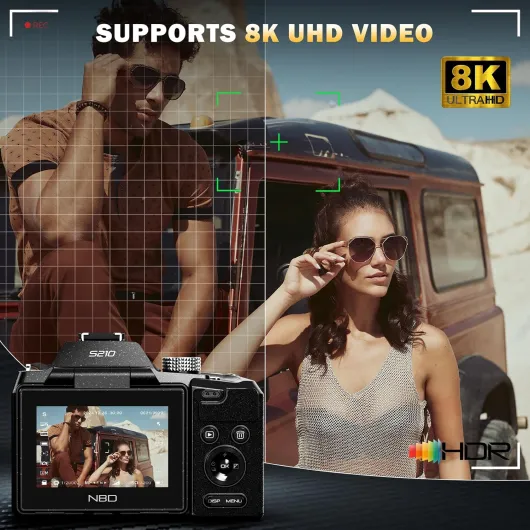
Video is kind of the same story. The camera can record 8K/5K/4K/2K/1080p/720p, but the real sweet spot is 1080p or 2K. At those settings, the footage looks acceptable for YouTube or casual vlogs. 4K and 8K modes give you bigger files but not a massive jump in actual detail, and rolling shutter (wobbly lines when you pan quickly) is noticeable. The frame rate options up to 90fps are fun for slow motion, but don’t expect buttery smooth pro‑level slow‑mo.
Autofocus is automatic AF‑A with phase detection, which sounds fancy, but in practice it’s hit or miss. When you’re in good light and not moving too much, it locks focus fairly quickly. When you walk toward the camera in vlog mode, it sometimes hunts or jumps behind you. For static shots it’s fine, for fast‑moving kids or pets it’s a bit frustrating. The image stabilization helps a bit with small hand shakes but doesn’t replace a gimbal – walking shots still look bouncy. Overall, performance is fine for a beginner and casual content, but if you’ve used a recent iPhone, Pixel, or a real mirrorless, you’ll notice the gap right away.
What this camera really is (once you ignore the marketing)
On paper, this is a bridge camera with a 1/2.8'' CMOS sensor, a 24–384mm equivalent lens (16x optical zoom), 64MP stills, and 8K video. It comes as a full kit: camera body, lens built‑in (no interchangeable lenses), 2x 2000mAh batteries, a 64GB microSD card, and the usual cables and strap. So out of the box, you don’t really need to buy anything else to start shooting, which is handy if you’re new to cameras.
You get a bunch of modes: full auto, P/A/S/M, night mode, macro, time‑lapse, slow motion, continuous shooting, self‑timer. The menu is pretty basic but at least they give you manual controls, which is rare at this price. Just don’t expect them to behave like a DSLR – the sensor is small and the aperture range (around f/2.6–f/3.9) doesn’t give you strong background blur, even if you open it up or zoom in.
The big selling points in the listing are 8K video, 64MP photos, Wi‑Fi control, and image stabilization. In practice, the 8K and 64MP are mostly about upscaling and interpolation. The files are that resolution, sure, but if you zoom in on a computer screen, you see that the detail is closer to a decent 1080p/4K camera than a real 8K system. It’s fine for YouTube and family videos, not something I’d use for professional work.
Overall, I’d describe this as a starter camera for people who want a real zoom lens and a flip screen without spending big money. It’s miles ahead of those super cheap toy cameras, but it’s not in the same league as a Canon G7X or a Sony ZV‑series. If you go in thinking “nice step up from my old compact or a basic phone,” you’ll be okay. If you expect cinema‑level 8K because the box says 8K, you’re going to be disappointed.
Wi‑Fi, app control & everyday usability: handy but a bit clunky
One of the selling points is the Wi‑Fi connectivity and app remote control. The idea is nice: connect the camera to your phone, control shooting from the app, and transfer photos and videos quickly. In practice, it works, but it’s not as smooth as using AirDrop or Google Photos from a phone. You have to switch the camera into Wi‑Fi mode, find the network on your phone, connect, then open the app. Once you’ve done it a few times it’s okay, but it’s not instant.
The app itself is basic. You can see a live view, trigger the shutter, start/stop video, and browse media on the card. For simple tripod setups (like filming yourself talking or doing unboxings), the remote function is actually pretty useful. I used it a few times to frame myself without running back and forth to the camera, and it did the job. There’s a slight delay in the preview, but it’s manageable if you’re not doing anything too fast.
Transfers over Wi‑Fi are fine for photos and short clips, but for larger 8K or 4K files it’s slow and you’re better off using a card reader or USB cable. I quickly stopped bothering with Wi‑Fi for big files because it just took too long. For Instagram‑type shots or quick clips you want to post on TikTok, it’s okay – just don’t expect instant syncing like you get with a high‑end camera and a polished app.
In everyday use, I’d say the camera is effective for simple content creation: basic YouTube videos, family events, travel snaps. The menu is a bit old-school but not confusing once you get used to it. There’s some lag when switching modes or reviewing photos, but nothing crazy. If you’re patient and not in a professional rush, it works. If you’re used to snappy smartphones and polished ecosystems, the whole experience feels a bit clunky and dated, but still usable for the price.
Pros
- Comes as a full kit: 2 batteries + 64GB card, ready to use out of the box
- 16x optical zoom and flip screen are genuinely useful for travel and vlogging
- Decent daylight image quality for casual photos and basic YouTube videos
Cons
- 8K and 64MP are mostly marketing; real detail and low‑light performance are modest
- Plastic build with no weather resistance; feels cheap and needs careful handling
- Autofocus and stabilization are only average, not great for fast action or walking shots
Conclusion
Editor's rating
After actually using this NBD 8K digital camera, I’d sum it up like this: it’s a budget bridge camera with a flashy spec sheet and very average real‑world performance. The good parts are clear: you get a big zoom range, a 180° flip screen that’s handy for vlogging, built‑in Wi‑Fi with remote control, and the nice bonus of two batteries plus a 64GB card right in the box. For a beginner, a teenager, or someone who just wants a simple camera for holidays and family events, it does the job as long as the light is decent.
On the downside, the whole 8K/64MP thing is mostly marketing. The files are that size, but the true detail and low‑light performance are closer to a basic camera than a high‑end one. Autofocus is okay but not reliable enough for fast action, the image stabilization is modest, and the build is light plastic that you need to treat with some care. If you’re already happy shooting with a modern phone, this won’t be a big upgrade in pure image quality; it’s more about having a proper zoom lens and a dedicated device.
I’d recommend it to people who: want an affordable all‑in‑one kit, like the idea of a flip screen and long zoom, and aren’t too picky about pixel‑peeping or low‑light performance. I’d skip it if you: plan to do serious YouTube work, want real 4K/8K quality, shoot a lot at night, or care a lot about autofocus speed. In that case, better to save and go for a used mirrorless or a well‑known compact from Canon, Sony, or Panasonic.