
Summary
Editor's rating
Is the PIXPRO FZ55 good value for money?
Design and handling: pocketable but a bit toy-like
Battery life and daily practicality
Build quality and how tough it feels
Image quality and everyday performance
What the PIXPRO FZ55 actually offers
Pros
- Very compact and light, easy to carry everywhere
- Simple interface and auto modes suitable for beginners
- Good image quality in daylight with a useful 5x zoom range
Cons
- Struggles in low light with noise and blur
- Cheap-feeling build and small, low-resolution screen
- No Wi‑Fi/Bluetooth and only digital image stabilisation

Specifications
View full product page →| Brand | KODAK |
Why I bought a cheap compact camera in 2026
I picked up the Kodak PIXPRO FZ55 mainly because I was tired of draining my phone battery every time I went on a weekend trip. I didn’t want to spend big money on a mirrorless camera, and I just needed something light, simple, and cheap that I wouldn’t stress about losing or dropping. This one kept popping up in the “best sellers” list, had a 4.5/5 rating, and the price was closer to a budget gadget than a serious camera.
I used it for about two weeks: a short city break, a family birthday, and a couple of walks in the park. So this isn’t a lab test, it’s just how it behaved in normal everyday use. I shot mostly in full auto, sometimes using macro and portrait modes, and I tried some indoor video at 1080p. I used a 32GB SDHC card, which is more than enough for casual photos and a few clips.
Overall, it does what you expect from a small point-and-shoot: it takes pictures without fuss, it fits in any pocket, and you don’t need to read the manual to get started. But it also feels dated in a few areas, especially if you’re used to a recent smartphone. The CCD sensor, the small 2.7-inch screen, and the digital stabilisation show their limits pretty fast when the light isn’t great.
If you’re expecting DSLR-level sharpness or smartphone-style night photos, you’ll be disappointed. If you just want a separate camera for holidays, kids, or grandparents who don’t like phones, it’s pretty solid. In this review I’ll go through what worked for me and what clearly didn’t, in plain language.
Is the PIXPRO FZ55 good value for money?
Looking at what you actually get, I’d say the FZ55 offers decent value if your expectations are realistic. You’re paying for a simple, no-frills compact camera with a 5x zoom, 16MP sensor, and 1080p video. It’s not going to beat a good smartphone, especially in low light, but it does free up your phone and gives you a dedicated device you don’t mind handing to kids or relatives.
Compared to other budget compacts in the same price range, it’s roughly on par. Some competitors offer slightly bigger screens or optical stabilisation, others have similar specs. What tips the scale a bit in Kodak’s favor is the very simple interface and the fact that it’s part of their “Friendly Zoom” series clearly aimed at casual users. For someone who just wants to press a button and get a picture, without diving into menus or modes, this camera is easy to live with.
On the downside, you do feel the age of the tech: CCD sensor instead of a newer CMOS, small low-res screen, digital-only stabilisation, no wireless connectivity. If you’re even slightly into photography or plan to learn manual settings, this camera will feel limiting very quickly. In that case, it might be smarter to save up a bit more for an entry-level mirrorless or a more advanced compact.
So in practice, I’d say the FZ55 is good value if you need: a cheap travel camera, a simple device for parents or grandparents, or a backup camera you don’t mind knocking around. If you already have a recent mid-range or high-end smartphone, the only real reason to buy this is to save your phone battery or to have a device you’re less afraid to lose or break. If you expect it to be a big upgrade in image quality over your phone, you’ll likely be underwhelmed.
Design and handling: pocketable but a bit toy-like
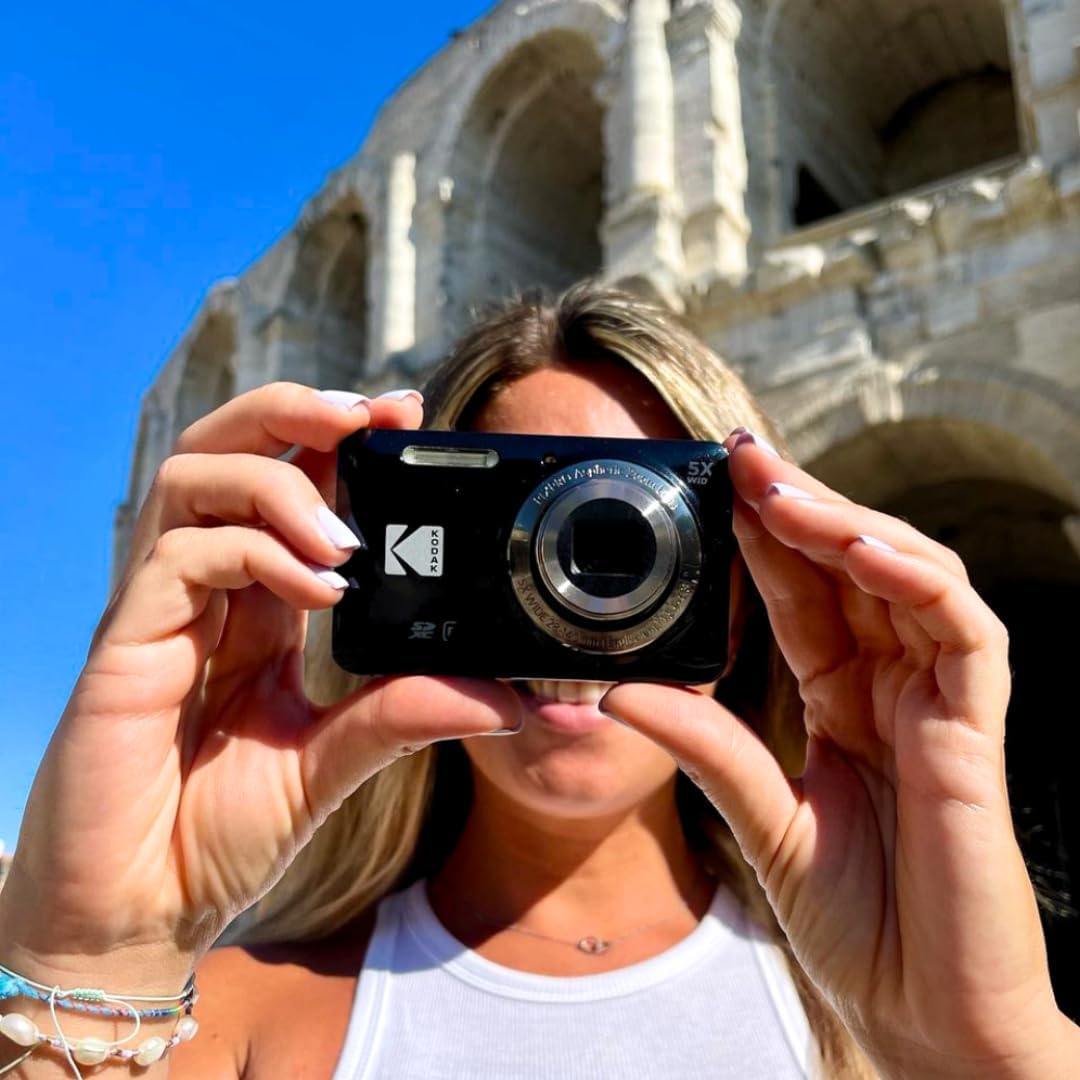
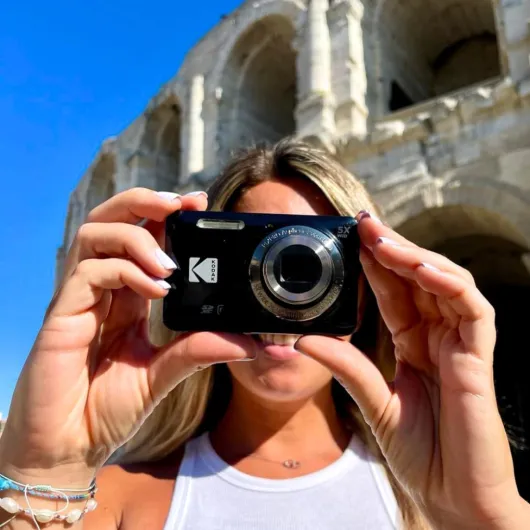
Design-wise, the FZ55 is very compact and light. At about 3.7 ounces, it almost feels like a toy when you pick it up, especially if you’re used to phones with big metal frames. The upside is that it fits easily in jeans pockets, small shoulder bags, or even a shirt pocket. I carried it around all day without noticing it, which is exactly what I wanted: a camera I can forget about until I need it.
The downside of that lightness is that it doesn’t feel very robust. The plastic body is fine, but it doesn’t give a sense of durability. The buttons are small and a bit “clicky” in a cheap way. The top has the power button and the shutter, with a zoom rocker around it. On the back you have a classic layout: directional pad, menu, playback button, and a dedicated video record button. Everything is logical, but the small buttons can be annoying if you have big fingers or if you’re using it with gloves.
The 2.7-inch LCD screen is another weak point. It’s not very bright, the resolution is low, and in strong sunlight I sometimes had trouble seeing if the shot was properly framed. Indoors or in the shade it’s fine, but outside at noon, you end up guessing a bit. There’s no touch function despite the spec list saying “capacitive” – all navigation is done with physical buttons. That’s not an issue for me, but don’t expect smartphone-like gestures or quick taps to focus.
In terms of layout, the camera is straightforward. You turn it on, the lens extends, and you’re ready to shoot in about two seconds. There’s a small wrist strap in the box, which I strongly recommend using. The battery and SD card share a compartment at the bottom next to the tripod mount. The door feels a bit flimsy, so I tried not to open it too often. Overall, the design is practical but cheap, which matches the price point. It’s not something you’ll admire on your shelf, but it’s light and simple enough to throw in a bag and forget.
Battery life and daily practicality
The FZ55 comes with a small Li‑ion battery and a USB charger in the box. You charge it by plugging the camera directly into the wall adapter or a USB port. Personally, I prefer external chargers where you can swap batteries easily, but for casual users this all-in-one approach is probably simpler. Charging from empty to full took me roughly a couple of hours using a standard USB adapter.
In terms of battery life, it’s okay but not impressive. During my weekend trip, I managed around a full day of mixed use: maybe 150–200 photos and a handful of short videos before the battery indicator started blinking. If you only take a few photos here and there, it’ll last longer, but if you’re the type who shoots everything, you’ll want either a power bank or a second battery. Unfortunately, there’s no battery percentage, just a basic icon with three levels, so it’s hard to know exactly how close you are to empty.
One annoying detail is that you can’t really use the camera while charging in a practical way. Technically it turns on when plugged in, but the cable gets in the way, and it’s not meant to be used as a webcam or anything like that. It’s more of a charge-then-shoot device. For a simple point-and-shoot that’s not a big deal, but don’t expect fancy continuous power options.
Overall, I’d say battery life is acceptable for a day trip if you’re reasonable with video and don’t spend hours reviewing photos on the screen. It’s definitely weaker than what I get from my phone if I only use the camera app, but since this frees your phone from heavy camera use, it kind of balances out. If you plan a longer holiday and want to shoot a lot, I’d strongly consider buying a spare battery and keeping the USB cable and adapter in your bag.
Build quality and how tough it feels
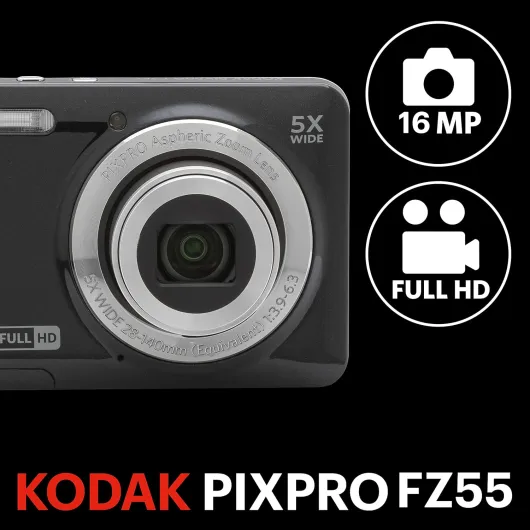
I haven’t abused the FZ55, but over two weeks of real use I got a pretty good idea of its build quality. As I said earlier, it’s light and all plastic, which doesn’t inspire much confidence at first touch. That said, it survived being tossed into a backpack with keys and cables, pulled in and out of pockets, and used by a kid with sticky hands. No cracks, no weird noises, just a few light marks on the body that you’d expect from normal use.
The weak point for me is the lens mechanism and the battery door. The lens extends every time you power on the camera, and retracts when you turn it off. It works fine, but it feels a bit fragile. I’d be careful not to turn it on while it’s still in a tight pocket or case, because if the lens hits something while extending, I wouldn’t be surprised if it jammed. Same story with the battery/SD card door: it opens and closes without issue, but the hinge and latch feel thin. I wouldn’t want to open it 20 times a day.
There’s no weather sealing, no shock protection, no claims of being waterproof or dustproof. This is not a camera for the beach in a sandstorm or heavy rain. A few light drops are probably fine, but I kept it in a bag or pocket when the weather turned bad. If you’re looking for something rugged for hiking, skiing, or the pool, this is not it. You’d need a different category of camera altogether.
In short, durability is acceptable for careful everyday use, but I wouldn’t call it tough. Treat it like a small electronic gadget, not like an action camera. For the price, I’m not shocked by the materials and build, but if you’re clumsy or buying this for a child who tends to drop things, I’d add a case and maybe a screen protector to give it a better chance of surviving.
Image quality and everyday performance
Let’s be clear: this is a basic 16MP CCD compact, so expectations need to stay realistic. In good light, outdoors or near a window, the photos are perfectly usable. Colors are a bit on the warm side but look natural enough, and the 16MP resolution is plenty for prints, photo books, or social media. For daytime city shots and family photos in the park, I was happy with the results. You can crop a bit without the image falling apart, as long as you don’t go crazy.
Where it starts to struggle is in low light or indoors. The CCD sensor and the limited maximum aperture (f/3.9–6.3) mean you quickly get noise, blur, or both. The camera bumps ISO up, and the images become grainy, with less detail and more smudging. Compared to my mid-range smartphone, the phone clearly does better at night or in dim bars. The digital image stabilization helps a bit with hand shake, but it doesn’t work miracles. If your subject is moving (kids, pets), you’ll get a fair share of blurry shots indoors.
The 5x optical zoom is decent for the size. At wide angle (28mm), you can easily fit a group of people or a building. At full telephoto (140mm equivalent), you can get closer to your subject without walking, which is handy for candid shots or animals in the park. The lens is not super sharp at full zoom, but again, for casual use it’s fine. The macro mode is actually one of the nicer surprises: you can focus quite close (around 5cm), which is fun for food, flowers, or small objects. Focus speed is average, not fast, but acceptable.
Video in 1080p is okay for quick clips but nothing more. The autofocus tends to hunt a bit when you move, and there’s no optical stabilisation, so walking shots look shaky. Sound is just basic mono, picks up wind easily, and there’s no mic input of course. For short memories and family moments, it does the job, but if you’re thinking of vlogging or YouTube, you’ll quickly hit its limits. Overall, performance is decent in good light, weak in low light, which is exactly what you’d expect at this price and with this hardware.
What the PIXPRO FZ55 actually offers
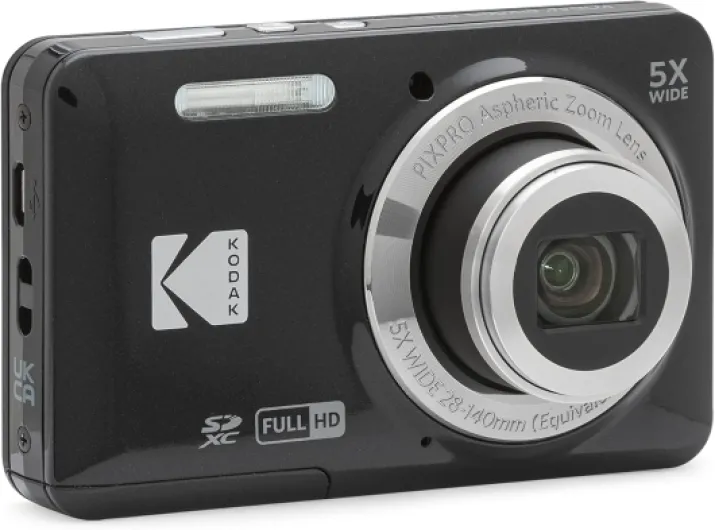
The Kodak PIXPRO FZ55 is a small compact camera with a 16MP CCD sensor and a 5x optical zoom (28–140mm equivalent). In practice, that means it’s wide enough for group photos and landscapes, and you can zoom in a bit for portraits or details, but it’s not a crazy long zoom. It records 1080p video, shoots photos in JPEG only, and everything is controlled through a 2.7-inch LCD screen on the back. There’s no viewfinder, no fancy manual controls, and no RAW format. It’s clearly aimed at casual users.
The camera has a bunch of software features that sound nice on paper: face detection, smile/blink detection, red-eye removal, HDR touch-up, and several scene modes like landscape, macro, and portrait. In practice, I mostly left it on auto and occasionally switched to macro when I was close to objects like food or flowers. The face detection works, but it’s not as fast or as sticky as what you get on a modern phone. The HDR “touch-up” is more of a mild correction than a real HDR photo like on smartphones.
Storage-wise, it supports SDHC/SDXC up to 512GB, which is way more than anyone needs for this type of camera. It has a tiny internal memory (63MB) which is basically useless, so you definitely need a card. Files are saved as JPEG and MP4, and the camera connects via USB 2.0 to transfer photos. There’s no Wi‑Fi, no Bluetooth, no app connection. To share your pictures, you either plug it into a computer with the included USB cable or use a card reader. Old-school, but simple.
Feature-wise, it sits in that zone of “enough for family use, nothing for geeks.” No manual exposure, no interchangeable lenses, just basic automatic shooting. That’s not a problem if you just want snapshots, but if you think you’ll want to learn photography later, this camera will limit you quite quickly. It’s fine as a first camera or a backup, not as a long-term hobby tool.
Pros
- Very compact and light, easy to carry everywhere
- Simple interface and auto modes suitable for beginners
- Good image quality in daylight with a useful 5x zoom range
Cons
- Struggles in low light with noise and blur
- Cheap-feeling build and small, low-resolution screen
- No Wi‑Fi/Bluetooth and only digital image stabilisation
Conclusion
Editor's rating
After using the Kodak PIXPRO FZ55 for a couple of weeks, my feeling is pretty clear: it’s a simple, budget compact that does its job in good light and doesn’t pretend to be more than that. The 16MP photos are fine for everyday use, the 5x zoom gives you some flexibility, and the camera is so light and small that you can carry it anywhere without thinking about it. For family trips, kids’ parties, or as a camera for someone who doesn’t like smartphones, it works.
On the flip side, you feel the compromises: basic plastic build, small low-res screen, weak low-light performance, and no wireless features. If you’re used to recent phones, especially for night shots or quick sharing, this will feel a bit old-fashioned. I wouldn’t pick it as a main camera for someone who wants to get into photography or cares a lot about image quality.
So who is it for? People who want a cheap, straightforward point-and-shoot, parents buying a first camera for a teenager, or anyone who wants to keep their phone battery for other things. Who should skip it? Anyone already happy with their smartphone camera and anyone who plans to learn manual photography. For the right user, it’s good value and practical; for the wrong user, it will feel like a step back.