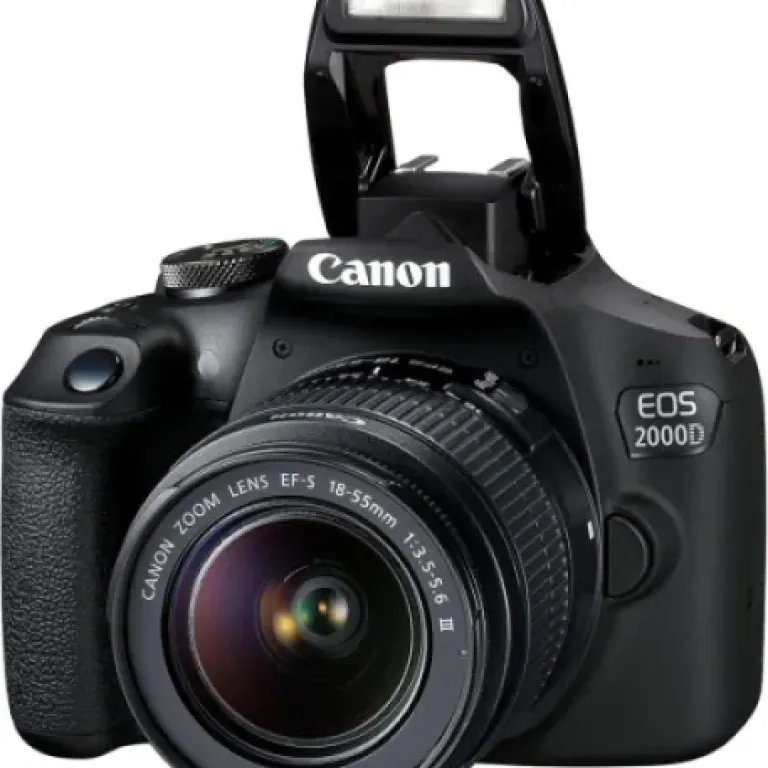

Summary
Editor's rating
Value for money: a good starter kit with clear trade‑offs
Design and handling: plasticky but practical
Battery life and everyday use: decent but get a spare
Build quality and durability: fine for normal use, not for abuse
Image quality and autofocus: good for learning, limited for action
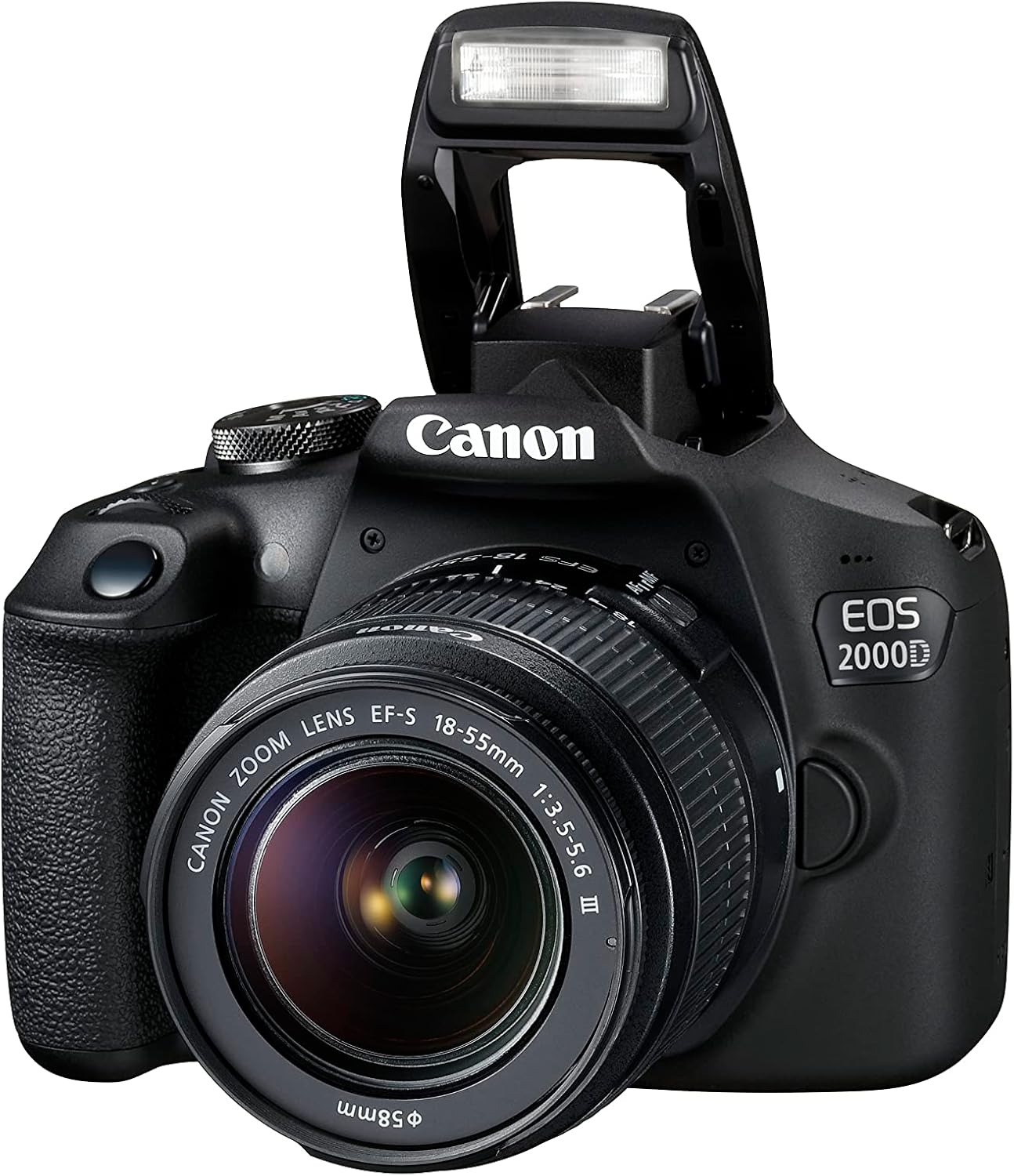
What you actually get with the EOS 2000D kit
Pros
- 24.1 MP APS‑C sensor with good image quality for the price
- Very beginner‑friendly controls and interface, easy to get started
- Versatile 18‑55mm zoom lens covers portraits and landscapes, good all‑rounder
Cons
- Kit lens has no optical image stabilisation, which hurts in low light and video
- Only 9 autofocus points and 3 fps burst, limited for sports or fast action
- Plastic body with fixed screen and no weather sealing, feels basic and not very future‑proof

Specifications
View full product page →| Brand | Canon |
A first “real camera” that doesn’t scare you off
I’ve been using the Canon EOS 2000D with the 18‑55mm kit lens for a few weeks, and I’ll be honest: I bought it because I wanted a “proper” camera without drowning in pro settings and menus. I’d mostly been using my phone and a very basic compact camera before this. The 2000D is clearly aimed at people like me who want to take a step up without doing a full photography degree.
From day one, what struck me is how quickly you can get usable photos. On full auto mode, I was taking shots that already looked clearly better than my phone in low light and for portraits. You can see more detail, and the background blur is nicer, even with this basic 18‑55mm lens. It’s not magic, but it’s a clear step up.
I used it for a weekend walk, a small family birthday, and some random street shots. I didn’t bother reading the whole manual, just used the mode dial (portrait, landscape, etc.) and the on‑screen hints. For a beginner, that’s pretty reassuring. You feel like the camera is helping you instead of punishing you when you don’t know every setting.
So overall, my first impression is: this is a beginner‑friendly DSLR that does the job. It’s not fast like the higher‑end Canons, and the lens is clearly entry‑level, but for someone starting out and learning how to use aperture, shutter speed and ISO, it’s a decent base that doesn’t cost a fortune.
Value for money: a good starter kit with clear trade‑offs
Looking at the price and what you get, I’d say the Canon EOS 2000D kit offers good value for beginners, but with some clear trade‑offs you should be aware of. You’re paying for a proven sensor, a simple interface, and the Canon ecosystem, not for fancy features. At the time I checked, it was sitting near the top of the Amazon DSLR rankings with a 4.7/5 rating, and I get why: for someone’s first “real camera”, it ticks most boxes without emptying your wallet.
On the plus side, you get:
- A 24.1 MP APS‑C sensor that gives you noticeably better image quality than a phone or cheap compact.
- A versatile 18‑55mm zoom that covers most everyday situations (portraits, landscapes, street).
- Wi‑Fi and NFC for easy sharing and basic remote control from your phone.
- A simple, familiar Canon interface with lots of online tutorials and community help.
On the downside, to keep the price low, Canon cut corners:
- The kit lens has no optical stabilisation, which hurts in low light and video.
- The body is basic plastic, not weather‑sealed, and the screen doesn’t flip.
- Only 3 fps burst and 9 AF points, which is limited for sports or fast action.
- No SD card in the box, so you have to buy that separately right away.
Compared to some newer entry‑level mirrorless cameras, you miss out on things like better autofocus in video, smaller size, and more modern connectivity. But those often cost more once you add a lens. So if your budget is tight and you mainly want to learn photography, print some photos, and shoot better family/holiday pictures, the 2000D kit is pretty solid value. If you already know you’ll get serious about video or action photography, it might be smarter to save a bit more and jump straight to a more advanced body.
Design and handling: plasticky but practical
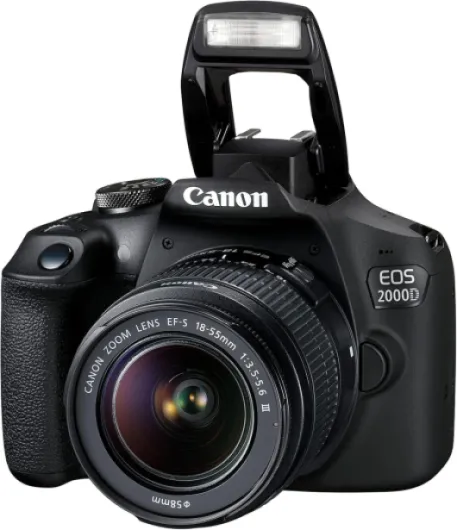
The design is very “classic Canon DSLR”. If you’ve ever held a Canon from the last 10 years, this one feels familiar. It’s a lightweight body (around 475 g), mostly plastic, but the grip is decent. I have average‑sized hands and I could hold it comfortably with one hand, though with the lens on I naturally used both for safety. The rubber on the grip gives enough traction; it doesn’t feel premium, but it doesn’t feel like a toy either.
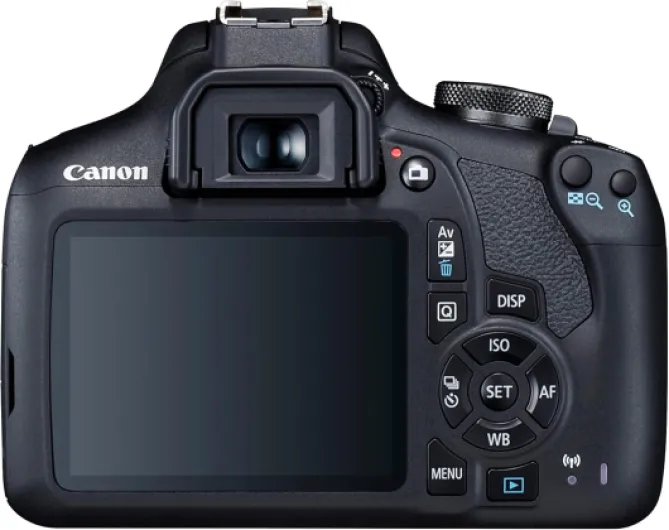
The button layout is straightforward: big mode dial on top, main control wheel, dedicated buttons for ISO, exposure compensation, playback, etc. For a beginner, the nice thing is that the most important stuff is physically accessible, so you don’t have to dig deep into menus all the time. The rear screen is a fixed 3" LCD with 920k dots. It’s sharp enough, but it doesn’t flip or tilt despite the spec sheet mentioning “tilting” – in practice, on the unit I used, it was fixed. So forget about comfortable selfie vlogging or shooting from weird angles using a flip screen.
One thing I noticed quite fast: the camera looks bigger than it actually feels. In the bag it looks like “a big DSLR”, but in hand it’s pretty compact. That’s nice if you don’t want to carry a brick all day. On the other hand, the plastic body doesn’t give the impression that it would survive heavy abuse. It’s fine for normal use, but I wouldn’t drop it or shoot in the rain without protection.
In short, the design is simple and functional: easy grip, clear buttons, no fancy extras. It’s not a camera you buy for its looks or premium feel. You buy it because it’s clear and easy to handle, which is exactly what most beginners need. Just don’t expect weather sealing, a flip screen, or a super solid magnesium body at this price.
Battery life and everyday use: decent but get a spare
The camera comes with a single rechargeable battery and a Canon charger. Coming from a compact that used AA batteries, this already felt like a big quality‑of‑life upgrade. No more hunting for batteries in drawers. In real use, I got roughly 400–500 shots per charge with a mix of occasional video, live view, and some chimping (checking photos on the screen). If you stick mostly to the optical viewfinder and avoid long video clips, you’ll be on the higher side of that range.
During a full day trip, I started with 100% and ended with around one bar left after about 350 photos and a few short 1080p videos. So for casual use, one battery is usually enough for a day. That said, if you’re travelling or shooting an event (wedding, long walk, festival), I’d honestly recommend buying a second battery. It’s cheap insurance, and you don’t want to be stuck with a dead camera just when the light gets nice.
Charging is straightforward: remove the battery, slot it into the charger, plug into the wall. No USB‑C or direct body charging here, which feels a bit old‑school compared to modern cameras and phones. It’s not a huge problem, but it means you have to carry the dedicated charger when travelling. Also, be careful with third‑party batteries: some work fine, others charge in the camera but not in the Canon charger (or the reverse). I had one cheap non‑Canon battery that physically fitted but refused to charge in the original charger, which was annoying.
Overall, I’d rate the battery life as solid but not impressive. It does the job for a beginner DSLR, but it’s not something you stop thinking about. If you like to review photos often and use Wi‑Fi to send images to your phone, it drains faster. So: decent autonomy, but for peace of mind, a spare battery in the bag is almost mandatory once you start using the camera more seriously.
Build quality and durability: fine for normal use, not for abuse
After handling the 2000D for a few weeks, my feeling is that it’s built to survive normal everyday use, but not serious abuse. The body is mostly plastic, and you can feel that when you tap it or twist it slightly. There’s a bit of flex if you grip it too hard, but nothing alarming. The mount feels solid enough when changing lenses; I didn’t notice any play or wobble between the body and the kit lens.
I carried it around in a simple shoulder bag (not even a real camera bag) during a couple of city walks and a light hike. It bumped lightly into things a few times, and there are no obvious scratches or damage. The buttons still click fine, and the mode dial has a firm, reassuring rotation. So for regular use — home, walks, holidays — it feels reliable enough. Just don’t treat it like a rugged action camera.
Where I’d be cautious is weather and dust. This camera is not weather‑sealed. I got caught in a light drizzle once and quickly tucked it under my jacket. No issue, but I wouldn’t shoot in proper rain with it. Same for sand or beach use: I’d really keep it in a bag when not shooting and avoid changing lenses in windy conditions. The 18‑55mm kit lens itself also feels basic: the zoom ring is a bit scratchy, and the focus ring is narrow and not very pleasant to use manually.
In the long run, I think the 2000D will hold up fine if you treat it with normal care: use a bag, don’t drop it, avoid heavy rain and sand, and don’t force the dials. It’s not a tank, but for the price and the target audience, the durability seems reasonable. If you know you’re rough with your gear or plan to shoot in harsh conditions, you might want a more robust body later on.
Image quality and autofocus: good for learning, limited for action
On the performance side, the 24.1 MP APS‑C sensor is the main strength. In daylight or decent indoor light, the photos are sharp, with good colours and enough detail to crop a bit if needed. Compared to my phone, the difference is clear as soon as you look at textures (hair, fabric, leaves) and background blur. Even with the basic 18‑55mm lens, portraits at 55mm with the background a bit far look pretty nice. It’s not a pro look, but it’s clearly above a basic compact camera.
Low light is where you see both the good and the bad. The good: the larger sensor handles higher ISO better than a phone. I got usable shots at ISO 1600, sometimes 3200, especially if I didn’t plan to zoom in too much. The bad: the kit lens is not very bright (f/3.5‑5.6) and there’s no optical stabilisation, so you either raise ISO or risk motion blur. For handheld night shots without flash, you have to be a bit careful with your stance and breathing, or you’ll get blurry photos.
The autofocus has 9 points and is fine for everyday situations: portraits, landscapes, still objects. It locks focus reasonably fast in good light. Where it struggles is with fast movement (kids running, pets, sports). The 3 fps burst rate is also on the slow side. You can still get some usable action shots, but you’ll miss moments more often than with a more advanced DSLR or mirrorless camera. For video, autofocus in live view is clearly slower and more hesitant than on newer Canon mirrorless bodies.
So in practice: for learning photography, street, travel, and family photos, the performance is perfectly decent. If your main goal is serious sports photography or fast action, this is not the ideal body. But as a first DSLR to understand exposure, depth of field, and composition, the image quality is good enough to keep you motivated, and the limitations are actually useful to learn what matters when you upgrade later.
What you actually get with the EOS 2000D kit
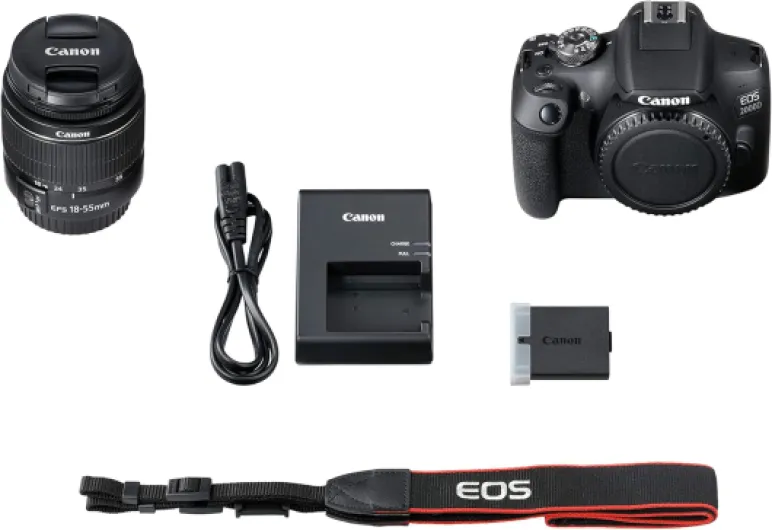
The kit I got is the classic combo: Canon EOS 2000D body + EF‑S 18‑55mm III lens. In the box, you get the body, the lens, a battery, the charger, a neck strap, and the usual thick manual. What you do NOT get is a memory card or a lens cap lanyard, which is a bit annoying. You have to buy an SD card separately before you can shoot anything, and if you’re clumsy like me, you’ll probably misplace the lens cap at some point.
The camera itself has a 24.1 MP APS‑C sensor, shoots photos and Full HD video (1080p), and does about 3 frames per second in burst mode. It has Wi‑Fi and NFC, so you can connect it to your phone via the Canon Camera Connect app. That part actually works pretty well once you’ve done the pairing once. I used it to send a few photos directly to my phone and post them without touching a computer.
The lens is the EF‑S 18‑55mm f/3.5‑5.6 III. It’s a basic zoom covering wide angle to short telephoto. It’s fine for portraits, landscapes, and general everyday stuff. Important detail: this version has no optical image stabilisation, only digital stabilisation in video, which is not the same. If you’re used to stabilized phone cameras, you’ll notice your hand shake more, especially in low light.
Overall, in terms of what’s in the box, it’s pretty standard for an entry‑level Canon kit. Nothing fancy, but you have everything you need to start shooting, apart from the SD card. For a beginner setup, it’s a pretty solid package: body, versatile lens, battery and charger. Just be ready to add a memory card and maybe a spare battery and bag if you want to use it more seriously.
Pros
- 24.1 MP APS‑C sensor with good image quality for the price
- Very beginner‑friendly controls and interface, easy to get started
- Versatile 18‑55mm zoom lens covers portraits and landscapes, good all‑rounder
Cons
- Kit lens has no optical image stabilisation, which hurts in low light and video
- Only 9 autofocus points and 3 fps burst, limited for sports or fast action
- Plastic body with fixed screen and no weather sealing, feels basic and not very future‑proof
Conclusion
Editor's rating
After spending time with the Canon EOS 2000D + 18‑55mm kit, my conclusion is simple: it’s a good first DSLR for someone starting from scratch, with clear limits that you’ll eventually bump into if you get more serious. The image quality is solid for the price, especially in decent light, and the 24.1 MP sensor gives you sharp, detailed photos that easily beat most phones for portraits and low‑light shots. The controls are clear, the learning curve is manageable, and there’s plenty of online help if the paper manual feels overwhelming.
Where it falls short is in more demanding situations: sports, fast action, and serious video work. The 9‑point autofocus and 3 fps burst are fine for casual use but not more. The lack of optical stabilisation in the kit lens is also a real downside, especially in low light and handheld video. The body feels okay but not tough, and the fixed screen makes some angles and vlogging less practical.
If you’re an amateur or beginner who wants to move beyond phone photography, learn the basics, and have a simple, affordable camera that gets the job done, this kit makes sense. If you already know you care a lot about video, fast action, or want something more future‑proof, I’d say skip it and look higher up in the Canon range or at a modern mirrorless body. For what it is — an entry‑level DSLR at a fair price — it’s a decent, no‑drama choice.