
Summary
Editor's rating
Is it worth the money?
Looks like a mini DSLR, feels like a budget compact
Battery life: mostly okay, but not consistent
Build quality and longevity: handle with care
Image and video quality: decent in daylight, quickly struggles in low light
What you actually get for the money
Pros
- Very complete bundle for the price (2 batteries, 32 GB SD card, bag, strap)
- Simple to use, good for kids and beginners who don’t want complex menus
- Decent photo and video quality in good light for casual use and basic vlogging
Cons
- Image quality and low‑light performance are clearly behind modern smartphones and branded cameras
- Build feels cheap and not very durable; no water resistance
- Battery life and battery quality can be inconsistent, with some reports of very fast drain

Specifications
View full product page →| Brand | DGVDO |
A cheap 4K camera that looks better on paper than in real life
I’ve been playing around with this DGVDO 4K 64MP compact camera for a bit, mainly out of curiosity. I already use my phone and a bigger mirrorless camera, so I wanted to see if a sub-£100 “4K vlogging camera” from a brand I’d never heard of could actually replace a phone for casual photos and videos. Short version: it kind of does the job for simple stuff, but don’t expect miracles just because it says 4K and 64MP on the box.
The first thing that hits you is the spec sheet. 4K, 64MP photos, autofocus, 16x zoom, Wi‑Fi, dual batteries, SD card included, webcam mode, filters, slow‑mo… all the buzzwords are there. On paper it looks like you’re getting a mini DSLR experience for the price of a budget smartphone accessory. In practice, it’s more like a decent toy camera that’s a step up from those super cheap kids’ cameras, but still far from what a proper camera or a good phone can do.
That said, I can see why it has good reviews. It’s simple, you pull it out of the box and you can start shooting immediately because the SD card and batteries are included. No need to buy extra gear, no complex menus. For someone who just wants to film holidays, family stuff, or start dabbling in vlogging without worrying about breaking an expensive camera, it’s not a bad little bundle.
But it’s not perfect. The marketing around 4K and 64MP feels a bit optimistic, the build is clearly budget, and things like low‑light performance, battery consistency, and autofocus are just “ok”. If you know what you’re buying and keep your expectations in check, it’s usable. If you’re expecting pro‑level quality because of the numbers on the product page, you’ll probably be disappointed.
Is it worth the money?
For under £100, this camera sits in an interesting spot. On one side, you have smartphones that already shoot decent photos and videos. On the other side, you have entry‑level cameras from big brands that cost more but offer better sensors, better lenses, and more reliable performance. This DGVDO model tries to squeeze into the middle by throwing a long spec sheet at you: 4K, 64MP, Wi‑Fi, dual batteries, SD card, webcam mode, loads of modes and filters. If you look at what’s in the box versus the price, the value is actually pretty good.
The question is: what do you really need? If you already have a good smartphone, this camera doesn’t bring a huge step up in image quality. In some situations, your phone will probably do better, especially in low light and with HDR. Where this camera makes more sense is for people who don’t want kids or beginners playing with their main phone, or for someone who wants a dedicated, simple device for vlogging and casual photography without spending big money.
Compared to a cheap used Canon or Sony compact, the DGVDO gives you more modern features on paper (4K, Wi‑Fi, webcam mode), but the overall image quality and build are still behind what you get from those brands. So it’s a trade‑off: more features and new product, but lower‑end performance. For a first camera for a teenager, or as a gift for someone who just wants to mess around with photos and videos, it’s decent value. For anyone serious about photography or content creation, I’d say save up a bit more.
So in terms of value, I’d call it good for casual users, average for everyone else. You’re not getting ripped off, but you’re also not getting a miracle device. It’s a budget camera that does what it promises at a basic level. As long as you buy it with that mindset and not because of the big 64MP label, you’ll probably feel you got your money’s worth.
Looks like a mini DSLR, feels like a budget compact
The design is clearly trying to imitate a small DSLR or mirrorless camera. From a distance, it looks pretty decent: black body, small grip, pop‑up flash, and a lens that sticks out enough to look “serious”. Once you actually pick it up, you immediately feel it’s light and mostly plastic. That’s not necessarily a bad thing if you want something easy to carry, but it doesn’t give that solid, reassuring feel you get from bigger brands. It’s more “toy‑ish but usable” than premium.
The good point is that it’s compact and lightweight. You can throw it in a small bag or even a big pocket, and it won’t drag you down on a day trip. The 3" screen is big enough to frame your shots comfortably, and the menus are simple, with icons that are easy to understand even if you’re not a camera geek. There’s a mode dial on top that lets you switch between photo, video, playback, and some scene modes without digging in menus, which is nice at this price.
There’s also the dual‑lens idea for vlogging and selfies. In practice, this just means there’s a way to flip to a front‑facing view so you can film yourself. It’s handy if you’re doing TikToks or simple YouTube videos and want to see yourself on screen. The grip is small but acceptable, and the included neck strap is basic but does its job. Buttons feel a bit cheap but they respond correctly, I didn’t have any that stuck or missed presses.
On the downside, everything about the body reminds you it’s a budget device. The plastic marks easily, it doesn’t feel like it would survive a serious drop, and it’s definitely not water‑resistant. The port covers and battery door feel a bit flimsy, so I wouldn’t be rough with it. If you treat it like an inexpensive gadget and not like a professional tool, the design is fine. Just don’t expect long‑term ruggedness or premium finishing for this price point.
Battery life: mostly okay, but not consistent
The camera comes with two 1050 mAh batteries, which is one of the strong points of the bundle. On paper, they claim around 8 hours of continuous shooting, but that’s clearly optimistic. In real use, with a mix of photos and short video clips, screen on most of the time, I was getting something closer to 1.5–2 hours per battery before it started dropping into the last bar. That’s still acceptable for a day out if you carry both batteries and don’t record nonstop.
What’s a bit annoying is the inconsistency. Some users mention the battery draining in 5 minutes, which sounds like either a defective battery or a faulty unit. I didn’t see anything that extreme, but I did notice that one of the two batteries seemed to drain faster than the other. It’s not dramatic, but you can tell they’re not high‑end cells. Also, the battery indicator isn’t very precise: it stays on full for a while, then drops quickly in the last third, so you don’t get a very accurate sense of how much time you have left.
Charging is done via the included charger and USB cable, and it’s not fast. You need to plan ahead and charge both batteries fully the day before a trip. There’s no wireless charging or fancy stuff, just a simple plug‑and‑wait setup. On the plus side, having two removable batteries is way better than a single built‑in one at this price. If one dies, you can at least swap and keep shooting, which is more than you get with many cheap devices.
So overall, battery life is “good enough” for beginners and casual use, but don’t trust the marketing numbers too much. If you plan to film long vlogs or events, you’ll have to manage your shooting time, lower the resolution, or carry a power bank and take breaks to charge. And if you get a unit where the battery dies in a few minutes like that 1‑star review, I’d just return it right away rather than trying to live with it.
Build quality and longevity: handle with care
Durability is where you really feel the budget nature of this camera. The body is light plastic, and while that makes it easy to carry, it doesn’t scream long‑term toughness. I didn’t drop it on purpose, but even just handling it, you can feel some flex if you squeeze the grip or twist the body a bit. The buttons and dials work, but they have that cheap clicky feel, not the solid feedback you get on more expensive gear.
The camera is not water resistant at all. There’s no sealing around the battery door or ports, and the manufacturer clearly lists it as “not water resistant”. So this is not something I’d happily use in heavy rain, near a pool with kids splashing, or on the beach without being careful. A bit of dust and occasional light drizzle is probably fine, but I wouldn’t push my luck. Sand and cheap plastic don’t mix well in the long run.
The lens is built‑in and not protected by a very strong cover, so you need to be careful when throwing the camera into a bag. I’d always use the included bag or at least keep it away from keys and other sharp objects. The moving parts like the pop‑up flash and battery door feel like the weak points: they work, but they don’t feel like they’d survive rough treatment or lots of opening and closing over many years.
For a kid, a teenager, or someone who just wants a cheap camera for occasional use, it’s acceptable as long as you’re not rough with it. If you’re used to more robust cameras, you’ll immediately feel the difference. This is the kind of device you treat gently: no throwing it in the back of the car, no leaving it rolling around in a backpack without protection, and definitely no drops on hard floors. If you keep that in mind, it should last long enough to justify the price, but I wouldn’t bet on it being a long‑term workhorse.
Image and video quality: decent in daylight, quickly struggles in low light
In terms of raw performance, this camera is very clearly built for casual use. In good light, outdoors or in a well‑lit room, the photos are pretty decent. Colors are a bit on the punchy side but not crazy, and for family photos, travel shots, or social media, it’s absolutely fine. The autofocus locks on reasonably fast if your subject isn’t moving too much, and the 6‑axis “anti‑shake” helps a bit when you’re shooting handheld. It’s digital stabilisation, so don’t expect miracles, but it does smooth out some small jitters in video.
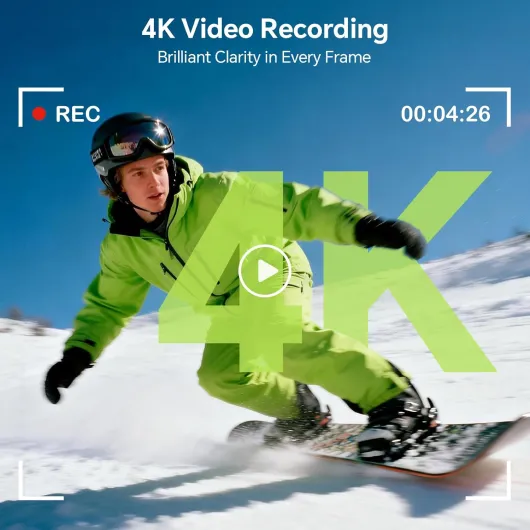
Video in 4K is usable, but you can tell the limitations of the sensor and processing. It looks sharper than 1080p, but if you look closely, details are not as clean as on a proper camera or even a recent phone. Frame rates up to 60 fps (in lower resolutions) are nice for smoother motion, but the image tends to get noisier and a bit muddy in darker areas. For simple vlogs, talking‑head videos, or filming your holidays, it gets the job done. If you’re picky about video quality, you’ll see the compromises pretty quickly.
Low light is where the camera starts to struggle. Indoors at night or in dim rooms, noise appears fast, and the autofocus becomes less reliable. Sometimes it hunts a bit before locking focus. The built‑in flash helps freeze subjects for photos, but it gives that typical compact‑camera “flat” flash look. For parties or quick snaps at night, it’s ok, but if your main use is shooting in bars, concerts, or very low light, this isn’t the right tool.
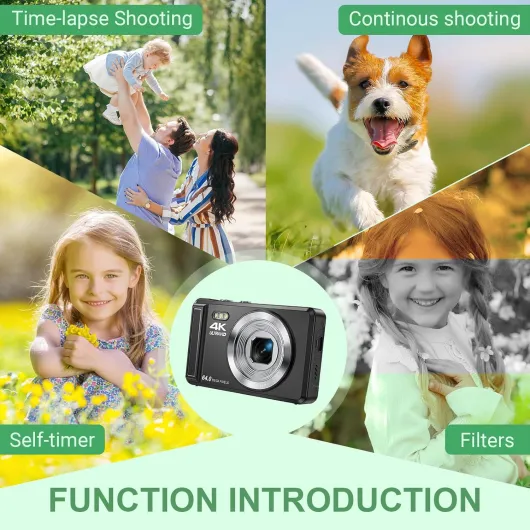
The extra features like slow motion, burst mode, filters, and exposure compensation are a nice bonus, but they feel like add‑ons rather than core strengths. Slow motion is more of a fun gimmick than a serious tool, and the filters are basically Instagram‑style effects baked into the camera. The webcam mode works: plug it into a PC, select it as a camera, and you’re good to go for basic streaming or calls. Overall, performance is exactly what you’d expect from a cheap compact: fine when conditions are good, quickly limited when they’re not.

What you actually get for the money
On paper, this camera tries to tick a lot of boxes. You get 4K video (2160p), 64MP stills, a 3" LCD, 16x digital zoom, autofocus, built‑in flash, Wi‑Fi, and a bunch of modes like slow motion, loop recording, burst, timer, and about 20 filters. It also doubles as a webcam over USB, and you can use it for streaming or video calls. The box comes fairly loaded: camera, 2 x 1050 mAh batteries, a 32 GB SD card, a simple bag, neck strap, USB cable, and charger. For under £100, that’s a lot of bits.
In day‑to‑day use, the camera feels very “point‑and‑shoot”. It boots fast enough, menus are basic but readable, and there’s an autofocus system that does its job as long as you don’t move too fast or shoot in very dark places. The 16x zoom is digital, not optical, so it’s basically cropping the image. It’s fine for checking something in the distance, but once you zoom past halfway, quality drops and you start to see noise and softness, especially in video.
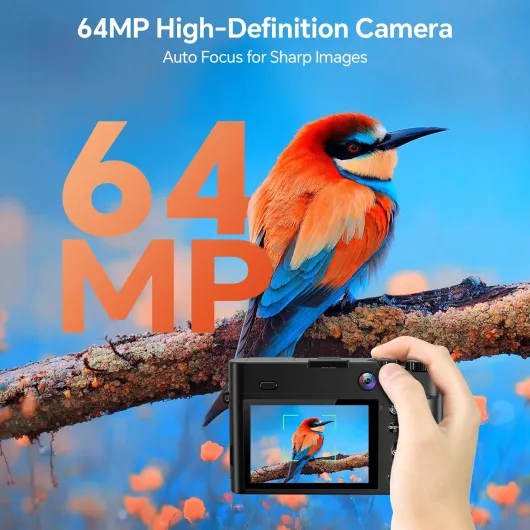
The 64MP spec is a bit misleading. The sensor is actually 13MP, and the camera upsizes the images. So yes, the files are 64MP in size, but the level of detail is more in line with a decent mid‑range phone, not a proper 64MP camera. Same for 4K: it’s usable and sharper than 1080p, but it doesn’t look like what you get from a Sony, Canon, or even a recent smartphone. It’s more like “good enough for YouTube when you’re starting out”, not cinema quality.
For a kid, a teenager, or a complete beginner who just wants something separate from their phone, the overall package is pretty solid. You don’t have to think about lenses, you don’t have to buy extra memory cards, and the camera is straightforward. Just be aware that most of the fancy numbers are more marketing than real‑world performance. It’s a simple camera that tries to look high‑end, but behaves like a budget compact, which is fine if that’s what you expect.
Pros
- Very complete bundle for the price (2 batteries, 32 GB SD card, bag, strap)
- Simple to use, good for kids and beginners who don’t want complex menus
- Decent photo and video quality in good light for casual use and basic vlogging
Cons
- Image quality and low‑light performance are clearly behind modern smartphones and branded cameras
- Build feels cheap and not very durable; no water resistance
- Battery life and battery quality can be inconsistent, with some reports of very fast drain
Conclusion
Editor's rating
Overall, this DGVDO 4K 64MP vlogging camera is a decent little gadget if you treat it as a budget toy‑camera for beginners, not as a serious camera. In good light, it takes perfectly usable photos and videos for holidays, family events, and basic vlogs. The included 32 GB card, two batteries, and simple controls make it easy to get going right out of the box. For kids, teens, or adults who just want something separate from their phone, it makes sense.
On the flip side, the big numbers on the product page (4K, 64MP, 16x zoom) are a bit misleading. The real sensor is 13MP, the zoom is digital, low‑light performance is weak, and the build quality is clearly budget. Battery life is okay but not as long as advertised, and there are some reports of very poor battery units. If you’re already used to modern smartphones or branded cameras, you’ll see the limitations fast.
I’d recommend this camera for: parents looking for a first “real” camera for a kid, beginners who want to try vlogging without spending a lot, or someone who just wants a cheap, simple device for casual photos and videos. I’d skip it if: you care a lot about image quality, you often shoot in low light, or you’re thinking about doing serious YouTube work. In those cases, you’re better off saving a bit more for an entry‑level camera from a known brand or just sticking with a good phone.