
Summary
Editor's rating
Value for money: decent long zoom on a tight budget
Design and handling: chunky, a bit heavy, but reassuring in the hand
AA batteries: convenient but not the most efficient
Build quality and reliability: mostly fine, but you feel the budget
Image quality and zoom performance: strong in daylight, weaker in low light
What this camera actually is (and isn’t)
Pros
- Very affordable way to get a 40x optical zoom for planes, wildlife, and travel
- Simple, beginner‑friendly interface with lots of automatic modes
- Uses standard AA batteries, easy to power anywhere with rechargeables or disposables
Cons
- Weak in low light, no RAW, and limited control over depth of field
- Build feels budget; lens cap fits poorly and screen smudges easily
- Quality control not perfect (reports of lens defects), so you need to check your unit early

Specifications
View full product page →| Brand | KODAK |
A cheap way to get a long zoom, with some trade‑offs
I’ve been using the KODAK Pixpro Astro Zoom AZ405 for a little while now, mostly for walks, weekend trips, and some random plane-spotting near the airport. I bought it because I wanted more zoom than my phone, but I didn’t want to spend DSLR or mirrorless money or start messing with lenses. On paper, 40x zoom, 20 MP and 1080p video for this price looked pretty solid, so I went in with realistic expectations: something better than a phone at distance shots, but not a pro camera.
Right away, it feels like a typical budget bridge camera: lots of zoom, lots of automatic modes, not many manual controls. It’s clearly aimed at beginners or casual users, not people who want to play with aperture or shoot RAW. That matches what some Amazon reviews say: good for aviation, holidays, and general use, less good if you want full creative control. I’d agree with that after using it.
The main thing I noticed is that the camera is built around convenience: auto everything, AA batteries, SD card in, shoot. That’s fine, but there are some limits: depth of field is basically not something you can really control, and low light is not its friend. If you’re dreaming of creamy background blur or clean night shots, this isn’t the right tool. If you just want to zoom in on stuff far away in daylight, it does the job pretty well.
Overall, it’s not perfect, and there are a few annoying details (lens cap, screen smudges, battery life), but for the money, I can see why it has a 4/5 average. You just need to know what you’re buying: a simple long-zoom camera for beginners and casual shooters, not a miracle machine that replaces a proper system camera.
Value for money: decent long zoom on a tight budget
On the value side, I think the KODAK Pixpro AZ405 makes sense for a certain type of user. You’re paying relatively little for a camera that gives you a long 40x zoom, 20 MP photos, 1080p video, and very simple operation. If your main goal is to get closer to subjects than your phone can, especially in daylight (planes, birds, kids playing far away, landmarks), it’s good value for money. That’s probably why it sits around 4/5 stars on Amazon with over a thousand reviews: it does what most casual buyers expect.
Where the value gets more debatable is if you compare it to what modern smartphones can do. In good light, many mid‑range phones now produce images that are as good or better at normal focal lengths, with better dynamic range and smarter processing. The AZ405 earns its place mainly because of the optical zoom. If you rarely need that zoom, then your phone might actually be a better all‑round camera, and this KODAK becomes less attractive.
Compared to more expensive bridge cameras from Canon, Panasonic, or Sony, the AZ405 clearly loses on image quality, speed, low light performance, and controls. But those cameras often cost two or three times more. So if your budget is tight and you just want something simple with a big zoom, the AZ405 is a reasonable compromise. You’ll have to accept some trade‑offs: no RAW, limited manual control, weaker low‑light performance, and a slightly cheap feel here and there.
For me, the camera makes sense for: beginners who want to experiment beyond a phone without spending much, parents or travelers who want a cheap zoom camera, and hobbyists like aviation or wildlife spotters who shoot mainly in daylight and don’t care about advanced settings. If you’re more serious about photography, you might outgrow this pretty fast and wish you had saved for a better model. In that case, the value is lower. But judged purely as a budget long‑zoom toy that gets the job done, it’s fairly priced.
Design and handling: chunky, a bit heavy, but reassuring in the hand
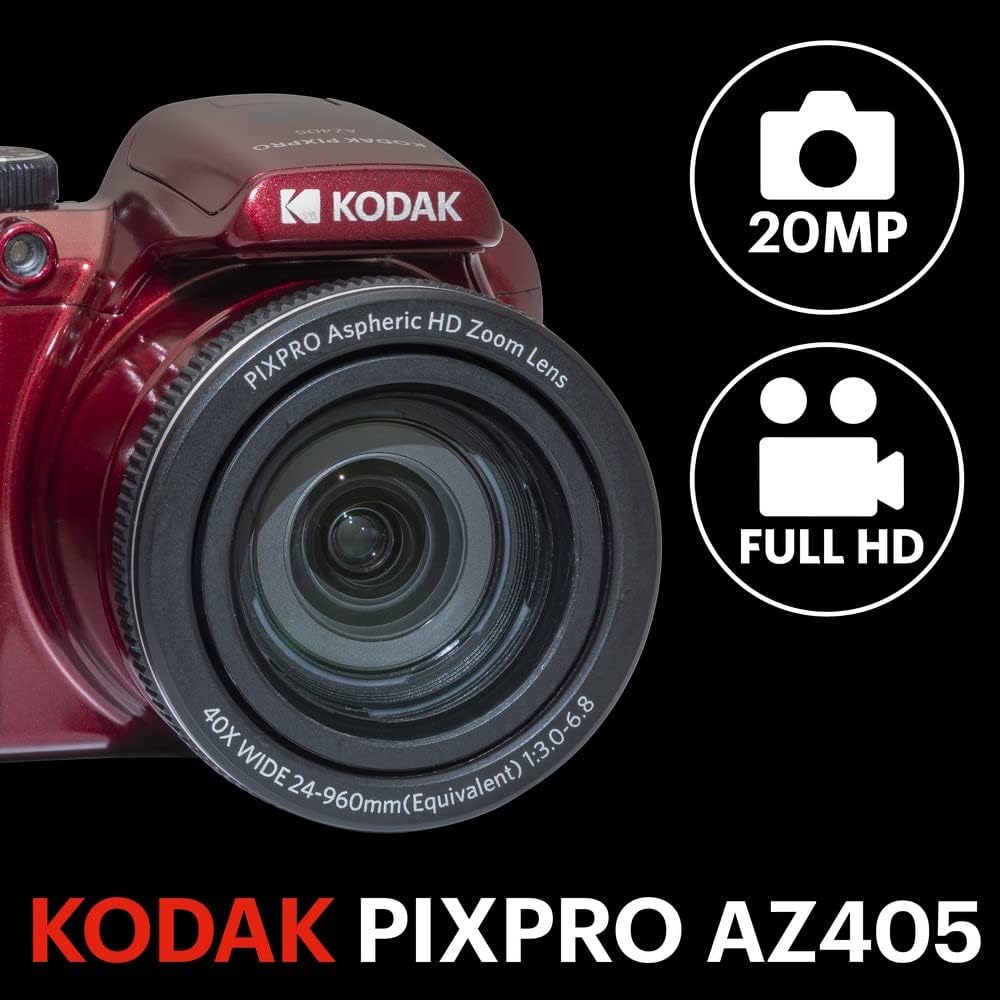
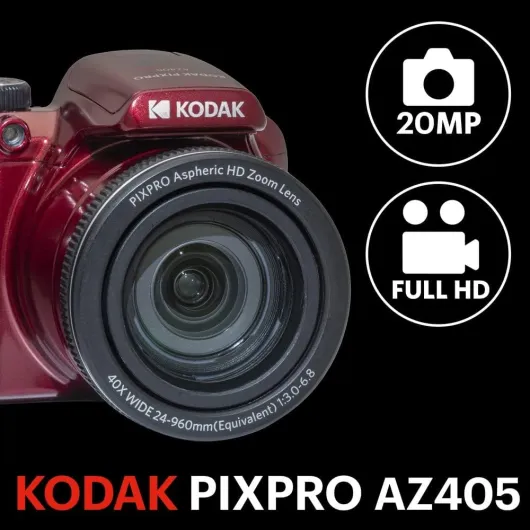
Design-wise, the AZ405 looks like a small DSLR that got shrunk in the wash. It has a proper hand grip, a protruding lens, and a built‑in flash on top. The red color is quite loud; some people will like the retro vibe, others might prefer black. Personally, I don’t mind it – it makes the camera easy to spot in a bag, and it looks a bit more fun than the usual all‑black gear. It’s not tiny: at around 720 g with batteries and card, it has some weight. One reviewer called it “quite heavy considering its size,” and that’s fair, but I actually like that because it feels more stable, especially at long zoom.
In the hand, the grip is decent. You can hold it one‑handed, but at 40x zoom you’ll want both hands on it to keep things steady, even with optical image stabilization. The physical buttons are basic but clear: zoom rocker around the shutter button, mode dial, playback, menu, etc. Nothing fancy, but nothing confusing either. The downside is the rear LCD is easy to smudge. Like one Amazon review mentioned, when you pick it up, it’s very easy to touch the screen and leave fingerprints. After a couple of outings I just kept a small microfiber cloth in the bag because it does get annoying.
The lens cap is another weak point. Multiple users mentioned that it doesn’t stay in place very well, and I had the same issue. It pops off too easily if you brush it or pull the camera out of a bag quickly. The tether they include is basically mandatory, otherwise you’ll lose the cap in a week. It’s a small thing, but it feels a bit cheap and you notice it every time you use the camera.
Overall, the design is functional but clearly budget. It feels okay in the hand, the controls are simple, and the overall shape is comfortable. Don’t expect premium materials or weather sealing. It’s a plastic bridge camera that tries to look like a mini DSLR and mostly succeeds in terms of ergonomics, with a few annoying quirks like the cap and the smudgy screen.
AA batteries: convenient but not the most efficient
One of the main quirks of the AZ405 is the power supply: it runs on standard AA batteries. On paper, that’s great. You don’t need a proprietary charger, and if you’re traveling or out in the countryside, you can buy AAs pretty much anywhere. That’s also what KODAK pushes in the description: you never have to worry about running out of power. In practice, it’s a bit more nuanced. Yes, you can always find AAs, but if you use cheap alkaline ones, you’ll burn through them quickly, especially if you’re reviewing photos a lot on the 3" LCD and using the zoom frequently.
From my experience and what one Amazon reviewer mentioned, the smart move is to invest in good rechargeable AAs (Eneloops or something similar). With a decent set, you get a reasonable number of shots per charge – enough for a day of casual shooting – and you don’t feel like you’re throwing money in the trash. With basic supermarket alkalines, you see the battery indicator drop noticeably faster, and that’s frustrating. The camera doesn’t include batteries in the box, so you need to plan for that from day one.
Another thing: swapping batteries is quick and simple, which I actually prefer over having to find a plug to charge a proprietary battery. For long days out, I just carry a second set of charged AAs and I’m safe. But compared to modern cameras with efficient lithium‑ion packs, the overall battery life per set isn’t great. If you’re coming from a phone or a mirrorless with a big battery, you’ll notice that you’re changing AAs more often than you might like.
So overall, the AA system is convenient but a bit old‑school. It’s great for people who travel or don’t shoot every day and like the idea of just popping in fresh batteries. It’s less ideal if you shoot heavily, because you’ll either spend a lot on disposables or you’ll have to manage several sets of rechargeables. I wouldn’t call it a dealbreaker, but it’s definitely something to factor into the cost and daily use.

Build quality and reliability: mostly fine, but you feel the budget
In terms of build quality, the AZ405 feels like what it is: a budget bridge camera made of plastic. The body doesn’t creak badly, the buttons work, and the zoom mechanism feels okay, but nothing about it screams high‑end. After packing it in a backpack a few times and using it outdoors, I didn’t notice any immediate issues: no loose parts, no rattling, and the lens extended and retracted normally. So for normal casual use, I’d say it holds up well enough.
That said, some of the details do feel on the cheaper side. The lens cap that doesn’t stay on well is one example – it gives you that little reminder that corners were cut. The rear screen also doesn’t have any noticeable protective coating; it picks up marks and small scratches if you’re not careful. I’d strongly suggest not throwing it in a bag with keys or rough items. A simple case or even a padded pocket goes a long way here.
I also noticed that Amazon reviews mention at least one unit arriving with a lens defect (a black arch in photos). That suggests quality control isn’t perfect. Mine didn’t have that issue, but it’s something to keep in mind: check your camera thoroughly in the first days. Shoot at different focal lengths and look at the corners of your images to make sure nothing weird is showing up. If there’s a defect, send it back right away rather than hoping it will “fix itself.”
There’s no weather sealing, so I wouldn’t use it in heavy rain or dusty conditions without protection. Treat it like a regular electronic device: light drizzle and a bit of dust are probably okay if you wipe it down, but don’t push it. Overall, durability is acceptable for the price, but this is not a rugged camera. If you’re careful and use a small case, it should last, but don’t expect it to survive serious abuse or rough travel conditions the way some higher‑end cameras might.
Image quality and zoom performance: strong in daylight, weaker in low light
The main reason to buy this camera is the 40x optical zoom, and on that front, it’s genuinely useful. For things like aviation photography, wildlife in good light, or just zooming in on details during a trip, it does a pretty solid job. One Amazon reviewer who uses it for planes was pretty happy with the clarity and reach, and I’d agree. At full zoom, you can pick out details that your phone camera just can’t reach. The optical image stabilization helps a lot; handheld shots at long zoom are usable if you’re not shaking too much and the light is decent.
The 20 MP CCD sensor delivers okay detail in good lighting. For daytime outdoor shots, colors are fine, sharpness is decent, and for viewing on a TV, computer, or social media, it’s more than good enough. Don’t zoom in at 100% on a big monitor expecting pro‑level sharpness; you’ll see noise and some softness, especially towards the long end of the zoom. But for the price range, I’d say the stills are totally acceptable. The camera’s auto scene mode usually picks something that works, and autofocus locks on reasonably well, though it’s not the fastest thing out there.
Where it starts to struggle is low light and indoor shooting. With a small 1/4" CCD sensor, noise creeps in quickly as soon as the light drops. The built‑in flash is basic and works for close subjects, but it’s nothing special. Don’t expect clean night cityscapes or fast action indoors. Also, as a user mentioned, you can’t really control depth of field, so you don’t get that strong background blur that you see on bigger cameras with larger sensors and fast lenses. Portraits look okay, but they don’t have that “pro” look, no matter what you do.
Video is 1080p MP4, and I’d call it “fine but nothing more.” It’s good enough for casual clips, family events, or some plane videos, but autofocus during video can hunt a bit, and the quality is clearly below a modern mid‑range phone in low light. In bright daylight it’s decent, though. The camera claims 30 fps continuous shooting, but in reality, the buffer and write speed are limited, so it’s not a sports camera. For everyday photography and long‑zoom shots in daylight, it gets the job done; just be realistic about its limits.

What this camera actually is (and isn’t)
The AZ405 is a bridge camera, meaning it sits between a compact point‑and‑shoot and a DSLR/mirrorless. You get a chunky body with a big zoom lens that you can’t remove, but you don’t have to think about lenses, mounts, or anything fancy. KODAK gives you a 40x optical zoom that goes from 24mm wide to 172mm (in 35mm equivalent terms, that’s roughly 24–960mm), a 20 MP CCD sensor, and Full HD 1080p video. It shoots only JPEG, no RAW, and it’s mostly automatic in terms of settings.
In practice, that means the camera is very straightforward: you turn it on, let the autofocus and auto scene mode handle everything, and you just compose and shoot. There is some control over shutter speed, which is nice, but you don’t really get proper control over aperture, so you can’t seriously play with depth of field. One Amazon reviewer mentioned that you can’t control depth of field, and that lines up with my experience: you’re not buying this for fancy portrait bokeh.
It takes SD cards (basic speed is fine because the camera itself isn’t super fast) and runs on AA batteries. That’s a big deal: no proprietary battery, no charger to forget. You just throw in four AAs and go. On the flip side, you really want decent rechargeables, because cheap alkalines drain pretty fast, especially if you’re using the LCD a lot and zooming in and out. The box is basic: you get the camera body with the built‑in lens, lens cap, and the usual paperwork. No remote, no fancy accessories.
So overall, this is a simple, long‑zoom camera aimed at novices. If you’re the kind of person who wants to plug into a computer via USB, copy JPEGs, maybe trim a bit in software, and that’s it, this camera fits that use. If you’re planning to seriously edit, shoot RAW, or need fast continuous autofocus, you’re looking at the wrong category of gear.
Pros
- Very affordable way to get a 40x optical zoom for planes, wildlife, and travel
- Simple, beginner‑friendly interface with lots of automatic modes
- Uses standard AA batteries, easy to power anywhere with rechargeables or disposables
Cons
- Weak in low light, no RAW, and limited control over depth of field
- Build feels budget; lens cap fits poorly and screen smudges easily
- Quality control not perfect (reports of lens defects), so you need to check your unit early
Conclusion
Editor's rating
The KODAK Pixpro Astro Zoom AZ405 is a no‑nonsense, budget bridge camera that gives you one main thing: a long 40x zoom in a simple, beginner‑friendly package. In good light, it delivers decent 20 MP photos and usable 1080p video, and the optical image stabilization helps keep shots steady, especially at longer focal lengths. The AA battery system is handy if you travel or don’t want to deal with proprietary chargers, as long as you invest in good rechargeables. For casual use – holidays, aviation spotting, basic wildlife, family events outdoors – it does the job and feels like honest value.
On the downside, you really feel the budget limits. Build is mostly plastic, the lens cap is annoying, the screen smudges easily, and there are some quality control complaints like lens defects. Image quality drops quickly in low light, you can’t properly control depth of field, there’s no RAW, and overall performance is slower than more expensive cameras. If you’re serious about photography or want room to grow with manual settings, this isn’t the right tool. But if you just want an affordable camera with a big zoom that’s easy to use and you accept its flaws, the AZ405 is a decent, practical option.