
Summary
Editor's rating
Value for money: good deal for beginners who want big zoom
Design and handling: feels like a small DSLR, with a few quirks
Battery life: OK for light use, weak for long days
Build and durability: plasticky but solid enough for normal use
Image quality and autofocus: good in daylight, struggles when light drops
What you actually get with this kit
Pros
- Very long 42x optical zoom with optical stabilization, useful for travel and wildlife in daylight
- Decent 20 MP image quality in good light with simple automatic modes
- Good value bundle with a 32 GB SD card included, ready to use out of the box
Cons
- Battery life is mediocre, often requires a spare battery for long days
- Weak low-light performance and slow autofocus at full zoom or in dim conditions
- Basic screen/viewfinder and plasticky build, not ideal for demanding or rough use

Specifications
View full product page →| Brand | KODAK |
A budget zoom monster that feels like a “real” camera
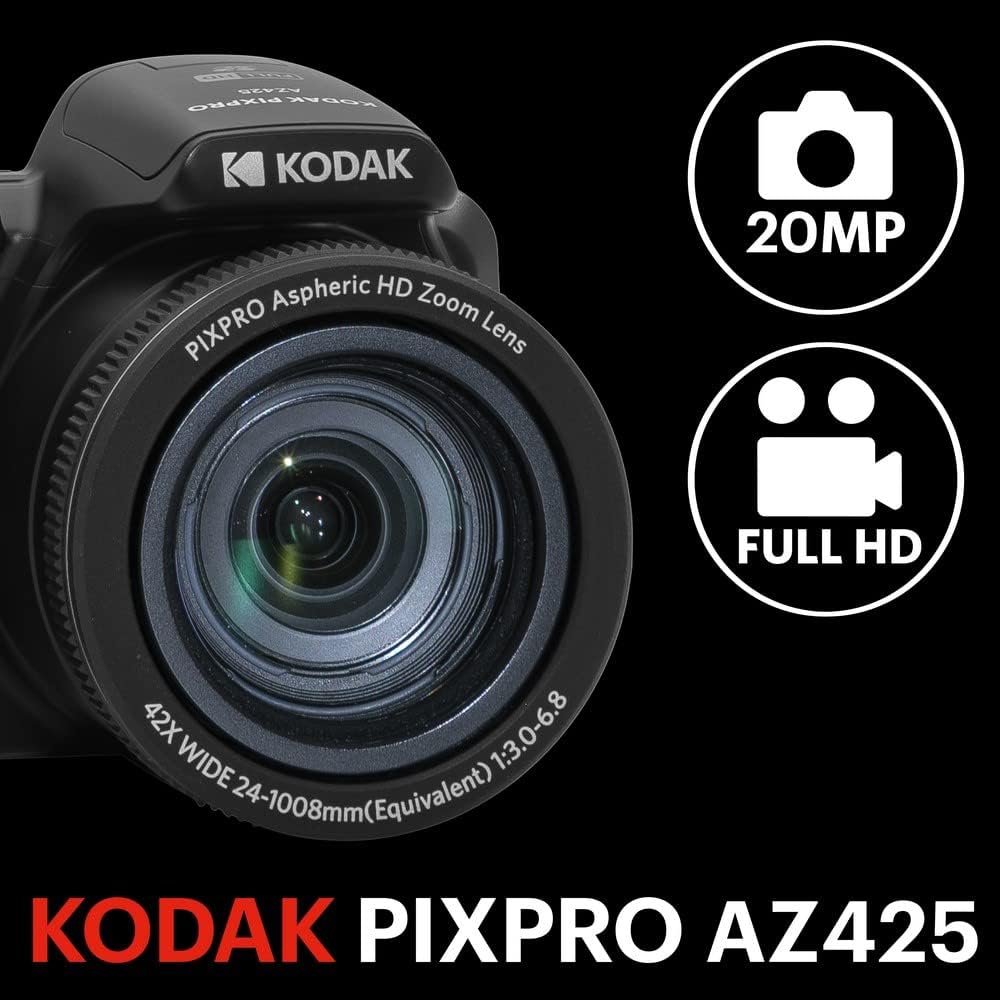
I’ve been playing with the KODAK Pixpro Astro Zoom AZ425 kit (camera + 32 GB SDHC card) for a little while, mainly for casual trips, walks, and some family events. I’m not a pro photographer, just someone who’s annoyed with phone zoom and wanted a cheap camera that looks and feels like a DSLR without the price and complexity. This one sits exactly in that space: a bridge camera with a big zoom and simple menus, clearly aimed at beginners or people who just want something more than a phone.
The main thing that pushed me to try it was the 42x optical zoom and the 20 MP sensor. On paper, that’s more than enough for holidays, zoo visits, airshows, that kind of stuff. The included 32 GB SD card is also a plus because you can literally start shooting right away, no need to buy extra storage on day one. It’s not a pro kit, but it’s convenient.
After a few days of use, I’d say the AZ425 is pretty solid for the price, but it comes with some clear trade-offs. Image quality is fine in good light, the zoom is genuinely useful, and the camera feels decent in the hand. On the downside, the autofocus can be slow, the screen is basic, and the battery life is not great if you shoot a lot of photos or video in one go. You can feel it’s a budget product once you start pushing it.
If you’re expecting DSLR-level performance, you’ll be disappointed. But if what you want is a simple camera with a long zoom that’s better than your phone in many outdoor situations, this thing gets the job done. Just be ready to read the manual online, tweak a few settings, and maybe buy a spare battery if you plan long days out.
Value for money: good deal for beginners who want big zoom
Looking at everything together—image quality, zoom, battery, build, and the fact that you get a 32 GB SD card in the pack—the AZ425 offers good value for money if you know what you’re buying. You’re paying for a long zoom and a “real camera” feel, not for cutting-edge tech or pro features. In that sense, it delivers: 20 MP photos, 1080p video, a 42x zoom with optical stabilization, and simple auto modes that most people can handle.
Where the value becomes a bit more debatable is if you compare it to modern smartphones. A decent mid-range phone will beat this camera in low light and convenience, but it can’t match the 42x optical zoom. So if zoom is your priority—wildlife in daylight, planes, distant buildings—this camera gives you something a phone simply can’t. If you only shoot nearby subjects and mostly post on social media, your phone might be enough and you’d save the money.
The included SD card is a small but real bonus: 32 GB is plenty for a casual user (thousands of photos and a good chunk of video). You don’t need to think about memory speeds or compatibility because it’s already matched to the camera. That saves a bit of hassle and cost. The downside is you might still have to spend extra on a spare battery and maybe a basic camera bag, so factor that into the real cost.
Overall, I’d say the AZ425 kit is worth it for someone who wants a cheap, easy bridge camera mainly for travel and outdoor shots. It’s not the best camera in the world, and there are better options if you raise your budget, but for this price bracket it’s a pretty solid compromise between features and cost. If you understand its limits and don’t expect miracles, you’ll probably be satisfied.
Design and handling: feels like a small DSLR, with a few quirks
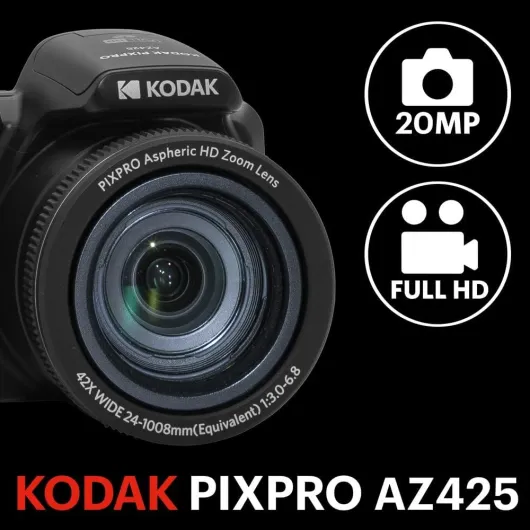
Design-wise, the AZ425 looks like a classic bridge camera: chunky grip, big lens barrel, and a decent amount of buttons. It’s not tiny, but it’s still fairly compact for a 42x zoom. The weight (around 0.85 kg) actually helps: it feels more stable in the hand than those super light plastic compacts. One Amazon reviewer mentioned being pleasantly surprised by the weight, and I agree. It doesn’t feel premium, but it doesn’t feel like a toy either.
The grip itself is comfortable enough for medium-sized hands. I could carry it all day with a strap and only felt a bit of fatigue after long zoom-heavy sessions. Where the design gets a bit annoying is when the lens extends fully during zoom. The barrel becomes quite long, and finding a safe grip with your left hand without accidentally covering the lens or blocking the flash takes a bit of practice. It’s not a deal-breaker, but at full zoom, the camera feels front-heavy and slightly awkward.
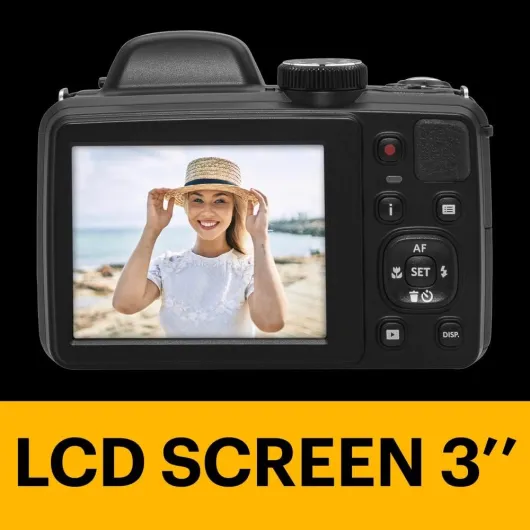
The button layout is fairly straightforward: zoom rocker around the shutter button, mode dial on top, and a set of buttons on the back for menu, playback, and quick settings. The plastic buttons are a bit “clicky” and feel cheap, but they work. The electronic viewfinder is technically there, but it’s basic and not very sharp. In bright sunlight, it’s still better than using the LCD, but don’t expect anything close to a DSLR or a mid-range mirrorless EVF.
In everyday use, the design gets the job done: you can pull it out, turn it on, and shoot quickly in auto mode. It’s not weather-sealed, so I wouldn’t use it in heavy rain. For travel and casual outings, though, the form factor is decent. It’s a camera that looks “serious” enough without being overkill, and most beginners will feel comfortable with it after a day or two.
Battery life: OK for light use, weak for long days
The AZ425 uses a rechargeable Li-ion battery, which is already better than those cheap bridge cameras that still run on AA batteries. Plugging it in and charging is simple enough, but it’s not a fast process. Out of the box, mine had around 10% charge and needed more than two hours to reach full. That matches what another user reported. So if you buy it just before a trip, charge it overnight before you actually need it.
In real-world use, the battery life is average at best. One reviewer mentioned only getting about two hours, and I had a similar experience when I was actively shooting and reviewing a lot of pictures on the LCD and recording some 1080p videos. If you’re just taking the occasional photo, the battery will last longer, but if you’re walking around a city or zoo and shooting all day, you’ll probably drain it before the day is over.
The camera doesn’t help much with power management. The LCD is always on unless you manually turn the camera off, and that screen is a big power draw. There are some auto power-off settings, but you still have to get used to switching the camera off between shots if you want to stretch the battery. For a casual half-day outing, it’s fine. For a full-day trip or holiday use, I’d strongly recommend buying a spare original battery and keeping it charged in your bag.
So, battery-wise, it’s usable but not comfortable. This is not a camera you can forget about and assume it will last all day. If you plan heavy use—lots of zooming, video, and image review—you need to manage your power carefully or carry a second battery. For the price, I wasn’t shocked, but I definitely wouldn’t call the battery a strong point of this camera.

Build and durability: plasticky but solid enough for normal use
In terms of build quality, the AZ425 is clearly made of plastic, but it doesn’t feel like it’s going to fall apart in your hands. The body panels fit together reasonably well, there are no weird creaks when you grip it firmly, and the lens mechanism feels smooth when it extends and retracts. The finish is basic, nothing fancy, but for a budget bridge camera, it’s acceptable.
I’ve tossed it in a backpack a few times (with the lens cap on and no special case) and it survived without any marks or issues. The buttons and dials still work fine, and the zoom mechanism hasn’t shown any weird noises or wobble. That said, it’s not rugged: no weather sealing, no shock protection, and I wouldn’t trust it in heavy rain or on a sandy beach without being careful. If you treat it like an entry-level electronic device and not like a GoPro, you’ll be fine.
The hinges and doors (battery/SD card compartment, ports cover) feel like the weak points. They’re thin plastic and don’t inspire a lot of confidence if you’re rough with them. I’m careful when opening and closing those. Long term, I could see someone snapping a door if they’re in a hurry or not paying attention. The lens cap is also just a simple plastic cap with a string; it works, but it’s easy to misplace or drop.
From what I’ve seen and from other user comments, durability is pretty solid for normal amateur use: trips, family events, holidays. If you’re expecting a camera that can handle harsh conditions, this isn’t it. If you just want something you can keep in a small bag and pull out on weekends, it should hold up as long as you’re not careless. For the price bracket, I’d call the durability acceptable but not impressive.
Image quality and autofocus: good in daylight, struggles when light drops
On the image quality side, the AZ425 is exactly what you’d expect from a 1/2.3" 20 MP CCD sensor in this price range. In good daylight, photos are sharp enough, with decent color and enough detail for prints and social media. If you set the resolution to the full 20 MP and maybe bump the color mode to “vivid”, you get punchy images that look fine on a laptop or phone. You’re not getting DSLR-level dynamic range, but for holidays and family shots, it’s totally acceptable.
Where it starts to fall apart is in low light. Even at ISO 800 or 1600, noise becomes very visible, and the camera tends to smear fine detail to hide it. Indoors without flash, images get soft and grainy pretty fast. The built-in flash helps for close subjects, but it’s not powerful enough for large rooms. If most of your photos are taken outside during the day, you’ll be happy. If you want nice evening shots or indoor events, this is not the best tool.
The autofocus is another mixed bag. It’s contrast-detect with a single focus point, and it works by half-pressing the shutter until you see a green square, as one reviewer pointed out. In good light and at the wide end, it locks on reasonably fast. At 42x zoom or in dim conditions, it hunts more and sometimes fails to lock at all. You can get sharp telephoto shots, but you need patience and a steady hand (or, ideally, a tripod). Moving subjects at long zoom are hard to capture cleanly.
Continuous shooting is advertised up to 30 fps, but in practice, the camera’s write speed and buffer are limited. Don’t expect long bursts like on a sports camera. For casual use—kids, pets, birds in decent light—it’s fine if you time your shots. Overall, performance is decent but nothing more. It’s clearly tuned for casual shooters who stay in auto mode and mostly shoot in good light.
What you actually get with this kit
This pack is basically a ready-to-shoot bundle: you get the KODAK Pixpro AZ425 bridge camera in black and a 32 GB Kodak SDHC UHS-I card. No batteries included in the box description is a bit confusing, but the camera itself runs on a rechargeable Li-ion battery, so you’re not dealing with AA batteries. Out of the box, my unit had a small charge (around 10%), so I had to charge it for a couple of hours before actually using it properly.
The camera has a 20 MP CCD sensor, supports Full HD 1080p video, and has a 42x optical zoom covering roughly 24–1000 mm equivalent (24–172 mm quoted, but in practice it feels like a strong telephoto). There’s optical image stabilization, which is crucial at that zoom level, and a 3-inch LCD screen on the back. No fancy tilting or flipping: it’s a fixed screen. It shoots JPEG only, no RAW, and video is recorded in MP4. There’s basic Wi‑Fi for transferring photos, but don’t expect a smooth smartphone-app experience like on more modern brands.
In terms of controls, you mostly rely on automatic modes and scene presets. It has auto scene detection, object tracking, and some post-editing options in-camera. It’s clearly aimed at people who don’t want to dive into manual exposure. You do get a self-timer, a built-in flash with automatic mode, and some menu options for ISO, white balance, and picture style (normal, vivid, etc.). It’s enough to play with but not enough to call it a learning tool for serious photography.
Overall, as a package, it’s simple but complete: camera, battery, SD card, and the usual strap and cable. The paper leaflet in the box is close to useless, though. You really need to download the full manual online if you want to understand all the settings and shortcuts. For a beginner, the kit is practical, but don’t expect hand-holding via good documentation in the box.
Pros
- Very long 42x optical zoom with optical stabilization, useful for travel and wildlife in daylight
- Decent 20 MP image quality in good light with simple automatic modes
- Good value bundle with a 32 GB SD card included, ready to use out of the box
Cons
- Battery life is mediocre, often requires a spare battery for long days
- Weak low-light performance and slow autofocus at full zoom or in dim conditions
- Basic screen/viewfinder and plasticky build, not ideal for demanding or rough use
Conclusion
Editor's rating
The KODAK Pixpro Astro Zoom AZ425 pack is a simple, budget-friendly bridge camera that makes sense if your main goal is to get a long optical zoom without spending a lot. The 20 MP sensor, 42x zoom, and optical stabilization give you enough flexibility for travel, wildlife in daylight, and general family photos. The included 32 GB SD card is a nice touch, so you really can start shooting right away. In good light, image quality is decent and colors are pleasing, especially if you use the vivid mode.
On the downside, you feel the compromises: autofocus is slow in low light and at full zoom, the CCD sensor struggles once the light drops, and the battery life is just average, sometimes barely a solid afternoon if you shoot a lot of photos and video. The screen and viewfinder are basic, and the plastic build, while acceptable, doesn’t invite rough handling. This is not a camera for people who want to learn manual photography or push their creativity with RAW files and fast bursts; it’s more of a point‑and‑shoot with a big lens.
If you’re an amateur or beginner who mainly shoots outdoors in daylight and you specifically want a big zoom without overthinking settings, this camera is a good value and will get the job done. If you care a lot about low-light performance, fast autofocus, or all-day battery life, or if your phone already has a solid camera and you don’t need extreme zoom, you can probably skip this and either stay with your phone or save up for a higher-end compact or entry-level mirrorless.