
Summary
Editor's rating
Value for money: good if you just want zoom, less good if your phone is already decent
Design and handling: looks like a mini DSLR, feels like a budget bridge
Battery life: decent for a day out, but don’t forget your charger
Build and durability: okay for normal use, but feels a bit fragile
Image quality and zoom: good in daylight, struggles at night and for fast action
What the Pixpro AZ421 actually offers in real life
Ease of use and real-world effectiveness: fine for auto mode, annoying when you dig deeper
Pros
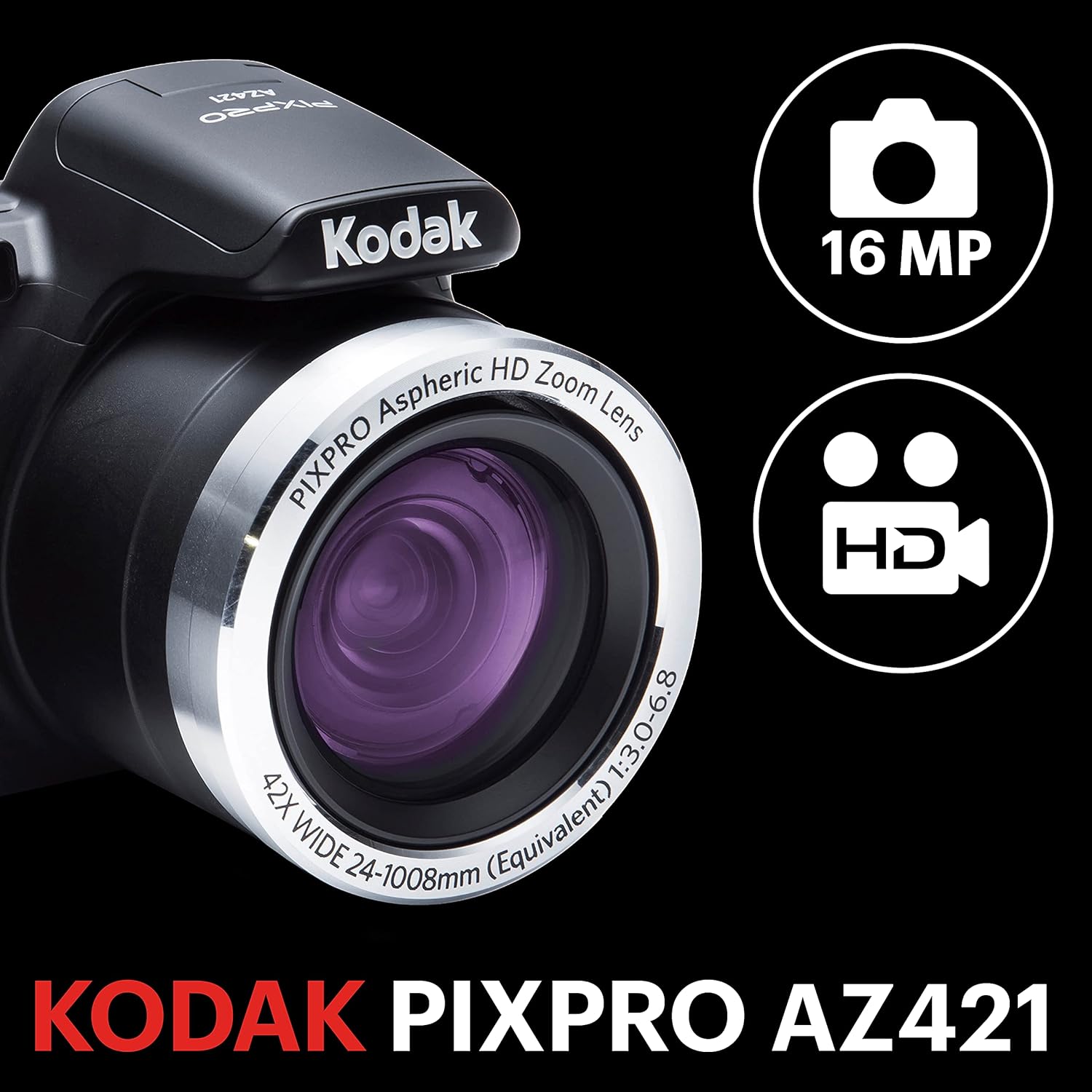
- Very long 42x optical zoom (24–1008 mm) useful for wildlife, travel and distant subjects
- Easy to hold thanks to the DSLR-style grip and relatively light weight
- Affordable price for a bridge camera with rechargeable battery and basic stabilisation
Cons
- Weak low-light performance and noisy, unreliable night photos
- Autofocus and menus are slow and not very intuitive, especially for macro and special shots
- Image quality and video (720p) feel dated compared to many modern smartphones

Specifications
View full product page →| Brand | KODAK |
A budget superzoom that looks tempting… on paper
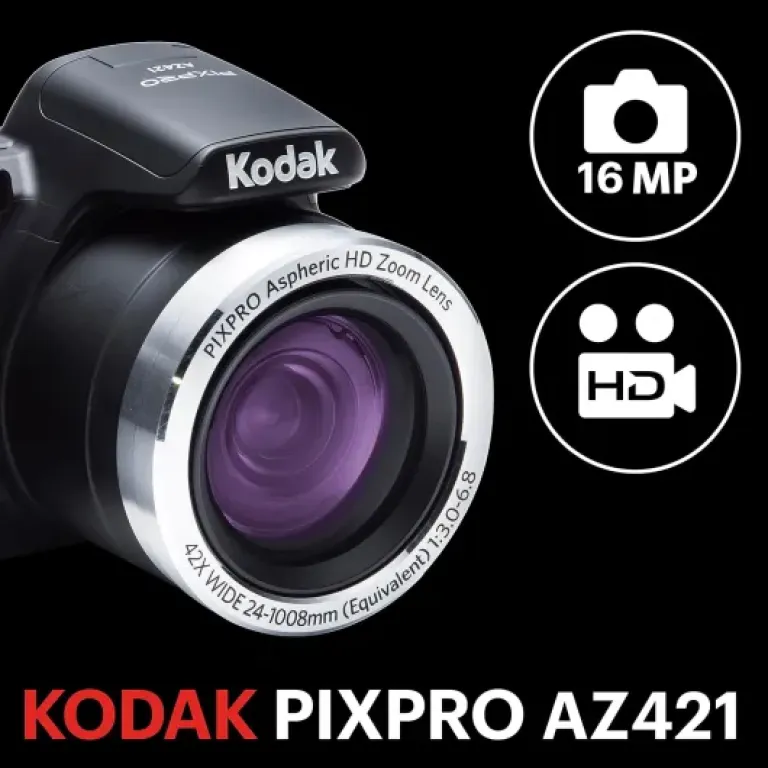
I picked up the KODAK Pixpro AZ421 because I wanted something better than my phone for holidays and family stuff, without spending DSLR money. On paper it looks pretty attractive: 42x optical zoom, 24mm wide angle, 16 MP, optical stabilisation, 720p video, and a proper grip, all for a relatively low price. Plus, I used to have a small Kodak compact years ago that I liked, so I was a bit biased in favour of the brand.
After a couple of weeks of use—walks, a weekend trip, some indoor family photos, and a few experiments at night—my feeling is pretty clear: it’s a decent starter camera if you’re coming from an old phone and just want a big zoom, but it’s far from magic. The zoom is the main selling point and it does what it says, but the rest of the camera is more “good enough” than “wow”. Especially in low light, you really see its limits.
I mainly used it in auto mode and with a few scene modes, like most beginners would do. I did try manual and some settings for specific shots (moon, moving subjects, macro), and that’s where I started to see why some Amazon reviews are disappointed. It’s not very intuitive, and you have to fight it a bit to get the photo you want. If you’re expecting DSLR-like control and quality, you’ll be frustrated.
So overall, I’d say this: if you want an affordable camera with a long zoom for daytime holidays and you’re not too picky, it gets the job done. If you care a lot about night photos, fast moving subjects, or you’re already used to newer smartphone cameras, you might find it a bit underwhelming. I’ll go into the details below: design, performance, low light, battery, and value for money.
Value for money: good if you just want zoom, less good if your phone is already decent
Let’s talk about value. The Pixpro AZ421 is clearly positioned as a budget bridge camera. For the price, you get a big 42x zoom, a proper grip, a 3" screen, stabilisation, and a rechargeable battery. For someone who currently only uses an old phone and wants to zoom in on distant subjects, it’s honestly not a bad deal. You get a “real camera” feel and more reach than almost any phone, and that’s the main reason to buy it.
However, you have to compare it to what people already have in their pockets. A lot of mid-range and even cheap smartphones now take very solid photos in good and low light, with way better processing. If your phone is from the last 3–4 years and has a decent camera, the jump in quality from this Kodak won’t blow your mind, especially in terms of colours and low light. Where the Kodak wins is zoom. Where it loses is convenience and overall image processing. So the camera only really makes sense if the long zoom is something you’ll actually use.
Compared to other entry-level bridge cameras, it’s competitive on price but not a standout on performance. You can find alternatives from Canon, Nikon, or Panasonic that cost a bit more but handle night scenes and autofocus better. On the flip side, if your budget is tight and you just want a simple, cheap way to photograph birds, distant buildings, or kids on the pitch from the sidelines in decent light, this one will do it without emptying your wallet.
So my take: it’s good value for money only for a specific user. If you’re a complete beginner, on a tight budget, and you mostly shoot in daylight and really want a big zoom, it makes sense. If you already have a solid smartphone and care about low-light or ease of use, you’re better off saving a bit more for a higher-end bridge or even a used DSLR/mirrorless. There’s nothing scandalous about the price, but there’s also nothing that makes it a crazy deal.
Design and handling: looks like a mini DSLR, feels like a budget bridge
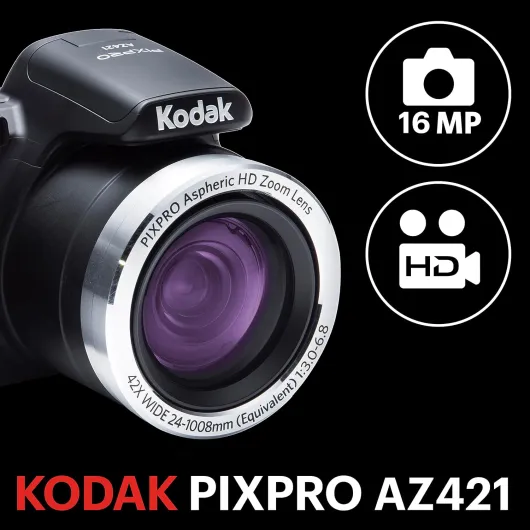
From the outside, the Pixpro AZ421 looks like a small DSLR. It has a proper grip, a protruding lens, and a fairly chunky body. When you first pick it up, it feels reassuring: not too heavy (about 0.98 lb / around 445 g), but not toy-like either. The grip is actually one of the things I liked most. You can hold it one-handed pretty easily, and the shutter button falls naturally under your finger. For walking around town or on a hike, it’s more comfortable than a flat compact camera.
The controls are pretty basic: a mode dial on top (auto, scenes, manual, etc.), a zoom lever around the shutter button, and a few buttons on the back around the screen. You get used to it quickly, but I wouldn’t call it intuitive if you’ve never used a camera before. For example, switching to macro or changing some settings means going into menus with a small directional pad and a few cryptic icons. It’s not impossible, just a bit clunky. After a few days, I knew where things were, but I still sometimes had to dig in the menu to find a simple option.
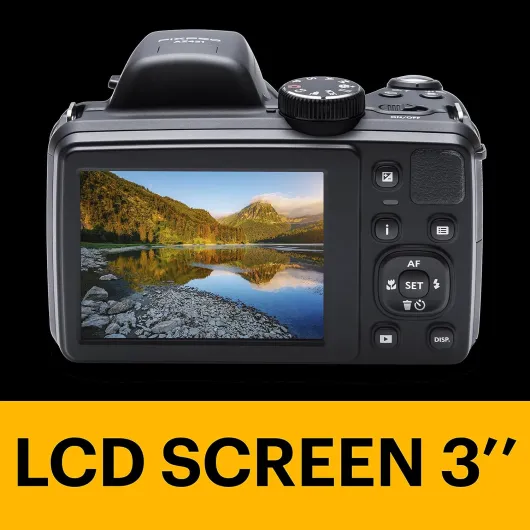
The 3-inch LCD is okay but not great. It’s bright enough outdoors most of the time, but the resolution and colour rendering are nothing special. You can compose your shot, check the framing, and that’s it. Don’t expect a super sharp, smartphone-style display. There’s also an electronic viewfinder mentioned in the specs, but it’s not something that really impressed me; it’s small and not very detailed, so I mostly stuck to the rear screen.
Build quality feels average. The plastic is clearly plastic: it doesn’t creak too badly, but it doesn’t feel premium either. The lens cap is basic, the battery door is a bit flimsy, and the buttons feel a bit cheap, but for the price I’m not shocked. It’s fine for normal use, but I wouldn’t throw it in a bag without a case. In short: the design is practical enough and comfortable to hold, but you can tell this is a budget camera once you start pressing buttons and navigating menus.
Battery life: decent for a day out, but don’t forget your charger
The Pixpro AZ421 uses a rechargeable Li‑ion battery (1100 mAh), which is a nice change from cameras that still use AA batteries. In everyday use, the battery life is okay but not outstanding. On a typical day out—say a city trip where I took around 150–200 photos with some zooming and a few short 720p videos—I ended up with the battery indicator in the last bar by the evening. So for casual use, it’s enough for one day, but not much more.
If you start doing a lot of zooming, reviewing photos on the screen, or recording longer videos, you can see the battery drop faster. The screen and zoom motor are the main power hogs. There’s no magic here: it’s a small battery, and the camera isn’t particularly power efficient compared to more modern devices. I wouldn’t go on a full weekend trip with heavy use and only one battery, unless you know you’ll be able to recharge at night.
The good thing is that it charges via an AC adapter and USB cable included in the box. So you don’t need a separate charger; you just plug the camera into the wall. It’s practical, but it also means the camera is out of action while charging. If you travel a lot or shoot a lot, I’d strongly recommend buying a second battery and maybe a cheap external charger so you can swap and keep shooting.
Overall, I’d rate the battery life as “acceptable but nothing special”. It doesn’t die instantly, but it doesn’t give you the confidence of some bigger cameras either. For a beginner using it mainly for holidays, birthdays, and weekend outings, it’s fine as long as you remember to charge it before each day and keep an eye on the indicator. If you’re more intensive, you’ll quickly feel the need for a spare battery.

Build and durability: okay for normal use, but feels a bit fragile
In terms of durability, the Pixpro AZ421 sits in that middle zone where it’s not a toy, but it doesn’t feel like gear you’d happily abuse either. The body is fully plastic, and you can feel that straight away. The grip area has a slightly textured finish that helps with holding it, but the rest of the shell feels quite basic. It doesn’t creak too much when you twist it lightly, which is good, but it doesn’t give the impression of something that will survive serious drops or rough treatment.
The parts that worried me a bit more are the moving and hinged bits: the battery/SD card door, the lens cap, and the zoom mechanism. The battery door is thin and has that “don’t push me too hard” feeling. It closes fine, but I can see it being a weak point if you’re constantly swapping SD cards or batteries. The lens cap is just a simple plastic cap with a string; it does the job, but it falls off quite easily in a bag if it catches on something. I quickly got into the habit of putting the camera in a small padded case to avoid scratches on the lens area.
As for the zoom, it works smoothly and I didn’t have any grinding or weird noises, but superzoom mechanisms are always a bit sensitive. If you get sand or dust in there, you’re in trouble. This is not a weather-sealed camera, so I wouldn’t use it in heavy rain, at the beach in strong wind, or in dusty environments without being careful. A simple rule: treat it more like an electronic device than a rugged outdoor tool.
Overall, for the price, the durability is acceptable: if you’re reasonably careful, it should hold up for holidays and casual use. But if you’re clumsy, have small kids who grab everything, or want something to throw in a backpack without thinking, this is not the most confidence-inspiring device. A cheap padded case and a bit of care are almost mandatory here.
Image quality and zoom: good in daylight, struggles at night and for fast action
Let’s be direct: the image quality from the Pixpro AZ421 is decent in good light, average in low light, and frankly poor if you push it too far (like max zoom at night). During the day, outdoors, it does a solid job. You get sharp enough photos, colours that are okay (a bit flat compared to my phone), and the 16 MP resolution is more than enough for sharing online or printing small photos. For holiday shots, landscapes, and simple family pictures, it gets the job done.
The big selling point is clearly the 42x optical zoom. In practice, it’s fun to use. You can go from a wide shot of a building to a close-up of a detail on the roof without moving. For animals in the park or birds sitting still, it’s pretty handy. The problem is that at the long end of the zoom, any movement is amplified: your hand shake, the subject moving, wind, everything. The optical stabilisation helps, but it’s not magic. I had quite a few blurred shots at full zoom if I wasn’t careful. A railing or a tripod makes a big difference here.
Where it really falls down is night shots and fast subjects. Several Amazon reviews mention night photography issues, and I agree. The CCD sensor and the processing just don’t handle low light very well. You get noise, difficulty focusing, and a lot of missed shots. Taking photos of the moon, for example, took me many tries before getting something usable, and even then it wasn’t fantastic. For moving subjects (kids running, birds in flight, sports), the autofocus and shutter speed combo just aren’t fast or reliable enough. You end up with a lot of blurred or out-of-focus images, even with the “anti blur” or moving subject settings turned on.
Macro is also a bit of a disappointment. You can get close, but it’s not super crisp, and the way you have to switch into macro mode is annoying (button + menu, not automatic). Compared to my old compact and even my mid-range phone, close-up shots of flowers or small objects look less detailed and less vibrant. So overall: solid daylight performance for static subjects, but if you care about night, macro, or action shots, you’ll probably be frustrated.
What the Pixpro AZ421 actually offers in real life
On the spec sheet, the Pixpro AZ421 sounds pretty complete for a cheap bridge camera. You get a 16 MP CCD sensor, a 24–1008 mm equivalent lens with 42x optical zoom, optical image stabilisation, 720p HD video, a 3" LCD screen, and a rechargeable Li-ion battery. It takes SD cards (up to 32 GB officially, some people force 64 GB but I’d stick to 32 GB to avoid surprises). There’s also Wi‑Fi mentioned in the product data, but in practice it’s not the strong point here and feels more like a checkbox feature than something you’ll use every day.
In real use, the main thing you notice is the range of the zoom. At 24mm, you can easily fit a big group or a landscape. At 1008mm, you’re right up in someone’s garden three streets away (not that you should do that). It’s pretty handy for animals, details on buildings, or just messing around on holiday. The stabilisation helps, but at full zoom you still need a steady hand or a wall/railing to lean on. Don’t expect razor-sharp shots at max zoom without some care.
The camera is clearly aimed at novices: lots of automatic modes, scene modes, and not too many deep custom options. It has continuous autofocus, face detection, and things like that, but it’s not a fast sports camera. Burst mode is around 5 fps on paper, but in reality it feels slower and the buffer fills up quickly. The 720p video is fine for casual clips but looks dated compared to any recent phone that does 1080p or 4K.
So if I sum it up: this is a camera built for someone who wants a simple “all-in-one” device with a big zoom and doesn’t want to dig into photography too much. It’s not meant for enthusiasts or people who love tweaking settings. If you buy it with that mindset, you’ll probably be okay. If you buy it expecting miracles because of the 42x zoom and 16 MP number, you’ll quickly see the limits.
Ease of use and real-world effectiveness: fine for auto mode, annoying when you dig deeper
On the “does it actually make your life easier” front, the Pixpro AZ421 is a bit of a mixed bag. If you stick to full auto mode, point at something in decent light, half-press to focus, and shoot, it works fine. Most people who just want holiday memories or simple family photos will get acceptable results without thinking too much. The autofocus is not lightning-fast, but it’s okay for static subjects, and face detection helps a bit with portraits.
The problems start when you try to do anything a bit more specific: macro, night shots, moving subjects, or playing with depth of field. Like some Amazon users mentioned, macro isn’t automatically detected in auto mode; you have to dive into the settings and switch it on, often shot by shot. That kills spontaneity. Same with night shots: you can get something decent, but it often takes a lot of tries and manual tweaking of ISO and exposure. My old compact and my phone both gave me more usable night shots with less effort, which says a lot.
Depth of field control is also limited. Even when you try to play with aperture, it’s hard to get a nice blurred background unless you’re very close to the subject and zoomed in. That’s just a limitation of the small sensor and lens design. So if your goal is those “portrait with creamy background” effects you see everywhere, you’re going to be disappointed. It can do a bit of that, but not in a consistent or easy way.
In daily use, I’d say the camera is effective enough for simple tasks, but not very rewarding if you’re trying to grow beyond basic snapshots. Menus are a bit clumsy, some features feel half-baked, and you need patience to get the best out of it. If you accept that and keep your expectations in check, it works. If you’re hoping to really progress in photography with this as your main tool, you’ll hit the ceiling pretty fast.
Pros
- Very long 42x optical zoom (24–1008 mm) useful for wildlife, travel and distant subjects
- Easy to hold thanks to the DSLR-style grip and relatively light weight
- Affordable price for a bridge camera with rechargeable battery and basic stabilisation
Cons
- Weak low-light performance and noisy, unreliable night photos
- Autofocus and menus are slow and not very intuitive, especially for macro and special shots
- Image quality and video (720p) feel dated compared to many modern smartphones
Conclusion
Editor's rating
The KODAK Pixpro AZ421 is a straightforward budget bridge camera that mainly sells itself on its 42x optical zoom. In good light and in auto mode, it does a decent job: you get okay sharpness, acceptable colours, and the kind of framing flexibility that phones can’t match at this price. For someone coming from an old smartphone or a very basic compact camera, and who mainly wants to shoot holidays, landscapes, and family events during the day, it’s a practical and affordable option.
Where it clearly struggles is anything more demanding: night photography, fast-moving subjects, macro, or people who want real creative control. The sensor and processing show their age, autofocus isn’t very confident, and the menus are a bit clunky. If your current phone already takes good pictures, the Kodak will only really beat it on zoom, not on overall image quality or ease of use. So I’d say it’s a camera for beginners who specifically want a big zoom at low cost and are ready to accept compromises elsewhere.
If you’re picky about image quality, shoot a lot at night, or want to seriously learn photography, I’d skip this and either save for a better bridge camera or look at used DSLR/mirrorless options. But if your budget is tight, your expectations are realistic, and you just want to get closer to the action in daylight without overthinking settings, the Pixpro AZ421 is a reasonable, no-frills choice.