
Summary
Editor's rating
Is it worth the money compared to other Micro Four Thirds options?
Small, light, and looks like it belongs on the camera
Everyday handling: the lens you forget is there
Build quality and weather resistance: solid enough, but not a tank
Image quality and autofocus: good, with a few limits
What this lens actually is (and isn’t)
Pros
- Very compact and light (around 156 g), easy to carry all day
- Good image quality and usable sharpness already at f/1.8
- Fast, quiet autofocus and weather‑resistant construction at a reasonable price
Cons
- No optical image stabilization, so you rely on the camera body
- Bokeh and low‑light performance are decent but not on the level of faster (f/1.4 or f/1.2) primes

Specifications
View full product page →| Brand | OM SYSTEM |
A normal lens that actually feels… normal
I’ve been using Micro Four Thirds bodies (mainly an OM-D E‑M5 III and a Panasonic G9) for a while, and I’ve owned the first version of the Olympus 25mm f/1.8 before. So when this M.Zuiko Digital 25 mm F1.8 II came out, I grabbed it to see if it’s still worth buying in 2024, with all the zooms and fast primes around. I’ve had it on my camera for a couple of weeks now, shot some street, a birthday party indoors, and a bit of casual video.
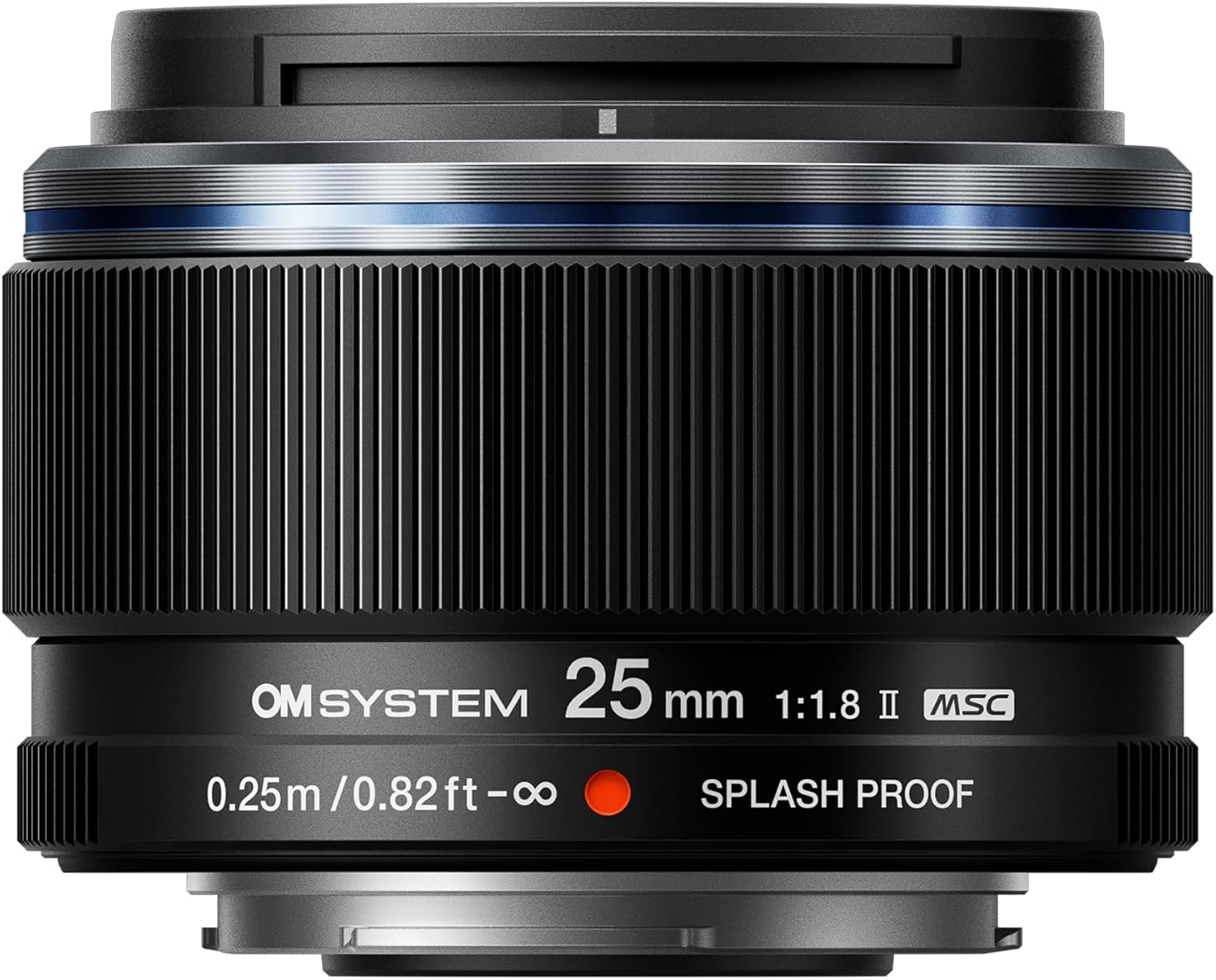
On paper, it’s super simple: 25mm on Micro Four Thirds, so roughly a 50mm full‑frame equivalent, f/1.8, small and light (around 156 g). No image stabilization, no crazy macro, just a normal prime. The brand sells it as a kind of do‑it‑all lens, and honestly, that’s pretty much how I ended up using it: leave it on the camera and forget about it.
In daily use, the main thing that stands out is how little it gets in your way. It’s light, the autofocus is quick and quiet, and the field of view feels natural. I didn’t have to think much about composition; it’s a focal length that just feels familiar. I took it on a walk, tossed the camera in a small sling bag, and didn’t think twice about weight or bulk.
It’s not perfect, and there are other primes in the system that are sharper or faster, but for a simple everyday lens it holds up well. If you’re expecting miracles in low light or ultra‑shallow depth of field, you might be a bit underwhelmed. But if you want a small lens that just does the job for general photography, this one is pretty solid.
Is it worth the money compared to other Micro Four Thirds options?
Value is where this lens makes the most sense. It’s not the cheapest 25mm in the Micro Four Thirds world, but it sits in a kind of middle spot: more expensive than basic plastic primes, cheaper than the faster f/1.4 and f/1.2 options. For the price, you’re getting decent optical quality, weather sealing, quiet autofocus, and a complete package with hood and caps in the box. A lot of competitors skip the hood, so that’s one less thing to buy.
Compared to the older M.Zuiko 25mm f/1.8 version I used, the differences in real‑world shots aren’t huge. If you already own the first version and are happy with it, I don’t see a strong reason to upgrade unless you specifically want the small design or sealing tweaks of the II, or you just need a fresh copy. But if you’re coming from the standard 14–42mm kit zoom, the jump in low‑light performance and subject separation is clearly noticeable. Being able to shoot at f/1.8 instead of f/3.5–5.6 indoors makes a real difference.
If you mainly shoot portraits and want more blur and nicer background rendering, you might be happier saving up for a 25mm f/1.4 or even a 42.5mm/45mm prime. Those lenses give more separation and usually a bit better micro‑contrast, but at the cost of more money and size. If you mostly shoot travel, street, and general family stuff, this 25mm f/1.8 II hits a good balance between performance, portability, and price.
So in my opinion, the value for money is pretty solid if you’re looking for a first prime or a small everyday lens. It’s not the best possible image quality in the system, but it’s good enough for most users, and the small size makes you more likely to actually carry it. For budget‑conscious shooters who still want something nicer than a kit lens, it’s a sensible buy.
Small, light, and looks like it belongs on the camera
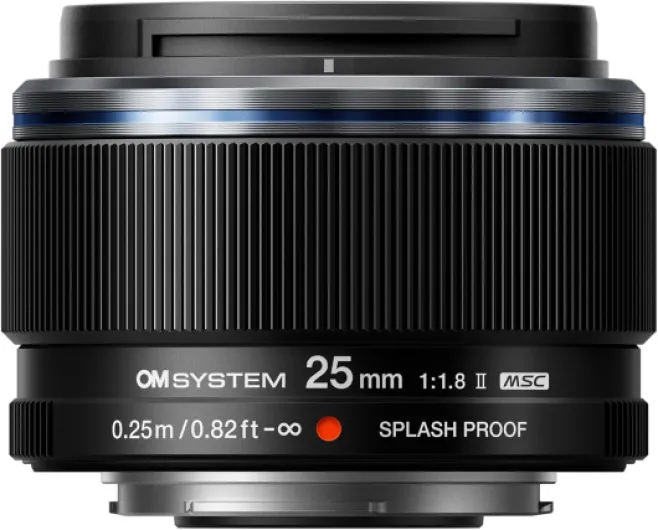
Design‑wise, this lens is very much in line with other M.Zuiko primes. It’s compact, weighs only about 156 g, and doesn’t make your camera front‑heavy. On my E‑M5 III, the combo was easy to hold one‑handed, and it fit into a small everyday bag without needing a big camera backpack. That’s honestly one of the big reasons I kept reaching for it instead of my 12–40mm f/2.8 zoom, which is noticeably bulkier.
The barrel is mostly plastic, but the mount is metal, and it doesn’t feel cheap. It’s not a tank, but it also doesn’t feel like a toy. The finish is a matte black that matches OM System bodies well and doesn’t scream “expensive lens” in the street, which I like. The included lens hood (LH‑49B) is a nice bonus; most brands charge extra for that now. It’s a simple petal hood, does the job, and helps keep stray light and fingerprints off the front element.
The focus ring is electronic (focus‑by‑wire), which is standard for this system. It turns smoothly and is reasonably damped, but you don’t get a distance scale or hard stops. For autofocus users, that’s not a big deal. For manual focus fans, it’s usable but not particularly satisfying. I used manual focus a bit for video, and it was fine, but not precise enough for very critical work. There’s no clutch mechanism like on some higher‑end Olympus PRO lenses.
One thing I appreciated is how balanced the lens feels on both small and medium bodies. On my Panasonic G9, which is chunkier, it almost looks too small, but in the hand it’s comfortable. It’s the kind of lens you can leave on the camera all day without thinking about it. So from a design perspective: nothing fancy, but practical and well thought out for everyday use.
Everyday handling: the lens you forget is there
From a handling and comfort point of view, this lens is easy to live with. The weight (around 156 g) is low enough that it doesn’t pull your camera forward, even on smaller bodies like the PEN series. I carried my E‑M5 III with this lens on a 4‑hour city walk, mostly on a simple neck strap, and my neck and wrist didn’t complain. Swapping back to a heavier zoom later in the day, I could really feel the difference.
The compact size also makes the camera less intimidating for people you’re photographing. When I was shooting street or taking casual portraits of friends, they reacted less to the small 25mm than to a bigger zoom. If you like candid shots or you’re shy about pointing a camera in people’s faces, this does help. It feels closer to carrying a compact camera than a “serious” DSLR setup.
In terms of controls, there isn’t much to say: you have the focus ring, and that’s it. No aperture ring, no custom buttons. For me, that’s fine; I control aperture on the camera body anyway. The focus ring is wide enough and grippy, so you can grab it easily even with light gloves. I did a bit of manual focusing in colder weather, and it was still manageable. The lens hood doesn’t get in the way, and the 46mm filter thread keeps filters small and cheap.
One small downside is that because it’s so light, the combo can feel slightly front‑light on bigger bodies like the G9, which are designed around chunkier lenses. It’s not a real problem, just a feeling thing. Also, if you’re coming from lenses with focus clutches or more physical controls, this will feel a bit basic. But for simple point‑and‑shoot style use with a bit of manual control when needed, the comfort level is high. It’s a lens you can keep on the camera all day without thinking about it.
Build quality and weather resistance: solid enough, but not a tank
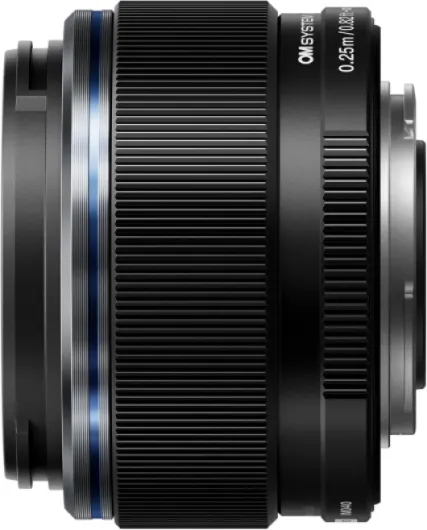
The lens is advertised as dustproof and splashproof, which is a step up from many entry‑level primes. I used it in light rain and a bit of wind‑blown dust without any issue. I didn’t baby it: camera over the shoulder, no special cover, just wiped it down afterward. No condensation inside, no odd noises, and everything kept working normally. Obviously I didn’t dunk it in water, but for typical outdoor use, it feels trustworthy.
The barrel is mostly plastic, but it’s not flimsy. The mount is metal, and the connection to the camera feels tight with no wobble. After a couple of weeks of frequent mounting and unmounting between two bodies, there’s no sign of play. The focus ring also hasn’t loosened or developed any grinding feel. It’s early days, but based on my experience with the previous version of this lens, these things usually hold up fine if you don’t abuse them.
Where you do feel the cost‑cutting is in the overall “heft”. Compared to PRO lenses from OM System, this one just feels lighter and less armored. If you’re the type who throws gear into a backpack with no padding, you’ll probably mark the plastic body sooner or later. A small padded pouch is a good idea if you care about cosmetic condition. The supplied caps and hood are okay; the hood is plastic but doesn’t feel like it will snap the first time you bump it.
So in terms of durability, I’d say: good for normal use, not built for abuse. It’s fine for travel, hiking, and daily carry, especially if you pair it with a weather‑sealed body. If you shoot in very rough conditions or tend to drop your gear, you might want something more rugged, but then you’re also looking at more expensive and heavier glass. For the weight and price, the durability level makes sense.
Image quality and autofocus: good, with a few limits
Let’s talk about what comes out of the camera. In terms of sharpness, the lens is already usable wide open at f/1.8, especially in the center. For portraits and general shots, I had no problem shooting at 1.8 and getting clean results. The corners are a bit softer wide open, which you see more in flat scenes like landscapes or buildings. Stop it down to f/2.8–f/4 and things even out nicely across the frame. For everyday photos, it’s more than good enough.
The bokeh (background blur) is decent, but keep in mind this is Micro Four Thirds and f/1.8, not a full‑frame 50mm f/1.4. You can separate your subject from the background, especially at closer distances, but you’re not getting ultra‑creamy backgrounds. For head‑and‑shoulders portraits at around 1–1.5 meters, the background blur looks pleasant and not too busy. The 7‑blade aperture gives rounded highlights at wider apertures, but if you stop down a lot, you can start seeing more geometric shapes in out‑of‑focus lights.
Autofocus performance is one of the strong points. On both my OM‑D and Panasonic bodies, AF was fast and nearly silent. For stills, it locked focus quickly in decent light, and only hesitated a bit in very dim rooms. For video, the focusing noise was basically inaudible in real‑world use; I didn’t pick up any obvious focus motor sounds on my on‑camera mic. Continuous AF for kids running around in a park worked reasonably well; it’s more limited by the camera body than the lens.
In low light, f/1.8 helps, but don’t expect miracles. You still need to push the ISO up in darker indoor scenes, and if your camera doesn’t have in‑body stabilization, the lack of optical IS on the lens is noticeable for slower shutter speeds. On my stabilized OM‑D, I could comfortably shoot at 1/20–1/30s and keep things sharp. On an older, non‑stabilized body, I had to stay closer to 1/60s to avoid blur, which means higher ISO. So performance is solid for the size and price, but if you’re chasing super low‑light performance, a faster prime like a 25mm f/1.4 or f/0.95 will obviously do better (with more cost and bulk).
What this lens actually is (and isn’t)
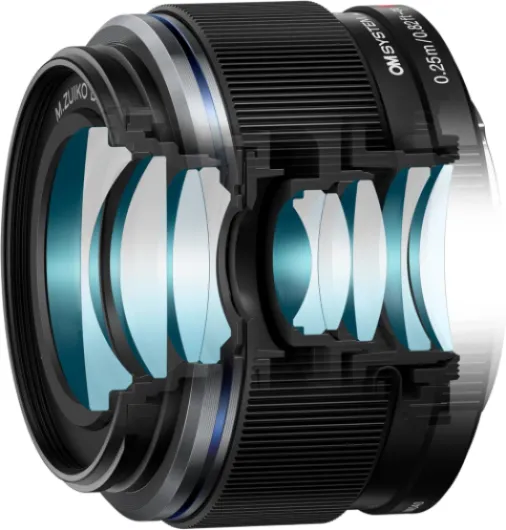
Let’s put the marketing aside and look at what you really get. The M.Zuiko Digital 25 mm F1.8 II is a standard prime for Micro Four Thirds: 25mm fixed focal length, maximum aperture f/1.8, minimum aperture f/22, 7 aperture blades, 46mm filter thread, and no built‑in image stabilization. It’s meant to be a general purpose lens for things like travel, street, family photos, and basic portraits. On a Micro Four Thirds body, it gives a 50mm equivalent angle of view, which is pretty close to what your eyes see.
In practice, that means it’s not a wide‑angle and not a telephoto. If you’re used to kit zooms (like 14–42mm), 25mm will feel tighter than 14mm but more natural than always staying at 42mm. I used it in a small living room and sometimes had to back up a bit, but for outdoor street shots and half‑body portraits it felt just right. The minimum focusing distance is about 0.25 m, so you can get pretty close for detail shots of food, small objects, or flowers, but it’s not a real macro lens.
The lens is also advertised as dustproof and splashproof, which is nice if you already have a weather‑sealed body. I shot with it in light drizzle and didn’t worry about it. It’s not something you notice day to day, but it’s reassuring if you like shooting outdoors and don’t want to baby your gear. Just don’t treat it like a diving housing; “splashproof” isn’t “waterproof”.
So overall, this isn’t a special‑effects lens. It doesn’t zoom, it doesn’t stabilize, and it doesn’t turn night into day. It’s a straightforward 50mm‑equivalent prime for people who want something small, decent in low light, and simple to use. If that’s what you’re after, the feature set makes sense. If you want one lens to cover everything from wide landscapes to tight portraits, this isn’t it.
Pros
- Very compact and light (around 156 g), easy to carry all day
- Good image quality and usable sharpness already at f/1.8
- Fast, quiet autofocus and weather‑resistant construction at a reasonable price
Cons
- No optical image stabilization, so you rely on the camera body
- Bokeh and low‑light performance are decent but not on the level of faster (f/1.4 or f/1.2) primes
Conclusion
Editor's rating
After a couple of weeks of real‑world use, I’d sum up the M.Zuiko Digital 25 mm F1.8 II as a simple, competent everyday lens that does what it’s supposed to do without drawing attention to itself. It’s sharp enough for most uses, light enough to carry all day, and the autofocus is quick and quiet. The weather sealing is a nice bonus at this size and price, especially if you shoot outdoors a lot. It’s the kind of lens you leave on the camera by default and only swap out when you need something very wide or very long.
It’s not perfect. The lack of optical stabilization will bother you if your body doesn’t have IBIS. The bokeh and low‑light performance are good for Micro Four Thirds, but not mind‑blowing; if you’re chasing very shallow depth of field or very clean high‑ISO shots, you’ll need faster glass or a different system. And if you already own the previous 25mm f/1.8, the upgrade is more “nice to have” than essential.
I’d recommend this lens to Micro Four Thirds users who want a first prime to replace or complement a kit zoom, people who value small size and low weight, and anyone who likes a natural 50mm‑equivalent field of view for everyday shooting. If you’re a portrait specialist, a low‑light addict, or someone who needs the absolute best optics, you might want to look at the brighter (and pricier) 25mm or 45mm options. For everyone else, this is a practical, no‑nonsense lens that gets the job done well enough to justify its spot in the bag.