
Summary
Editor's rating
Value for money: decent starter kit if you know the limits
Design & handling: feels like a small mirrorless, behaves like a compact
Battery life & storage: two batteries help, but don’t expect all‑day shooting
Photo & video performance: fine for casual use, not for pixel peepers
What this camera actually is (once you ignore the marketing buzzwords)
Wi‑Fi & app control: nice idea, mediocre execution
Pros
- Flip screen and light body make it handy for vlogging and selfies
- Comes with 64GB card and two batteries so you can start shooting immediately
- Simple menus and controls that beginners can pick up quickly
Cons
- 16x zoom is digital only, so image quality drops noticeably when zoomed in
- Average low‑light performance and basic autofocus, not suited for fast action or wildlife
- Wi‑Fi app is clunky and unreliable, better to use USB or a card reader for transfers

Specifications
View full product page →| Brand | NBD |
A cheap way to get off your phone… kind of
I’ve been using this NBD 5K 64MP camera for a bit as a “step up” from my phone for casual photos and some basic vlogging. I’m not a pro photographer, I just wanted something with a flip screen, a bit of zoom, and a separate device so I’m not draining my phone battery every time I film. On paper, this thing looks packed: 5K video, 64MP photos, Wi‑Fi, flip screen, macro and wide lenses, two batteries, and a 64GB card in the box.
In practice, it feels like a middle ground between a smartphone and a real mirrorless camera. It’s way more flexible than a phone in some ways (proper grip, physical buttons, flip screen), but you can feel the limits of the small 1/2.3'' sensor and the digital zoom. If you’re expecting DSLR-level quality because it says 5K and 64MP, you’re going to be disappointed. If you treat it as an easy little camera for everyday stuff and vlogs, it makes more sense.
I mainly used it for family stuff, some indoor shots, a couple of walks outside, and a test vlog for YouTube. I also tried the Wi‑Fi app and the macro lens for close‑ups of small objects on my desk. I didn’t baby it; it went into a backpack, got handled with slightly greasy hands after snacks, and got turned on and off a lot to see how the batteries hold up.
Overall, it’s not perfect, and there are clear corners cut, but it does get the job done for simple content. The key is knowing what you’re buying: this is a casual, beginner‑friendly camera, not a wildlife or sports machine. If you keep your expectations realistic, you can be pretty happy with it. If you’re picky about image quality or want fast autofocus and a strong zoom, you’ll probably want to look elsewhere.
Value for money: decent starter kit if you know the limits
Price‑wise, this NBD camera sits in that awkward space between a basic compact and the cheapest older‑generation mirrorless cameras on sale. The good part is what you get in the box: camera, 64GB card, two batteries, flip screen, macro/wide lens, Wi‑Fi, and a bunch of shooting modes. For someone just starting with photography or vlogging, that’s a lot of features for not a lot of money. You can hand this to a beginner and they’ll be able to shoot right away without extra purchases.
The flip screen alone makes it more useful than many cheap compacts if you want to film yourself. Add the included wide‑angle and macro lens, and you can play around with different looks without buying extra gear. For simple use—family photos, holidays, basic YouTube or TikTok videos—it gets the job done. That lines up with a few Amazon reviews saying it’s beginner‑friendly and good as a present for someone just starting out.
On the downside, you’re still dealing with a small sensor, digital zoom, average autofocus, and a pretty weak app. If you compare it to slightly more expensive used gear from big brands (older Canon/Sony/Panasonic mirrorless bodies with a kit lens), those often give you much better image quality, real optical zoom, and more reliable performance. The trade‑off is you don’t get a brand‑new kit with card and batteries, and they’re usually more complex to learn.
So in terms of value, I’d say: it’s good for people who want a simple, all‑in‑one starter camera with a flip screen and don’t want to think too much. It’s less good for anyone who already knows a bit about cameras or wants room to grow. If you’re picky and willing to learn, you’ll get more long‑term value from a used entry‑level mirrorless. If you just want something better than your old point‑and‑shoot or to keep your phone free while you film, this NBD is a reasonable buy.
Design & handling: feels like a small mirrorless, behaves like a compact
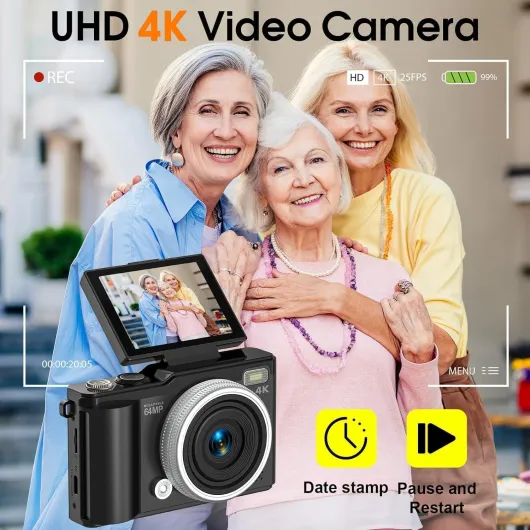
Physically, the camera looks like a mini mirrorless. It has a little grip on the right side, a lens that sticks out a bit, and a 3-inch screen that flips up 180°. In the hand, it’s light, almost toy‑like, but not in a terrible way. It’s the kind of weight where you can hold it up for a full vlog without your arm screaming. The buttons are clearly labeled: power, shutter, zoom rocker, mode dial, and a few menu buttons on the back. After 10–15 minutes, I was navigating it without thinking too much.
The flip screen is the best design feature for me. You can flip it up to face you for selfies or vlogging, or angle it for low or high shots. The hinge doesn’t feel premium, but it didn’t feel like it would snap off either. I tossed it into a backpack a few times and it survived just fine. The screen resolution is only 360 × 640 with 144,000 dots, so it’s not super sharp, but it’s good enough to frame your shot and check focus roughly.
One thing to note: there’s no real optical viewfinder experience like on proper cameras, despite the spec line saying “viewfinder type: optical.” You’ll be using the screen 99% of the time. Also, the camera body is all plastic. It doesn’t flex in the hand, but it’s clearly built to a price. The buttons have a bit of a clicky, cheap feel, but at least they respond reliably. The included 52mm wide/macro lens screws on and off the front thread easily enough, though you’ll want to be careful not to cross‑thread it.
In use, it’s simple and not intimidating. If you’re coming from a phone, the jump in complexity is small. If you’re used to a Canon or Sony mirrorless, this will feel basic and limited. For what it’s aimed at—beginners and casual vloggers—the overall design works. Just don’t expect a rugged or premium object; this is more like a neat gadget you’ll throw in your bag than a camera you’ll baby for years.
Battery life & storage: two batteries help, but don’t expect all‑day shooting
The camera comes with two lithium‑ion batteries, which is nice at this price. Each battery is pretty small (around 28g), and in real use I was getting roughly 60–90 minutes of mixed shooting per battery—some short video clips, some photos, a bit of menu fiddling, and screen on most of the time. If you’re mainly taking still photos, you’ll easily get through a half day on one battery. If you’re recording a lot of 4K/5K video, you’ll drain it faster and probably want both batteries charged.
There’s no fancy external charger in my case; you charge via the camera’s USB port, which is slower and less convenient if you want to charge one battery while using the other. It works, but it’s not the most practical if you’re traveling and shooting a lot. I ended up charging both overnight and was fine for casual weekend use. Power management isn’t particularly smart either—the camera doesn’t feel super efficient, and the screen being on all the time doesn’t help, but that’s pretty standard for these cheap digitals.
On storage, the included 64GB TF card is a good move. You can start shooting straight away without buying extra memory. At the default settings, 64GB is enough for a lot of photos and a fair amount of video. The spec says about 229 minutes of recording capacity, but that will depend on resolution and compression. Still, for a beginner or casual user, you won’t fill it in one outing unless you’re filming long sessions in high resolution.
The camera supports up to 256GB cards, so if you get into more serious filming, you can upgrade later. Transfer is done via USB or Wi‑Fi. Personally, I found it easier to just pop the card into a reader for faster transfer, but if you’re not comfortable with that, USB works fine, just slower. Overall, battery and storage are good enough for casual use: not pro‑level endurance, but with two batteries and 64GB in the box, you’re not constantly stressed about running out of juice or space during a normal day.
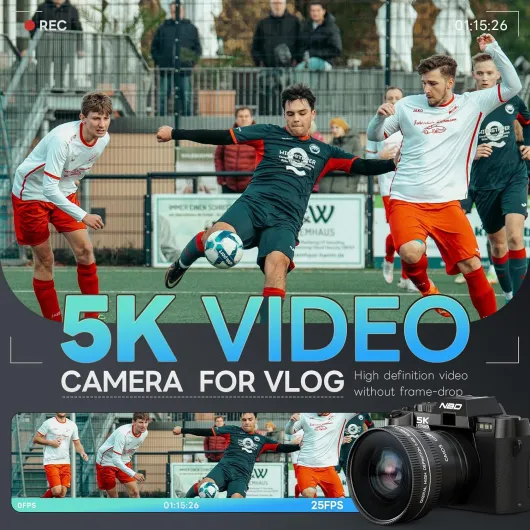
Photo & video performance: fine for casual use, not for pixel peepers
Let’s talk image quality, because that’s where most people get either pleasantly surprised or a bit let down. In good daylight, the photos are honestly pretty solid for the price. Colors are okay out of the box, maybe a bit on the punchy side, and the 64MP resolution gives you enough detail for social media, small prints, and general use. I took some outdoor shots of buildings and trees, and on a laptop screen they looked decent. Zooming in 100% reveals the limitations of the sensor and lens, but for normal viewing it’s fine.
In low light, things get weaker. Indoors in the evening with regular room lighting, noise starts to creep in, and the anti‑shake helps a bit with keeping things from being a blurry mess, but you can’t expect miracles from a 1/2.3-inch sensor at ISO up to 6400. Autofocus also gets slower and can hunt a bit, especially if your subject doesn’t have a lot of contrast. For simple family shots or filming yourself talking in a reasonably lit room, it’s okay. For dim bars, concerts, or fast‑moving kids in a dark living room, it struggles.
For video, the 5K/4K options sound great, but the real‑world difference compared to 1080p on this camera isn’t as huge as the numbers suggest. The footage is usable, especially for YouTube or TikTok once compressed, but it doesn’t have the crisp, clean look you’d get from a bigger‑sensor camera. Rolling shutter (wobbly lines when you pan quickly) is there but not awful. The anti‑shake is more like digital stabilization: it helps smooth small hand movements but won’t give you gimbal‑level steadiness while walking.
Autofocus is simple: one AF point, hybrid AF‑A mode. It’s fine if you’re centered in the frame and not moving around too much. I found it okay for talking‑head videos but not great for erratic subjects. One Amazon review saying it’s not ideal for wildlife is spot on—between the digital zoom and the average AF, it’s just not built for that. Overall performance: good enough for beginner content and memories, but if you’re picky about sharpness, dynamic range, or fast focusing, you’ll hit its limits quickly.
What this camera actually is (once you ignore the marketing buzzwords)
On the listing, this NBD camera is pitched as a 5K, 64MP, Wi‑Fi-enabled, vlogging-ready machine with 16x zoom and a flip screen. That sounds like a lot, but once you start using it, you quickly see where it shines and where the spec sheet is a bit optimistic. The sensor is 1/2.3-inch, which is basically compact camera / smartphone territory. So yes, the files are 64MP, but it’s more about resolution numbers than dramatic real-world sharpness jumps over a decent phone.
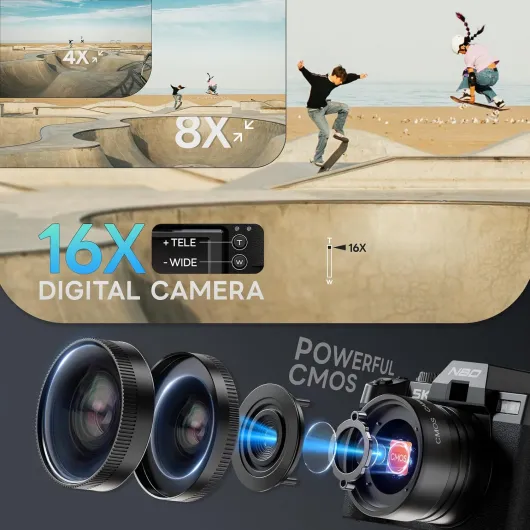
The lens is fixed focal length (4.58mm) with digital 16x zoom, not optical. That means when you zoom in, you’re basically cropping the image. At low zoom, the image is decent for casual use. At higher zoom levels, especially in lower light, it starts to look soft and noisy. So if you were thinking of this as a budget wildlife camera, it’s just not that. It’s more suited to people, indoor scenes, and talking‑to‑camera style videos at arm’s length or on a tripod.
What I did like is that it comes as a more or less complete kit: camera, 64GB TF card, two batteries, and the extra wide‑angle/macro lens. For a beginner, that’s convenient. You don’t have to run out and buy storage or a second battery immediately; you can literally charge it, pop in the card, and start shooting. The menu is fairly straightforward, and there are automatic modes plus some basic scene presets like portrait, landscape, night portrait, and sports.
So in simple terms: this is a compact digital camera aimed at vloggers and beginners who want a flip screen and easy controls, not a serious interchangeable‑lens system. It’s closer to a point‑and‑shoot with some extra toys (Wi‑Fi, flip screen, add‑on lens) than a true mirrorless in the sense most people imagine. If you go into it with that mindset, its strengths and weaknesses are easier to accept.
Wi‑Fi & app control: nice idea, mediocre execution
One of the big selling points on the product page is the Wi‑Fi and app remote control. In theory, it sounds great: control the camera from your phone, see a live preview, change settings, and transfer photos wirelessly. In reality, it’s a bit hit and miss. I installed the recommended app, connected the camera’s Wi‑Fi, and after a bit of fiddling it did work. I could see the live view and trigger the shutter from my phone, which is handy if you’re filming yourself and the camera is on a tripod.
The problem is the connection feels fragile and the app is clunky. One of the Amazon reviews calling the app “crap” isn’t totally wrong. Sometimes it connects quickly, other times it takes a while or fails and you have to toggle Wi‑Fi off and on again. The interface looks dated and not very polished. Changing settings from the app is slower than just using the camera buttons in many cases. For basic remote start/stop and framing yourself, it’s usable. For anything more advanced, it becomes annoying.
File transfer over Wi‑Fi is also slow. Pulling a few photos is okay. Trying to move a bunch of 5K or 4K clips over Wi‑Fi is painful; I gave up and just used a card reader. If you’re patient and hate cables, you can make it work, but it’s not exactly smooth. For me, the app ended up being something I use occasionally, not a core feature I rely on every time I shoot.
So, Wi‑Fi and app control are more of a bonus than a core strength. They’re nice for the occasional remote selfie or static vlog where you want to see yourself on your phone screen, but they’re not well executed enough to be a key reason to buy this camera. If you’re expecting a polished, smartphone‑like wireless experience, you’ll be disappointed. If you treat it as a backup option and mainly use USB or a card reader, you’ll be less annoyed.
Pros
- Flip screen and light body make it handy for vlogging and selfies
- Comes with 64GB card and two batteries so you can start shooting immediately
- Simple menus and controls that beginners can pick up quickly
Cons
- 16x zoom is digital only, so image quality drops noticeably when zoomed in
- Average low‑light performance and basic autofocus, not suited for fast action or wildlife
- Wi‑Fi app is clunky and unreliable, better to use USB or a card reader for transfers
Conclusion
Editor's rating
After using the NBD 5K 64MP camera for everyday stuff and some test vlogs, my conclusion is pretty straightforward: it’s a decent beginner and casual vlogging camera, as long as you don’t expect miracles. In good light, the photos and videos look fine for social media and casual viewing. The 180° flip screen is genuinely useful, the included 64GB card and two batteries make it easy to start, and the body is light and simple to handle. For someone just getting into cameras or wanting a small device for vlogging without touching their phone, it makes sense.
Where it falls short is when you push it beyond that casual use. The 16x zoom is digital, so don’t plan on serious wildlife or sports work. Low‑light performance is average, autofocus is basic, and the Wi‑Fi app feels half‑baked. If you already care about image quality, dynamic range, or fast autofocus, you’ll hit its limits pretty fast and probably wish you’d saved for an entry‑level mirrorless from a bigger brand. But if you just want a straightforward camera for kids, pets, holidays, and simple videos, and you like having a flip screen and a full kit out of the box, it offers reasonable value.
So: who is it for? Beginners, casual users, and new vloggers who want something easy and don’t want to dig into complex camera systems. Who should skip it? Anyone serious about photography, people who want strong zoom performance, or those who get annoyed by clunky apps and average low‑light quality. It’s not fancy, it’s not pro, but for basic everyday use, it does the job.