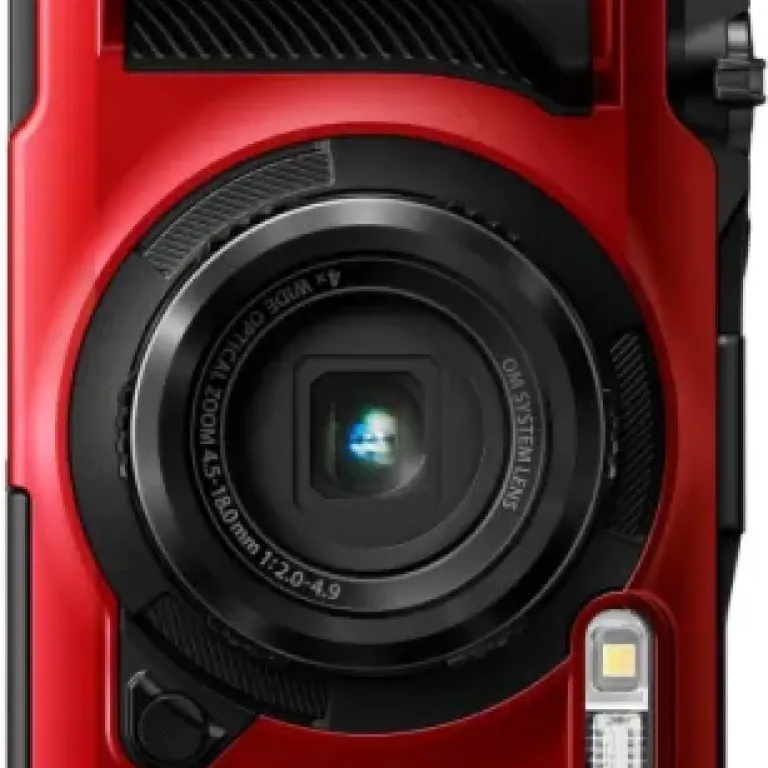

Summary
Editor's rating
Value for money: not cheap, but makes sense for specific users
Design: chunky, practical, and clearly built to be abused
Battery life: acceptable, but bring a spare if you shoot a lot
Packaging & included stuff: bare-bones but functional
Durability: this is where it earns its “Tough” name
Performance: good in daylight, decent underwater, weaker in low light
What the TG‑7 actually is (and what it isn’t)
Pros
- Very rugged: waterproof, shockproof, crushproof and cold-resistant, genuinely usable in harsh conditions
- Bright F2.0 lens with good macro and underwater modes, plus RAW and 4K video support
- Compact size with proper physical controls and USB‑C charging, easy to carry and top up on the go
Cons
- Average low-light performance due to small sensor; modern phones can look cleaner at night
- Battery life is only decent; heavy users will need at least one spare battery
- Upgrade over the Olympus TG‑6 is modest, so existing TG‑6 owners may not see much benefit

Specifications
View full product page →| Brand | OM SYSTEM |
Why I grabbed the TG‑7 instead of trusting my phone (again)
I picked up the OM System Tough TG‑7 mainly because I was tired of babying my phone every time I went near water, sand or snow. I’ve already killed one smartphone with sea water, and after one more holiday of shooting everything in a cheap plastic pouch, I’d had enough. I wanted something I could literally throw in a backpack, take into the sea, drop on rocks, and not stress about every minute. The TG‑7 kept coming up in forums and from a couple of photographer friends as the “just use this and stop worrying” option, so I went for it.
I’ve used it now on a rainy hiking weekend, a few cold morning walks, and one indoor macro session messing around with random objects and plants. So this is not a lab review; it’s just what it’s like to live with it in real life. I’m not sponsored, I paid for it myself, and I’m comparing it mostly to my phone camera (Pixel) and an older compact I had years ago, plus what I remember from trying the Olympus TG‑6 briefly.
Right away, the main feeling is: this thing is built to be abused. I don’t worry when I put it in a bag with keys, or when I rinse it under the tap after mud or sea water. That changes how often you actually use a camera. With a mirrorless body or even a big bridge camera, I often left them in the room because of the weight and the fear of rain. With the TG‑7, if I’m going out, it just comes with me. No mental drama.
Is it perfect? No. If you’re expecting DSLR-level image quality or phone-style computational tricks in low light, you’ll be disappointed. But if you want something that takes decent photos and video in rough conditions, lets you get very close for macro, and doesn’t freak out around water, it does the job pretty well. Think of it as a tough, practical tool, not a magic picture machine.
Value for money: not cheap, but makes sense for specific users
Price-wise, the TG‑7 sits in an awkward spot: it’s more expensive than a basic compact and not far from some entry-level mirrorless kits on sale, and many people will say “my phone is good enough”. And to be fair, if you only shoot in safe, dry, city-type conditions, a good phone camera probably covers 90% of what you need. So this camera is not great value for everyone. It’s aimed at a pretty clear group: people who are often around water, sand, snow, or rough environments and who want a dedicated camera that can take abuse.
For that group, I think the value is actually pretty solid. You’re paying for ruggedness, waterproofing, and a set of features (underwater modes, macro system, RAW, GPS, 4K) in one compact package. If you go snorkeling, kayaking, skiing, hiking in the rain, or just have kids who drop everything, the cost starts to feel justified because you’re not risking a £800–£1200 phone or a delicate mirrorless body. Add in the fact that you can get real macro with optional accessories (like the LG‑1 light guide) and that some pros even use it for field macro work, and it becomes a flexible little tool.
On the downside, you have to factor in accessories. A spare battery, a floating strap, a decent SD card, maybe a case – that all adds up. If you go deeper into the system with converters and lights, it can get pricey fast. Also, if you already own a TG‑6, the upgrade is not huge. You get USB‑C, some new video tricks, and a bit of ergonomic polish, but image quality is basically the same. In that scenario, I’d say the value is questionable unless your TG‑6 is dying or you really want those new features.
Overall, I’d rate the value as good but very use-case dependent. If your adventures are mostly poolside and the odd rainy walk, this might be overkill. If you regularly go on trips where water, mud, and impacts are part of the deal, it starts to pay for itself in peace of mind and the shots you actually bring back. It’s not a bargain, but it’s a practical purchase if you fit the target user profile.
Design: chunky, practical, and clearly built to be abused
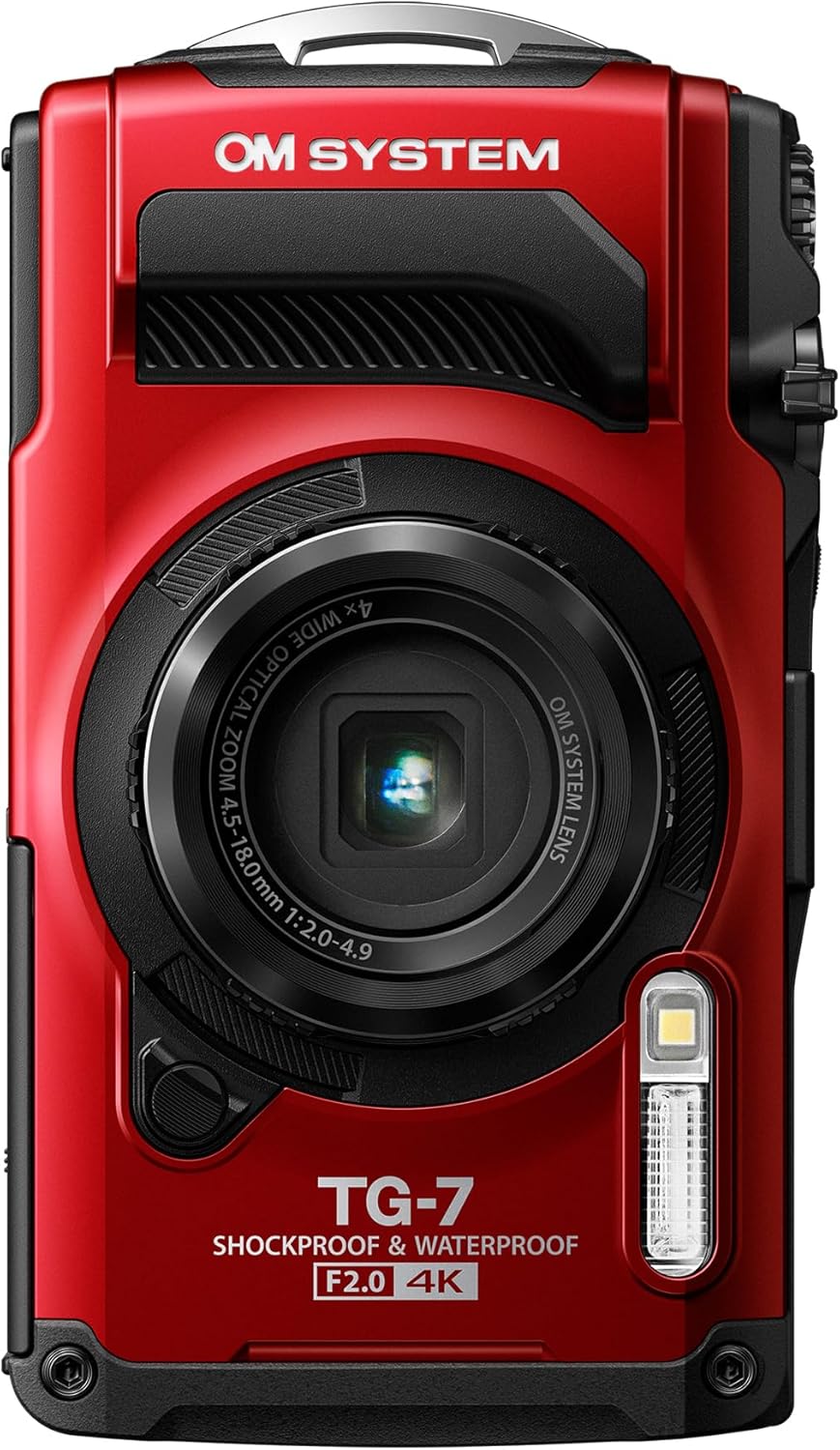
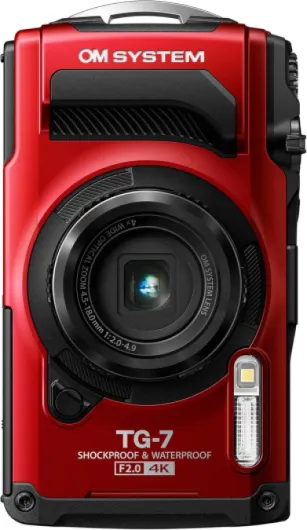
Design-wise, the TG‑7 is not sleek or minimalist. It looks like a small brick with a lens on it, and that’s kind of the point. The red version I have is easy to spot in a bag or on a wet rock, which I actually like. The front has a metal-looking plate with screws visible, and the whole thing gives off a “tool, not jewelry” vibe. It’s not pretty in a classic way, but it feels trustworthy. The size is pocketable in a jacket or hiking pants, but it’s thicker than a phone for sure. You notice it, but it’s still much lighter and less bulky than a mirrorless body with a lens.
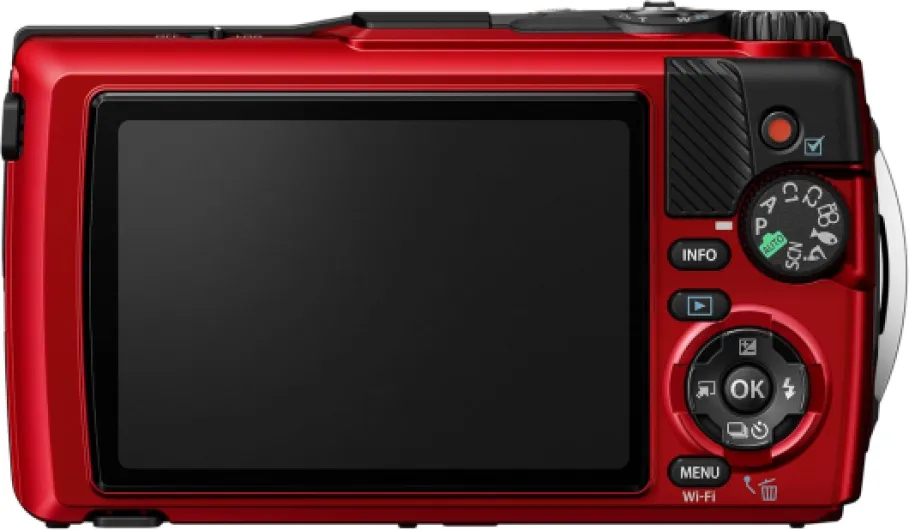
The grip on the TG‑7 is better than I remember from the TG‑6. There’s a more pronounced rubberized area, and the camera feels less slippery, especially when wet. I used it with cold, slightly numb fingers and could still hold it without fear of dropping it. The shutter button is big and has a clear half-press feel, which helps when you’re trying to focus quickly. The mode dial is on top and has enough resistance that it doesn’t spin by accident in a pocket. The back buttons are small but usable, and after a couple of days I could navigate them without thinking too much.
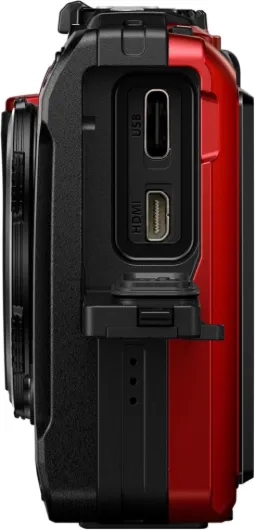
One thing I appreciate is the dual locking doors for the battery/SD card and the USB‑C port. Both have a latch and a secondary lock, which at first feels annoying but you quickly understand why: that’s your waterproof seal. If you’re the type who rushes and forgets to close things properly, this extra step is actually good. I took it into the shower and under a tap just to rinse off sand and salt, and no leaks so far. Just make sure the little yellow indicators are hidden (that means it’s locked).
Layout-wise, it’s a compromise between giving you options and keeping it simple. You get a dedicated video record button, zoom rocker, and a control ring around the lens that can be assigned to certain functions. The screen doesn’t flip or fully articulate – it’s a fixed 3-inch LCD – so if you care a lot about vlogging angles or selfies, that’s a limitation. For my use (travel, hiking, underwater, macro) it’s fine. In short, the design is focused on being used outdoors, not on looking fancy on a desk.
Battery life: acceptable, but bring a spare if you shoot a lot
Battery life on the TG‑7 is okay but not great. It’s in line with other small compacts: usable for a day if you’re moderate, but if you shoot a lot of bursts, video, or use GPS logging, you’ll drain it faster than you think. On a typical hiking day where I took around 250–300 photos, a few short 4K clips, and messed with menus a bit, I ended the day with roughly 25–30% battery left. That’s fine, but not generous. When I did more video and a bit of continuous shooting, I killed the battery before dinner.
The good part is USB‑C charging directly in the camera. That’s a big improvement over older models that still used micro‑USB or required an external charger. I just plugged it into the same power bank I use for my phone and topped it up during a lunch break or in the car. For travel, this is very convenient: one cable, one power bank, both devices sorted. It charges reasonably fast; not blazing, but enough that a 30–40 minute break can give you a decent bump.
With GPS, Wi‑Fi, and Bluetooth enabled, battery drops faster. If you’re not actively using the field sensor logging or constant connectivity, I’d turn those off when you don’t need them. The menus let you control some of that, but it’s worth taking 5 minutes to set it up once. If you like to track your routes and have the GPS data in your photos, just be aware there’s a trade-off in battery life.
My honest take: if you’re going on a full-day excursion or a multi-day trip where you can’t always charge, buy at least one spare battery. They’re small and light, and it removes the stress of watching the percentage all day. For casual use (a walk, a half-day at the beach, a city stroll), one battery is fine. For intense days with lots of shooting or video, one battery feels a bit tight. It’s not a deal-breaker, but it’s something to plan for.
Packaging & included stuff: bare-bones but functional
Packaging is pretty straightforward, nothing fancy. The TG‑7 comes in a simple box with the camera, a Li‑92B rechargeable battery, a hand strap, and a USB‑C cable for charging the battery inside the camera. No separate external charger, no case, no SD card. It’s very much a “here’s the core kit, the rest is on you” approach. The internal cardboard protection does the job; mine arrived without any damage or loose parts. If you’re used to premium unboxing experiences, this isn’t that. It’s closer to “industrial but fine”.
The included hand strap is okay but basic. It’s better than nothing, but if you’re planning to use the camera in water, I’d strongly suggest buying a floating wrist strap. The camera itself doesn’t float, and dropping it in a lake or off a boat without a float is a quick way to say goodbye. The USB‑C cable is short but usable; I ended up using my own longer one most of the time. At least it’s a standard port now, so you’re not stuck hunting for a weird proprietary cable.
I do think OM System could have thrown in at least a simple pouch or a basic screen protector, considering the price. The camera is tough, yes, but the screen can still scratch, and a soft case would help when tossing it in a bag with other gear. Also, no SD card in the box means you need to remember to order one at the same time, or you’ll be staring at the camera on day one with nothing to shoot onto. Not a huge deal, but a bit stingy given the cost of the camera.
In short, the packaging and included accessories are minimal but functional. Nothing feels cheap or flimsy, but you don’t get any nice extras either. Expect to budget for at least a memory card, a spare battery, and some sort of strap or case, especially if you’re taking it into water or rough environments. The camera itself is the main event; the rest is just enough to get you started and no more.
Durability: this is where it earns its “Tough” name
This is the main reason to buy the TG‑7, and honestly, it delivers. I didn’t do torture tests, but I used it the way I normally wouldn’t dare use a camera: threw it in a backpack with metal stuff, put it in sandy pockets, rinsed it under a tap, used it in heavy rain, and took it into the sea. It’s rated waterproof to 15 m, shockproof from 2.1 m, crushproof to 100 kg, and cold-resistant to -10 °C. I didn’t dive that deep, but I did several long snorkeling sessions, including in salt water, and it kept working fine. After each session I rinsed it with fresh water as recommended.
Build quality feels solid. There are no creaky parts, the doors close firmly, and the buttons still feel responsive after being used wet and with sand around. The screen hasn’t scratched badly yet, though I’m not going out of my way to protect it. I’d still suggest a simple screen protector if you’re picky about marks. The lens is recessed and protected by a ring, so it’s less exposed than on many compacts. I bumped it into rocks a couple of times underwater and saw no damage.
The anti-fog tech seems to work decently. Going from a cold environment to a warm, humid one, I had a bit of mist on the outside of the lens (normal), but the inside didn’t fog up. With some cheaper waterproof cameras or housings, internal fog can ruin half your shots. Here, as long as you don’t open the doors in a steamy bathroom or on a beach with waves splashing, you should be fine. Just follow basic common sense: check the seals, keep them clean, don’t open it when it’s wet or sandy.
Compared to just using a phone in a waterproof case, the TG‑7 feels way more confidence-inspiring. Phone pouches always make me nervous – one tiny tear or bad seal and your phone is dead. Here, the whole device is built for this. I’m sure you could break it if you really tried, but for normal outdoor, travel, and family chaos, it feels very robust. For me, the peace of mind is the main selling point: I stop thinking “careful, careful” and just shoot.
Performance: good in daylight, decent underwater, weaker in low light
On the performance side, the TG‑7 is solid for what it’s built for: outdoor, travel, underwater, and macro. In good light, the 12 MP sensor and F2.0 lens deliver sharp, clean photos with decent color straight out of camera. If you shoot RAW and know how to edit a bit, you can squeeze out more detail and dynamic range, but for most casual shots the JPEGs are fine. I printed a few A4 photos from a hike and a beach walk, and they look perfectly acceptable on paper. Not “wow”, but definitely good enough for albums and framing.
The autofocus is quick enough for general use. It’s not sports-camera fast, but I had no real issue catching moving people, waves, or fish while snorkeling. Continuous shooting at up to 20 fps is useful if you want to capture a specific moment, like a jump into the water or a splash. The buffer isn’t endless, but for short bursts it works. Underwater modes help with color correction; water tends to eat reds and make everything blue/green, and the TG‑7 does a decent job of bringing some life back into those shots without you needing to tweak every file.
Where the camera struggles is low light and high ISO, which is expected with a 1/2.3" sensor. Indoors in dim rooms or at night, noise creeps in quickly, and details get mushy if you push the ISO too high. A modern smartphone with heavy computational processing can sometimes produce cleaner-looking night photos, especially for static scenes. The TG‑7 can still shoot in those conditions, but you need to manage expectations and maybe use a bit of support (lean on a rail, use a mini tripod, etc.). For me, this is a trade-off I accept because the camera can go places where I wouldn’t risk my phone.
Video performance is okay. 4K looks sharp in good light, and Full HD 120 fps slow motion is fun for water splashes and action. The stabilization helps, but it’s not magic – if you’re snorkeling in a strong current, your footage will still be a bit shaky. The built-in mic is basic; it picks up wind and water noise easily, so don’t expect pro audio. For quick clips of underwater life, kids jumping into a pool, or hiking views, it’s totally fine. For serious video work, you’d want something else. Overall, performance is “good enough” in the conditions it’s meant for, with clear limits once the light drops.
What the TG‑7 actually is (and what it isn’t)
The OM System Tough TG‑7 is basically a compact 12 MP camera with a bright F2.0 wide-angle lens, 4x optical zoom, and a body that’s sealed and reinforced. Specs-wise, it’s waterproof to 15 m, shockproof from 2.1 m, crushproof up to 100 kg, and it’s rated down to -10 °C. In plain language: it can handle drops, cold, sea water, and sand far better than any phone or regular compact. It shoots 4K video, does RAW photos, has proper underwater and macro modes, GPS and sensors, and a bunch of “field” features like logging your route.
In daily use, the strongest point for me is the combo of toughness + dedicated controls. You get real buttons, a mode dial, and a camera you can use with wet hands or light gloves. Compared to a phone, it’s just less stressful in sketchy conditions. Picture quality at 12 MP is fine for prints, social media, and basic cropping. It’s not going to rival a big-sensor camera in low light, but in daytime, especially outdoors, it holds up well. The lens starts at a fairly wide angle (equivalent to around 25 mm) which is handy for landscapes, underwater scenes, and general travel shots.
Function-wise, it’s packed: underwater modes, several macro modes (including focus stacking), time-lapse, interval shooting, 4K video, Full HD 120 fps for slow motion, and RAW if you like editing. It also has Wi‑Fi and Bluetooth to connect to your phone, but I’ll be honest: the app and pairing process feel a bit clunky. It works, but it’s not as slick as just AirDropping from an iPhone or similar. Still, once set up, it’s handy to pull images to your phone at the hotel or at home.
What the TG‑7 is not: it’s not a replacement for a serious mirrorless system if you care a lot about low-light, dynamic range, and bokeh. It’s also not a huge jump over the older TG‑6 in pure image quality – they share the same 12 MP sensor and lens. The TG‑7 brings more video options (vertical video, time-lapse movie), USB‑C charging, a slightly improved grip, and some quality-of-life tweaks. So if you already have a TG‑6 in good condition, I’d think twice before upgrading. But if you’re coming from a phone or an old compact, it’s a big step up in ruggedness and flexibility.
Pros
- Very rugged: waterproof, shockproof, crushproof and cold-resistant, genuinely usable in harsh conditions
- Bright F2.0 lens with good macro and underwater modes, plus RAW and 4K video support
- Compact size with proper physical controls and USB‑C charging, easy to carry and top up on the go
Cons
- Average low-light performance due to small sensor; modern phones can look cleaner at night
- Battery life is only decent; heavy users will need at least one spare battery
- Upgrade over the Olympus TG‑6 is modest, so existing TG‑6 owners may not see much benefit
Conclusion
Editor's rating
After using the OM System Tough TG‑7 in real conditions – rain, sea water, mud, and a few clumsy drops – my takeaway is simple: it’s a very practical tool if you actually need the toughness. Image quality is good enough for most people in daylight, the underwater and macro modes are genuinely useful, and the fact you can toss it in a bag or rinse it under a tap without stress changes how often you bring a camera with you. It’s not a low-light monster, and it won’t replace a big-sensor system for serious photography, but that’s not what it’s built for.
Who is it for? People who spend a lot of time outdoors, around water, or in rough conditions: hikers, snorkelers, divers (within the depth limit or with a housing), skiers, parents with chaotic kids, and anyone who has already killed a phone with water or sand. If that’s you, the TG‑7 makes sense and feels like a solid investment, especially if you value reliability over ultimate image quality. Who should skip it? If you mostly shoot city trips, cafes, and indoor scenes, or you baby your gear and hardly ever go near water, your phone or a basic mirrorless will give you better low-light performance and more flexibility.
It’s not perfect – battery life is just okay, the app is clunky, and the upgrade from the TG‑6 is fairly modest – but as a rugged compact that “just works” in harsh conditions, it does its job well. If you go in with realistic expectations about image quality and see it as a tough companion rather than a replacement for a full camera system, you’ll probably be happy with it.