
Summary
Editor's rating
Value for money: good entry point, as long as you accept the trade‑offs
Design and build: decent clone vibes, with a big weak point
Battery life: decent, but cold weather kills it fast
Durability and reliability: body is fine, lenses are the real risk
Image quality and stabilization: good for the price, not GoPro/Insta level
What you actually get and how it’s set up
Pros
- Good 5.7K 360 image quality in daylight with decent stabilization and horizon lock
- Large touchscreen and simple menus make it easy to use, even for beginners
- Strong price-to-features ratio with two batteries included
Cons
- Very exposed lenses with no official repair service or lens protectors
- Slow startup time and weaker low-light performance
- Limited accessory ecosystem (no external mic, no official dual charger, few mounts/cases)

Specifications
View full product page →| Brand | AKASO |
A cheaper way to try 360 without going all‑in on Insta360
I picked up the AKASO 360 mainly because I wanted to try 360 footage for bike rides and hikes, but I didn’t feel like dropping Insta360 money just to see if I’d actually use it. This one sits clearly in the "budget alternative" camp: 5.7K 360 video, 72MP photos on paper, comes with two batteries, but no microSD card in the box. I used it for a couple of weeks on a bike, a few walks, and some quick family clips in the park.
Right away, you can tell what AKASO is trying to do: copy the basic idea and layout of an Insta360 X-series, cut some corners on polish and ecosystem, and hit a lower price. If you go in expecting that, you won’t be shocked. If you expect the same level of smoothness and accessories as the big brands, you’ll be a bit annoyed in places.
What stood out to me during those first days is that the camera is actually pleasant to hold and use. The touchscreen is bigger than older 360 models I’ve tried, and the menus are pretty straightforward. I didn’t have to dig into the manual to figure out how to switch modes or change resolution. For a first 360 camera, that matters a lot: you just want to hit record and play with the footage later.
It’s not perfect. Startup is slow, there are basically no official accessories yet, and the exposed lenses are a real weak point because there’s no repair service if you crack one. But as a first step into 360, especially if you catch it around the £160–£180 mark, it’s a fairly safe experiment as long as you accept its limits.
Value for money: good entry point, as long as you accept the trade‑offs
Price‑wise, this thing sits well below an Insta360 X3 or a GoPro Max. I paid around £170 for the standard kit with two batteries and the pouch. For that money, you get legit 5.7K 360 video, decent stabilization, a big screen, an app that actually works, and a camera that feels more solid than the price suggests. If you’re just curious about 360 or want to shoot bike rides, hikes, or casual trips without going all in, it’s a pretty good value for money.
Where the price difference shows is in all the "polish" and ecosystem stuff. The startup time is slow, the app is functional but not as smooth as the big brands, and the lack of accessories is annoying. No official lens protectors, no external charger, no easy way to buy extra batteries, no waterproof dive case yet. If you compare the whole experience to an Insta360, it feels like you’re getting maybe 70–80% of the features and refinement for about half the price. Depending on your expectations, that’s either a fair trade or a deal‑breaker.
If you’re the type who likes to tinker, doesn’t mind using generic tripods and mounts, and just wants to play with the "invisible selfie stick" effect and 360 reframing, this makes sense. The image quality in good light is easily good enough for social media and YouTube, and the included two batteries save you a bit of money right away. On the other hand, if you’re planning to use a 360 cam heavily for work, or you’re very clumsy, the lack of repair options and accessories might cost you more in the long run than just buying a more established brand upfront.
So in practice, I’d say: as a budget entry into 360, the value is solid. It’s not the cheapest action cam out there, but for a dual‑lens 5.7K setup with working software, it’s priced fairly. Just go in with clear eyes about what you’re not getting: support, accessories, and the last bit of image quality and stabilization.
Design and build: decent clone vibes, with a big weak point
The design is clearly inspired by the Insta360 X line: tall, slim, dual fisheye lenses on both sides, and a touchscreen under one of the lenses. The body is mostly plastic, but it doesn’t feel like a toy. There’s no creaking when you squeeze it, and the weight (around 180 g) gives it a bit of heft without being annoying on a helmet or a bike mount. It’s compact enough to slip into a jacket pocket, though I quickly learned that’s risky because of the exposed lenses.
The 2.29" touchscreen is actually one of the nicer parts of the design. It’s larger than older 360 cams I’ve used, reasonably bright, and mostly responsive. Sometimes it lags a bit or ignores a swipe, but nothing dramatic. For framing and changing settings on the fly, it’s good enough. The power and shutter buttons are clear and easy to find by touch, but they are a bit too easy to press. I had a couple of accidental power‑ons in my bag, and one time it started recording in my pocket. Not a big drama, just something to be aware of.
The ports and doors are laid out sensibly: battery and SD card behind a hinged door on one side, USB‑C on the other with a rubber cover. No loose bits to lose, which I appreciate. It’s splash‑resistant, so it handled light rain on a ride without any issue, but this is not a dive camera. For proper underwater use you’d want a dedicated case, which doesn’t exist yet from AKASO as far as I can see.
The main design weakness is the lens protection, or rather the lack of it. Like all 360 cams, the glass sticks out and is very exposed. That’s normal, but the difference here is: if you chip or scratch it, AKASO basically has no repair service and no spare lens parts. One user dropped it on cobblestones and got a chipped lens; support basically told them there’s no fix. That means one bad fall can make the camera partially or fully useless. With no official lens guards yet, you really need to baby this thing, use the pouch whenever it’s not on a stick, and be careful where you mount it.
Battery life: decent, but cold weather kills it fast
AKASO includes two batteries in the box, which is one of the clear plus points. They claim about 60 minutes per battery at 5.7K/30, and around 120 minutes total between the two. In mild temperatures (spring weather, around 10–15°C), that’s roughly what I saw: about 50–60 minutes of mixed use per battery with the screen on and some Wi‑Fi/app use in between. So for a normal ride or a short hike, the included pair is enough if you’re not constantly recording.
Where it falls apart is in the cold. One user mentioned that at around –10°C, a battery dropped to about 5 minutes of life, even when kept in a warm pocket before use. I didn’t have quite that extreme, but at around 0°C I definitely noticed a faster drain and some sudden drops from 30% to almost empty. That’s not unique to this camera; all action cam batteries hate cold, but this one seems especially sensitive. If you plan to shoot skiing or winter rides, expect to babysit the batteries and keep them on your body until the last moment.
Charging is done via the camera itself using USB‑C. There’s no external dual‑battery charger included and I couldn’t easily find an official one. That means if you want to charge both batteries, you have to swap them in the camera, which is a bit tedious. It would be much nicer to drop them into a small dock and charge them together while the camera rests. Also, spare batteries are hard to find at the moment, so you’re basically stuck with the two you get.
One upside: the camera can record while plugged into a power bank, which is handy for longer static shots or if you’re using it on a bike with a power source. So overall, battery life is "good enough" for typical outings, but the ecosystem around charging and spares is weak, and performance in the cold is clearly a weak spot.

Durability and reliability: body is fine, lenses are the real risk
During normal use, the camera body itself feels pretty solid. The plastic casing doesn’t flex, the doors stay shut, and the rubber cover over the USB‑C port seems to keep out splashes and light rain. I’ve used it in drizzle and on wet roads, and it kept working without any warnings or weird behaviour. For everyday outdoor use—bike rides, hikes, general filming—it holds up well enough.
The bigger concern is long‑term durability of the lenses. Like all 360 cams, they bulge out and are the first thing to hit the ground if you drop it. That’s expected, but usually big brands either sell replaceable lens protectors or offer a paid repair service. From what I’ve seen and from one user’s experience, AKASO doesn’t offer either at the moment. They chipped a lens on cobblestones and were basically told there’s no repair option or spare parts, which is pretty rough. In their case, the chip was near the edge of the image so they could reframe around it, but if the damage was central, the camera would be basically done.
The included "protective pouch" is soft and fine for transport in a bag, but it’s not a hard case. It won’t save you from a drop onto concrete. And there are almost no official accessories like lens guards or a proper hard carry case yet. You can probably adapt third‑party accessories for other 360 cams, but that’s trial and error. So day to day, I found myself being way more careful than with a GoPro: always using the pouch, never putting it lens‑down on a table, and double‑checking mounts before riding off.
On the software side, the camera and app were stable for me. No random crashes, no corrupted files, and the Wi‑Fi connection stayed up as long as I didn’t wander too far. That part feels reliable enough. The weak link is clearly physical: one bad drop on a hard surface can make this an expensive paperweight, and at the moment there’s no official path to fix that.
Image quality and stabilization: good for the price, not GoPro/Insta level
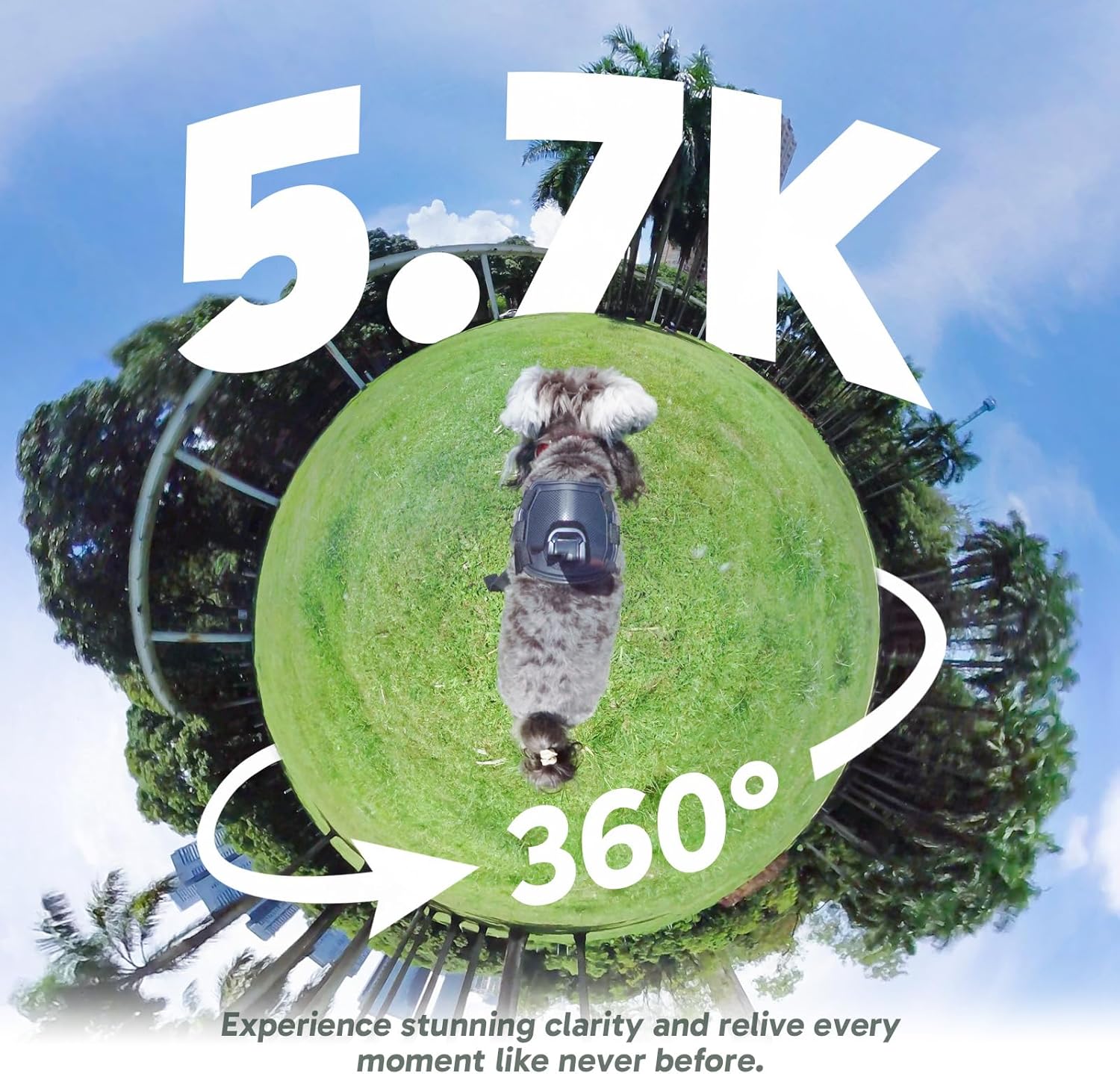
On paper, you get 5.7K 360 video at 30 fps and up to "72MP" photos using dual 1/2" 48 MP sensors. In reality, the video looks pretty solid in good light. On a sunny bike ride, colours looked natural, maybe a bit less punchy than Insta360’s default look, but that’s not necessarily bad; it feels more neutral and you can tweak it in the app. When you don’t zoom in too much, the footage looks clean and detailed enough for YouTube or social media.
When you start punching in heavily or cropping a lot in the app, you see the limits. The image becomes softer and a bit pixelated, especially on distant details like trees and buildings. That’s normal to some extent for 5.7K 360 (since you’re spreading those pixels all around you), but compared to an Insta360 X3, you can see that the Akaso is a step behind in sharpness and colour tuning. It’s not unusable, just something to keep in mind: this is a budget 360 cam, not a pro tool.
In low light, things go downhill faster. Indoors or at dusk, noise creeps in, especially in the shadows, and the auto exposure tends to push ISO up, which makes the image grainy. You can switch to manual exposure and follow the 180‑degree shutter rule to keep motion natural, which helps a bit, but this is not a night camera. For casual indoor clips it’s okay; for anything serious in low light, I’d look elsewhere or stick to daytime shooting.
Stabilization is actually quite decent. The "SuperSmooth" digital stabilization and 360 horizon lock keep footage watchable even when the camera is shaking on a bike mount. I’d put it like this: if Insta360 is a 10/10 on stabilization, this feels around 8.5/10. You still feel some micro‑jitters on rough roads, but the horizon stays level and there’s no wild wobble. For running, walking and cycling, it does the job. Audio is fine as long as there’s not much wind; the dual mics with wind reduction help a bit, but there’s no external mic port, so if you really care about sound, you’ll want a separate recorder.

What you actually get and how it’s set up
In the box you get the camera, two batteries, a small protective pouch, a USB‑C cable, a lens cloth and a quick start guide. No microSD card, no selfie stick, no mounts. So don’t expect to use it straight away on a helmet or a bike unless you already own standard action cam mounts and at least one decent SDXC card (V30 or better, personally I’d go V60 like they recommend). The 1/4" tripod thread on the bottom makes it easy to attach to generic tripods and selfie sticks, which is handy because AKASO’s own "invisible" stick is sold separately and not easy to find everywhere yet.
The interface is simple: swipe down for general settings, left for playback, right for exposure, up for resolution/frame rate. If you’ve used any modern action cam or even a smartphone camera, you’ll figure it out in a couple of minutes. There’s a "quick capture" mode where pressing the record button turns the camera on and starts recording automatically, then pressing it again stops and powers it down. In theory that’s perfect for catching quick moments, but the startup is around 10–12 seconds, which feels long in real life. A few times I thought I was already recording, but the camera was still booting.
On the app side, you need a reasonably recent phone (Android 9+ in my case). The app connected pretty fast and immediately asked to update the camera firmware. Once that was done, I could download clips, reframe, use the AI tracking and export. The workflow is similar to Insta360’s app: shoot first, decide framing later. It’s not as polished visually, but all the basics are there: keyframing, aspect ratio changes for social media, simple filters and speed control. Export times on my mid‑range Android were acceptable; not lightning fast, but it didn’t freeze or crash.
Overall, the presentation is pretty no‑nonsense: you get the core hardware and software to start shooting 360, but no ecosystem around it yet. If you already have tripods, clamps and selfie sticks, it’s fine. If you expect a full kit with mounts, cases and lens protectors out of the box, this will feel barebones.
Pros
- Good 5.7K 360 image quality in daylight with decent stabilization and horizon lock
- Large touchscreen and simple menus make it easy to use, even for beginners
- Strong price-to-features ratio with two batteries included
Cons
- Very exposed lenses with no official repair service or lens protectors
- Slow startup time and weaker low-light performance
- Limited accessory ecosystem (no external mic, no official dual charger, few mounts/cases)
Conclusion
Editor's rating
After using the AKASO 360 for a bit, my feeling is pretty simple: it’s a good budget way to try 360 filming, as long as you accept its limits. In good light, the video looks clean, the stabilization is more than decent, and the app gives you all the basic tools to reframe and share clips without needing pro editing skills. The big touchscreen and straightforward menus make it easy to live with day to day, and the two included batteries are a nice touch at this price.
On the flip side, startup is slow, low‑light performance is mediocre, and the ecosystem is basically bare at the moment. The real red flag for me is the exposed lenses with no official repair or lens protectors from AKASO. One bad drop can ruin the camera, and there’s no clear way to fix it. Also, no external mic port and no easy‑to‑find spare batteries or chargers means it’s not ideal for more serious or professional use.
Who is it for? People who want to experiment with 360 on a tighter budget, vloggers or cyclists who mainly shoot in daylight, and anyone who doesn’t care about having the absolute best image quality, as long as it looks good enough on a phone screen. Who should skip it? If you’re clumsy, plan to shoot a lot in rough conditions, need solid accessory support, or want the most polished experience, you’re better off saving for an Insta360 or GoPro Max. This AKASO gets the job done for casual users, but it’s not the kind of camera I’d fully trust in harsh or professional scenarios.