
Summary
Editor's rating
Value for money: decent if you know the limits
Design and handling: feels like a mini DSLR but with some quirks
AA batteries: practical but not very efficient
Build quality and long‑term feel
Image quality and zoom: good in daylight, weak in low light
What you actually get and who it’s aimed at
Pros
- Very long 40x optical zoom with optical image stabilisation, useful for wildlife and travel
- Simple to use with automatic modes and a comfortable grip for beginners
- Runs on AA batteries and comes with a 32 GB SD card, so easy to keep powered and store plenty of shots
Cons
- No viewfinder, making it hard to use in bright sunlight with only the LCD screen
- Weak low‑light performance and autofocus struggles indoors or in shade compared to modern smartphones
- AA batteries drain fairly quickly and the camera has no real Wi‑Fi despite some marketing blurbs suggesting otherwise

Specifications
View full product page →| Brand | KODAK |
A cheap long‑zoom camera I grabbed for holidays
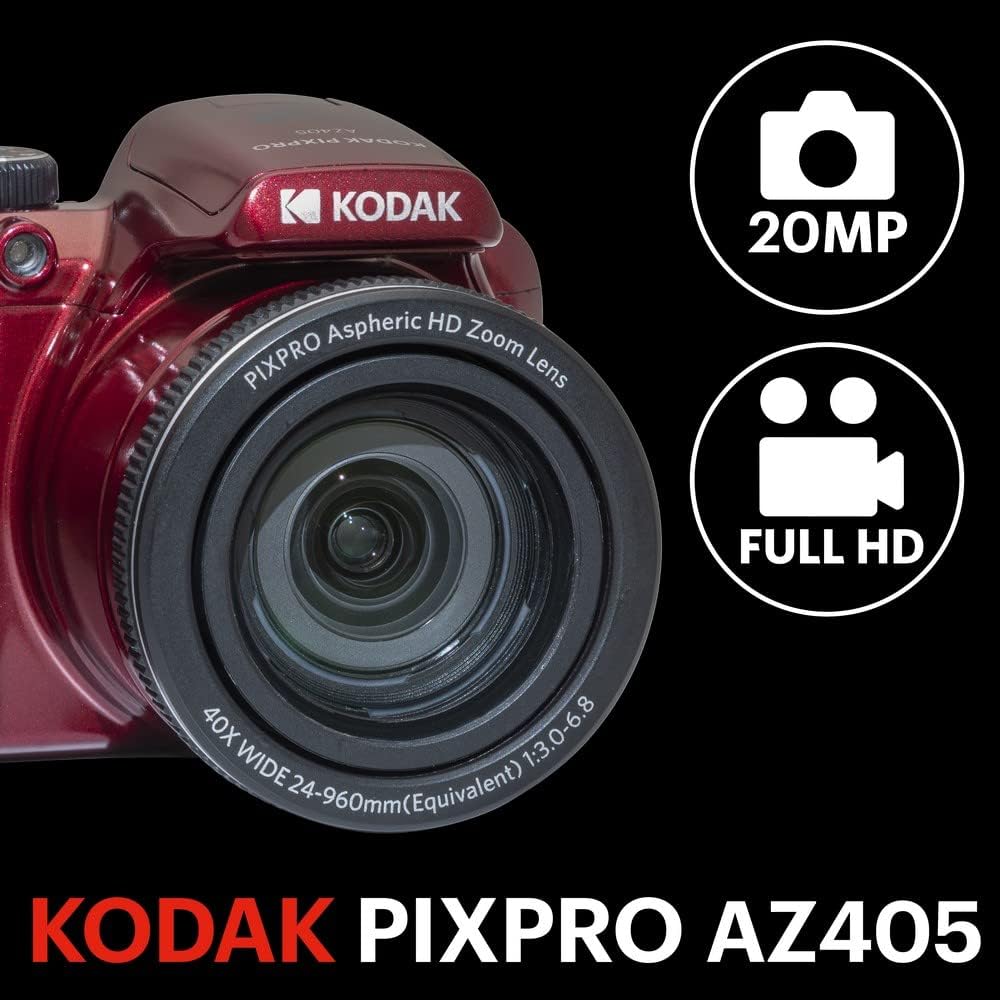
I picked up the KODAK Pixpro Astro Zoom AZ405 bundle (the red one with the 32 GB SD card) because I wanted something better than my phone for zoo trips and holidays, but I didn’t feel like dropping big money on a DSLR or mirrorless. On paper it sounded pretty solid: 20 MP, 40x optical zoom, optical image stabilisation, and Full HD video. Plus it runs on AA batteries, which sounded handy for travel. I used it for about three weeks: a weekend city trip, a full day at the zoo, and a couple of family events indoors.
Right away, I’ll say this: if you’re expecting DSLR quality, forget it. This is more of a point‑and‑shoot with a big zoom. Outside in daylight it does a decent job and the zoom is genuinely useful. Indoors or in shade, it starts to struggle, and you feel the limits of the small CCD sensor and basic JPEG processing. My phone (a mid‑range Android, nothing fancy) often gave cleaner shots in low light, but the Kodak beats it when you really need that long zoom.
The bundle itself is simple: camera, strap, lens cap, and the 32 GB Kodak SDHC U1 card. No batteries in the box, which is a bit annoying because you can’t use it straight away if you forget to buy some. I threw in four decent NiMH rechargeables and that’s basically mandatory in my opinion, otherwise you’ll burn through alkalines fast. Setup was straightforward: pop in the card and batteries, set date/time, and you’re shooting.
Overall first impression after a few days: it feels like a camera aimed at beginners who mostly shoot outdoors. It’s simple, most things are automatic, and the 40x zoom is the main reason to buy it. But there are some compromises: no viewfinder, mixed performance in low light, and the whole Wi‑Fi thing is confusing because the product page suggests it, but this specific bundle is basically USB only. If you accept those trade‑offs, it’s okay. If you’re picky about image quality or shoot a lot indoors, you’ll probably be annoyed.
Value for money: decent if you know the limits
Price‑wise, the AZ405 bundle sits in the budget bridge camera zone. For the money, you get: a 20 MP long‑zoom camera, optical stabilisation, 1080p video, and a 32 GB SD card. Compared to buying a DSLR with a 300 mm+ lens, it’s obviously much cheaper and more compact. Compared to a mid‑range smartphone, you’re trading modern processing and low‑light performance for a much longer optical zoom. So the value really depends on what you need. If you mainly shoot during the day and want reach, it’s not a bad deal.
Where the value drops a bit is in the corners they cut: no viewfinder, no real Wi‑Fi despite some marketing blurbs mentioning it, no RAW, and pretty average low‑light performance. The Amazon rating of 3.9/5 sums it up: people are generally okay with it, but there are clear complaints. One person praised the zoom and ease of use, another called it a great entry camera but noted the quality drop in shade, while others were annoyed by the lack of viewfinder and the misleading connectivity claims. That lines up with my experience.
If you compare it to slightly more expensive bridge cameras from Canon, Panasonic, or Nikon, those often give you better sensors, viewfinders, and sometimes proper Wi‑Fi or Bluetooth. So if you can stretch your budget a bit, there are better balanced options. But if you’re locked to this price range, want a new device (not used), and you’re okay with its limits, the AZ405 pack is good enough value. You get everything you need to start shooting right away, apart from the batteries.
Personally, I’d say it’s worth it for someone who doesn’t want to think too much, mainly shoots outdoors, and just wants to zoom in on stuff on holiday. If you’re more demanding or you’re already into photography, you’ll probably feel it’s a bit basic and might prefer to save up for something with a better sensor and a viewfinder.
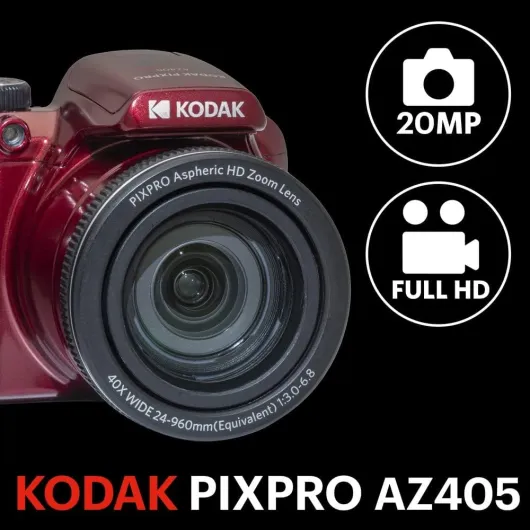
Design and handling: feels like a mini DSLR but with some quirks
In the hand, the AZ405 looks like a shrunken DSLR: a chunky grip, lens barrel that extends when you power it on, and a decent amount of physical buttons. The grip is actually pretty good; I could hold it securely with one hand thanks to the textured surface, even when the lens was fully zoomed. It’s plastic all around, but at this price that’s expected. It doesn’t feel premium, but it also doesn’t feel like it’s going to fall apart as long as you’re not throwing it around. The red colour is bright, almost toy‑like, which some people will like and others will hate. Personally, I got used to it after a day.
The main downside in the design is the lack of a viewfinder. You only have the 3" rear LCD to frame your shots. Indoors or in the shade, no problem. Outside in bright sunlight, the screen becomes hard to see, just like one of the Amazon reviewers said. I often found myself guessing the composition because of reflections. That’s where a simple optical or electronic viewfinder would have helped a lot, especially for long zoom shots where you want stability. I ended up using my hand as a hood around the screen, which is not ideal.
Button layout is mostly logical: zoom rocker around the shutter, mode dial on top, playback and menu buttons on the back. There’s no learning curve if you’ve used any compact camera before. The menus are not pretty, but they’re clear enough. One thing I noticed is that the camera is a bit slow to start up and to extend the lens, so you can’t just whip it out and instantly grab a shot like with a phone. You press power, wait a second or two, then you’re ready. Not a deal‑breaker, but you do miss a few spontaneous moments.
Overall, the design is practical but basic. It feels like a simple bridge camera built to hit a low price, not to impress. The size is okay for carrying in a small bag; it’s bulkier than a phone, obviously, but lighter than an entry‑level DSLR with a telephoto lens. If Kodak had added a basic viewfinder and maybe a tilting screen, the handling would be much better. As it is, it’s usable, just not very comfortable in bright outdoor conditions.
AA batteries: practical but not very efficient
One of the key selling points of this camera is that it runs on AA batteries. On paper, that’s handy: you can buy alkalines anywhere if you’re travelling, and you’re not stuck with a proprietary battery that costs a fortune or is hard to replace. In practice, it’s a bit of a mixed bag. First, the camera doesn’t come with batteries in the box, so you need to remember to buy a set before your first outing. I used four 2500 mAh NiMH rechargeables, and I’d say that’s basically mandatory if you don’t want to keep throwing money at disposables.
With fully charged NiMH batteries, I got through a full afternoon at the zoo: around 250 photos and a handful of short 1080p clips before the battery indicator started dropping. That’s acceptable, but not great. If you use the LCD a lot (which you have to, since there’s no viewfinder) and zoom in and out constantly, it drains faster. With cheap alkaline AAs I tried once, it was worse: the camera started complaining after roughly 150–180 shots. So yes, AA is convenient, but it’s not very efficient compared to a decent dedicated lithium‑ion pack.
Another thing: the battery indicator isn’t very precise. It stays on full for a long time, then suddenly drops to half, then to red fairly quickly. That makes planning a bit tricky. For a day trip, I ended up carrying a second set of rechargeable AAs in my bag, just in case. Swapping batteries is easy, but it’s still more hassle than just plugging in a USB‑C cable like with some newer compacts or charging a single proprietary pack every night.
So overall, the AA system is practical if you travel a lot or don’t shoot every day, but it’s not ideal for heavy users. If you’re fine investing in two good sets of NiMH rechargeables and a charger, you’ll be okay. If you rely on alkalines, expect to spend money and deal with frequent changes. The reviewer who had a nightmare returning the camera because of batteries also highlights another point: shipping devices with loose batteries can be a hassle with some couriers, especially across borders.

Build quality and long‑term feel
After a few weeks, the AZ405 still felt solid enough, but it’s clearly built to a budget. The body is all plastic, including the lens barrel and most buttons. There’s a bit of creak if you squeeze the grip hard, but nothing alarming. The finish on the red version looks like it could scratch if you’re rough with it or toss it in a bag with keys. I used a simple padded case and had no marks, but I wouldn’t trust it loose in a backpack for long.
The moving parts – mainly the zoom mechanism and lens cap – behaved fine. The zoom doesn’t feel super refined; you can hear and feel the motor working, but it did its job. There’s no weather sealing, so I was careful not to use it in rain or dusty environments. At the beach I kept it mostly in the bag and only took it out briefly; sand and a non‑sealed extending lens are not a good mix. For normal city and family use, I don’t see a big problem, but this is not a camera I’d bring to harsh conditions.
The buttons and dials are basic but functional. After a few hundred presses, they still clicked properly. The battery and SD card door feels like the weak point: the plastic hinge doesn’t inspire huge confidence. If you’re constantly swapping batteries, I’d be gentle with it. The included 32 GB SD card worked fine the whole time; write speeds were enough for 1080p video and continuous shooting at the camera’s modest burst rate. I didn’t have any file corruption or random shutdowns.
In short, durability is acceptable for casual use, but I wouldn’t treat this like a rugged camera. Use a case, don’t drop it, avoid rain and dust, and it should last. If you want something that can take abuse, this isn’t it. For the price and the target audience (novices, family use), the build is in line with expectations: not premium, not terrible, just middle of the road.
Image quality and zoom: good in daylight, weak in low light
Let’s talk about the main point: how the photos actually look. In good daylight, outdoors, the AZ405 is decent. At the wide end (24 mm equivalent), pictures are sharp enough in the centre for casual use: family shots, landscapes, city streets. Colours are a bit on the punchy side, but nothing crazy. For prints up to standard photo sizes or sharing on social media, it’s fine. The 20 MP resolution is more than enough; the limiting factor is the small 1/2.3" CCD sensor and the JPEG processing, not the megapixels.
The 40x optical zoom is the fun part. At the zoo, I could frame animals that were quite far away and still get a usable shot. The optical stabilisation definitely helps; at full 960 mm equivalent, you need a steady hand, but I managed several sharp photos in daylight. There’s also digital zoom up to 160x, but honestly, the quality drops a lot there. I turned it off after trying it a couple of times because the images looked soft and noisy. Stick to the optical 40x if you care about the final result.
Where it struggles is indoors and in shade, exactly like one of the Amazon reviewers mentioned. As soon as the light drops, the camera pushes the ISO up, and the CCD sensor starts to show noise and smearing. Faces can look a bit mushy, and details disappear. Compared to my phone, the Kodak often loses in these situations, because modern phones use aggressive processing and bigger sensors. I had several shots at a family dinner where my phone simply did better. The autofocus also tends to hunt more in low light, and I had a few completely blurry images where the camera just didn’t lock focus properly, which matches the 1‑star review complaining about focus issues.
Video performance is okay for casual clips: 1080p MP4, decent in good light, but not very sharp and the autofocus can be slow to adjust if subjects move a lot. The built‑in mic is basic; it picks up wind noise easily. For quick holiday clips it’s fine, but I wouldn’t use it for anything serious. Overall, performance is good enough for beginners outdoors, but if you’re picky or you shoot a lot in low light, you’ll hit its limits fast.

What you actually get and who it’s aimed at
This pack is basically a simple bridge camera for beginners: 20 MP CCD sensor, fixed lens with 40x optical zoom (24–960 mm equivalent), 3" LCD screen, 1080p video, and AA battery power. The SD card in the bundle is a 32 GB Kodak Ultra High Speed U1 SDHC, which is fine for photos and basic Full HD clips. The camera saves photos only in JPEG and videos in MP4, so there’s no RAW or fancy stuff. It’s clearly not targeting enthusiasts who like to edit heavily; it’s for people who just want usable pictures straight from the camera.
The user interface is pretty simple. You have an “Easy” mode plus scene modes, automatic scene detection, and object tracking. There’s no manual mode or advanced controls like you’d find on a more serious bridge or DSLR. You basically point, zoom, half‑press to focus, and shoot. It does have optical image stabilisation, which is important at 960 mm equivalent; without that, hand‑held shots would be a disaster. The menus are a bit old‑school, but after 15–20 minutes of poking around I could find what I needed: resolution, ISO range, self‑timer, and video settings.
From the specs and my use, this camera is mainly for:
- Casual users who want more zoom than a smartphone
- Parents or grandparents who prefer physical buttons over touchscreens
- People going on holidays, zoo trips, or sports days in daylight
It’s not for people who care a lot about low‑light quality, fast autofocus for sports, or wireless transfer. One Amazon reviewer also pointed out the missing viewfinder, and I agree: the lack of an eye‑level viewfinder is a real limitation outdoors in bright sun. Also, the Wi‑Fi mention in some Kodak blurbs is misleading here; this specific AZ405 pack behaves like a basic USB‑only camera. For the price, it’s okay, but you have to know what you’re buying: a straightforward long‑zoom snapshot camera, not a pro tool.
Pros
- Very long 40x optical zoom with optical image stabilisation, useful for wildlife and travel
- Simple to use with automatic modes and a comfortable grip for beginners
- Runs on AA batteries and comes with a 32 GB SD card, so easy to keep powered and store plenty of shots
Cons
- No viewfinder, making it hard to use in bright sunlight with only the LCD screen
- Weak low‑light performance and autofocus struggles indoors or in shade compared to modern smartphones
- AA batteries drain fairly quickly and the camera has no real Wi‑Fi despite some marketing blurbs suggesting otherwise
Conclusion
Editor's rating
After using the KODAK Pixpro AZ405 bundle for a few weeks, my conclusion is pretty simple: it’s a basic long‑zoom camera that does the job outdoors, but it has clear limits. The 40x optical zoom and optical stabilisation are the main reasons to buy it. For zoo trips, sightseeing, or kids’ sports in decent light, it delivers usable photos that most families will be happy with. The handling is straightforward, the grip is comfortable enough, and the included 32 GB card means you’re almost ready to go out of the box (just add AA batteries).
On the downside, the lack of a viewfinder is annoying in bright sun, low‑light performance is weak compared to modern phones, and the autofocus can struggle indoors or in shade. The AA battery system is practical for travel but not very efficient unless you invest in good rechargeables. The whole Wi‑Fi confusion (some Kodak commentary vs. actual USB‑only behaviour on this bundle) also leaves a bit of a bad taste, and build quality is strictly average plastic.
I’d recommend this camera to casual users and beginners who mainly want more zoom than their phone and who shoot mostly in daylight: parents, grandparents, or someone going on a holiday and wanting a simple point‑and‑shoot with reach. If you care about image quality in all conditions, want a viewfinder, or plan to get deeper into photography, I’d skip this and look at a slightly more expensive bridge or even a used DSLR/mirrorless kit. It’s not terrible, it’s not great; it’s a budget tool that gets the basics done if your expectations are in check.