Summary
Editor's rating
Value for money: a complete starter kit with a few trade-offs
Design and ergonomics: compact, flip screen, and classic look
Battery and endurance: two 1500 mAh packs for more flexibility
Build and durability: basic construction for everyday use
Image and video performance: strong numbers, realistic expectations
Specs and positioning: what this NBD camera really offers
Pros
- Complete starter kit: includes 64 GB microSD card and two 1500 mAh batteries
- 5K/4K video and 64 MP stills with 180° flip screen for vlogging and selfies
- Lightweight compact design and simple automatic modes suited to kids and beginners
Cons
- 18x zoom is fully digital, which limits quality when zoomed in
- Small 1/2.3" sensor and basic MOV/JPG formats restrict low‑light and pro use
- No clear, consistent confirmation of effective image stabilisation or rugged features

Specifications
View full product page →| Brand | NBD |
A budget 5K vlogging camera aimed at beginners
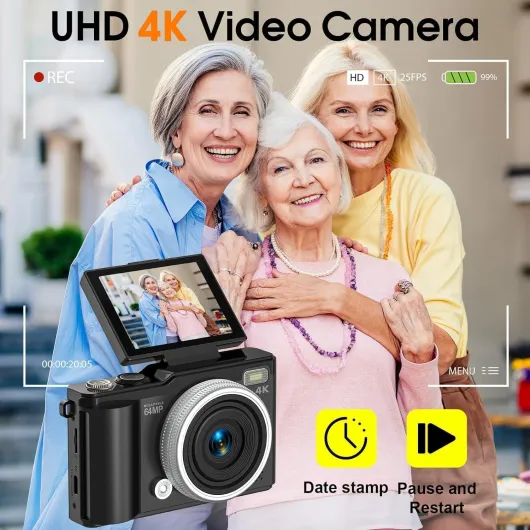
The NBD 64MP digital camera positions itself as a small, affordable device for beginners, kids, and casual vloggers who want something more dedicated than a phone, but without dealing with a full DSLR or mirrorless system. On paper, it offers a lot of big numbers for the price bracket: 64 MP stills, up to 5K video, and an 18x digital zoom, all in a compact body weighing about 238 g. The manufacturer clearly targets simple use with automatic modes and a flip screen for selfies and vlogging.
Among the published reviews, buyers mainly use it for children, teenagers, or as a basic travel or learning camera. Comments describe it as easy to understand, with menus and controls that a novice can pick up in less than an hour with a bit of guidance. That matches the spec sheet: automatic exposure, autofocus, and a few scene modes (portrait, landscape, night) are there to avoid complex settings. It’s not trying to compete with serious interchangeable-lens cameras, but to be a straightforward point‑and‑shoot.
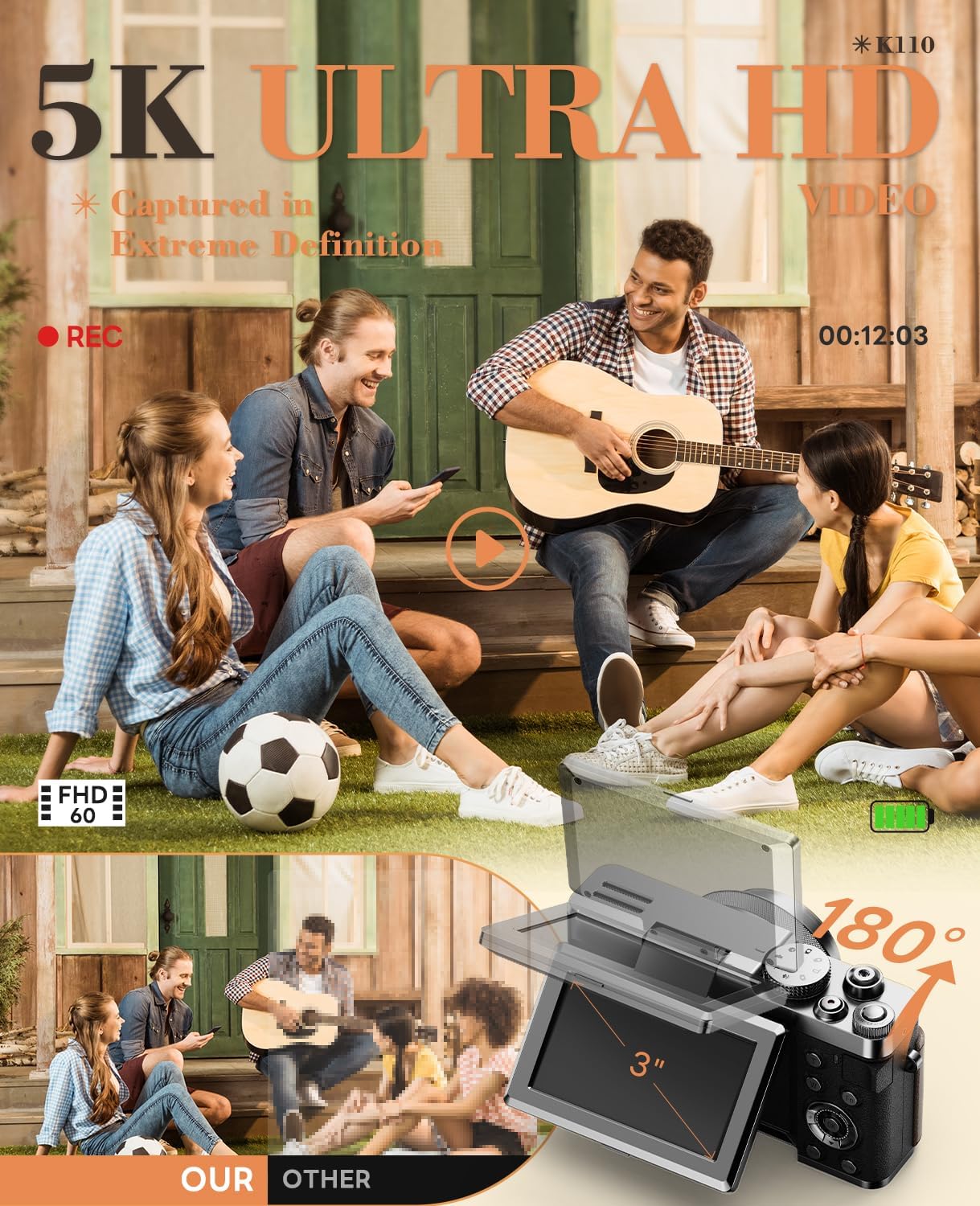
What stands out is the combination of video-centric features and beginner focus. The 180° flip screen is clearly aimed at vlogging and selfies, the camera can act as a webcam over USB, and it records up to 5K at 30 fps in MOV format. For someone starting a YouTube or TikTok channel and not wanting to rely on their phone, this is the kind of spec sheet that looks attractive, especially with the included 64 GB microSD card and two batteries.
It’s not perfect on paper: the zoom is fully digital, the sensor is a small 1/2.3" CMOS, there’s no mention of advanced codecs, and the advertised image stabilisation looks inconsistent with another line that says there is no stabilisation. Still, the overall picture is a compact, simple camera that gives kids and beginners a dedicated tool to learn framing, basic settings, and simple video creation without spending a lot. In my opinion, the introduction angle is clear: this is a low-risk entry ticket into dedicated photography and vlogging gear.
Value for money: a complete starter kit with a few trade-offs
Even though the current price is not displayed here, the overall package clearly aims at the budget end of the camera market. For that segment, the spec sheet is loaded: 64 MP photos, 5K/4K video, flip screen, stereo mic, webcam mode, and an included 64 GB microSD card plus two 1500 mAh batteries. Many competing beginner cameras or kids’ cameras either skip the card or provide a very small one, and often include only a single battery. That alone improves the out‑of‑box value because you don’t need to buy extra accessories immediately.
The user feedback is strongly positive overall, with a 4.8/5 average from 15 ratings on Amazon. Buyers highlight that it’s a good starter camera for kids, that image quality is decent for the size and price, and that it’s simple to learn. One reviewer explicitly calls it a "great gift idea" for children and another describes it as a "good quality camera at an affordable price". These comments match the positioning: not a professional tool, but a low‑risk purchase to introduce someone to photography and vlogging without spending big on a major brand.
The trade-offs that keep the price down are clear: no optical zoom (it’s digital only), a small sensor, basic MOV/JPG formats, and no confirmed robust image stabilisation despite a mention in the marketing line. There’s also limited long‑term feedback because the review count is still modest. For someone who wants to shoot serious low‑light video, rely heavily on zoom, or work professionally, this camera will likely feel limited quite quickly. In that case, paying more for a known brand with a larger sensor, optical zoom, and proven stabilisation would make sense.
In my opinion, the NBD 64MP 5K camera offers good value for a narrow but clear audience: parents who want a real camera for their kids instead of a toy, beginners who want to learn framing and simple settings, and casual vloggers who just need a basic flip‑screen camera to start recording content. It’s not a bargain for everyone, but in that specific use case—first steps into photography and video creation—it provides a complete kit and a reasonable feature set for the money.
Design and ergonomics: compact, flip screen, and classic look
The NBD 64MP 5K vlogging camera follows a classic compact camera design. Dimensions are listed as 12.5 × 5.6 × 7 cm, so it’s roughly the size of a small point‑and‑shoot that fits in a jacket pocket or small bag. The weight is around 238 g, which on paper is quite light compared to DSLRs or mirrorless bodies with lenses. Several reviews describe it as lightweight and easy to carry, suitable for children or teenagers to hold without fatigue. One buyer, however, mentions returning a unit from the same brand because they found it heavy; that shows perception will vary depending on what someone is used to (phone vs DSLR, for example).
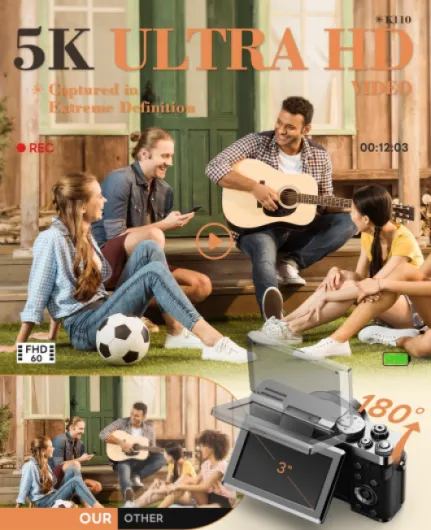
The camera comes in silver, with a retro‑style, "classic" design mentioned by at least one reviewer. This kind of aesthetic usually appeals to people who like the look of old compact film cameras but still want digital convenience. The 3‑inch OLED screen is mounted on a 180° flip hinge, which is central to the vlogging and selfie pitch. Being able to see yourself while recording makes it much easier to check framing and expression without guessing. For group photos and low‑angle or high‑angle shots, this kind of articulating screen is simply more practical than a fixed panel.
Control-wise, while the exact button layout is not fully detailed, the comments from buyers who gave the camera to kids suggest that the interface is simple enough to grasp in under an hour with some explanation. That usually implies straightforward menus, labelled buttons, and clear mode switching (photo/video, playback, zoom controls, etc.). One reviewer mentions a "nice 2.7‑inch screen", which likely refers to a different but similar NBD camera; in this model, the spec sheet clearly lists a 3‑inch screen. The idea remains the same: a back screen that is large enough for beginners to review what they shot and navigate the menus.
From an ergonomic standpoint, the camera is designed to be used in fully automatic mode most of the time, with some manual exposure control available for those who want to experiment later. For kids and true beginners, that’s arguably a sensible choice. You don’t get dedicated dials for shutter speed and aperture like on higher-end gear, but you get a camera that you can grab, turn on, point, and shoot. In my opinion, the design is coherent with its target audience: compact, familiar, visually pleasant, and focused on ease of use rather than deep manual control. It’s basic, but that’s likely what its buyers are looking for.
Battery and endurance: two 1500 mAh packs for more flexibility
The NBD 64MP vlogging camera is equipped with lithium‑ion batteries rated at 1500 mAh. The spec sheet lists "Number of batteries: 1 (included)", but the descriptive text and user feedback both mention that two batteries are actually provided. That’s an important detail, because having a spare battery is often more useful than a slightly larger single battery, especially for travel, vlogging days, or events where you can’t recharge easily.
There is a note about a 30‑minute recording capacity, which likely refers to a per‑clip limit rather than total battery life. Many small cameras limit continuous video recording to 30 minutes per file for technical and regulatory reasons. In practice, buyers are more interested in how long the camera can run on a single charge. One reviewer reports that with the screen on and the camera used constantly, the battery lasts around two hours, and that a full recharge takes about one hour. That’s one user’s experience, not a lab measurement, but it gives a useful ballpark for real‑world use.
For a device with a 3‑inch OLED screen, 5K/4K video, and a small 1500 mAh battery, a couple of hours of intensive use per battery sounds plausible. In normal mixed use (some photos, some video, some standby), many users will probably get more time before needing to swap. The fact that the camera is USB‑powered also helps: you can top up from a power bank, laptop, or wall charger relatively quickly, which is practical for travel and vlogging on the go.
In my opinion, the battery setup is a sensible compromise for this category. It’s not built for all‑day professional shooting, but with two batteries in the box and roughly a few hours of operation under heavy use, beginners and kids will likely be covered for typical outings, school events, or short vlogging sessions. The only caveat is that there’s no published official CIPA battery life figure, so expectations should be based on that single user report and the hardware specs. If someone plans to record long sequences in 5K or 4K, a power bank or extra batteries would be a smart addition.
Build and durability: basic construction for everyday use
There is no detailed breakdown of the materials used in the chassis, but given the price range and positioning, it’s safe to assume a predominantly plastic build with metal only where necessary (mounts, screws, maybe some frame components). User comments describe the camera as "lightweight" and "built to last" for kids, which suggests that the casing feels reasonably solid for casual use, even if it’s not designed for harsh professional environments. No reviews report cracks, major failures, or obvious weak points at the time of writing.
The camera’s compact form factor and low weight are double‑edged for durability. On one hand, a lighter device is less likely to suffer severe damage if it falls, simply because there’s less mass impacting the ground. On the other, cheaper plastics can scratch more easily and may not handle repeated impacts as well as more robust materials. This model is clearly not ruggedised: there’s no mention of water resistance, shock resistance, or weather sealing. So it should be treated like a typical consumer electronic device—fine for everyday use, but not for heavy rain, dust storms, or being tossed around without care.
From a mechanical standpoint, the most delicate part is usually the 180° flip screen hinge. Articulating screens are convenient but add moving parts that can wear out or break if forced. There are no specific complaints about this in the reviews, which is a good sign, but long‑term durability naturally can’t be guaranteed from a small sample of early buyers. The same goes for the digital zoom mechanism: since it’s digital rather than optical, there is no extending zoom barrel to worry about, which actually simplifies the mechanical side and can improve reliability compared to compact cameras with moving lenses.
In my opinion, the durability picture is that of a standard entry‑level compact: fine for kids and beginners as long as it’s handled with normal care, kept away from water and sand, and carried in a small case or pouch when not in use. For the price, that’s acceptable. People who need something tougher for hiking in bad weather, sports, or frequent travel abuse should look at rugged or waterproof models instead. Here, the goal is everyday family and vlogging use, not heavy-duty adventure shooting.
Image and video performance: strong numbers, realistic expectations
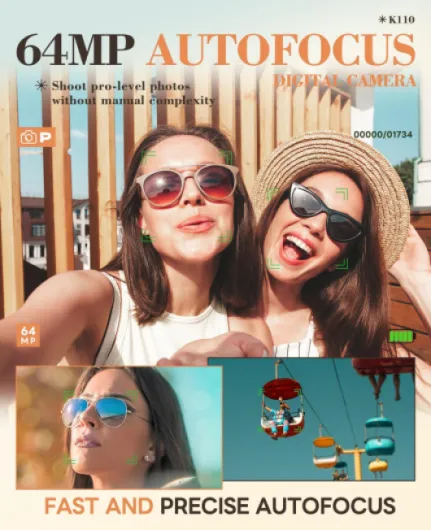
On paper, the 64 MP sensor and 5K video look very impressive for a small, beginner‑oriented camera. The 1/2.3‑inch CMOS sensor size is typical of compact cameras and action cams, so the resolution figure is likely boosted by pixel binning or interpolation. That doesn’t mean the images are bad; it just means that expectations should be realistic: you’re not getting the same level of dynamic range or low‑light performance as a larger APS‑C or full‑frame sensor. For daytime outdoor use, family events, and casual vlogging, this sensor size is usually fine.
Published reviews mostly describe the image quality as "decent" or "nice" for the size and price. One buyer mentions "vibrant colors and crisp images" during daytime, and "ok" results in low light, which is exactly what you’d expect from a small sensor compact. This matches the spec sheet: basic JPEG output with adjustable JPEG quality (Basic, Normal, Fine), but no RAW. You get enough detail for social media, prints up to moderate sizes, and simple cropping, but this is not intended for heavy professional editing.
Video performance tops out at 5K/30 fps according to the specs, with lower resolutions like 4K, 2K, 1080p, and 720p also available. For vlogging and YouTube, 4K/30 fps is usually the sweet spot, and having 5K as an option mainly gives extra room for cropping or reframing in editing. The MOV format is standard and should work fine in most editing software. The stereo microphones and webcam mode add flexibility for streaming or video calls, which is a plus for content creators starting out. However, there’s no mention of high bitrates or advanced audio controls, so this is entry-level video quality, not a pro setup.
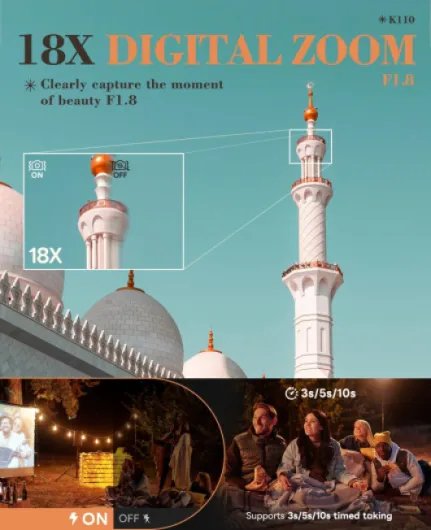
The 18x zoom is fully digital based on the specs, so performance-wise it’s better to treat it as a framing convenience rather than a true telephoto solution. Digital zoom essentially crops the image, so the more you zoom, the more you sacrifice detail and increase noise. One parent reviewer even mentions trying to teach their child to shoot without relying on zoom, which is a wise approach with such a system. In my opinion, the performance is good enough for beginners and kids: solid in daylight, acceptable indoors with enough light, but clearly not designed for demanding night photography or heavy zoom use. It does the job for learning composition and basic video, as long as you keep expectations in line with the price and sensor size.
Specs and positioning: what this NBD camera really offers
The core promise of this NBD model is 64 MP photos and 5K video from a compact, all‑in‑one body. It uses a 1/2.3‑inch CMOS sensor with an effective 64 MP resolution and supports multiple video resolutions: 5K, 4K, 2K, 1080p, and 720p at up to 30 fps. Stills and video are saved in JPG and MOV formats, which are widely compatible with basic editing software and social media platforms. For a beginner device, that’s a practical combination: no RAW or advanced codecs to manage, but simple files that are easy to transfer and share.
The lens offers an 18x digital zoom with a minimum focal length of 18 mm noted in the spec sheet. It’s important to underline that this is digital zoom, not optical; so zooming in heavily will likely reduce image quality, especially in low light. Shooting modes are basic but useful: portrait, landscape, and night. White balance options include Auto, Cloudy, Daylight, Fluorescent, and Incandescent, which is enough to adapt to most casual scenarios without digging into complex color settings.
On the video and vlogging side, the camera integrates a 3-inch OLED flip screen that rotates 180°, stereo microphones, and can serve as a webcam via USB. The display resolution is modest (360 × 640 pixels), but for framing yourself and checking focus, that’s usually adequate. There’s a built-in flash, an electronic viewfinder, and compatibility with tripods and monopods via a standard mount. The camera is also advertised with time-lapse and some form of image stabilisation, though the spec table also states “Has Image Stabilization: No”, which is a bit contradictory.
Accessories are another strong point: a 64 GB microSD card is included, and storage can be expanded up to 256 GB. The box contains the camera body and basic accessories, and buyers mention a cable in the package. Two lithium‑ion batteries of 1500 mAh each are provided, even though the spec line lists "Number of batteries: 1"; in the descriptive text it’s clearly stated that two are in the box. In my opinion, the overall presentation is that of a fully usable kit out of the box for a beginner: no need to buy a card separately, no need to invest in extra power immediately, and a simple USB connection for data or webcam use.
Positioning-wise, this camera sits in the entry-level all‑in‑one digital camera segment. It ranks around 11,491 in Electronics & Photo and 127 in All-in-One Digital Cameras on Amazon, which suggests modest but real demand. With a 4.8/5 average over 15 reviews, feedback is positive but still fairly limited in volume. In my opinion, it targets a narrow but clear audience: parents who want a first "real" camera for a child or teen, and adults who want a cheap, light vlogging camera without diving into complex systems or spending much more on major brands.
Pros
- Complete starter kit: includes 64 GB microSD card and two 1500 mAh batteries
- 5K/4K video and 64 MP stills with 180° flip screen for vlogging and selfies
- Lightweight compact design and simple automatic modes suited to kids and beginners
Cons
- 18x zoom is fully digital, which limits quality when zoomed in
- Small 1/2.3" sensor and basic MOV/JPG formats restrict low‑light and pro use
- No clear, consistent confirmation of effective image stabilisation or rugged features
Conclusion
Editor's rating
The NBD 64MP 5K vlogging camera is, in my opinion, a solid starter option for kids, teens, and adults who want a simple, dedicated camera without diving into complex or expensive systems. It combines a small 1/2.3" CMOS sensor, 64 MP stills, and up to 5K/30 fps video with an articulating 3" OLED flip screen, stereo mics, and basic auto modes. Add in the included 64 GB card and two 1500 mAh batteries, and you get a usable kit right away, which is a big plus in this price segment.
It’s important to keep expectations realistic: the zoom is digital, not optical; low‑light performance and heavy zoom use will have clear limits; and this is not a pro‑level video system. There’s also some spec inconsistency around image stabilisation, and no ruggedisation for harsh conditions. But user feedback is largely positive, especially about ease of use, portability, and daytime image quality.
If you’re a parent looking for a first "real" camera for a child, a beginner wanting to learn basic photography, or a new vlogger who just needs a flip‑screen camera to start recording, this NBD model looks like good value for money. If you already care about optical zoom, strong low‑light performance, or advanced manual control, you’ll be better served by stepping up to a more capable compact or an entry‑level mirrorless system from a major brand.