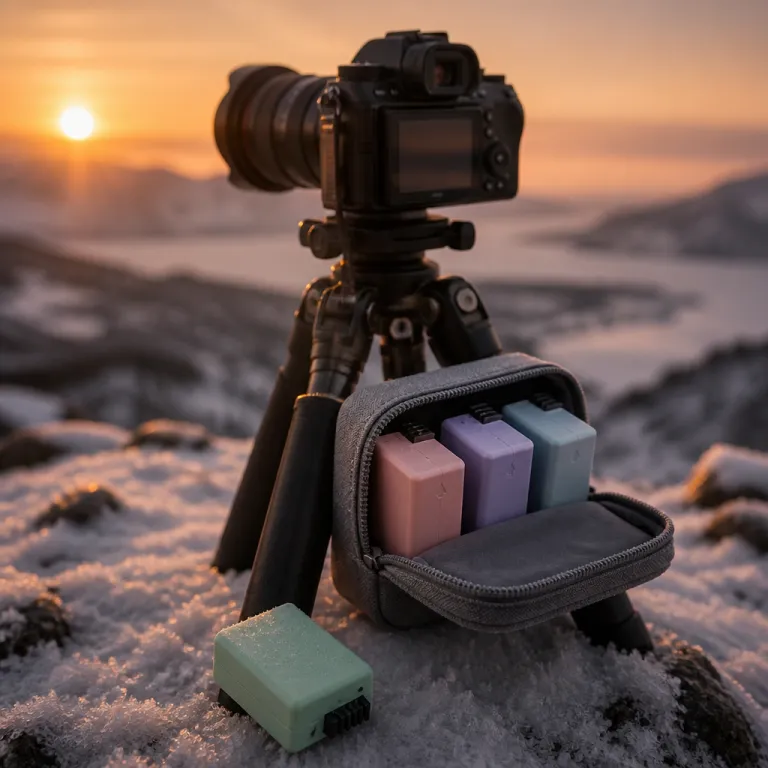
Why cold weather wrecks your expected shot count
Cold air quietly sabotages the shot count you expect from your camera batteries. The chemistry inside a lithium-ion pack slows down as temperatures fall, which means fewer ions move between the electrodes and your camera suddenly thinks the battery is empty. You feel that sting when outdoor cameras shut down on a frosty ridge even though the on-screen meter showed half a charge at the trailhead.
In practical terms, expect your camera batteries to lose roughly 20 to 30 percent of usable capacity once the air dips below 0 °C. Lab tests from manufacturers such as Panasonic and Sony show similar drops in discharge curves between 23 °C and −10 °C, confirming that the loss is usually temporary rather than permanent damage. The same batteries often bounce back once they warm up in your jacket pocket or camera bag, but this cold weather sag arrives unpredictably, which feeds battery anxiety and makes people overbuy spare battery packs they rarely use in milder seasons.
Think of the mAh mark printed on a lithium battery as a best case scenario measured at room temperature, not a promise for a windy summit. A 2 000 mAh pack that normally gives around 500 stills on a mid-range mirrorless camera in CIPA-style testing might deliver barely 300 frames when you shoot long exposures in freezing weather. Video is even harsher on battery life because constant sensor readout, in-body stabilization, and bright screen use accelerate battery drain and exaggerate the cold penalty.
For travel and landscape photography, plan around the worst likely conditions rather than the brochure numbers. If you expect a full day of hiking with sub-zero gusts, assume each of your lithium batteries will behave like a smaller pack and derate your expectations by at least a third. That conservative mindset keeps you shooting instead of rationing frames and watching the battery icon blink while the light turns perfect over the ridge.
Reading mAh ratings and CIPA numbers without getting misled
The mAh rating on a camera battery tells you how much charge it can theoretically store, but it does not tell the whole story. Two batteries with the same 2 200 mAh mark can behave very differently in cold weather because of cell quality, internal resistance, and how efficiently your specific cameras draw power. That is why one brand of lithium batteries might limp through a winter sunrise while another keeps your camera ready for a final burst as the clouds open.
CIPA ratings, defined by the Camera & Imaging Products Association, try to standardize expectations by measuring how many shots a camera can take under controlled conditions with flash use, menu browsing, and power cycling. Those CIPA numbers are usually conservative for still photography, yet they collapse once you start recording 4K video, using continuous autofocus, or chimping every frame on the rear screen. In freezing weather the gap widens further, because the test protocol does not fully reflect how a lithium battery behaves when the pack is chilled and the camera firmware aggressively protects against sudden shutdowns.
For a realistic planning baseline, take the CIPA rating for your camera and treat it as a middle-of-the-road estimate for temperate weather. If you mostly shoot bursts of stills with the viewfinder and keep the screen dim, you can often exceed that rating by roughly 20 percent in mild conditions but fall 30 percent short in deep cold. When you add heavy video use, long exposures, or time-lapse photography, expect your effective battery life to drop to a third of the CIPA figure, especially with compact outdoor cameras that run hot internally.
Once you understand this pattern, the mAh number becomes a relative comparison tool rather than a promise. A higher capacity lithium battery or third-party pack with a slightly larger rating can buy you a safety margin, but it will not magically defeat cold weather chemistry. For more advanced power setups such as Gold Mount style solutions, guides that explain why Gold Mount batteries matter for digital camera users can help you judge when external packs are worth the extra bulk.
Choosing first and third party batteries that will not let you down
Picking the right mix of first party and third party camera batteries matters more in cold weather than in summer city breaks. Major brands design their own lithium batteries and firmware to talk to each other, so the camera can estimate remaining battery life accurately and shut down gracefully before voltage sags too far. Some newer bodies even authenticate packs, which means a cheap lithium battery clone might trigger warnings, refuse to charge, or behave unpredictably when the weather turns cold.
Reputable third party makers such as Wasabi, Neewer, and some RavPower lines have built solid track records with older cameras that lack strict authentication. In those systems a well made spare battery from a trusted brand can match or slightly exceed the performance of the original pack, even in cold weather, while costing less and offering higher mAh ratings. The risk rises with recent mirrorless bodies that use smarter communication between camera and battery, where firmware updates sometimes block unlicensed packs or cause sudden battery drain when the pack voltage dips.
For travel photographers who rely on outdoor cameras in remote places, I recommend at least one genuine manufacturer pack plus one or two vetted third party spares. That mix gives you reliable communication for accurate battery life readings and a cost effective way to carry more lithium batteries without doubling your budget. If you step up to rigs powered through D Tap or similar connectors, learning how to use an OB302 to D Tap adapter cable for your digital camera setup becomes essential so that external battery packs integrate safely with your gear.
Whatever you choose, avoid no name lithium battery listings that look suspiciously cheap or lack clear safety certifications. Poorly built camera batteries can swell, leak, or shut down abruptly in cold weather, which is the last thing you want when shooting wildlife at dawn. Treat your power system as seriously as your lenses, because a dead pack turns even the best camera into an expensive paperweight.
| Battery model | Approx. capacity (mAh) | Typical CIPA shots* | Cold-weather notes & quirks |
|---|---|---|---|
| Sony NP-FZ100 (OEM) | 2 280 mAh | 650–720 (A7 IV / A7R IV bodies) | Very efficient; holds voltage well below 0 °C. Fully supported by Sony firmware with accurate percentage readout. |
| Canon LP-E6NH (OEM) | 2 130 mAh | 360–510 (EOS R5 / R6 II bodies) | Good cold performance; older LP-E6N packs also work but may show reduced capacity after heavy video use. |
| Nikon EN-EL15c (OEM) | 2 280 mAh | 420–740 (Z6 II / Z7 II bodies) | Backwards compatible with many EN-EL15 bodies; some early third-party EN-EL15 variants trigger warnings on newer Z cameras. |
| Wasabi / Neewer EN-EL15-type | 2 000–2 300 mAh | Similar to OEM in Nikon DSLRs | Often excellent value for older Nikon DSLRs; on Z-series mirrorless, check for firmware compatibility and test in mild weather first. |
| Generic LP-E6-type (no-name) | Claimed 2 000–2 600 mAh | Highly variable | Some packs underperform by 30–40% versus label and may shut down early in cold; avoid for critical trips. |
*CIPA figures are approximate published ranges for representative camera bodies and assume room-temperature testing with mixed use.
Smart packing formulas and field habits for cold trips
Once you understand how cold affects battery life, you can plan your packing list with less guesswork. A simple formula works well for still photography trips, where you take the CIPA rating for your camera, estimate your shots per day, and then multiply by 1.5 to cover cold weather losses and occasional video clips. For example, if your camera is rated for 400 shots and you expect 600 frames per day, you divide 600 by 400 to get 1.5, then multiply by 1.5 again and round up, which means carrying at least three batteries.
That 1.5 multiplier builds in a realistic buffer for battery drain from long menus, image review, and the extra power your camera uses to stabilize lenses or sensors. In harsher cold weather or on multi day treks without charging, I often bump the factor closer to 2, especially with small mirrorless cameras that rely heavily on the rear screen. Video shooters should be even more conservative, because continuous recording can chew through a lithium battery three to five times faster than casual stills, particularly when the pack is chilled.
Field habits matter as much as raw battery packs, so it helps to turn the main cold weather tips into a quick checklist:
- Keep spare battery sets in an inner pocket close to your body so they stay warmer than the air around your tripod.
- Rotate packs regularly so no battery spends hours freezing in the camera; swap before the icon turns red.
- When a battery shows low in the cold, replace it with a warm spare and tuck the “empty” pack inside your jacket so it can recover.
- Turn off wireless features, lower screen brightness, and avoid unnecessary half presses that keep autofocus and metering circuits awake.
- Use the viewfinder instead of the rear screen whenever possible, since that single change can noticeably extend battery life in cold weather.
- If you rely on external power banks or USB C charging, remember that many cameras cannot shoot while charging, so you still need at least one healthy internal pack.
Charging, storage, and long term battery health
Cold weather exposes weak batteries, but long term habits decide how quickly your packs age. Lithium batteries gradually lose capacity with every full charge and discharge cycle, and most camera batteries reach about 80 percent of their original capacity after roughly 300 to 500 cycles according to typical manufacturer cycle-life specs. That degradation accelerates if you constantly run packs to zero, store them fully charged in hot cars, or leave them on trickle chargers for weeks.
For the longest life, store camera batteries around 40 to 60 percent charge in a cool, dry place when you will not use them for several weeks. Avoid leaving a lithium battery fully topped up in the camera bag on a sunny dashboard, because heat is far more damaging than occasional cold weather use. When you return from a trip, label each pack with the date and a simple mark system so you can rotate usage and avoid hammering the same spare battery on every outing.
USB C charging through the camera body is convenient in hotels and trains, but it often runs slower than a dedicated charger and can warm the camera unnecessarily. I prefer using the supplied wall charger at home, where each lithium battery charges independently and the camera stays cool and ready to grab. On the road, a compact dual charger powered by a USB power bank gives you flexibility without forcing you to leave the camera tethered overnight.
For more advanced power setups, external guides on how to manage landscape lenses and filters or how to integrate power accessories can help you design a balanced kit that supports both optics and energy needs. A resource that explains landscape lenses decoded, focal length, aperture, and filters can also remind you that weight saved on glass might be better spent on one extra battery in winter. In the end, the best cold weather power strategy is the one that keeps your camera ready when the light finally breaks through the clouds.
Managing subscriptions, sharing, and feedback without losing focus
Modern photography is tangled with online platforms where you can subscribe to creators, mute noisy accounts, and reply to posts that inspire you. When you read a detailed guide about camera battery life cold weather tips, it often comes with options to bookmark the page, follow an RSS feed, or use a bookmark subscribe button so you can return before your next trip. Those tools are useful, but they should support your shooting rather than distract you from learning how camera batteries behave in real cold weather.
If you follow blogs through an RSS feed, consider adding a dedicated folder for outdoor cameras, power accessories, and winter photography so you can subscribe RSS style without cluttering your main reading list. Some platforms let you mute subscribe notifications or even subscribe mute specific threads, which keeps your focus on practical advice about lithium batteries, spare battery choices, and battery packs instead of endless gear arguments. When you find a particularly clear explanation of battery drain or a nuanced take on lithium battery safety, use a feed permalink or permalink print option so you can print report style notes and keep them in your camera bag.
Community feedback can also shape how you refine your own cold weather habits. Thoughtful likes reply chains under a field report sometimes highlight tricks such as taping hand warmers near camera batteries or using small pouches to keep a spare battery warm against your base layer. If you see inappropriate content or dangerously bad advice about puncturing lithium batteries or bypassing safety circuits, use the report inappropriate or inappropriate content tools rather than engaging directly, because safety around camera batteries is not negotiable.
When you share your own experience, include concrete details about which cameras you used, how many batteries you carried, and what the actual temperatures felt like on location. That kind of print permalink style record helps other photographers judge whether your camera battery life cold weather tips apply to their gear. Over time, a well curated mix of bookmark subscribe habits, muted distractions, and honest field reports turns your online photography feed into a practical extension of your winter shooting kit.
FAQ
How much capacity do camera batteries lose in cold weather ?
Most lithium batteries in modern cameras lose roughly 20 to 30 percent of their usable capacity once temperatures drop below freezing. The loss comes from slower chemical reactions rather than permanent damage, so the same battery often recovers some charge after it warms up. Planning for that temporary drop keeps your battery life expectations realistic on winter trips.
Is it safe to use third party batteries in my camera ?
Well made third party camera batteries from reputable brands are generally safe in older bodies that do not enforce strict authentication. Newer cameras sometimes check for specific chips inside the lithium battery, which can cause warnings or reduced performance with unlicensed packs. When in doubt, carry at least one official battery and test any third party spare battery at home before relying on it in harsh cold weather.
How many batteries should I pack for a multi day hike ?
A practical rule is to divide your expected shots per day by the CIPA rating for your camera, then multiply by 1.5 and round up. That formula builds in a buffer for cold weather losses, extra image review, and occasional video clips. For very low temperatures or heavy video use, increasing the factor toward 2 gives more peace of mind.
What is the best way to keep batteries warm while shooting ?
Store spare batteries in an inner jacket pocket close to your body and rotate them regularly with the pack in the camera. Small insulated pouches or cases help shield camera batteries from wind and rapid temperature swings. Avoid leaving a lithium battery exposed on a tripod mounted camera for long periods when you are not actively shooting.
How should I store camera batteries between trips ?
For long term storage, keep lithium batteries at around 40 to 60 percent charge in a cool, dry place away from direct sunlight. Do not leave them fully charged in hot cars or on chargers for weeks, because heat and constant top ups accelerate capacity loss. Label each pack and rotate usage so no single battery absorbs all the wear over time.