
Summary
Editor's rating
Value for money: good feature set, but not unbeatable
Design: pretty to look at, a bit too small to grip
Battery life & connectivity: okay for a day, but bring a power bank
Comfort & handling: great to carry, a bit fiddly to hold
Build quality & durability: solid enough, but doesn’t feel premium
Image quality & autofocus: sharp files, decent AF, not a sports monster
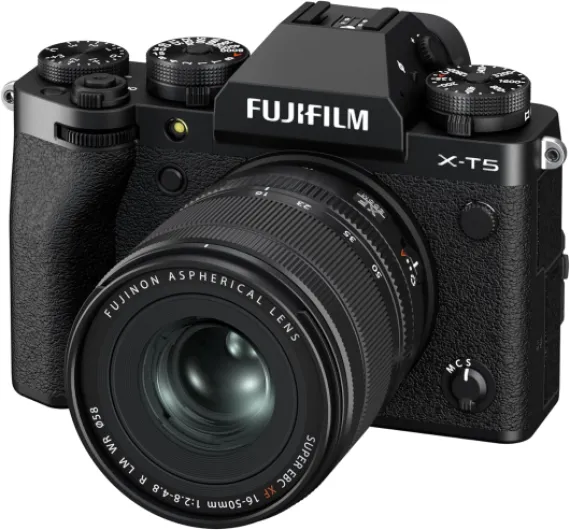
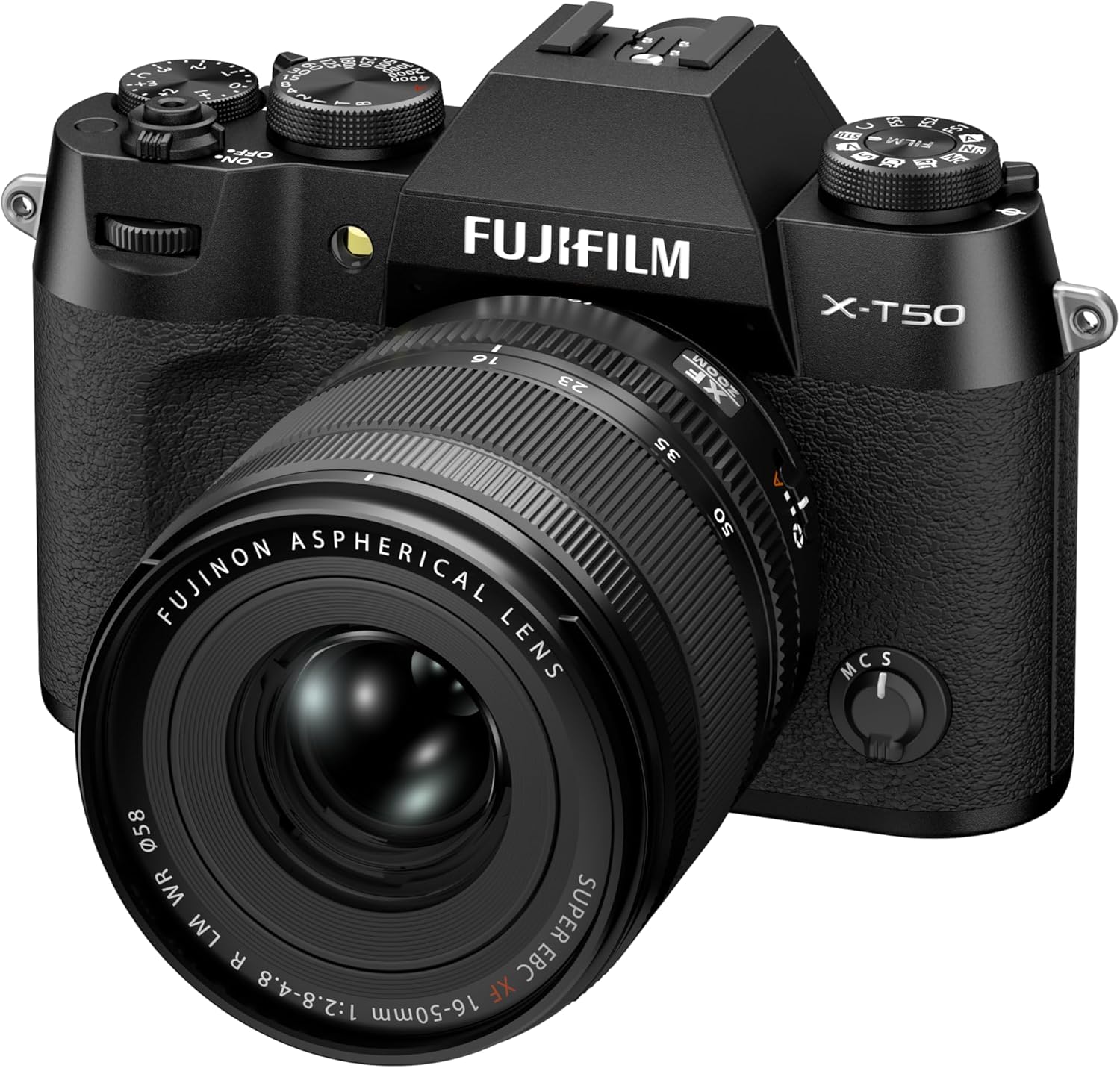
What you actually get with the X-T50 + 16–50mm kit
Pros
- 40MP APS-C sensor with very detailed images and good dynamic range
- Compact and lightweight body with a versatile 16-50mm f/2.8-4.8 kit lens
- In-body image stabilisation that helps in low light and with non-stabilised lenses
Cons
- Small grip and light build make it less comfortable and less confidence-inspiring to hold
- Autofocus and IBIS performance are decent but behind some competitors, especially for fast action and video
- Battery life is average and basically requires at least one spare for full-day use

Specifications
View full product page →| Brand | Fujifilm |
A small Fuji that punches above its weight (most of the time)
I’ve been using the Fujifilm X-T50 with the new XF 16-50mm f/2.8-4.8 as my main walkaround camera for a couple of weeks. Before this, I was on a Canon M6 II and I also use a bigger full-frame body for jobs, so I’m not coming to this as my first camera. I wanted something small, light and stabilised that I could throw in a sling bag and actually carry every day, not just on “photo days”.
On paper, the X-T50 checks a lot of boxes: 40.2MP APS-C sensor, in-body stabilisation, 6K video, film simulations, and a lens that covers 16-50mm (so roughly 24-75mm full-frame equivalent). In reality, it feels like a mix of smart choices and a few weird ones. You can feel that Fujifilm tried to shrink an X-T5 experience into a smaller body, but some compromises are obvious as soon as you start shooting.
The first days, what stood out most was the image quality vs size. The files are detailed, and the kit lens is better than I expected, especially at the wide end. At the same time, the body feels almost too small, and I caught myself squeezing it uncomfortably when shooting one-handed. It’s a camera that makes you want to go out and shoot, but it also reminds you that compact doesn’t always mean comfortable.
If you’re curious about how this combo behaves in real life – ergonomics, autofocus, stabilisation, video, and whether the 40MP sensor is actually worth it in such a tiny body – here’s my honest take, no brand loyalty and no romantic talk. Just what worked for me, what annoyed me, and who I think this kit makes sense for.
Value for money: good feature set, but not unbeatable
Price-wise, the X-T50 with the 16-50mm sits in that mid-range mirrorless zone where there’s plenty of competition from Sony, Canon, and even Fujifilm’s own older models. For what you pay, you get: 40MP sensor, IBIS, a bright-ish kit zoom (f/2.8–4.8 is better than the usual f/3.5–5.6), 6K video, and a very compact package. On paper, that’s a lot of camera for the money, especially if you value resolution and stabilisation.
But it’s not all perfect. Some Fuji X lenses don’t fully exploit the 40MP sensor, especially older zooms, and you can feel that if you pixel-peep. The kit 16-50mm is actually one of the better matches for this body in terms of sharpness vs size, but if you start adding more lenses, the cost climbs quickly. Also, for roughly similar money, you can find full-frame entry bodies with simpler lenses that give you better high-ISO performance and more depth of field control, though usually without the same compactness and stabilisation combo.
For a hobbyist who wants a small, high-res, fun-to-use camera with good JPEG color and usable video, the value is pretty solid. You’re paying partly for the Fuji look and shooting experience, not just raw specs. If you mainly shoot for social media and don’t print big, you might be just as happy with a cheaper 26MP Fuji body and a good prime lens, and save some money. The 40MP sensor is nice, but it’s not mandatory for everyone.
So in my view, the X-T50 kit is good value if you know why you want it: compact size, 40MP, IBIS, Fuji colors, and a versatile zoom. If you’re just looking for the absolute best performance per euro, especially for action or hardcore video, there are other systems that might make more sense. It’s not a bad deal, but it’s also not the automatic best choice for every type of user.
Design: pretty to look at, a bit too small to grip
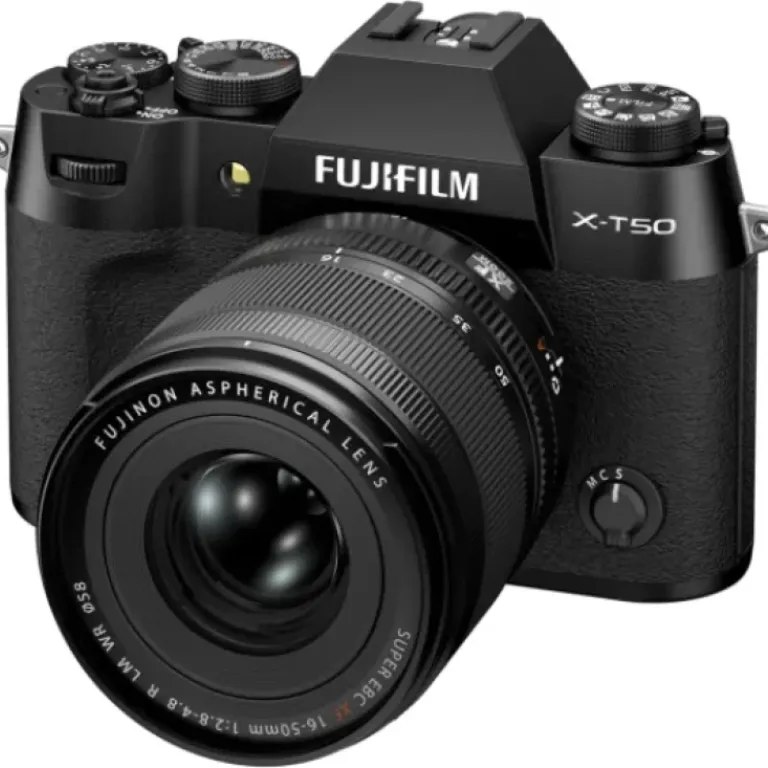
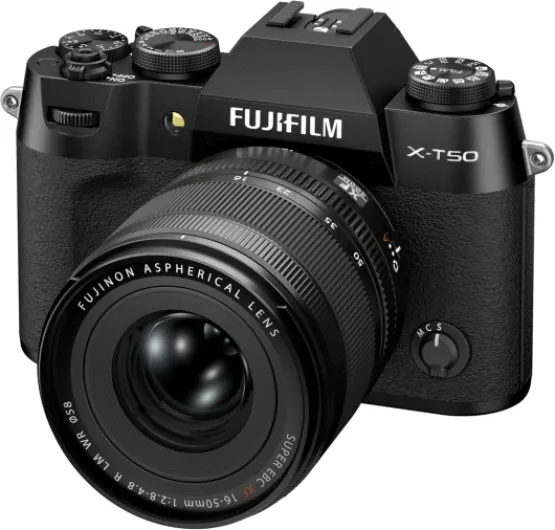
Design-wise, the X-T50 looks like a shrunken retro camera: top dials, central viewfinder hump, small grip, and a new Film Simulation dial. On the desk or on a shelf, it looks nice. In the hand, it’s a bit of a mixed bag. The rounded shape is more comfortable than the older boxy X-T30-style bodies, but the grip is still shallow. After a few hours of walking around with it, I started to feel that my little finger had nowhere to go. I ended up curling it under the body, which isn’t ideal with a heavier lens.
The Film Simulation dial on top is a love-or-hate thing. Personally, I used it the first day to try a few looks (Classic Chrome, Provia, etc.), then mostly ignored it. I’d rather set my film sim once and change exposure with the front and rear dials. It feels like a feature aimed at beginners who want quick color changes, but on a camera that otherwise tries to look and feel more advanced. I would have preferred a more useful dial, like dedicated ISO back on top or a custom mode dial with more flexibility.
The EVF is 0.62x magnification, which is okay but not immersive. Coming from a larger full-frame EVF, it feels a bit tunnel-like. It’s usable and sharp enough, but if you’re picky about viewfinders, this won’t blow you away. The rear screen is a tilting LCD, not fully articulating. For photography, especially low and high angles, it’s perfect. For vlogging or selfies, it’s not great since you can’t see yourself from the front. I think that’s fine for this camera’s target user, but worth knowing.
One thing I did like: the control layout is fairly simple. You’ve got a mode dial, exposure comp dial, and two command dials. Buttons are small but mostly well placed. If you have big hands, you’ll probably want an add-on grip or SmallRig plate plus maybe a thumb rest. Without those, the camera feels like it’s on the edge of slipping, especially with one hand and the lens zoomed out to 50mm. So, design looks good and feels modern retro, but ergonomics definitely lean towards “compact first, comfort second”.
Battery life & connectivity: okay for a day, but bring a power bank
Battery life on the X-T50 is fine but not impressive. I managed roughly a day of casual shooting (around 250–300 photos, a few short 4K clips, some chimping, and some menu fiddling) on a single charge. If I shot more video or used continuous shooting a lot, the battery dropped noticeably faster. This is not a camera where you go on a weekend trip with one battery and feel totally safe. If you’re traveling or doing long days, a second battery is basically mandatory.
The good news is that it charges via USB-C, so I often just plugged it into a power bank during lunch or in the car. That makes it easier to live with, especially if you already carry USB-C cables for your phone or laptop. There’s only one USB port, so no charging and tethering at the same time, but for a small mirrorless body in this price range, that’s normal.
On the connectivity side, Wi‑Fi and Bluetooth worked as expected. Pairing with the Fujifilm app was mildly annoying the first time (as usual with camera apps), but once set up, I could transfer JPEGs to my phone without much hassle. It’s not lightning fast, but it’s good enough to post photos while you’re out. I didn’t bother with remote control much, but the basic functions are there if you want to trigger the camera from your phone.
So, battery and connectivity are practical but nothing special. It’s not a camera that excels in endurance, but it’s also not a disaster. If you accept that you need at least one spare battery and maybe a power bank, it’s perfectly usable for a full day of shooting. For heavy video users, though, I’d say plan your power strategy carefully or look at something with a beefier battery.
Comfort & handling: great to carry, a bit fiddly to hold
Carrying this combo around is easy. The weight and size are the main reason to get something like the X-T50. I could throw it into a small sling with my wallet and keys and forget it was there. Compared to lugging a full-frame body and a 24-70, this setup feels like a day off. Walking all day in the city or while traveling, my neck and shoulders were clearly happier with this kit.
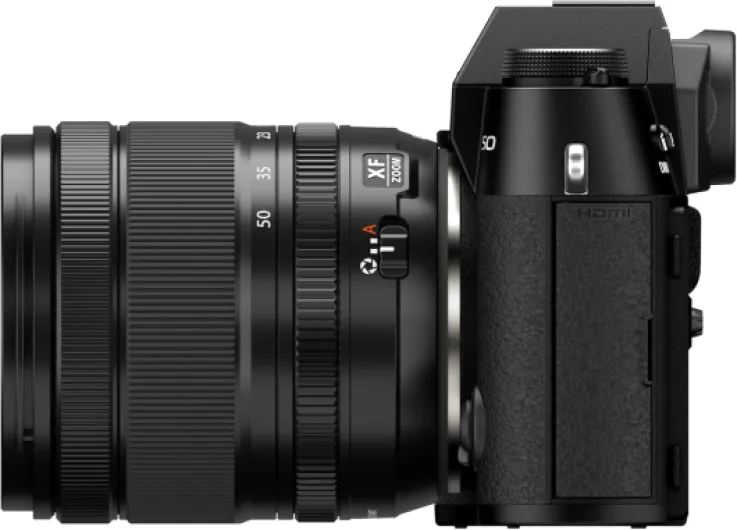
Actually shooting with it is another story. The grip is too small for my taste. My ring and little finger hang off the bottom, and with the 16-50mm zoomed out, I always felt like I had to over-squeeze the grip to feel safe. After about an hour of street shooting, my right hand felt a bit tense. I can see why one of the Amazon reviewers said you basically need a SmallRig plate and a hotshoe thumb rest. This doesn’t kill the camera for me, but it’s something you notice quickly if you’re coming from a slightly bigger body.
The controls are mostly comfortable. The dials have decent resistance, and I didn’t accidentally bump exposure comp or mode more than once or twice. The touchscreen is responsive, and tap-to-focus works fine, but I ended up using the joystick most of the time out of habit. Menu navigation is okay – not the cleanest in the world, but you can set up a My Menu and Q Menu to speed things up. If you’re used to Fujifilm, you’ll adapt fast; if you’re coming from Canon or Sony, you’ll need a couple of days to stop hunting for settings.
Overall, comfort is split: great to carry, average to hold. For casual shooting, travel, and people who value compactness over deep grip comfort, it’s fine. If you have large hands or shoot long sessions, just budget for a grip extension from day one. Once I mentally accepted that, handling became more tolerable, but out of the box the camera definitely feels like it prioritises “small” over “secure”.
Build quality & durability: solid enough, but doesn’t feel premium
Out of the box, the X-T50 feels light and a bit plasticky, especially if you’re used to heavier magnesium-alloy bodies. One Amazon reviewer said it feels cheap, and I kind of get what they mean. The top dials and buttons work fine, but there isn’t that reassuring heft you get from some higher-end bodies. It doesn’t feel like it’s going to fall apart, but it also doesn’t scream “tough camera” when you pick it up.
The lens, the XF 16-50mm f/2.8-4.8 R LM WR, is weather-resistant on paper, which is nice. The body itself, though, is not heavily marketed as fully weather-sealed like Fuji’s higher-end models. I used it in light drizzle and dusty streets without any issue, but I wouldn’t be super relaxed using it in heavy rain or very rough conditions. For normal travel, city, and home use, I think it’s perfectly fine; for hardcore outdoor abuse, I’d be more cautious.
The moving parts – screen hinge, dials, and buttons – all behaved well during my test. The tilting screen feels reasonably sturdy, with no wobble. The EVF eyecup stayed in place. Nothing rattled. So while the camera doesn’t give that brick-like feeling, in practice I didn’t run into any durability problems in normal use. Just keep in mind this is more of an everyday camera than a tool you’d want to drop or bash around regularly.
Long term, my only concern would be how the finish and buttons hold up after a couple of years of heavy use. Based on what I felt, it should be fine for an average hobbyist who takes care of their gear, keeps it in a bag, and doesn’t throw it around. If you’re rough on equipment or you work in harsh conditions, I’d probably look at something higher in Fuji’s lineup or add a cage for extra protection.
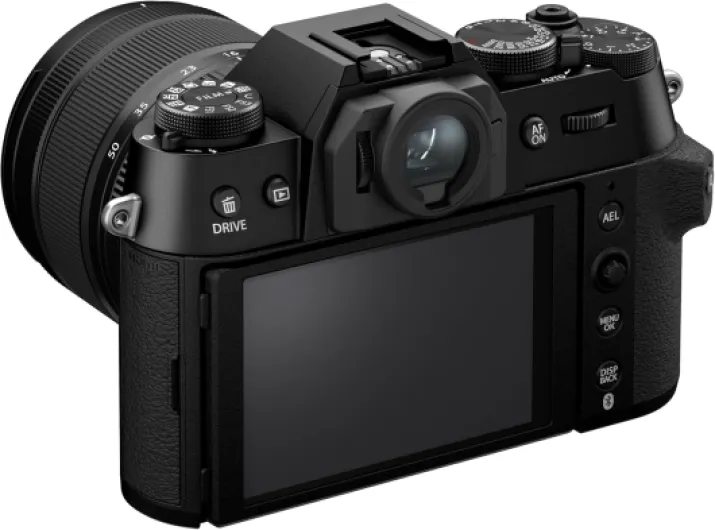
Image quality & autofocus: sharp files, decent AF, not a sports monster
The 40.2MP sensor is the star here. In good light, the files are very sharp, and you can crop a lot without them falling apart. With the 16-50mm, I got very usable shots across the range, especially from 16 to about 35mm. At 50mm, you lose a bit of bite compared to the wide end, but it’s still solid for a kit zoom. Detail in textures, bricks, foliage, and skin is clearly above older 24MP APS-C cameras I’ve used. If you print big or like to crop, this is where the X-T50 shines.
Low light performance is good for APS-C. I was comfortable shooting up to ISO 3200 without worrying too much. At 6400, there’s visible noise, but for social media or smaller prints it’s still fine. The dynamic range in RAW is useful: I could pull back highlights in skies and lift shadows in street scenes without the image breaking too quickly. The files are big, though, so if your computer is old, expect slower imports and edits.
Autofocus is good but not class-leading. Face and eye detection worked well for walking-around portraits and family shots, but it’s not as sticky or fast as the latest Sony or Canon systems I’ve tried. For kids running around or fast-moving subjects, I had a few more missed shots than I’d like. For normal travel, street, and everyday photography, it’s fine. The lens’ linear motor helps – focus is quiet and reasonably quick, and I didn’t notice major hunting except in very low light.
Continuous shooting up to 20 fps is nice on paper, but the buffer and AF tracking make it more of a casual action tool than a sports camera. If you’re into wildlife or fast sports, I’d look elsewhere. For me, as a general-purpose camera, the performance is pretty solid: great image quality, AF that gets the job done most of the time, and enough speed for typical hobby use. Just don’t expect miracles in very fast or chaotic situations.
What you actually get with the X-T50 + 16–50mm kit
The kit is straightforward: X-T50 body, XF 16-50mm f/2.8-4.8 R LM WR lens, battery, basic strap, charger via USB-C, and the usual paperwork. No external charger brick, no remote, nothing fancy. The lens mount is Fujifilm X, so you can add other XF lenses later. The body alone is around 438 g, and the kit together lands closer to the listed 678 g. In the hand, it feels light but not toy-like, somewhere between a compact and a small DSLR.
The sensor is a 40.2MP APS-C X-Trans CMOS 5 HR, with the X-Processor 5. That means big files, good dynamic range, and more detail than most people honestly need for Instagram or small prints. ISO goes from 64 to 51200 (expanded from 125 in practice), and you get in-body image stabilisation (IBIS) rated up to 7 stops. There’s a single SD slot (UHS-II), which is fine for casual and travel use but not ideal for paid gigs where you want backup recording.
On the video side, it shoots 6K, 4K, and 1080p, with HEVC and MOV options. Continuous shooting goes up to 20 fps, and autofocus uses 425 phase-detect points with eye and face detection. It’s not the fastest AF system on the market, especially compared to the latest Sony or Canon bodies, but for normal stills and casual video it held up fine in my use. You also get Wi‑Fi and Bluetooth for pairing with a phone, which is handy for quick sharing.
This kit feels aimed at people who want something more serious than a phone but less bulky than a full-frame DSLR. Skill level is labeled as “Amateur”, which is fair: the camera has manual controls and RAW/HEIF support, but the design and menus are friendly enough that someone upgrading from a phone or basic compact can get into it without reading a 300-page manual. Just keep in mind those 40MP files are big and will push an older laptop more than a 24MP body would.
Pros
- 40MP APS-C sensor with very detailed images and good dynamic range
- Compact and lightweight body with a versatile 16-50mm f/2.8-4.8 kit lens
- In-body image stabilisation that helps in low light and with non-stabilised lenses
Cons
- Small grip and light build make it less comfortable and less confidence-inspiring to hold
- Autofocus and IBIS performance are decent but behind some competitors, especially for fast action and video
- Battery life is average and basically requires at least one spare for full-day use
Conclusion
Editor's rating
The Fujifilm X-T50 with the XF 16-50mm is a compact, high-resolution camera that’s genuinely enjoyable for everyday photography, as long as you accept its quirks. The 40MP sensor, IBIS, and the 16-50mm zoom give you sharp, detailed images in a small package, and the film simulations make the JPEGs look good straight out of camera. For travel, street, and general family use, it’s a very capable setup that you’ll actually want to carry with you.
On the flip side, the body feels a bit too small and slightly plasticky, the grip isn’t great, and the autofocus, while decent, doesn’t match the best from Sony or Canon. Battery life is okay but not strong, and video is good for casual use but not ideal for long, serious shoots. If you mainly care about comfort, ruggedness, or top-tier AF, you might be happier with a slightly larger or different system.
I’d recommend this kit to people who want a light, everyday camera with high resolution and nice color, who shoot mostly photos with some casual video, and who don’t mind adding a grip or extra battery. If you’re into fast sports, heavy video work, or you’re very rough on your gear, I’d say skip this and look at more robust bodies or full-frame options. It’s a solid all-rounder for the right user, but it’s not the best at everything.