
Summary
Editor's rating
Value for money: where this lens really makes sense
Design and handling: light, plastic, and a bit quirky
Comfort and real-world use: the lens you actually carry
Durability and build: plastic, but not flimsy
Performance: great in daylight, struggles when the sun goes down
What you actually get in this kit
Pros
- Very light and compact for a 100–400mm, easy to carry all day
- Good sharpness and fast autofocus in daylight, especially on R7/R10
- Strong value for money compared to Canon’s L telephotos
Cons
- Slow variable aperture (f/5.6–8) limits low-light and evening sports
- Plastic build with no weather sealing, feels less robust for harsh conditions
- Zoom ring turns opposite to many other Canon zooms, takes time to adapt

Specifications
View full product page →| Brand | Canon |
A long lens that doesn’t kill your back (or your wallet)
I’ve been using the Canon RF 100-400mm f/5.6-8 IS USM on an R7 and occasionally an R6 for a mix of birding, kids’ sports and some casual wildlife. On paper, the specs don’t look very sexy: f/5.6–8, plastic build, no weather sealing. But after a few weeks of dragging it around parks, tracks and hiking trails, it grew on me a lot more than I expected.
The first thing that stood out is the weight. Coming from older EF telephotos and heavier zooms, this thing feels almost toy-like when you pick it up. I was honestly worried that meant cheap optics and soft images, but in daylight it delivers very sharp files, especially from 100–300mm. At 400mm, if you’re not pixel-peeping, it’s more than good enough for social media, prints, and family albums.
I mainly shot handheld, often at the long end, and the combo of lens IS and in-body stabilization on the R7 really helped. I was getting usable shots at 1/250s at 400mm, which I would not even try with older, heavier glass. The slow aperture does force you to push ISO once the sun starts going down, and you don’t get that strong background blur you’d get from a faster 70–200 or the L-series 100–400.
If you’re expecting a pro-level tank with weather sealing and bright glass, this isn’t it. But if you want reach, decent sharpness, and a lens you’ll actually carry all day without hating life, this RF 100–400 hits a nice middle ground. It’s not perfect, but for the price and weight, it’s a pretty solid everyday telephoto for hobby shooters.
Value for money: where this lens really makes sense
From a value perspective, this lens is pretty strong. You’re getting 100–400mm reach (or 160–640mm equivalent on APS-C) with image stabilization and decent sharpness in a very light package, at a price that’s far below Canon’s L telephotos. For parents, hobbyist birders, and travelers, that combination is hard to ignore. You’re basically trading build quality and aperture speed for portability and price, and for a lot of people that trade is fair.
Compared to something like a 70–200 f/4, you lose light and some background blur, but you gain a lot of reach. Compared to the RF 100–500 L, you obviously lose weather sealing, top-tier optics, and that extra 100mm, but you also keep a lot more money in your pocket and shave off some weight. If your main output is web, social media, and moderate prints, this lens is more than enough. You only really start to feel limited if you’re shooting in bad light a lot or if you’re very picky about bokeh and edge-to-edge sharpness.
The extras in this kit (UV filter and cap keeper) don’t radically change the value, they’re just small add-ons. I wouldn’t buy this kit specifically for the accessories; I’d buy it for the lens, and consider the rest minor bonuses. If you can find the lens standalone at a similar price, I’d be just as happy with that and maybe invest in a better quality filter separately.
So in plain terms: for daylight sports, wildlife, and general telephoto use on an R-series body, this is good value for money. It’s not the cheapest lens on earth, but for what it does and how easy it is to carry, I don’t feel like it’s overpriced. If you know you need strong low-light performance or pro-grade build, you’ll have to pay a lot more and carry more weight. If you just want reach without going broke, this hits a nice spot.
Design and handling: light, plastic, and a bit quirky
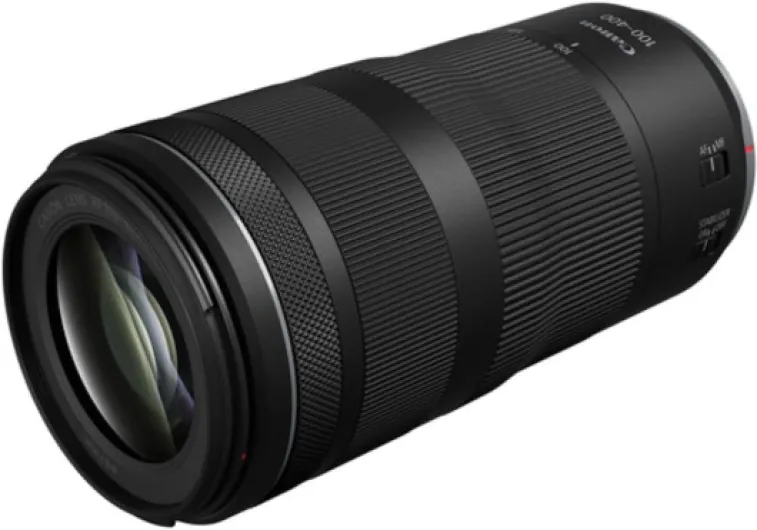
Design-wise, this lens is very clearly built for people who care more about weight and practicality than looking pro. The barrel is mostly plastic, the finish is the standard Canon RF non-L look, and there’s no red ring or metal tank feeling. That said, it doesn’t feel like a toy in the hand. The zoom ring is reasonably wide, the control ring is easy to find without looking, and the switches (AF/MF and stabilizer on/off) are where you’d expect them.
The thing that threw me off at first is the zoom direction. It turns the opposite way from most of my other lenses, including older EF zooms. More than once, especially when tracking birds or kids running, I twisted the ring the wrong way and lost my framing. After a week or so I started to adapt, but it’s still something I need to think about. On the plus side, the zoom action is smooth and there’s basically no zoom creep, even when walking with the camera hanging down. There is a 100mm lock, but I never really needed it.
In terms of size, it’s longer than a 70–200 f/4 when extended, but much lighter. It balances nicely on an R7 or R10; on an R5/R6 it still feels fine, just a bit more front-heavy but nothing crazy. There’s no tripod collar, which would be nice for long sessions on a monopod, but again, weight is low enough that it’s not a dealbreaker. The focus ring is electronic and pretty light to the touch, which is okay for occasional manual focus but not my favorite for precise work.
There’s no weather sealing gasket at the mount and no official weather resistance, so I treated it with more care than my L glass. I used it in light mist once and it survived, but I wouldn’t push it in steady rain or dusty environments. Overall, the design feels like a conscious compromise: light and user-friendly, but clearly not built for abuse or rough pro work. For casual shooters and hobbyists, it’s honestly a decent tradeoff.
Comfort and real-world use: the lens you actually carry
What I liked most about this lens isn’t some lab spec, it’s the fact that I actually bring it with me. My old EF 100–400 L and a full-frame DSLR were great, but I often left them at home because of the weight. With the RF 100–400 on an R7, I can walk around a park or trail for a few hours with the camera around my neck or on a sling strap and not feel wrecked at the end. For casual birding and family outings, that matters more than having the perfect bokeh or tank-like build.
The grip and balance on smaller RF bodies are good. On the R7, it feels like a well-matched combo: not front-heavy, easy to hold one-handed for short bursts, and light enough that you don’t constantly feel the need to rest it down. When tracking birds or runners, I could pan fairly smoothly without fighting the weight. For parents shooting their kids’ sports or travelers who want reach without a giant setup, this is a comfortable option.
One small annoyance is the reversed zoom direction, which I mentioned earlier. In fast action situations, that did cost me a few shots at first. But apart from that, the handling is simple: no complicated switches, no weird focus limiter modes to think about. Just zoom, half-press, and shoot. The Nano USM motor is nearly silent, so it also works fine for casual video where you don’t want to hear loud focusing noises.
If you’re used to big, heavy telephotos, this lens almost feels too light at first, like it can’t be any good because it doesn’t weigh a ton. But after a couple of long days out, that lightness becomes the main reason you keep choosing it. Comfort-wise, it’s not luxurious or fancy, but it’s practical, and that’s honestly the key selling point for me.
Durability and build: plastic, but not flimsy
Let’s be clear: this is not built like an L-series lens. There’s a lot of plastic, no weather sealing, and it doesn’t give that “I could hammer nails with this” feeling. That said, after tossing it in a backpack, carrying it on hikes, and using it at a few dusty fields, it’s held up fine. No loose rings, no weird rattles, and the zoom action still feels smooth. The mount is metal, so at least that part is solid where it connects to the camera.
I did baby it a bit more in bad weather. On a misty day, I used a cheap rain cover because I just don’t trust the lack of gasket at the mount. If you’re used to shooting in the rain with sealed lenses, this will feel like a step back. If you’re a casual shooter who mostly goes out in decent weather, it’s probably not a big deal. Just don’t expect it to tolerate repeated heavy rain, sandstorms, or constant beach spray without some risk.
The included UV filter can help a bit with front element protection, but again, it’s not some rugged pro accessory. I’d rather rely on a decent padded bag and basic common sense. The lens barrel doesn’t wobble when fully extended to 400mm, which is good. Some cheaper zooms get a bit of play at the long end; this one feels reasonably tight for the class. I didn’t notice any zoom creep either, which helps with long-term confidence that the internals aren’t too loose.
Overall, I’d describe durability as good enough for normal hobby use, but not something I’d trust for rough professional conditions day in and day out. If you’re careful with your gear and don’t treat your lenses like rental units, it should last. If you’re used to tossing cameras around on sidelines or in harsh environments, you’ll probably want something tougher.
Performance: great in daylight, struggles when the sun goes down
In good light, this lens performs way better than its f/5.6–8 spec suggests. On my R7, autofocus is quick and quiet, and it pairs well with Canon’s subject tracking. For birds sitting on branches, runners on a track, or kids playing soccer in the afternoon, it usually locks on and stays there. Image stabilization does its job: at 400mm I was getting sharp shots around 1/250s handheld, and with careful technique I could sometimes push it lower. For a lightweight telephoto, that’s pretty solid.
Sharpness is good across most of the range. From 100–300mm, I was pleasantly surprised: details on feathers, faces, and distant buildings looked crisp. At 400mm, you lose a bit of bite, but it’s still very usable. If you’re the type who zooms to 200% on a 32MP file and compares to an L lens, you’ll see the difference. But for normal use, printing, and online posting, it absolutely gets the job done. Chromatic aberration and fringing are controlled well enough that I didn’t stress over it, especially with in-camera corrections on.
Where the lens clearly shows its limits is in low light. Indoors, at dusk, or under stadium lights, that f/8 at the long end hurts. On the R7 I had to crank ISO pretty high to keep shutter speeds usable for sports, and even then autofocus started to hesitate and hunt more. For daytime track meets, the lens was great. For evening soccer under mediocre lights, I switched to a faster 70–200 because the 100–400 just couldn’t keep focus and exposure without noise going crazy.
I also tried it with a 2x teleconverter once on an R5 just to see, and honestly, that’s more of a fun experiment than a practical setup. You end up at f/11–16 and autofocus slows down a lot, so I wouldn’t buy this lens with the idea of permanently running it with a converter. Overall, performance is very solid in the conditions it’s designed for: outdoor, daylight, and subjects that aren’t in total shade. If you understand that and don’t expect miracles in low light, you’ll be pretty happy with what it delivers.
What you actually get in this kit
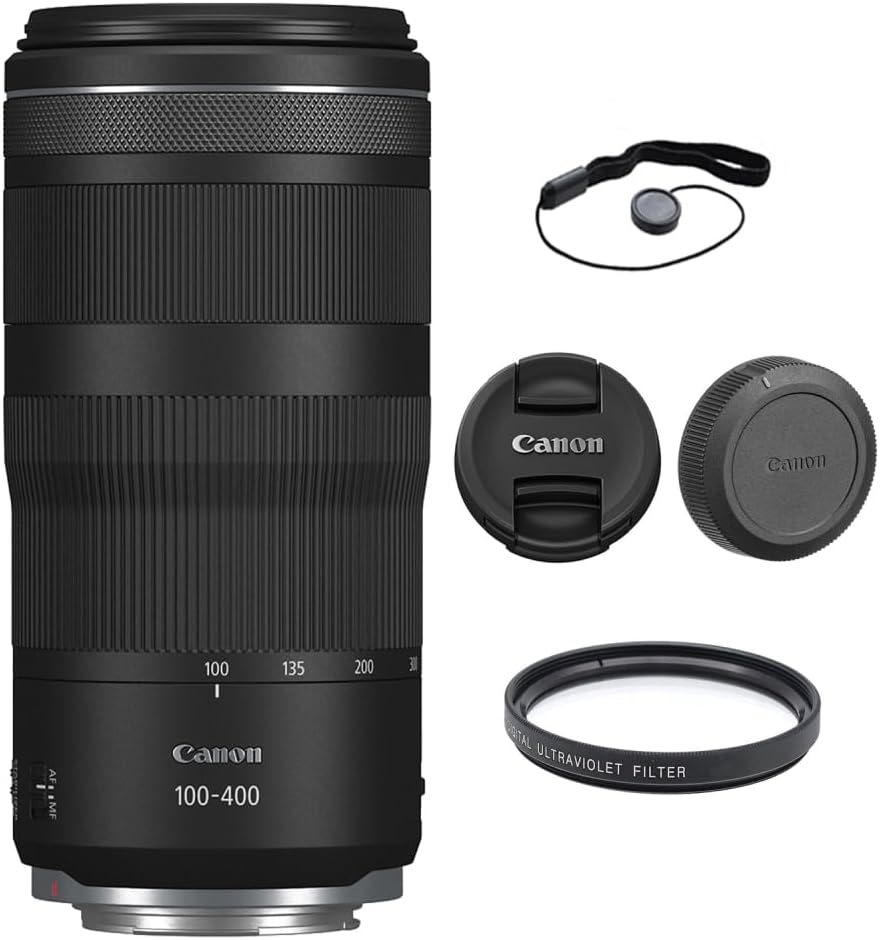
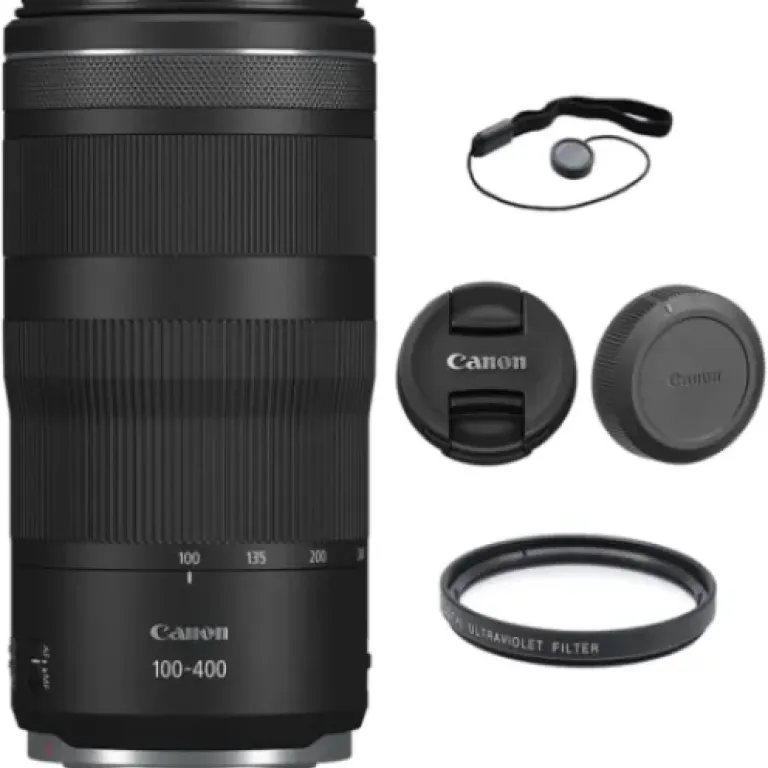
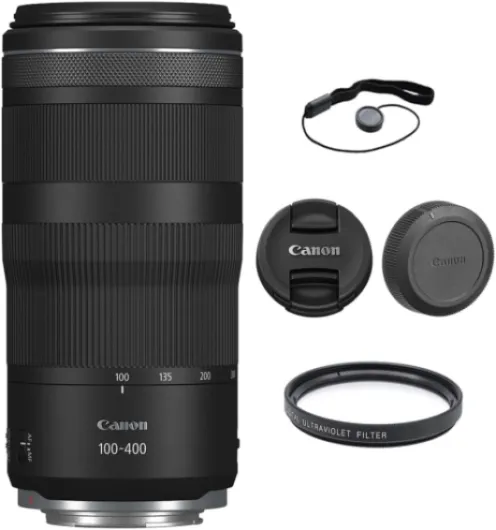
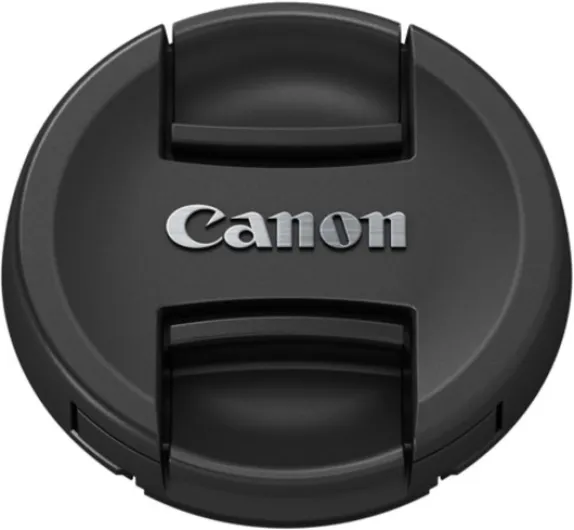
This specific bundle is basically the standard Canon RF 100–400mm f/5.6–8 IS USM lens plus a 67mm UV filter and a lens cap keeper. The lens itself comes with the usual Canon front cap (E-67 II), the rear RF cap, and the 1-year Canon warranty. Nothing fancy in the box: no hood, no pouch, no tripod collar. Just the basics. If you’re used to Canon L lenses, this feels a bit barebones, but at this price range it’s kind of expected.
The UV filter included is a generic 67mm piece. I wouldn’t call it bad, but it’s not some high-end multi-coated filter either. I used it for a bit, then took it off when shooting into the sun because I was worried about possible flare and contrast loss. For basic protection it’s fine, especially if you’re not super picky about image quality. The lens cap keeper is one of those cheap elastic things that sticks to the cap so you don’t lose it. It’s practical if you tend to drop caps, but I personally removed it pretty quickly because it annoyed me when swapping filters.
The core of the kit is obviously the lens. It’s an RF-mount, full-frame compatible telephoto zoom that goes from 100 to 400mm with a variable aperture (f/5.6 at the short end down to f/8 at 400mm). It has image stabilization, a Nano USM autofocus motor, and Canon’s usual control ring that you can customize. On an APS-C body like the R7 or R10, it gives you a field of view roughly equivalent to 160–640mm, which is great for wildlife and field sports.
So in practice, this bundle is decent if you want to start shooting right away without worrying about buying a filter separately. Just don’t buy it thinking the extras are high-end accessories. They’re more like small bonuses. The real value is in the lens itself, and that’s what I’ll focus on for the rest of the review.
Pros
- Very light and compact for a 100–400mm, easy to carry all day
- Good sharpness and fast autofocus in daylight, especially on R7/R10
- Strong value for money compared to Canon’s L telephotos
Cons
- Slow variable aperture (f/5.6–8) limits low-light and evening sports
- Plastic build with no weather sealing, feels less robust for harsh conditions
- Zoom ring turns opposite to many other Canon zooms, takes time to adapt
Conclusion
Editor's rating
After using the Canon RF 100–400mm f/5.6–8 IS USM in real situations—kids’ sports, birding walks, and general outdoor shooting—I’d sum it up like this: it’s a very practical telephoto for people who care more about reach, weight, and price than about having pro-grade build and bright apertures. In good light, the sharpness and autofocus are genuinely solid, and the stabilization makes handheld shooting at 400mm realistic, even if your technique isn’t perfect.
It’s not without flaws. The slow aperture limits you in low light, the all-plastic, non-sealed build doesn’t inspire huge confidence in bad weather, and the reversed zoom direction is annoying at first. But the main thing is that I actually took this lens with me instead of leaving it on a shelf. For hobby shooters, that matters more than chasing perfect specs. On an R7 or R10, it’s a very capable daylight sports and wildlife combo; on full-frame, it still does a good job if you accept the same light limitations.
If you’re a parent shooting outdoor games, a beginner getting into birding, or a traveler who wants reach without lugging a brick, this lens makes sense and offers good value. If you’re a pro who needs reliable performance in rain, under stadium lights, or for critical work, you’ll probably outgrow it and look at the L series. For most casual and enthusiast users though, it’s a pretty solid, no-nonsense telephoto that earns its place in the bag.