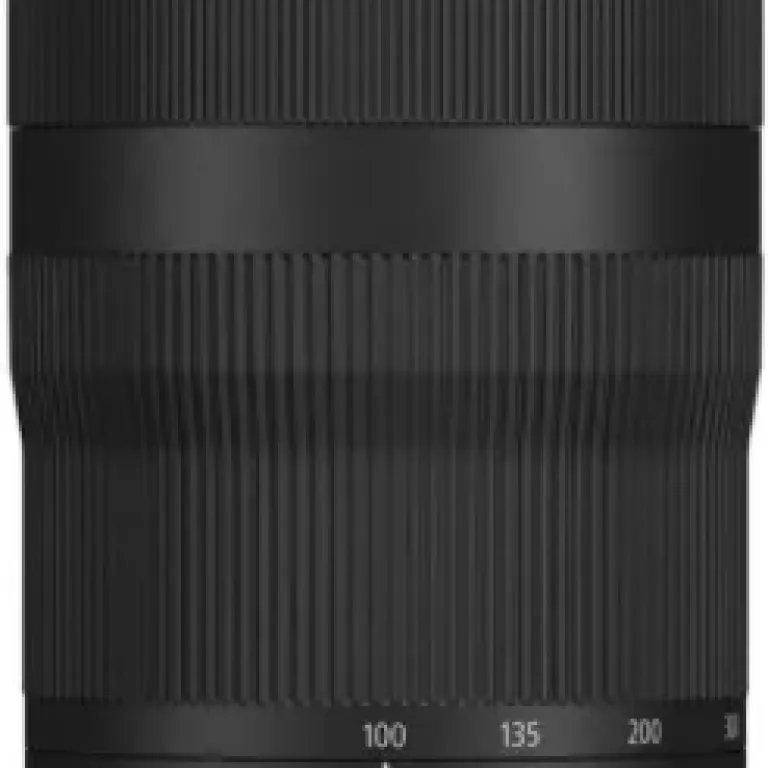

Summary
Editor's rating
Value for money: strong bang for the buck if you accept the trade-offs
Design and handling: light, plasticky, and slightly annoying zoom direction
Comfort and usability: the lens you actually carry all day
Durability and build: fine for normal use, not for rough weather
Performance: sharp in good light, struggles when the sun goes down
What this lens actually is (and what it isn’t)
Pros
- Lightweight and compact for a 100–400mm zoom, easy to carry all day
- Good sharpness and effective image stabilization in daylight use
- Affordable way to get long reach on RF bodies, especially APS-C (R7/R10)
Cons
- Slow maximum aperture (F8 at 400mm) makes low-light and night sports difficult
- Plastic build with no real weather sealing, not ideal for harsh conditions
- Zoom ring direction is reversed compared to many Canon lenses and takes getting used to

Specifications
View full product page →| Brand | Canon |
A budget wildlife lens that actually stays in your bag
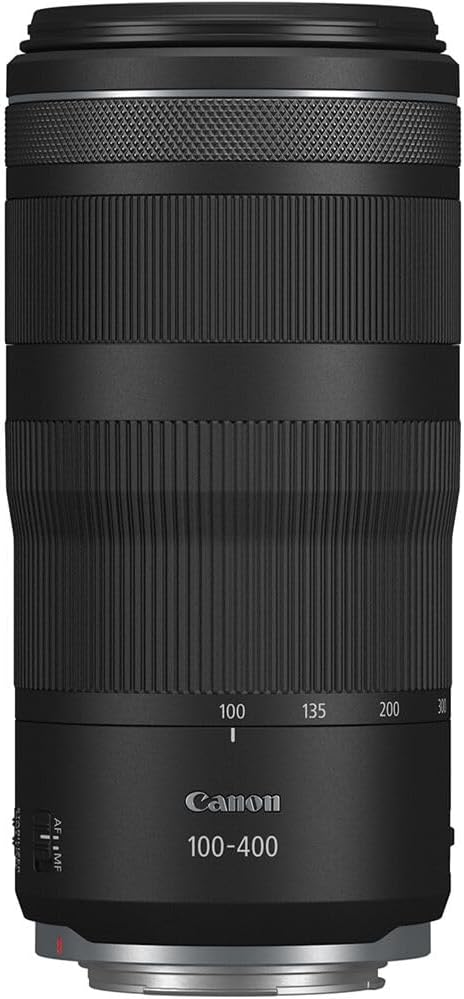
I’ve been using the Canon RF 100-400mm F5.6-8 IS USM for a while on an EOS R7 and briefly on an R5, mainly for birds, kids’ sports, and some travel shots. In short, it’s a long lens that doesn’t break your back or your bank, but you do pay the price in low-light performance and build quality. If you’re coming from heavy EF telephotos, this thing feels almost toy-like in the hand, in a good and bad way.
What pushed me to try it was simple: I wanted reach beyond 200mm without dragging around a big white L lens or spending four figures. The reviews on Amazon are mostly positive, and I’d agree with the 4.6/5 vibe: it’s pretty solid for what it is, but not some miracle lens. You just have to be honest about when and how you’ll use it.
After a couple of weekends of birding and a few high-school track and soccer sessions, the pattern is clear: in daylight, the lens performs much better than I expected for the price and size. In dusk or bad indoor light, you immediately feel the F8 at the long end. If you’re hoping to shoot night sports at 400mm with this, you’ll be frustrated.
If you think of it as a light, affordable way to get to 400mm (or even 800mm with a teleconverter) for outdoor use, it gets the job done and can produce very sharp files. If you expect pro-level speed, weather sealing, and clean low-light performance, you’re looking at the wrong lens line. It’s that simple.
Value for money: strong bang for the buck if you accept the trade-offs
From a value perspective, the RF 100-400mm F5.6-8 IS USM is hard to argue with if you’re on RF and need reach. New, it’s priced well below Canon’s L telephotos, and it regularly goes on sale or in bundles. For what you pay, you get solid sharpness, useful stabilization, decent autofocus, and a focal range that covers most casual wildlife and field sports needs. That’s why it sits high in the mirrorless lens best-seller lists and has a 4.6/5 rating on Amazon – it hits that sweet spot for many people.
The main compromises you’re paying for are: slow aperture (F8 at the long end), plastic build, lack of weather sealing, and no included hood/tripod collar. If you’re mostly shooting daylight and you don’t abuse your gear, those downsides aren’t deal-breakers. But if you regularly shoot night games, indoor events, or in rough weather, you’ll quickly run into the limits and might end up buying a faster, pricier lens anyway.
Compared to alternatives, there isn’t much at this exact price and weight on RF yet. The step up is usually a 70-200 F4 or an RF 100-500L, which are way more expensive and heavier. So for many hobbyists, this lens is good value for money: it fills the long end without forcing you into pro-level investment. If you already own a fast telephoto and just want something lighter for travel or hiking, it also makes sense as a secondary lens.
So I’d put it this way: if your budget is limited and your main use is outdoor, daytime shooting, the value is strong. If you’re already thinking about shooting serious low-light sports or you expect heavy weather resistance, you’re better off saving longer for something higher-end, because this lens won’t magically do those jobs well.
Design and handling: light, plasticky, and slightly annoying zoom direction
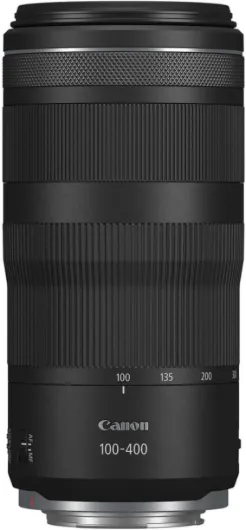
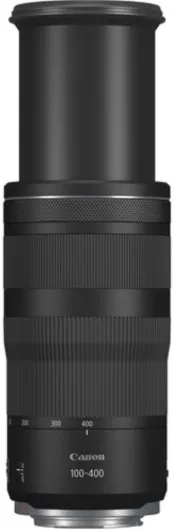
Design-wise, the first thing you notice is the weight. On an R7 or R10, the combo feels very manageable, even for long hikes or all-day events. Compared to my old EF 100-400mm L on a DSLR, this setup feels like half the burden on the neck. The lens is about 6.5 inches long retracted and extends as you zoom to 400mm. It’s not tiny, but for 400mm reach, it’s pretty compact and doesn’t scream “huge pro lens” everywhere you go.
The build is mostly plastic, including the barrel, with a metal mount. It doesn’t feel cheap in the sense of rattling or flexing, but it also doesn’t give you that tank-like feel of Canon’s L lenses. There’s no real weather sealing, which is a bit annoying if you’re often out in mist, light rain, or dusty environments. Personally, I’m cautious: I avoid shooting in obvious rain with it and keep a cheap rain cover in my bag just in case. For the price, I get why Canon skipped the sealing, but I’d have happily paid a bit more to have at least basic protection.
One small but real gripe: the zoom ring turns the opposite way compared to a lot of Canon EF zooms and many third-party lenses. You do get used to it, but for the first few outings, I kept twisting the ring the wrong way when trying to quickly zoom in on a bird. The zoom action itself is smooth, and there’s a lock at 100mm, though zoom creep hasn’t been an issue for me so far. The control ring is handy if you like assigning ISO or exposure compensation to the lens, and the focus ring is light but usable for manual tweaks.
Overall, the design is focused on portability and practicality over toughness. It’s the kind of lens you’re not scared to toss in a bag or carry all day. Just don’t expect to bang it around in heavy rain or sand storms like you might with an L lens. If you baby your gear a bit and mostly shoot in normal outdoor conditions, the design gets the job done without drama.
Comfort and usability: the lens you actually carry all day
For comfort, this lens is one of the main reasons to buy it. At around 1.8 lb, it’s light enough that I can walk with it on an R7 around my neck or on a strap for a couple of hours without feeling destroyed. Compared to my old 6D with the EF 100-400L, this combo feels almost casual. For hiking, birding, or walking around a sports field, that matters more than people think. A heavy lens you leave at home is useless; this one actually comes with you.
Balance on smaller bodies like the R10 is okay, though it does start to feel a bit front-heavy when fully zoomed to 400mm. On the R7 or R6, it feels more natural in the hand. The zoom ring has enough resistance that you don’t get zoom creep, and the throw from 100 to 400 isn’t too long, so you can quickly go from a wider field to tight framing. After a short learning curve with the reversed zoom direction, you can operate it without thinking too much.
Another comfort point is noise and distraction. The AF is very quiet, which is nice for wildlife or shooting kids’ events where you don’t want mechanical clacking drawing attention. The lens length at 400mm is noticeable but not intimidating like a huge white telephoto; people don’t stare as much, which I personally like at school events. There’s no tripod collar included, but given the weight, I didn’t really miss it for normal use. For long static sessions (like birds at a feeder), I sometimes mount the camera on a monopod and it’s fine even without a collar.
In day-to-day use, I’d say comfort is one of the strongest points of this lens. You give up some low-light performance and toughness, but in exchange you get a telephoto that doesn’t punish your shoulders and that you actually bring along. If your main use is casual wildlife, travel, or daytime sports, the comfort factor alone makes it a very practical tool.
Durability and build: fine for normal use, not for rough weather
On durability, this is where you clearly see that it’s not an L lens. The barrel is plastic, the switches feel decent but not premium, and there’s no real mention of weather sealing. After normal use – some hikes, dusty fields, a bit of sea air – mine is holding up fine. No wobble, no odd noises, and the zoom is still smooth. So for regular hobby use and some travel, I’m not worried about it falling apart anytime soon.
That said, I’m careful with it in bad conditions. I don’t shoot in rain with this lens unless I have a simple rain cover. I also avoid changing focal length in heavy dust or sand. With an L lens, I’d be more relaxed; with this, I treat it like mid-range electronics, not a rugged tool. The plastic does have one upside: if you accidentally bump it, it feels like it might flex a bit instead of denting like metal, and it also keeps the weight down, which reduces the strain on the mount over time.
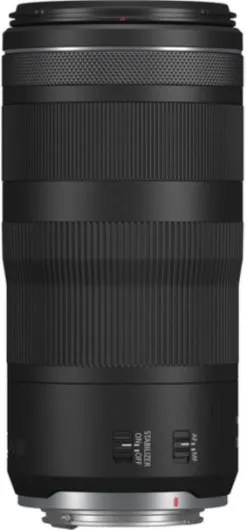
The mount itself is metal and feels solid when attaching and detaching. After repeated mounting on two bodies, I haven’t noticed any play. The switches (AF/MF, stabilizer) haven’t given me trouble either. But again, this is based on normal hobby use, not daily pro abuse in rain, snow, and sand. I wouldn’t pick this lens if I were a full-time sports or wildlife pro working in tough environments week after week.
Overall, durability is decent but nothing more. Treat it reasonably, don’t dunk it in rain, don’t throw it around, and it should last you years. If you want something you can absolutely thrash in any condition, you’re in the wrong price bracket and should look at Canon’s L telephotos instead.
Performance: sharp in good light, struggles when the sun goes down
In terms of image quality, the lens is sharper than I expected for something in this price and weight class. At 100–300mm, center sharpness is very good on both APS-C and full-frame, and 400mm is still solid if you don’t expect clinical perfection at pixel level. For wildlife and sports, it’s more than enough, and the files hold up nicely to a bit of cropping, especially on the R7. Chromatic aberration is well controlled most of the time, thanks to that single UD element, and I didn’t run into any ugly color fringing that ruined shots.
Autofocus with the Nano USM motor is quick and quiet. On the R7, subject tracking for birds and kids running on a track worked well in daylight. The lens keeps up with bursts and doesn’t hunt much when there’s enough contrast. On the R5, I did notice that in lower light it starts to feel slower and sometimes hunts, especially past 300mm. It’s not unusable, but if you’re used to fast L glass, you feel the difference right away. The slow maximum aperture doesn’t help the AF system, and you see that at dusk or under weaker artificial lights.
Where this lens clearly shows its limits is low light and indoor sports. At 400mm and F8, you’re forced to push ISO pretty high or drop shutter speed lower than ideal. For daytime soccer, track, birds in decent light – it’s fine, and you can get nice, crisp results. Try night football or indoor gym sports and the combo of small aperture and slower AF becomes painful. This is why a lot of people pair it with something like a 70-200 F4 or F2.8 for evening games and keep the 100-400 for daytime.
The image stabilization is genuinely useful. I’ve managed sharp shots at 400mm around 1/125–1/250s handheld when I’m careful, which is pretty good for a lens this long. For static subjects like distant mountains or perched birds, it’s a big help. For fast-moving subjects, you still need a decent shutter speed, so don’t expect IS to fix motion blur from a sprinting kid or flying bird. Overall, performance is very respectable in good light and clearly budget-level in bad light. You just need to know which situations suit it.
What this lens actually is (and what it isn’t)
The Canon RF 100-400mm F5.6-8 IS USM is a compact telephoto zoom for Canon’s RF mount (so EOS R, RP, R7, R10, R5, R6, etc.). On full-frame it’s a straight 100–400mm. On APS-C bodies like the R7 and R10, you’re effectively looking at a 160–640mm field of view, which is pretty handy for wildlife and field sports. The max aperture is F5.6 at 100mm and slides all the way to F8 at 400mm, so it’s a slow lens on paper.
Canon gave it optical image stabilization rated to about 5.5 stops, and up to 6 stops if your camera has IBIS. In real life, that means I can shoot at 400mm around 1/250s handheld on an R7 and still get plenty of sharp shots, even with my not-so-steady hands. Autofocus uses Canon’s Nano USM, which is quick and quiet. It also works with Canon’s RF 1.4x and 2x teleconverters if you really want to push it out to 560mm or 800mm equivalent focal length (though at that point your aperture becomes very small).
The lens weighs about 1.8 lb (around 635–650 g) and is roughly the size of an old EF 70–300mm zoom, just a bit longer at full extension. It’s mostly plastic, with no real weather sealing, and that’s clearly where Canon saved cost and weight. You don’t get an included tripod collar or lens hood in the box, so factor that in if you’re used to Canon’s L lenses where that stuff comes standard.
So in practice, this is not a premium L lens. It’s a budget-friendly, long-reach zoom for people who value light weight and decent performance over rugged build and wide apertures. If you walk in with that expectation, it makes sense. If you’re expecting it to replace a 100-400L or 70-200 F2.8 for serious pro work in all conditions, you’ll be disappointed pretty fast.
Pros
- Lightweight and compact for a 100–400mm zoom, easy to carry all day
- Good sharpness and effective image stabilization in daylight use
- Affordable way to get long reach on RF bodies, especially APS-C (R7/R10)
Cons
- Slow maximum aperture (F8 at 400mm) makes low-light and night sports difficult
- Plastic build with no real weather sealing, not ideal for harsh conditions
- Zoom ring direction is reversed compared to many Canon lenses and takes getting used to
Conclusion
Editor's rating
The Canon RF 100-400mm F5.6-8 IS USM is a practical telephoto zoom for RF shooters who care more about reach, weight, and price than about speed and tank-like build. In good daylight, it delivers sharp, usable images for wildlife, birds, daytime sports, and travel. Autofocus is quick enough for most hobby use, and the image stabilization lets you handhold at 400mm without feeling like you’re gambling every shot. The light weight means it’s a lens you actually carry, not one that sits at home because it’s too heavy.
On the flip side, the slow maximum aperture and lack of weather sealing are real limits. Once the light drops – dusk soccer games, indoor practices, dim forests – you start to fight high ISO, slower shutter speeds, and less confident autofocus. If you expect it to replace a 70-200 F2.8 or a 100-400L in tough conditions, you’ll be disappointed. But if you’re honest about your use case – mostly outdoor daytime shooting on a hobby budget – it’s a very sensible choice.
I’d recommend this lens to: Canon R7/R10 owners wanting a light birding and sports lens, travel shooters who want long reach without a huge lens, and anyone building an RF kit on a moderate budget. People who should probably skip it: those who mainly shoot evenings, indoor sports, or in harsh weather, and pros who need rugged gear and fast apertures. For the right user, it’s a pretty solid, good-value workhorse that does its job without drama.