Summary
Analysis score
Average of the criteria rated below
Value for money: what you really get for the price
Design, controls, and that 360° mode dial
Battery life, charging stand, and everyday practicality
Build quality, long‑term prospects, and reliability signals
Image quality, autofocus, and real‑world performance potential
What this 8K dual‑lens camera actually offers
Pros
- Very complete kit: 32 GB card, two batteries, cradle charger, bag, lens hood, and cables included
- Dual‑lens design with selfie/front lens and 3.2-inch IPS touchscreen suited for vlogging and content creation
- Good ease of use and generally positive buyer feedback on image quality in good light for the price
Cons
- Small 1/4‑inch sensor, digital zoom only, and heavy interpolation behind the 8K/88 MP claims
- Uses AVI video format instead of more modern, efficient codecs like MP4/H.264
- Not designed for rugged use or serious low‑light and professional work compared to mirrorless/DSLR alternatives

Specifications
View full product page →| Brand | XNSIAKXA |
An 8K "pro" camera at a budget price: realistic or overhyped?
The XNSIAKXA DC226 is one of those cameras that immediately raises an eyebrow: 8K video, 88 MP photos, dual lenses, Wi‑Fi, touchscreen, 6‑axis stabilization, and a whole bag of accessories, all from a little‑known brand and clearly aimed at beginners and content creators. On paper, it promises a lot more than typical point‑and‑shoots in this price range. The Amazon rating sits around 4.2/5 from roughly 950 reviews, which suggests buyers are mostly satisfied, at least for the intended use.
From the description and comments, this is clearly not a camera trying to compete with big DSLR or mirrorless systems from Canon, Sony, or Nikon. It’s more of an “upgrade from a smartphone” tool for vlogging, casual photography, and social media content. The fixed lens with only digital zoom, the small 1/4‑inch sensor, and AVI video format all show that we’re in the compact, entry‑level world, even if the marketing pushes the 8K and 88 MP numbers hard.
Several buyers highlight that the DC226 is easy to use, lightweight, and ready to shoot thanks to the included 32 GB card, two batteries, lens hood, bag, and cables. The general tone of positive reviews is that it “does the job” for everyday videos and photos, especially in good light, and that it’s a decent choice to start creating content without learning a complex camera system. That matches the feature set: touchscreen, Wi‑Fi transfer, selfie lens, and webcam mode.
In my opinion, the real question is not whether it can shoot 8K or 88 MP in a technical sense, but whether the overall experience (autofocus, low light, stabilization, file format, ergonomics) holds up for the price. There are clear strengths on the spec sheet and in the comments, but also some compromises that appear once you look closer: tiny sensor, digital stabilization only, AVI format, and no optical zoom. This analysis goes through those points one by one to see who this camera actually suits.
Value for money: what you really get for the price
Even though the exact price isn’t mentioned here, the DC226 clearly sits in the budget to lower mid‑range segment for digital cameras. For that kind of money, the spec sheet is packed: 8K video, 88 MP photos (even if interpolated), dual lenses, 3.2‑inch touchscreen, Wi‑Fi, 6‑axis digital stabilization, and a full bundle of accessories including a 32 GB card, two batteries, cradle charger, bag, lens hood, and cables. You rarely see that many extras from major brands at similar prices.
The user reviews are generally positive. Many buyers say the image quality is good for the price, with sharp photos and decent color in well‑lit scenes. Several highlight that it’s a good starter camera for beginners, teens, or students who want more control and a more “camera‑like” feel than their phone. People also appreciate the Wi‑Fi transfer to smartphone and the simple interface. That’s exactly the kind of feedback you want to see if you’re judging value: the product seems to meet or slightly exceed the expectations of its target audience.
On the other hand, there are clear trade‑offs behind the marketing. The 1/4‑inch sensor is tiny compared to even cheap APS‑C or Micro 4/3 cameras, which limits low‑light performance and dynamic range. The absence of optical zoom and reliance on 16x digital zoom means that zoomed images will lose detail. And the use of AVI video format is dated and less efficient than MP4, which can be annoying for editing and storage. The 8K and 88 MP labels are very likely achieved through heavy processing rather than native capture, so expecting true pro‑grade 8K quality would be unrealistic.
In my opinion, the value is good if you see this as a step up from a basic phone camera, not as a rival to mirrorless or DSLR gear. For someone who wants to start YouTube, TikTok, or casual photography with a dedicated camera, a flip‑style touchscreen, selfie lens, and Wi‑Fi, it’s a compelling package. For a hobbyist who is ready to learn about lenses, RAW files, serious low‑light work, and long‑term system growth, saving up for a used body from a major brand might be smarter. Here, you are paying for convenience and a complete kit, more than for deep image quality potential.
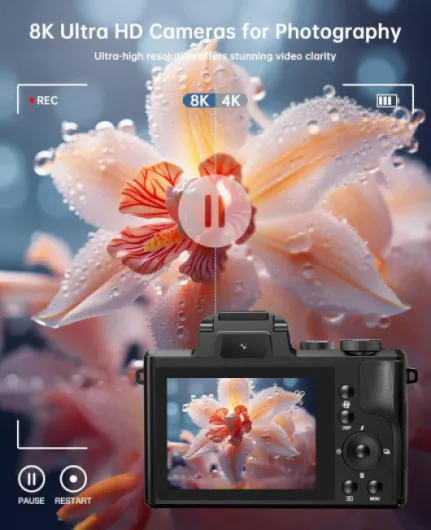
Design, controls, and that 360° mode dial
On the design side, the DC226 goes for a compact, travel‑friendly form factor. It weighs around 1.02 kg according to the sheet, which sounds quite high for a compact camera and is probably the boxed weight rather than the bare body; several reviews describe it as lightweight and easy to carry. The main visual points are the dual‑lens layout (front and rear lenses for normal shooting and selfies/vlogging) and the 3.2-inch IPS touchscreen on the back, which flips usage toward a smartphone‑like experience for framing and menu navigation.
One specific design feature highlighted by the brand is the 360° rotary dial for modes: Timelapse Video, Filter, Portrait, Scene, Slow Motion, Landscape, Auto, Program, etc. For beginners, a physical dial is usually more intuitive than digging through menus. Comments from buyers often say the camera is easy to use and quick to grasp, which fits with this layout: simple dial, touchscreen, and basic buttons. The presence of a built‑in LED flash with automatic and fill‑flash modes adds to the all‑purpose design for indoor or low‑light snapshots.
The camera comes with a lens hood and lens cap, which is uncommon at this price level and gives at least some protection from flare and bumps. There’s also a neck strap and camera bag, so the whole kit is designed for people who want a ready‑to‑go setup for travel and everyday use. The connectivity side is covered with one USB port and one HDMI port, making it usable as a webcam or for playback on a TV/monitor.
In my opinion, the design logic is clear: simple, “grab and shoot”, social‑media focused. The dual‑lens layout is a nice idea for vlogging and selfies, especially combined with the touch screen. The downside on paper is that the body does not seem to offer any weather sealing or serious ruggedness, and the controls look fairly basic compared to more advanced cameras. For users who want a straightforward camera to learn framing and basic settings, that’s fine. For those expecting a robust tool for intensive or outdoor professional work, the DC226 looks more like an entry‑level toy than a workhorse.
Battery life, charging stand, and everyday practicality
The DC226 comes with two lithium‑ion batteries, each with an advertised average life of about 150 minutes. On paper, that means up to around 5 hours of use if you rotate both batteries, though real‑world recording at high resolution usually shortens those numbers. Still, for an entry‑level camera, including a second battery in the box is already a strong advantage compared to many budget devices that ship with only one.
A notable element is the presence of a cradle charger / charging stand. Instead of charging only through the camera body via USB, you can place the batteries in the stand and charge them externally. That’s practical if you’re shooting while the second battery charges, or if you want to keep the camera free for use near a power outlet. Several reviews point out that having the two batteries and the charger included makes the camera more usable for longer recording sessions or travel, without immediately having to buy extra accessories.
The battery weight is given as 27.6 grams per cell, which is in the normal range for small camera batteries. There’s no explicit indication of milliamp‑hour capacity, but given the claimed 150‑minute average life and the camera’s compact size, it likely runs somewhere in the typical 800–1200 mAh range for this class. Combined with the Wi‑Fi function, touchscreen, and 8K recording, actual autonomy will depend a lot on how you use the camera: heavy Wi‑Fi transfers, continuous 8K recording, and maximum screen brightness will drain faster.
In my opinion, the overall battery proposition is a plus for this product. The presence of two batteries and a dedicated charger offsets any modest individual battery capacity. For casual users filming a few clips and taking photos throughout the day, this setup should be comfortable. For intensive shooting (for example, long live streams or extended vlogs in 8K), you should expect to manage power more carefully, possibly by lowering resolution or keeping spares. But compared to many entry‑level cameras that cut corners on power accessories, the DC226 looks fairly generous here.
Build quality, long‑term prospects, and reliability signals
The DC226 is built around a compact plastic body with a 1/4‑inch CMOS sensor and a fixed lens. There is no mention of metal chassis, weather sealing, or shock protection, so it’s reasonable to consider it a standard consumer‑grade device, not something designed for heavy professional abuse. The included lens hood, lens cap, and camera bag at least provide some protection for the lens and body during transport, which is useful for travel and casual outdoor shooting.
Among the Amazon comments, the recurring theme is that the camera feels lightweight but reasonably solid for the price. Buyers use it for everyday photos, social media content, and trips, and there are no widespread complaints about it falling apart quickly in normal use. The average rating of 4.2/5 across about 950 reviews also suggests that catastrophic reliability issues are not common, otherwise the rating would likely be lower. That said, with this kind of off‑brand, budget electronics, long‑term reliability (several years) is always a question mark, simply because there is less track record than with major manufacturers.
The brand advertises a 12‑month “hassle‑free” refund and replacement and 24‑hour customer service. For an inexpensive camera, that’s reassuring, especially if something fails early like a dead pixel cluster, lens issue, or battery defect. It doesn’t magically turn the camera into a rugged tool, but it reduces the risk of being stuck with a dead unit shortly after purchase. Accessories like the neck strap and bag can also help avoid drops and scratches, which are common sources of damage.
In my opinion, durability is acceptable but not exceptional here. The camera looks suited for normal casual use: home, travel, school projects, and basic content creation. It is not the device you’d choose for harsh environments, professional event coverage, or intensive daily studio work. Users who treat their electronics with basic care should be fine, especially within the first year backed by the warranty. Those who know they are rough on gear or need something to survive bad weather and frequent transport would be better off with a more established brand and a body explicitly designed for toughness.
Image quality, autofocus, and real‑world performance potential
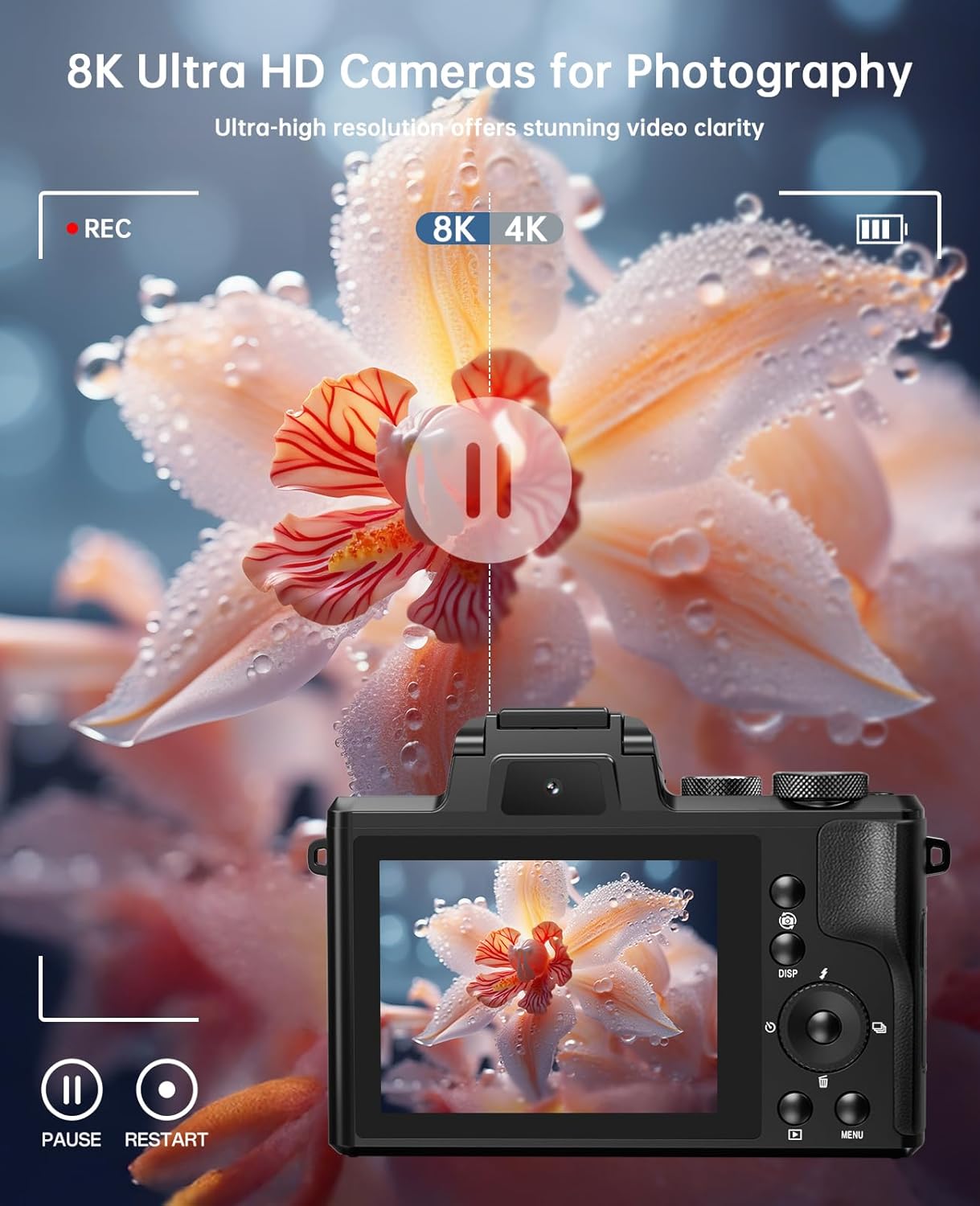
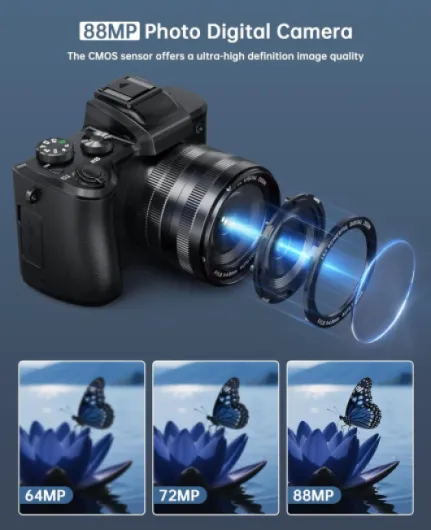
The spec sheet for the DC226 heavily pushes 88 MP stills and 8K video. Technically, the photo sensor resolution is listed as 88.02 MP with 12‑bit depth, but there’s also a mention of a 12 MP photosensitive chip. That strongly suggests that the native sensor resolution is much lower than 88 MP and that the high number comes from interpolation or upscaling. On a 1/4‑inch CMOS sensor, cramming a true 88 MP would not make much sense anyway: it would hurt dynamic range and low‑light performance. So, on paper, the resolution marketing is likely exaggerated, and the real quality will depend more on processing than on raw megapixels.
Despite that, many buyers say in their reviews that photos are sharp with good color in good light and that videos look clear for everyday use, vlogging, and social media. A few even mention a slightly “vintage” look to the images, which they find pleasant. That lines up with what you’d expect: in daylight, a small sensor and fixed lens can produce decent, social‑media‑ready results, especially if the camera applies strong sharpening and contrast. In low light, the ISO range up to 6400 and the LED flash help, but with such a small sensor and digital stabilization, there will reasonably be noise and limited dynamic range.
The autofocus system is advertised as hybrid, with phase detection, contrast detection, face detection, and eye detection. Buyers often mention that the autofocus feels fast enough for casual use, and that half‑pressing the shutter to lock focus works well for them. For a camera in this category, that’s a strong point: if the AF reliably locks onto faces for vlogs and portraits, it will satisfy the target audience. The camera also offers continuous shooting (3 shots), slow motion, and time‑lapse, which are nice creative tools, even if the implementation is likely basic.
In my opinion, the performance here is good for beginners and casual creators, but not more than that. The 8K and 88 MP labels should be taken as marketing rather than a guarantee of pro‑level quality. The AVI video format is old and not as efficient as modern codecs like MP4/H.264 or H.265, which means larger files and potentially less compatibility. The digital 6‑axis stabilization will help smooth light walking or handheld shots, but it is no match for optical stabilization or gimbals. For TikTok, YouTube, Instagram, and family videos, the camera seems capable. For serious filmmaking, low‑light work, or heavy editing workflows, there are better tools.
What this 8K dual‑lens camera actually offers
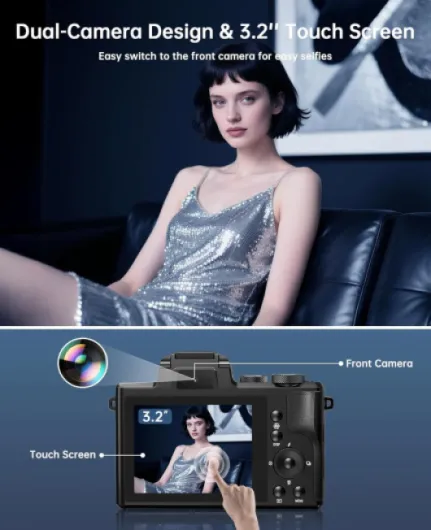
The XNSIAKXA DC226 positions itself as a compact vlogging and photography camera with a focus on resolution and convenience. The headline specs are eye‑catching: 8K UHD (4320p) video and an 88 MP photo sensor resolution, backed by autofocus with phase, contrast, face, and eye detection. It also features 6‑axis digital stabilization, a 3.2-inch IPS touchscreen, and built‑in Wi‑Fi for transferring files to phones via the iSmart DV2 app.
The camera uses a fixed lens with 16x digital zoom and an aperture around f/2.8 according to the sheet. There is no optical zoom and no interchangeable lens mount. This makes it closer to a classic point‑and‑shoot, but with modern extras: selfie lens on the front, webcam mode, time‑lapse, slow motion, continuous shooting, smile/face detection, and various scene modes (Portrait, Landscape, Auto, Program, etc.). The ISO range is 100–6400, and files are saved as JPG for photos and AVI for video.
One strong selling point is the all‑in‑one package. You get the camera, a 32 GB TF card, two lithium batteries, a charging stand/cradle, USB and HDMI cables, lens hood, lens cap, neck strap, cleaning cloth, adapter, and a camera bag. Many buyers mention that you can start shooting right away without buying extras, which is attractive for beginners or as a gift. The brand also advertises 24‑hour customer service and a 12‑month refund/replacement promise.
In my opinion, the DC226 is clearly built as a starter tool for content creators, students, and casual users who want something more camera‑like than a phone, but without the complexity and cost of a mirrorless system. The spec sheet looks ambitious for the category, but you have to keep in mind the 1/4‑inch sensor size, digital zoom, and AVI format: this is a budget compact with boosted resolution numbers and convenience features, not a professional production camera despite the “professional” wording in the listing.
Pros
- Very complete kit: 32 GB card, two batteries, cradle charger, bag, lens hood, and cables included
- Dual‑lens design with selfie/front lens and 3.2-inch IPS touchscreen suited for vlogging and content creation
- Good ease of use and generally positive buyer feedback on image quality in good light for the price
Cons
- Small 1/4‑inch sensor, digital zoom only, and heavy interpolation behind the 8K/88 MP claims
- Uses AVI video format instead of more modern, efficient codecs like MP4/H.264
- Not designed for rugged use or serious low‑light and professional work compared to mirrorless/DSLR alternatives
Conclusion
Analysis score
The XNSIAKXA DC226 is a feature‑loaded budget camera aimed squarely at beginners, teens, and casual content creators. The real strengths are practical: dual lenses for normal shots and selfies, a large touchscreen, Wi‑Fi transfer, two batteries with a cradle charger, and a full accessory kit including a 32 GB card and bag. The Amazon rating around 4.2/5 with many verified purchases praising ease of use and decent photo/video quality suggests it generally delivers what this audience expects.
On the flip side, the tiny 1/4‑inch sensor, digital zoom only, and AVI format clearly place it below even entry‑level mirrorless cameras in terms of pure image quality and workflow. The 8K and 88 MP marketing numbers should be treated as interpolation rather than a promise of pro‑tier output. In my opinion, this camera makes sense if you want a simple, all‑in‑one package to start vlogging or learning photography basics without spending much, and if your main destinations are YouTube, TikTok, and social media. Users who care about low‑light performance, color grading, lens options, and long‑term system growth should look at more established camera systems instead.