
Summary
Editor's rating
Is It Worth the Money?
Design and Build Quality
Performance in Real-World Use
Pros
- Affordable price
- Wide focal length range
- Lightweight and compact
Cons
- No image stabilization
- Slow autofocus
- Reduced sharpness at 300mm

Specifications
View full product page →| Brand | Canon |
Introduction to the Canon EF 75-300mm Lens
If you're in the market for a budget-friendly telephoto zoom lens, the Canon EF 75-300mm f/4-5.6 III might catch your attention. It's designed for those who want to dabble in telephoto photography without breaking the bank. The lens has been around for quite some time—since 2003, in fact—which means it's a tried and tested option for many Canon SLR users.
The lens offers a focal length of 75-300mm, making it versatile for various photography styles, from capturing detailed portraits to shooting distant wildlife. However, it doesn't come with image stabilization, which is something to consider, especially if you plan on shooting handheld at the higher end of the zoom range.
One of the main draws of this lens is its affordability. It's often one of the first telephoto lenses people consider when stepping up from a kit lens. While it isn't loaded with high-end features, it gets the job done for most casual photographers. Just be prepared for some limitations, particularly in low-light conditions due to its maximum aperture of f/4-5.6.
Overall, the Canon EF 75-300mm f/4-5.6 III is a decent starting point for those looking to explore telephoto photography. It won't blow you away, but it offers a solid introduction at a reasonable price.
Is It Worth the Money?
When it comes to value, the Canon EF 75-300mm f/4-5.6 III delivers a good deal for those on a budget. It's one of the least expensive telephoto lenses in the Canon lineup, which makes it accessible for beginners or hobbyists who aren't ready to invest in pricier optics. For the price, you get a functional lens that covers a wide focal range from 75mm to 300mm, suitable for a variety of shooting scenarios.
However, it's important to manage expectations. This lens is not going to compete with Canon's L-series lenses in terms of image quality or build. But for someone who's just starting out or doesn't need top-tier performance, it offers decent capabilities. You'll be able to capture a good range of subjects, from portraits to distant wildlife, albeit with some compromises in speed and sharpness.
The lack of image stabilization is a notable downside, as it limits handheld shooting in less-than-ideal lighting conditions. If image stabilization is a deal-breaker, you might need to consider other options, though they will likely be more expensive.
Overall, the Canon EF 75-300mm f/4-5.6 III presents a solid value proposition for those who need a versatile telephoto lens without spending a fortune. It's not perfect, but it will get you started on your telephoto journey.
Design and Build Quality
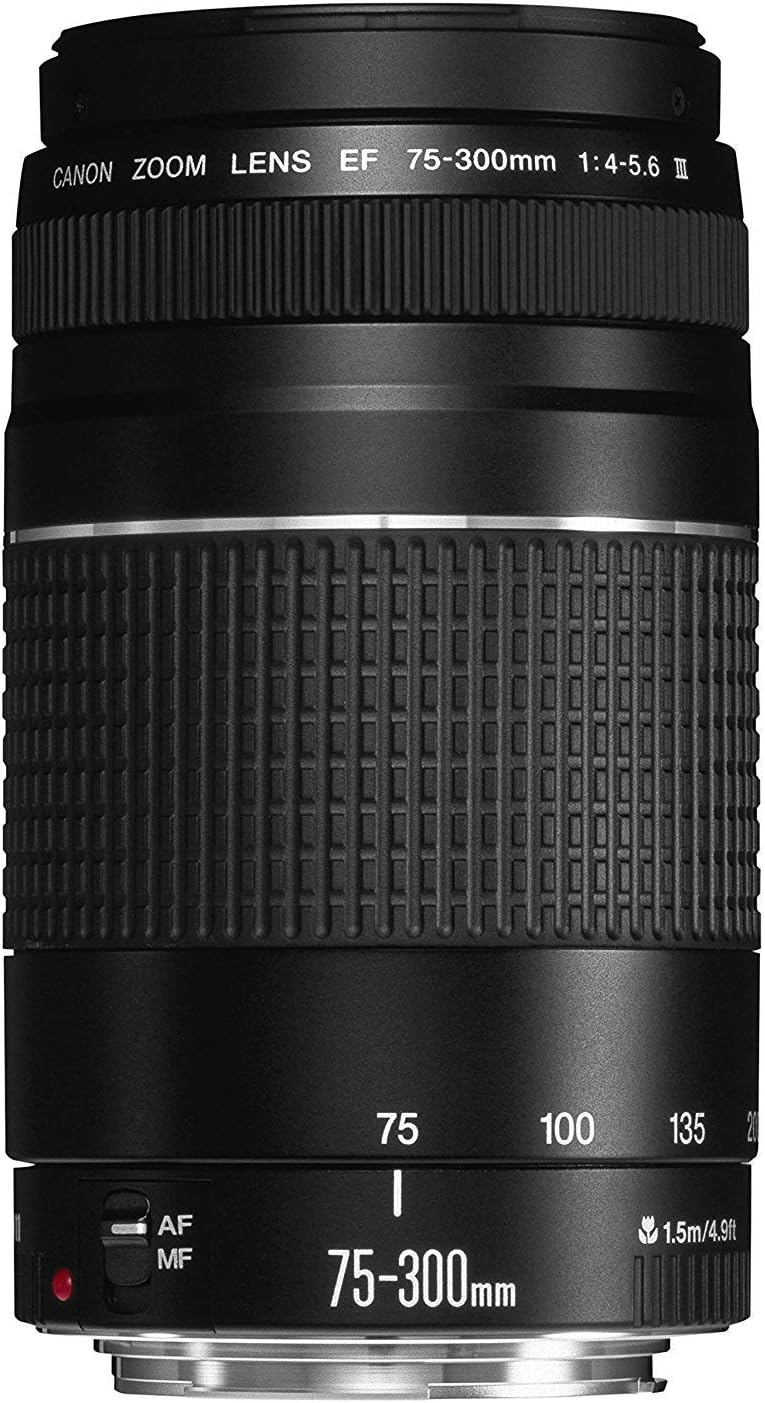
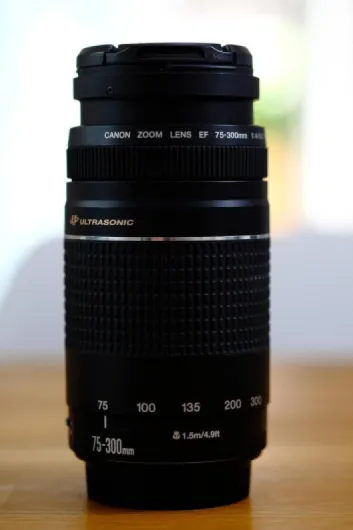
When it comes to design, the Canon EF 75-300mm f/4-5.6 III keeps things pretty straightforward. It's not the most robust lens out there, but it doesn't feel flimsy either. The construction is mostly plastic, which helps keep the weight down to 16.8 ounces. This is definitely a plus if you're planning to carry it around for extended periods.
The lens measures 2.8 inches in diameter and 4.8 inches in length. It's compact enough to fit in most camera bags without much hassle. The zoom mechanism is a rotating type, which operates smoothly for the most part. There's a silver ring on the front part of the zoom ring, which gives it a slightly more polished look, although it doesn't add much in terms of functionality.
However, one thing to note is the absence of weather-sealing. So, if you're planning to use it in conditions where moisture or dust might be an issue, you might want to be cautious. The lens also lacks an internal focusing mechanism, which means the front element rotates during focusing. This can be a bit of a nuisance if you're using a polarizing filter.
In a nutshell, the design and build quality of the Canon EF 75-300mm f/4-5.6 III are decent for its price point. It doesn't feel like a premium lens, but it doesn't feel like it's going to fall apart any time soon either.
Performance in Real-World Use
Performance-wise, the Canon EF 75-300mm f/4-5.6 III is a mixed bag. It's not going to rival more expensive lenses, but it performs adequately for its price. The autofocus system is driven by a DC motor, which is noticeably slower and noisier compared to lenses with USM (Ultrasonic Motor). This can be a bit frustrating when shooting fast-moving subjects, such as in sports or wildlife photography.
In terms of image quality, the lens produces decent results at the shorter end of the zoom range. As you zoom in further, you'll notice a drop in sharpness, especially at the maximum 300mm focal length. Chromatic aberration and fringing are also more noticeable in high-contrast scenes, but these are somewhat expected at this price point.
Another thing to keep in mind is that the lens does not have image stabilization. This means you'll need steady hands or a tripod, particularly when shooting at slower shutter speeds or in low-light conditions. It can be challenging to get sharp images otherwise, especially at the long end of the zoom.
In conclusion, while the performance of the Canon EF 75-300mm f/4-5.6 III isn't groundbreaking, it's perfectly serviceable for beginners and casual shooters. Just be prepared to work around its limitations if you're aiming for top-notch image quality.
Pros
- Affordable price
- Wide focal length range
- Lightweight and compact
Cons
- No image stabilization
- Slow autofocus
- Reduced sharpness at 300mm
Conclusion
Editor's rating
The Canon EF 75-300mm f/4-5.6 III is a decent telephoto zoom lens for those who are just getting into photography or need an affordable option to complement their existing gear. It's a no-frills choice that offers good value, especially if you're primarily shooting in good lighting conditions. The lens provides a versatile focal length range, making it suitable for a variety of subjects from portraits to sports and wildlife.
That said, the lens does have its limitations. The lack of image stabilization can be a hindrance for handheld shooting, especially at the longer end of the zoom range or in dim lighting. Autofocus is slower and noisier compared to more advanced lenses, which might be a concern for those planning to capture fast-moving subjects.
In summary, if you're on a tight budget and need a basic telephoto lens, the Canon EF 75-300mm f/4-5.6 III is worth considering. However, if you're looking for a lens with better optical performance and features like image stabilization, you might want to explore other options.